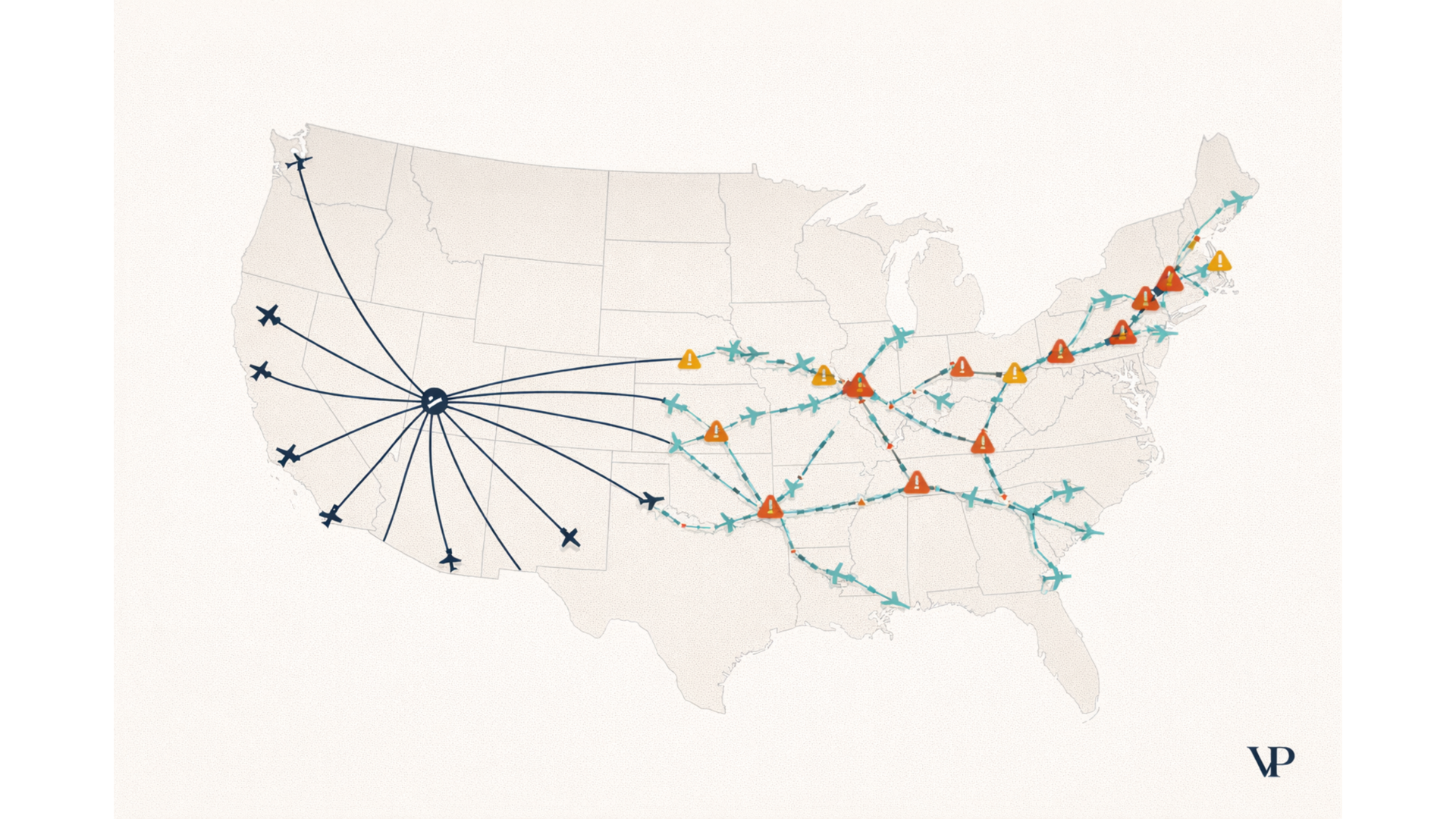
December 2022. Winter Storm Elliott sweeps across the United States. Every major airline cancels flights. Delta recovers in two days. United recovers in two days. American recovers in two days. Southwest Airlines spirals for an entire week—16,900 cancelled flights, two million stranded passengers, $1.2 billion in losses. The storm didn't single out Southwest. Something else broke. And that something is the same fragile math running most of the world's logistics networks right now.
The failure wasn't weather. It was software. Specifically, it was a scheduling optimizer built on mid-20th-century mathematics that couldn't keep up with 21st-century chaos. And the fix the industry is now chasing—wrapping ChatGPT around the same broken systems—won't solve it either. What's needed is a fundamentally different kind of AI. Not one that talks about schedules, but one that can actually repair them. We call this Deep AI, built on Graph Reinforcement Learning, and we believe it's the only credible path to logistics systems that get stronger under stress.
The Real Reason Southwest Broke While Everyone Else Bent
The standard explanation—"Southwest had old technology"—is true but incomplete. The deeper cause is architectural, and it starts with how the airline's network is shaped.
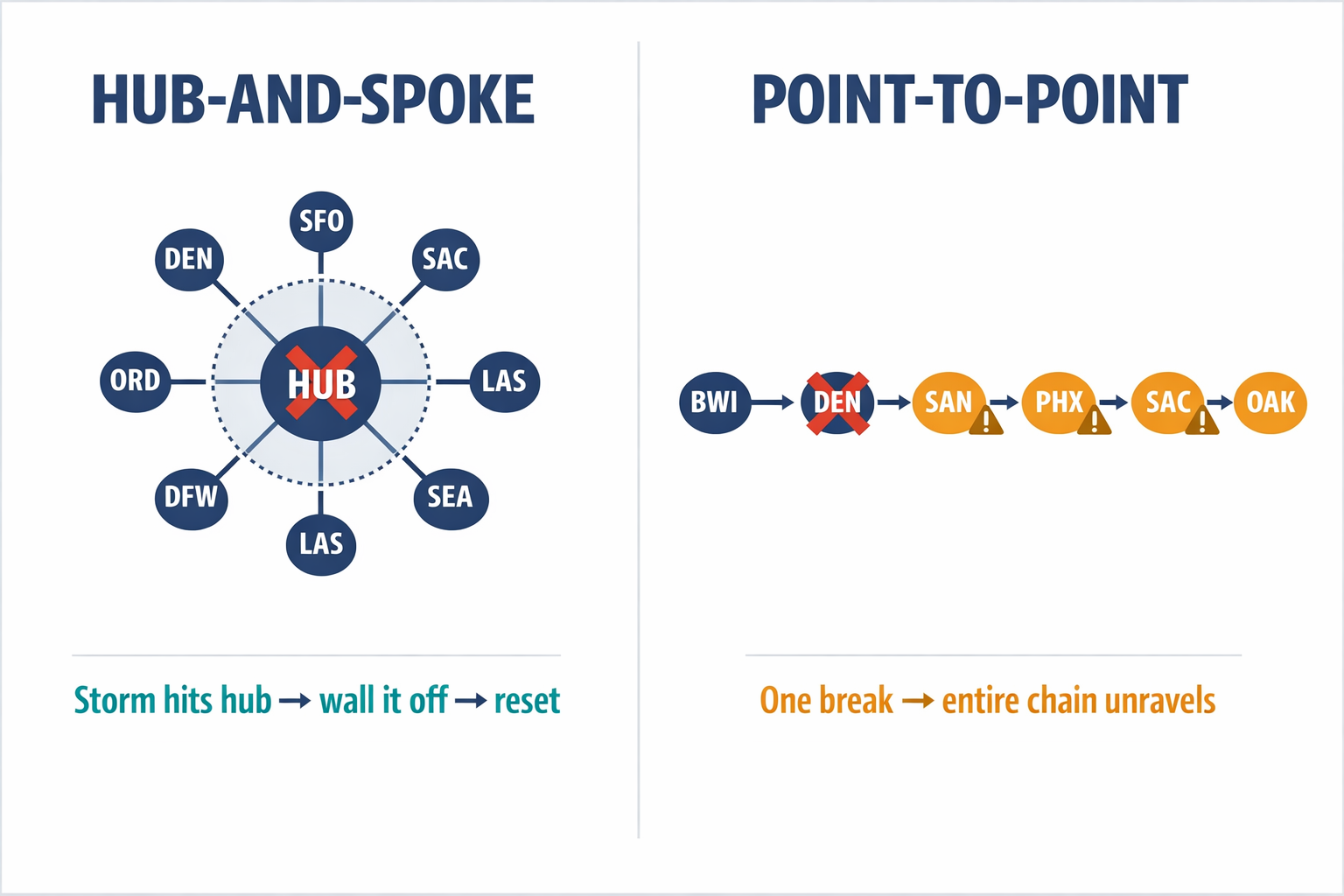
Delta, United, and American run hub-and-spoke networks. Flights radiate from central airports like Atlanta or Newark. When a storm hits a hub, the airline walls it off. Cancel everything in and out of Newark for a morning, reset, and restart. Crews and planes naturally cycle back to the hub, creating built-in recovery points.
Southwest pioneered a different model: point-to-point. A single plane and crew might fly Baltimore → Denver → San Diego → Phoenix → Sacramento in a chain. This is brilliantly efficient—more direct routes, higher aircraft utilization, lower costs. But it's structurally fragile. A delay in Baltimore doesn't just affect the Denver flight. It cascades down the entire chain. The crew that was supposed to fly San Diego to Phoenix is now stuck in Denver. The plane they were supposed to meet is stranded.
When one link breaks in a hub network, the hub absorbs the shock. When one link breaks in a chain, the whole chain unravels.
During the storm, this topological weakness collided with a software failure. Southwest's scheduling system—a legacy optimizer called SkySolver—needs to know exactly where every crew member is to compute a recovery plan. But as disruptions multiplied, the electronic crew notification systems became overwhelmed. Pilots and flight attendants had to call in manually. Hold times hit eight hours. The system was computing schedules based on crew positions that were hours out of date. It was solving the wrong puzzle, and the puzzle was getting harder every minute.
By December 26, the weather had cleared. Southwest was still cancelling over half its flights—not because of snow, but because they had literally lost track of their own people.
Why 1950s Math Can't Handle 2020s Chaos
SkySolver belongs to a family of tools built on Mixed-Integer Linear Programming—essentially, taking a frozen snapshot of the world and computing the cheapest possible schedule. This works beautifully on a calm Tuesday. It fails catastrophically in a crisis, for three specific reasons.
The problem explodes in size. Assigning crews to flights is what mathematicians call NP-Hard. For an airline with 4,000 daily flights, the number of possible crew-to-flight combinations is effectively infinite. Solvers manage this through clever shortcuts, but those shortcuts break down as disruptions multiply. Runtime doesn't increase gradually—it hits a cliff. The time to find even a workable (forget optimal) solution exceeds the window in which that solution is still relevant.
The backup plans are tuned for normal days. When the primary solver chokes, systems fall back to simpler rules of thumb—greedy algorithms that assume historical patterns hold. A storm that rewrites the entire map of crew availability renders those assumptions useless. The system can't even find a valid starting point to begin recovering.
Uncertainty is treated as a bug, not a feature. These solvers are built to work with certainties: "Flight 101 arrives at 2:00 PM." If Flight 101 might arrive anywhere between 2:00 and 4:00 PM, the solver can't handle the range. Operators are forced to guess a single number. If the guess is wrong, the plan breaks and has to be recomputed from scratch. In a volatile environment, this creates an endless loop of replanning that never catches up to reality.
We explored these failure mechanics in depth in our interactive analysis of antifragile logistics.
Real-world logistics is a fundamentally uncertain process. We've been managing it with tools that require certainty to function.
The ChatGPT Trap
After the Southwest debacle, the industry scrambled for solutions. The timing coincided with the generative AI boom, and vendors began flooding the market with "AI copilots" for supply chain management—chat interfaces layered over existing systems. Ask a question in plain English, get a schedule back. It sounds transformative. It isn't.
The dominant pattern is what we call the "LLM Wrapper." A large language model sits on top of the same legacy solver. A user types "How do we recover the Denver schedule?" and the LLM translates that into a query for SkySolver. The user experience improves. The underlying math doesn't change at all. If the solver is trapped in a combinatorial explosion, a chatbot can't talk it out.
Think of it like putting a voice-activated interface on a car with a seized engine. The conversation is smoother. The car still doesn't move.
The problem goes deeper than interface, though. LLMs are prediction machines—they guess the next word based on statistical patterns in their training data. Scheduling is a constraint satisfaction problem. It requires checking thousands of hard rules simultaneously: a pilot can't fly more than eight hours, a plane can't depart without maintenance clearance, a crew member needs minimum rest between shifts.
An LLM that generates a schedule looking 99% correct sounds impressive. In creative writing, 99% accuracy is excellent. In crew scheduling, if that remaining 1% means a pilot is assigned with seven hours and fifty-nine minutes of rest instead of the legally required eight, the entire schedule is illegal. LLMs prioritize what sounds right over what is right. They can hallucinate feasibility.
A schedule that reads well but violates one constraint isn't 99% correct. It's 100% unusable.
Benchmarks on combinatorial problems like the Traveling Salesman Problem confirm this: as the number of variables increases, LLM performance degrades rapidly. They "visit" cities twice, skip others entirely, and can't maintain state tracking over long sequences. They also can't simulate what happens twenty steps downstream from a decision—the butterfly effect where cancelling one flight today prevents a cascade of ten cancellations tomorrow. Generative AI has a role in logistics: reporting, documentation, communication. But it is structurally unsuited to be the brain of a logistics network.
Graph Reinforcement Learning: Teaching AI to Think in Networks
If legacy solvers are too slow and LLMs are too unreliable, what actually works? Our answer is Graph Reinforcement Learning (GRL)—a combination of two AI techniques purpose-built for this problem.
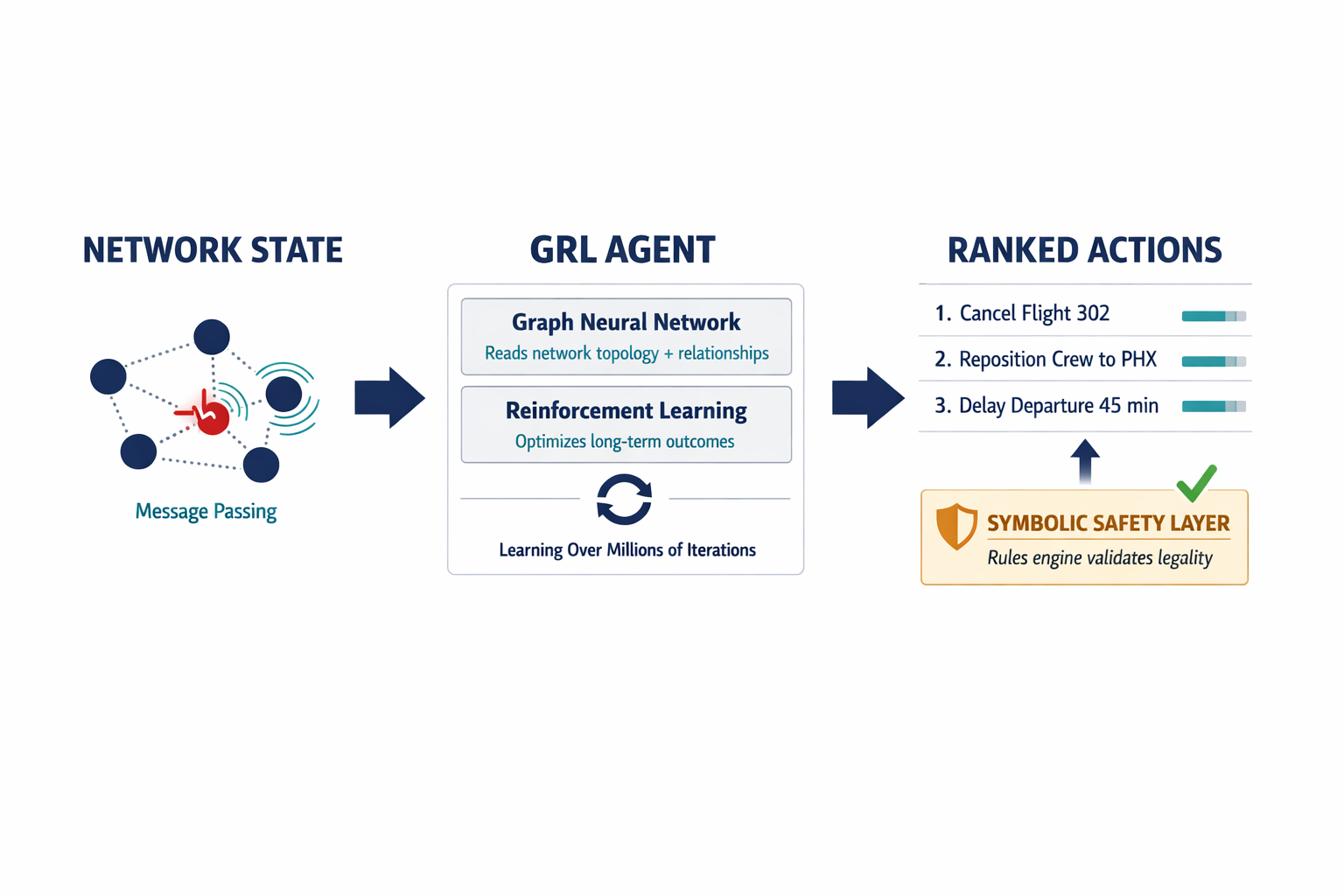
The first component recognizes that logistics networks aren't spreadsheets. They're graphs. Airports are dots; flights are lines connecting them. Warehouses are dots; truck routes are lines. Traditional AI struggles with this kind of interconnected structure. Graph Neural Networks (GNNs) are designed specifically for it. They encode every entity—every pilot, plane, airport—as a mathematical representation that captures both its own properties and its relationships to everything else in the network.
The critical capability is what's called message passing. When a blizzard closes Denver, that information doesn't just update Denver's status. It flows through the network to every connected entity. A crew in Baltimore preparing to fly to Denver receives a "risk signal" in their data representation before they even depart. The system sees the blast radius of a disruption in real time, across the entire network simultaneously. Legacy systems would need hours of manual cross-referencing to achieve the same awareness.
The second component is Reinforcement Learning (RL)—the same family of techniques that taught AI to beat world champions at Go. An RL agent observes the network state, takes an action (swap a crew, cancel a flight, delay a departure), and receives a reward or penalty based on the outcome. Over millions of training iterations, it learns a strategy—not for one specific crisis, but a general policy for navigating disruptions.
The crucial difference from legacy solvers: RL optimizes for long-term outcomes, not immediate ones. A traditional system might say "don't cancel this flight, it loses revenue." An RL agent learns: "If I don't cancel this flight now, the crew gets stuck in Denver, and I lose ten flights tomorrow. Cancel it now." It learns strategic sacrifice for systemic survival.
For networks the size of a major airline, we use Multi-Agent RL—a global agent monitoring overall network health and setting priorities, with local agents at each airport optimizing their own resources within those constraints. They negotiate and coordinate, preventing the single-point-of-failure bottleneck that destroyed Southwest's recovery.
Training on Ten Thousand Years of Catastrophe
You can't train a reinforcement learning agent through trial and error on a live airline. One bad decision could strand thousands of passengers. The solution is a Digital Twin—a high-fidelity simulation that replicates every rule, constraint, and physical reality of the client's operation.
Our Digital Twins aren't dashboards or 3D visualizations. They're physics-based engines that model every aircraft (with tail-specific maintenance cycles), every gate, every crew member (with individual fatigue counters and contract terms). Every simulated action is checked against digitized versions of FAA regulations and union contracts.
The real power is in manufacturing experience. Real-world data is overwhelmingly biased toward normal operations. Major meltdowns are rare. If we trained only on historical data, the AI would never learn crisis management. Instead, we use stochastic generators to inject chaos into the simulation—synthetic super-storms, mass mechanical groundings, labor disruptions. We simulate the equivalent of 10,000 years of operations in a week, with a curriculum that starts easy and progressively introduces more complex cascading failures.
By the time our agents encounter a real crisis, they've already navigated thousands of worse ones. They've explored the edges of the problem space where legacy solvers crash, and they've learned how to navigate back to stability.
For the full technical methodology behind our simulation and training architecture, see our detailed research.
The Safety Layer: Making Sure AI Can't Break the Rules
A valid concern with any AI making operational decisions in aviation: how do you prevent it from generating an illegal schedule? Neural networks are famously opaque. We address this with what we call a Neuro-Symbolic Architecture—a hybrid system inspired by the NICE framework for robust scheduling.
The neural network (the GRL agent) analyzes the complex, noisy state of the network and proposes a ranked set of actions. Then a separate, deterministic logic engine—essentially a digitized rulebook—acts as a filter. If the neural network suggests assigning a pilot who hasn't had enough rest, the logic engine sets the probability of that action to zero. The AI literally cannot execute an illegal move.
The neural network provides the intuition. The symbolic layer provides the law. Together, they guarantee that every decision is both smart and legal.
This hybrid approach also solves a performance problem. Instead of a solver searching through billions of possibilities (the legacy approach), the neural network narrows the field to the ten most promising options. The symbolic engine only needs to validate and fine-tune those few candidates. Computation time drops from hours to seconds.
What Happened When We Re-Ran the Southwest Crisis
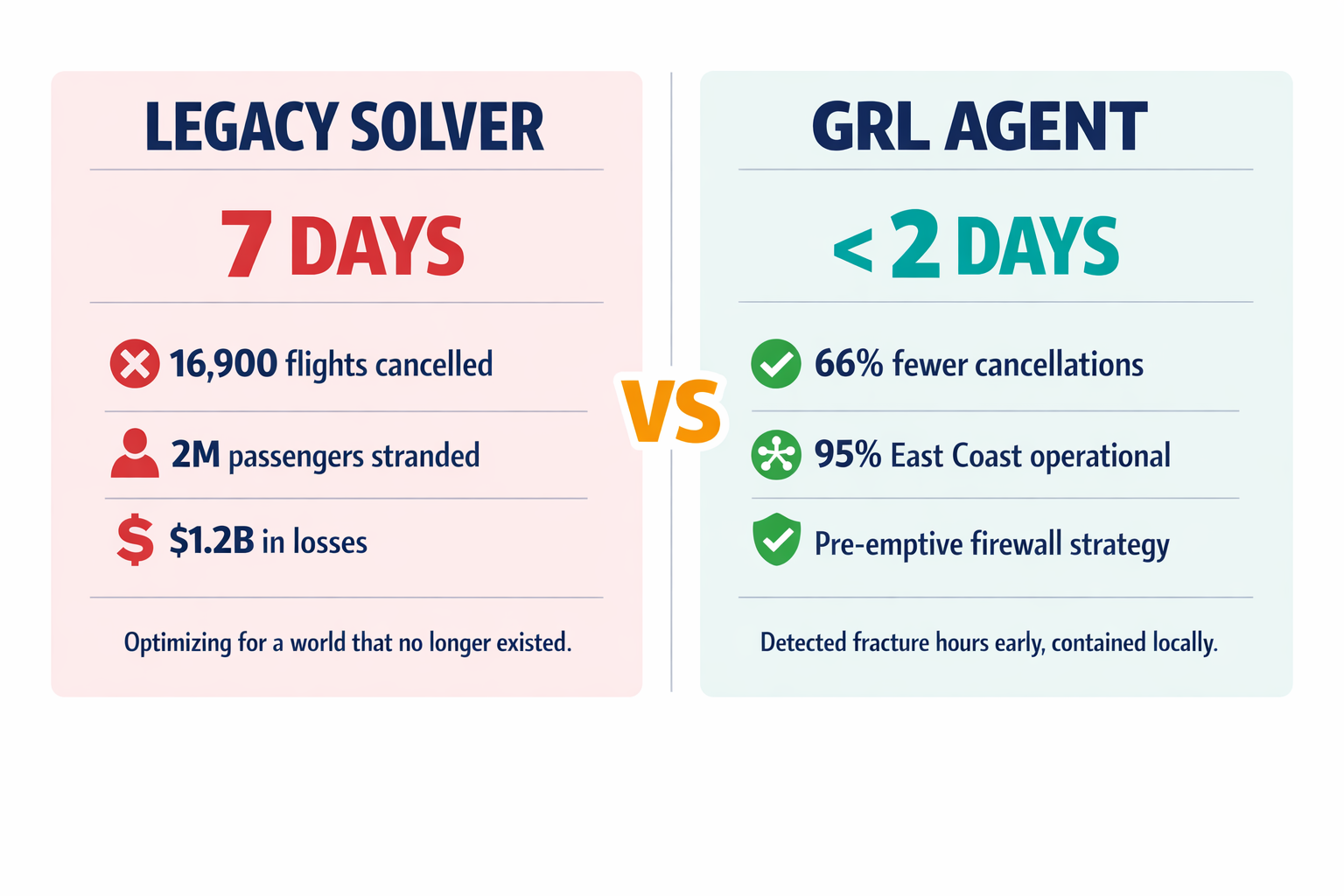
We reconstructed the December 2022 meltdown in our Digital Twin and benchmarked our GRL architecture against a legacy solver proxy.
The legacy solver behaved exactly as SkySolver did in reality. As data inputs lagged behind the actual state of the network, it optimized for a world that no longer existed. Recovery time: seven days.
Our GRL agent detected the point-to-point network fracture emerging in Denver hours before it became unmanageable. It executed a pre-emptive firewall strategy—cancelling 20% of flights into Denver early, containing the disruption locally, while simultaneously repositioning crews to Phoenix to create a secondary operational base.
The result: the East Coast network remained 95% operational. Total cancellations were reduced by 66%. What was a week-long national meltdown in reality became a contained regional disruption in simulation.
The same architecture applies beyond airlines. In maritime ports, where a delayed vessel triggers cascading berth, crane, and truck scheduling failures, our agents automatically renegotiate slot times and appointments in real time. In rail networks, where a single wrong "which train waits on the siding" decision can cause gridlock hundreds of miles away, GRL agents outperform human dispatchers by 15-20% in delay reduction—often by making counterintuitive moves like holding a freight train early to clear a path for an express train fifty miles upstream.
But Can This Actually Work at Scale?
A reasonable question. Reinforcement learning has a reputation for working brilliantly in games and simulations but struggling in messy real-world environments. Three things make logistics different from the typical RL failure case.
First, the problem has clear, measurable objectives. Minimize cancellations, minimize delay, minimize crew overtime. The reward signal isn't ambiguous.
Second, the Digital Twin provides unlimited, realistic training data. The classic RL bottleneck—insufficient experience—disappears when you can simulate millennia of operations.
Third, the deployment model is deliberately cautious. We don't flip a switch from human control to full autonomy. The system runs in shadow mode first, making recommendations alongside human dispatchers. We can show a client: "In last Tuesday's disruption, the human scheduler took four hours to recover. Our shadow agent found a solution in two minutes that would have saved $500,000." Trust is built on empirical evidence, not promises.
What This Means for Your Operations
The Southwest meltdown wasn't an anomaly. It was a preview. Climate volatility is increasing. Supply chains are more interconnected and more fragile. The "tail risk" events that legacy systems can't handle—the storms, the canal blockages, the cascading failures—are becoming the dominant cost driver over any ten-year horizon. Southwest lost $1.2 billion in a single week. That erased years of efficiency gains from running a lean network.
The path forward isn't bolting a chatbot onto broken infrastructure. It's rebuilding the decision-making layer with AI that understands network topology, reasons about long-term consequences, and gets better—not worse—under pressure.
Our team recommends four phases: digitize your network into a graph model and Digital Twin; deploy AI agents in shadow mode to learn and validate; graduate to an AI copilot that assists human dispatchers with neuro-symbolic guarantees; and finally, enable autonomous execution for low-risk, high-frequency decisions.
The question isn't whether logistics needs this kind of intelligence. The question is whether your organization will build it before the next storm hits.
If your team is grappling with the gap between legacy optimization and real-time resilience, we'd welcome the conversation.