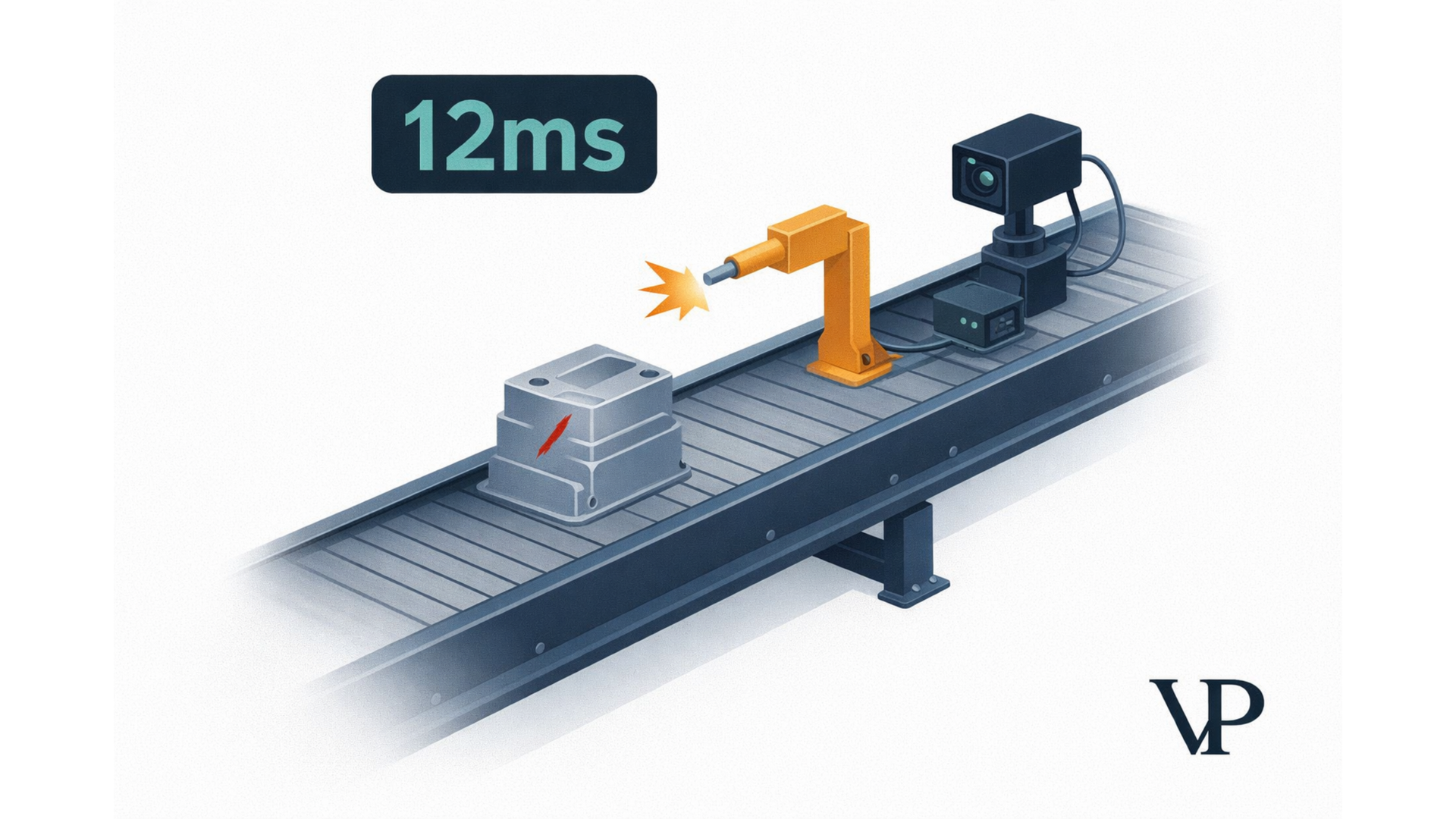
A defective part rolls off a conveyor belt at 2 meters per second. A cloud-based AI correctly identifies the defect — 800 milliseconds later. By then, the part has traveled 1.6 meters, blown past the rejection mechanism, and entered the supply chain. The AI was right. It was also useless.
That scenario isn't hypothetical. It's the exact failure that made my team rethink everything we believed about edge AI in manufacturing. We'd spent years building cloud-first architectures, trusting that faster networks and bigger servers would eventually close the gap between digital intelligence and physical reality. They didn't. Physics won.
What we discovered — and what I want to share here — is that for real-time industrial control, the cloud isn't just slow. It's a liability.
800 Milliseconds Is an Eternity on a Conveyor Belt
The math is embarrassingly simple, and that's what makes it so damning.
A conveyor moves at 2 m/s. The camera sits 1 meter before the pneumatic ejector. That gives you exactly 500 milliseconds to capture an image, run inference, and fire the reject signal. Miss that window and the part is gone — physically past the point of no return.
The cloud round-trip we measured? 800ms. Not because the AI model was slow — the actual inference took maybe 100ms on a cloud GPU. The rest was eaten by image encoding, upload over a congested factory network, queueing at the data center, and the return trip. Every one of those steps added unpredictable delay.
The cloud gave us the right answer 300 milliseconds too late. In manufacturing, a correct answer that arrives late is indistinguishable from no answer at all.
I remember standing on that factory floor, watching the rejection arm fire at empty air — the defective part already two feet downstream — and thinking: we built this wrong.
What 12 Milliseconds Changes
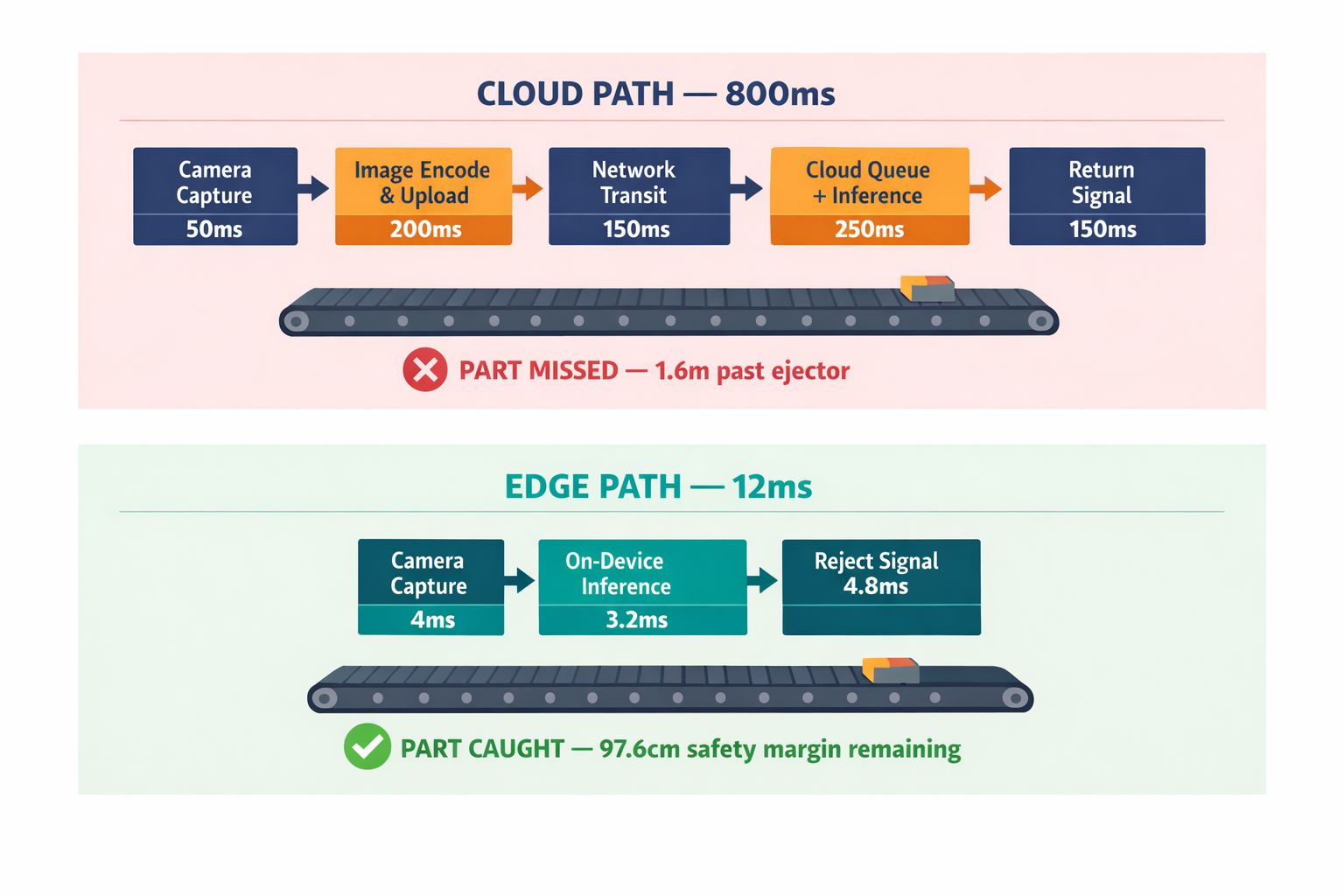
We moved the AI model off the cloud and onto an NVIDIA Jetson device bolted directly to the conveyor frame. The camera feeds into the Jetson over a direct cable connection — no internet, no data center, no prayer that the ISP is having a good day.
Total latency dropped from 800ms to 12ms. During those 12 milliseconds, the part moves just 2.4 centimeters. That leaves 97.6 centimeters of safety margin before the ejector — enough room for multiple verification passes if we wanted them.
The technical trick that made this possible is something called model quantization. We took a standard object detection model trained in 32-bit precision and compressed it to 8-bit integers. The model became four times smaller and dramatically faster, while accuracy dropped less than 1%. For a binary question — scratch or no scratch — that tradeoff isn't even a tradeoff. We explored this in depth in our interactive analysis of edge-native AI in manufacturing.
To give you a sense of the performance gap: a YOLOv8 detection model running through a cloud API clocks in at 800ms+ including network time. The same model, optimized with NVIDIA's TensorRT compiler and running INT8 on a Jetson Orin NX, completes inference in 3.2 milliseconds. That's not an incremental improvement. It's two different universes of capability.
The $22,000-Per-Minute Problem Nobody Talks About
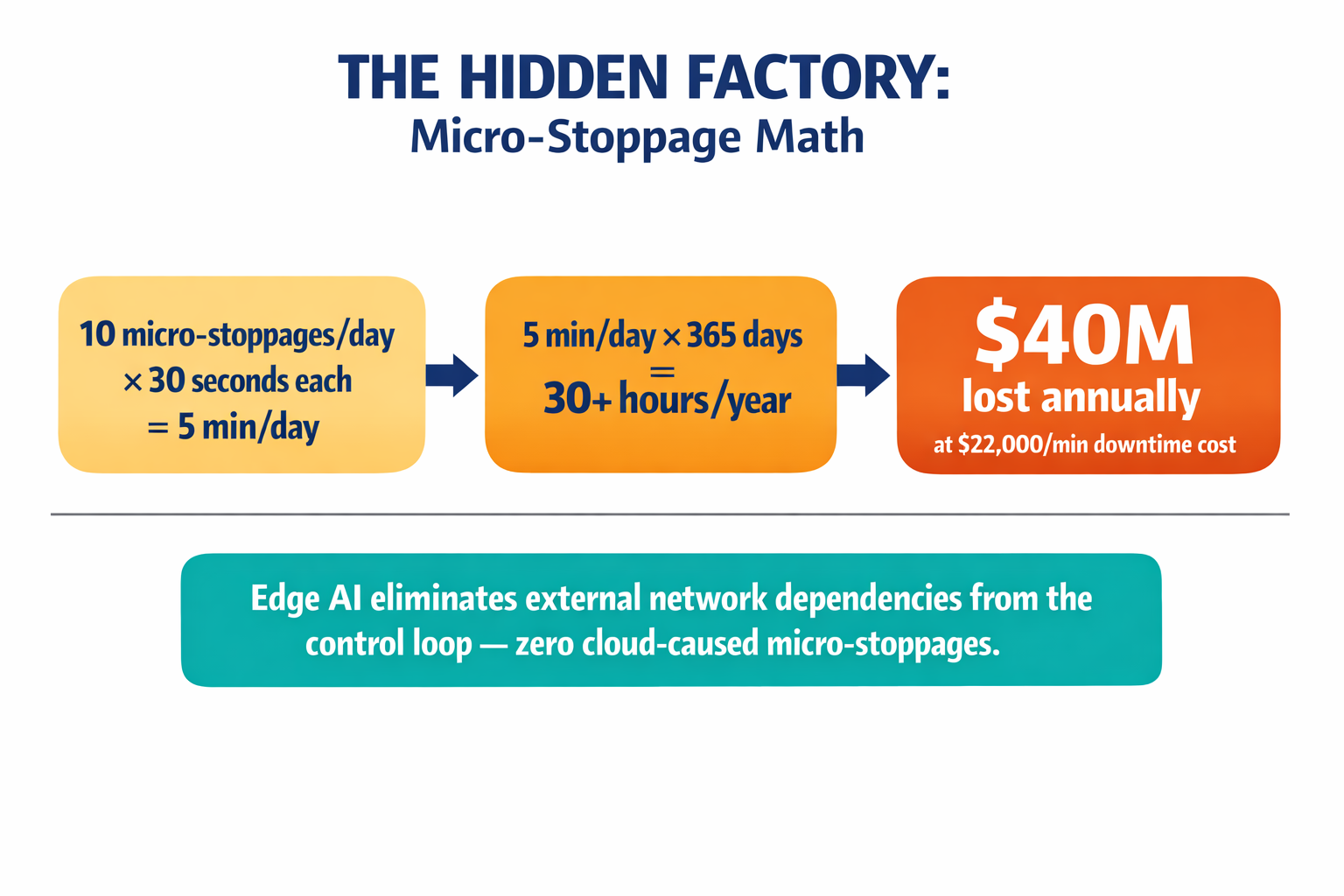
Speed matters because downtime is ruinously expensive. In automotive manufacturing, unplanned downtime costs an average of $22,000 per minute. Siemens updated that figure in 2024 for large plants: $2.3 million per hour. Those numbers have roughly doubled since 2019.
But the headline-grabbing outages aren't what keep me up at night. It's the micro-stoppages — the 30-second pauses caused by a network timeout, a cloud API hiccup, a brief synchronization error. They're too short to trigger an incident report. Nobody writes a postmortem for a 30-second pause.
Now multiply: ten micro-stoppages per day, 30 seconds each, adds up to over 30 hours of lost production per year. At $22,000 per minute, those invisible glitches cost nearly $40 million annually. My team started calling this the "Hidden Factory" — production capacity that exists on paper but evaporates through latency-induced friction that nobody is measuring.
Micro-stoppages are the manufacturing equivalent of a slow leak. You don't notice until the floor is flooded.
Edge AI eliminates this category of failure entirely. When the compute lives on the machine, there's no external network dependency in the control loop. No ISP. No cloud provider. No DNS resolution. The system keeps running even if someone cuts the internet cable.
"Just Use 5G" — And Other Dangerous Simplifications
Every time I present this argument, someone asks about 5G. The marketing promise is seductive: 1-5 millisecond latency, massive bandwidth, wireless flexibility. Why bolt a computer to every machine when you can just upgrade the network?
Because factories are hostile RF environments. Steel beams scatter signals. High-voltage motors and arc welders generate electromagnetic noise that jams wireless connections. A forklift driving between a sensor and a 5G small cell breaks the line-of-sight that millimeter-wave 5G requires, causing sudden latency spikes.
And even if 5G worked perfectly inside a factory — which it doesn't — you're still sending data to a remote server and waiting for a response. You've improved one link in a chain that has six weak links.
There's also a bandwidth problem that rarely gets discussed. A single quality inspection station with four 4K cameras running at 30 frames per second generates roughly 80 Mbps of compressed video. A factory has hundreds of stations. Streaming all of that to the cloud 24/7 isn't just technically challenging — the data egress fees alone can run tens of thousands of dollars monthly.
With edge processing, the AI watches every frame locally and discards the normal ones. Only anomalies get saved and uploaded — typically less than 1% of total frames. That's a 99% reduction in bandwidth and a proportional drop in cloud storage costs.
The Acoustic Revolution: Teaching Machines to Hear Their Own Failures
The most surprising part of this journey had nothing to do with cameras. It started when a client's CNC spindle — spinning at 20,000+ RPM — seized without warning. The bearing had been failing for days, but nobody could see it. The damage was internal.
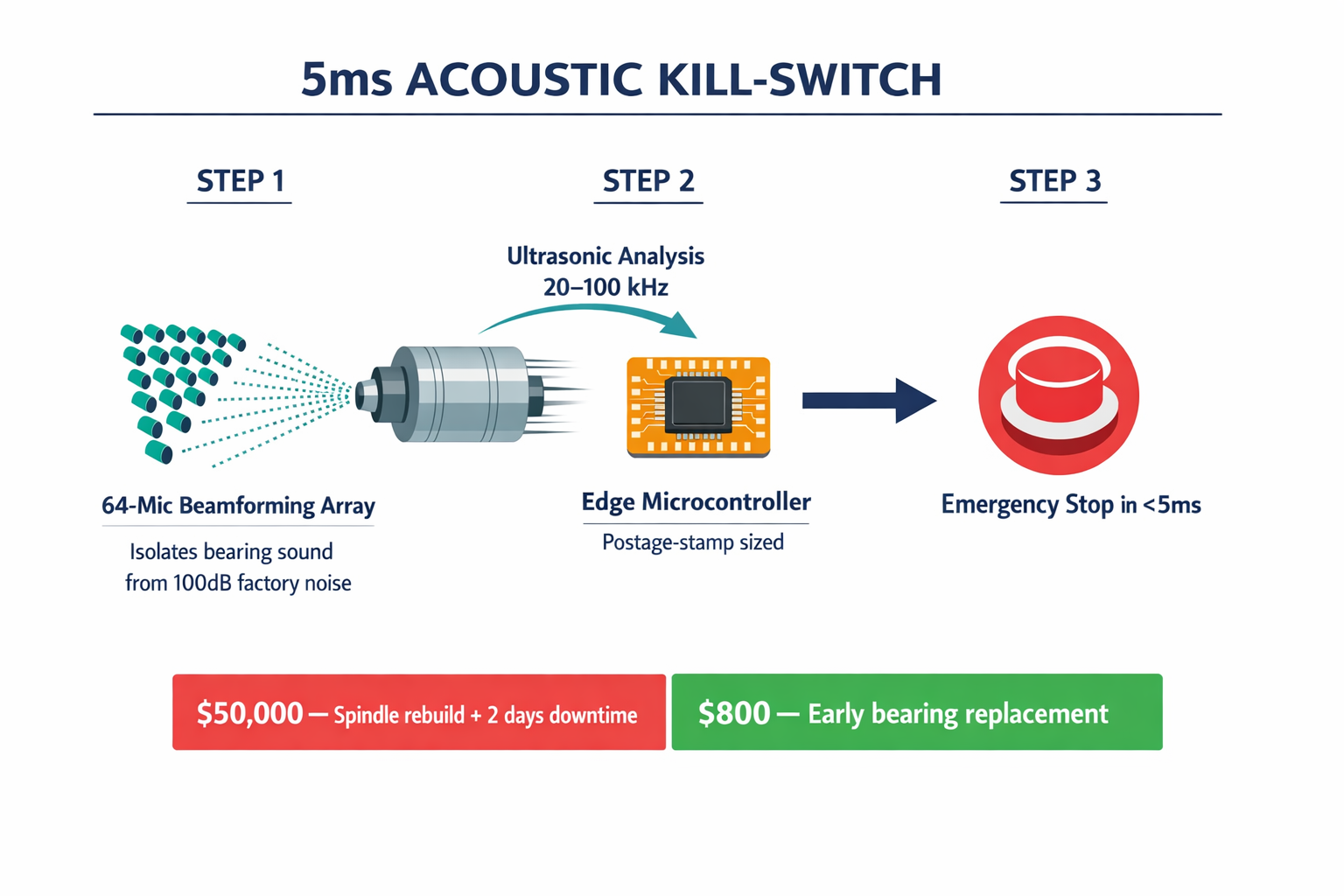
Traditional monitoring uses vibration sensors, but vibration is a lagging indicator. By the time a bearing vibrates noticeably, the metal is already pitted and cracked. Ultrasonic sound, on the other hand, is a leading indicator. When a bearing loses lubrication or develops a microscopic crack, the increased friction generates high-frequency stress waves — 20 to 100 kHz, well above human hearing — long before the damage becomes visible or audible.
We built a 5-millisecond acoustic kill-switch. A high-frequency microphone pointed at the spindle feeds audio into a tiny machine learning model running on a microcontroller — not even a full computer, just a chip smaller than a postage stamp. The model continuously analyzes the sound spectrum. When it detects the specific frequency signature of a failing bearing, it triggers an emergency stop in under 5 milliseconds.
A $500 bearing replacement or a $50,000 spindle rebuild. That's the difference 5 milliseconds makes.
One client — an automotive parts manufacturer — had been losing spindles to coolant contamination. Metal shavings would get into the coolant, accelerate bearing wear, and the first sign of trouble was a catastrophic seizure. Each incident cost $45,000 plus two days of downtime. After we installed the acoustic system, it caught the contamination signature on the first occurrence. The machine stopped. The bearing was damaged but the spindle shaft survived. Repair cost: $800. For the full technical methodology behind our acoustic and vision edge systems, see our detailed research on industrial AI latency and edge computing.
The real trick in a noisy factory is isolating the signal. We use acoustic beamforming — an array of 64 or more microphones that measures tiny differences in when sound arrives at each mic. This lets the AI mathematically "aim" its hearing at a specific point in space, like the bearing housing, while filtering out the 100-decibel ambient roar of the factory floor.
What About Security and Data Sovereignty?
Cloud-based AI requires a constant stream of sensitive data — images of prototypes, production rates, proprietary assembly techniques — to leave the factory premises. For defense contractors bound by ITAR regulations, or pharmaceutical companies with strict compliance requirements, this is often a non-starter.
Edge AI restores what I think of as the digital air gap. The Jetson processes the image locally. Raw data never leaves the device's memory. The only thing transmitted to the central dashboard is metadata: "Part #1234: PASS." The manufacturer retains absolute control over their intellectual property.
There's also the resilience argument. A cloud-dependent factory has a single point of failure: its internet connection. A backhoe cuts a fiber line, a storm takes out the ISP, a DDoS attack hits the provider — and production stops. An edge-native factory is autonomous. Lose the internet and the cameras keep inspecting, the microphones keep listening, the PLCs keep acting. Logs cache locally and sync when connectivity returns.
Does This Mean the Cloud Is Dead?
No. The cloud is excellent at what it was designed for: training models on massive datasets, running analytics on historical data, coordinating across facilities, and pushing updated models to edge devices. What it cannot do — what physics prevents it from doing — is participate in real-time control loops where milliseconds determine whether a defective part ships or a spindle survives.
The architecture we advocate is decentralized intelligence. The edge handles the split-second decisions. The cloud handles the big-picture learning. They complement each other, but the control loop belongs to the device on the machine, not the server 500 miles away.
I also get asked about cost. A Jetson module runs about $2,000. Add $5,000 in sensors, enclosures, and integration. At $22,000 per minute of downtime, that $7,000 investment pays for itself if it prevents 19 seconds of unplanned stoppage per year. The ROI isn't measured in quarters. It's measured in seconds.
What I'd Tell a Plant Manager Reading This
Start with a latency audit. Walk your floor and identify every control loop where a decision depends on data leaving the building. Measure the time-to-criticality for each — how fast is the conveyor, how quickly does the spindle spin, how narrow is the window between observation and action. If that window is under one second, the cloud doesn't belong in the loop.
Then look at your micro-stoppages. Most MES systems don't even log pauses under five minutes. Start logging them. I suspect you'll find a Hidden Factory of lost capacity that nobody has quantified.
The future of industrial AI isn't about bigger models in bigger data centers. It's about the right model on the right device, at the point where code meets kinetic energy.
The experiment with cloud-based real-time control ran its course. For the unforgiving physics of the factory floor, the verdict is in. If you're wrestling with similar latency challenges in your operations, I'd genuinely like to hear what you're seeing — the edge cases (pun intended) are where the most interesting problems live.