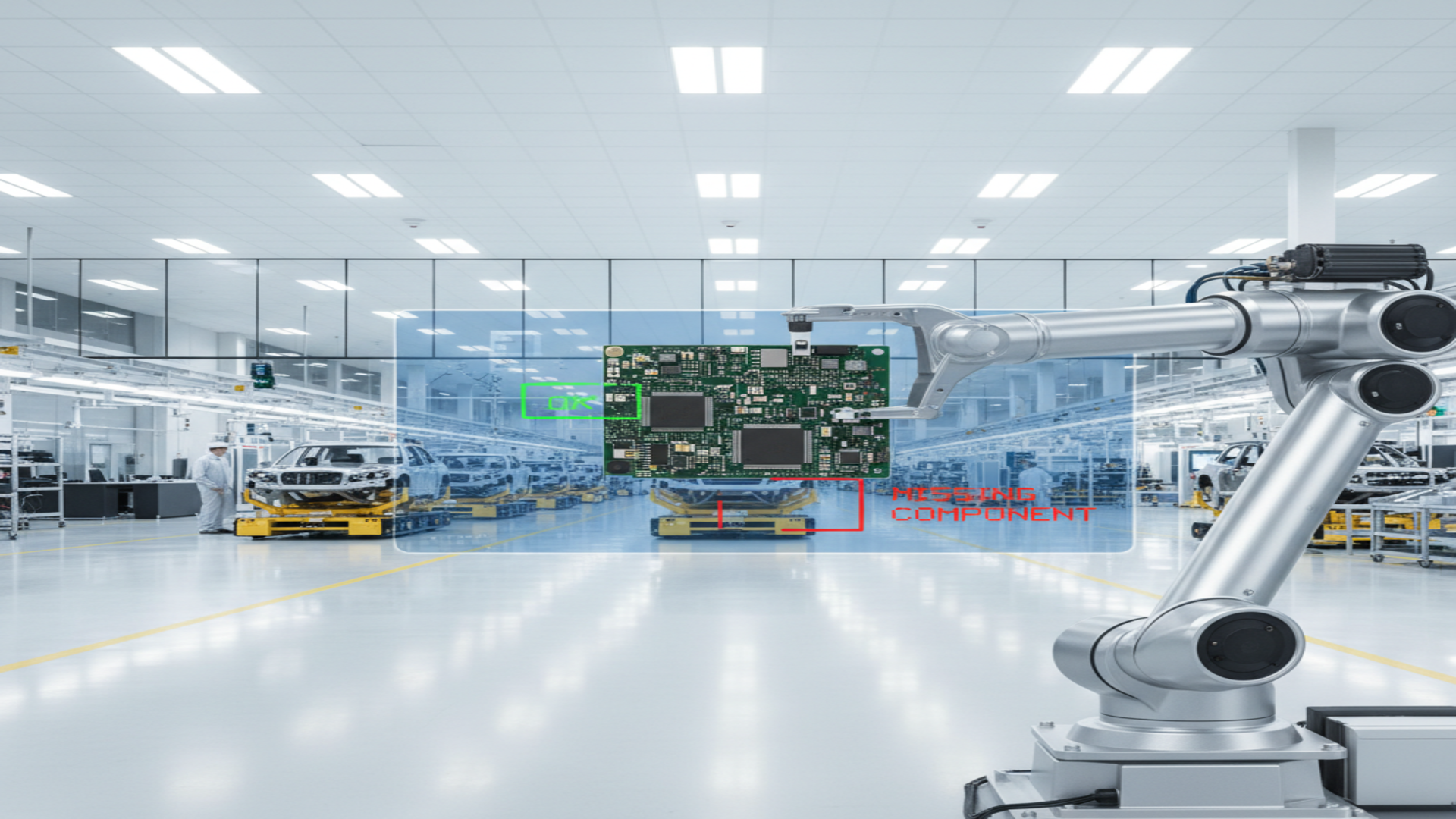
A defective part rolls off a conveyor belt at 2 meters per second. A cloud-based AI system spots the defect — correctly — but by the time the "reject" signal travels to the data center and back, the part has already traveled 1.6 meters past the ejection point. It is packed, shipped, and someone else's problem. The AI was right. The physics made it irrelevant. This is the edge AI manufacturing problem we have spent years solving, and the reason our team no longer trusts the cloud with anything that moves.
That 800-millisecond round trip might sound trivial. On a webpage, you would never notice it. On a factory line where a conveyor gives you exactly 500 milliseconds to act, it is the difference between catching every defect and catching none of them.
800 milliseconds. That is how long the cloud takes to tell a factory what the factory already needed to know 300 milliseconds ago.
What Happens When Your AI Misses a 500-Millisecond Deadline?
Manufacturing runs on hard deadlines — not the "we'll get to it" kind, but the physics kind. If a camera sits one meter from an ejection mechanism and the belt moves at 2 meters per second, you have exactly 500 milliseconds to capture the image, analyze it, and fire the actuator. Miss that window by a single millisecond and the part is gone.
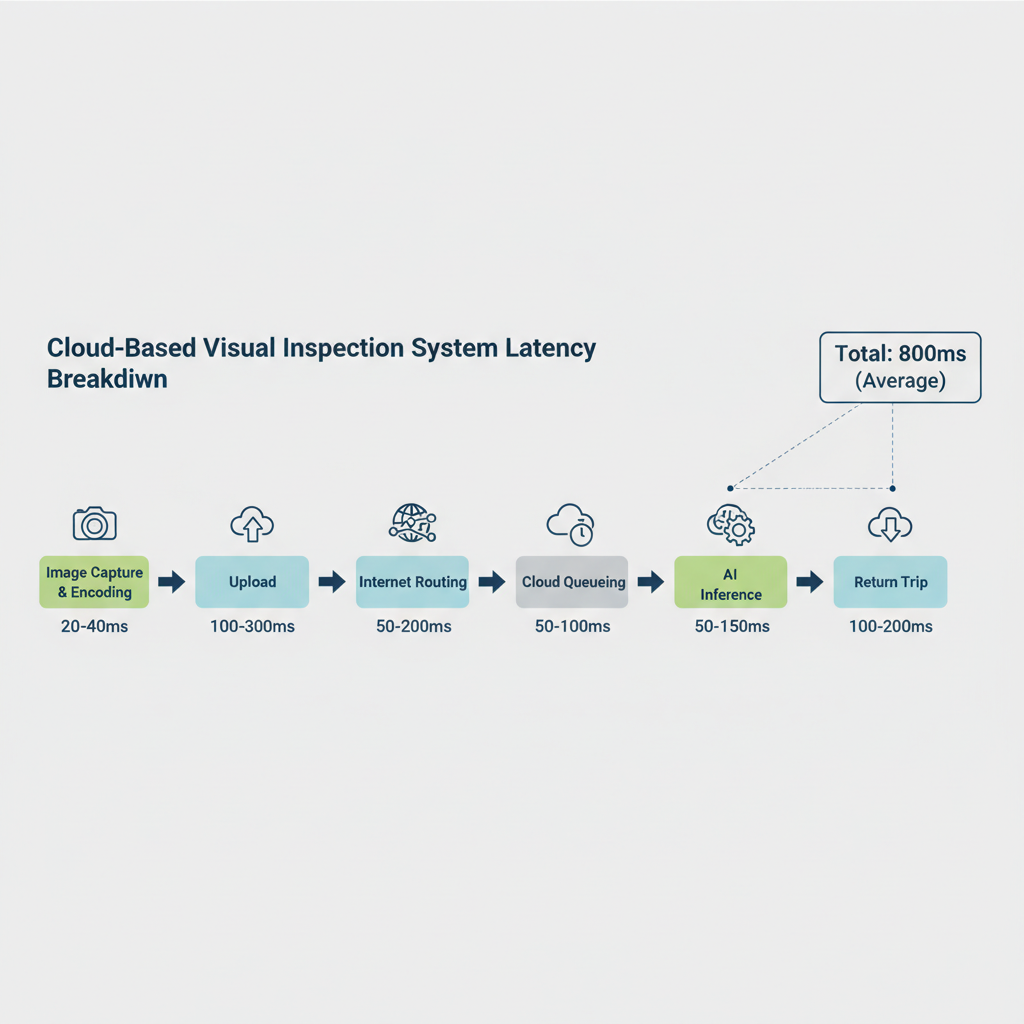
When our team audited the latency chain of a typical cloud-based visual inspection system, the numbers were damning. Image capture and encoding: 20-40ms. Uploading through the factory firewall and ISP: 100-300ms. Internet routing and packet jitter: 50-200ms. Cloud queueing for a GPU worker: 50-100ms. Actual AI inference: 50-150ms. The return trip: another 100-200ms. Total: 800 milliseconds on average, with unpredictable spikes above that.
The real killer is not the average. It is the variance. The internet was designed for reliability — if a packet drops, the protocol waits and retransmits. That is fine for email. For a pneumatic actuator that needs to fire at exactly the right moment, late data is worse than no data, because the physical world has already moved on.
What Happens When You Move the Brain to the Machine?
We took the AI model off the cloud and put it directly onto an NVIDIA Jetson device — a credit-card-sized computer with dedicated AI processing hardware — mounted right on the conveyor frame. The compute went from 500 miles away to less than one meter away. The communication channel went from the public internet to a direct physical connection.
The result: 12 milliseconds total latency. During those 12 milliseconds, the part travels just 2.4 centimeters, leaving 97.6 centimeters of safety margin before the ejection point.
We achieved this through a technique called model quantization — converting the AI model from 32-bit precision to 8-bit integers. Think of it like compressing a high-resolution photo: you lose a tiny amount of detail that does not matter for the task, but the file becomes four times smaller and processes dramatically faster. In our deployments, the accuracy difference is typically less than 1%. For a defect detection task — is there a scratch or not? — that difference is meaningless.
We cut inference latency by 98.5%. The part now travels 2.4 centimeters during processing instead of 1.6 meters.
We explored the full technical pipeline — hardware selection, quantization calibration, and real-time optimization — in our detailed research on industrial AI latency and edge computing.
What Does One Minute of Downtime Actually Cost?
The financial case is almost absurdly simple. Unplanned downtime in automotive manufacturing costs an average of $22,000 per minute. Siemens reports that for large plants, the figure has climbed to $2.3 million per hour. That number compounds fast: lost production revenue, 500 workers standing idle at full wages, scrapped material in the machine, contractual penalties for missed just-in-time deliveries, and overtime shifts at 1.5x pay to catch up.
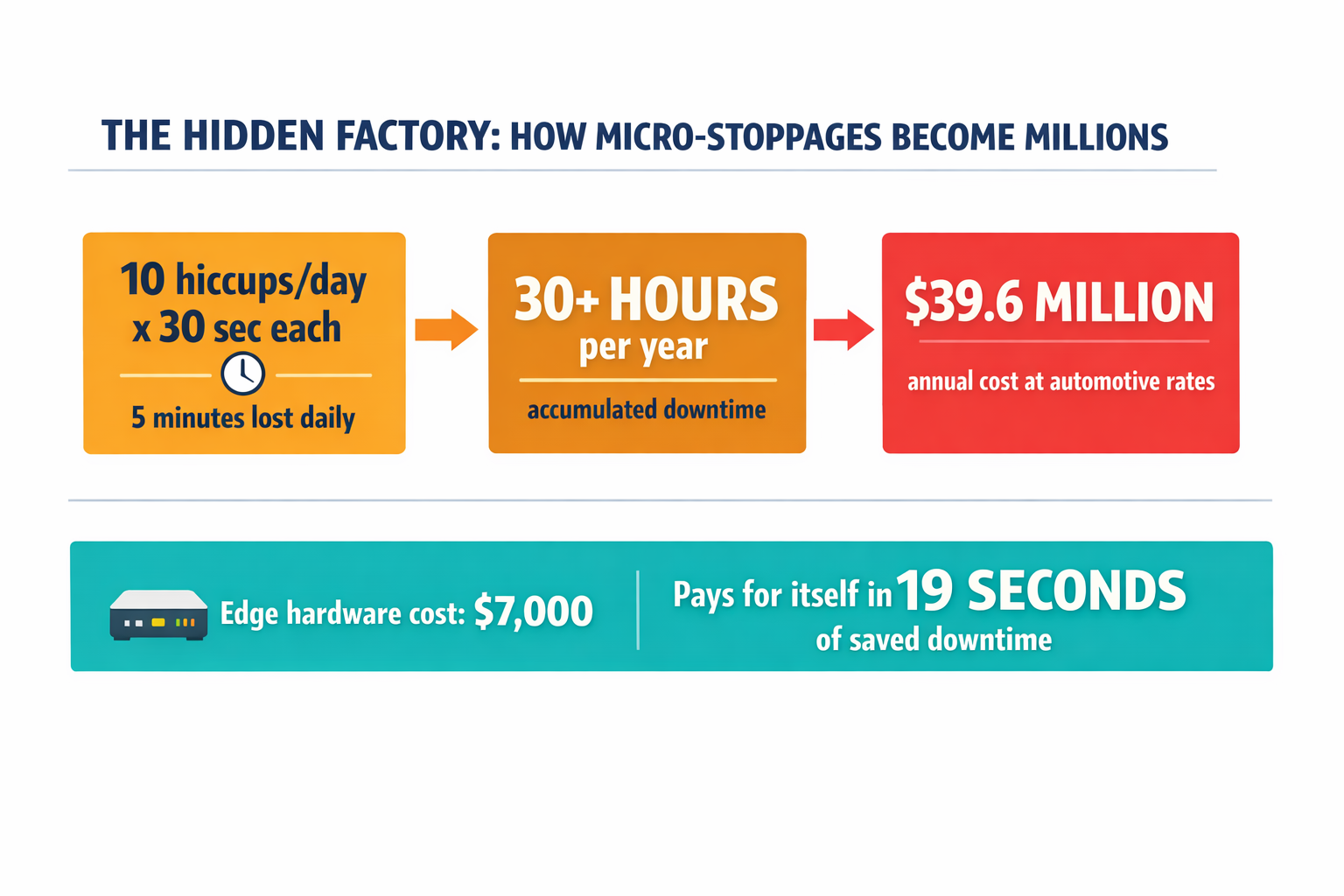
But the headline-grabbing outages are not where most money disappears. Our team tracked what manufacturers call the "Hidden Factory" — micro-stoppages of under five minutes caused by network timeouts, sensor resyncs, and cloud latency spikes. If a cloud-dependent system hiccups ten times per day for 30 seconds each, that is five minutes of lost production daily. Over a year, those "minor" glitches accumulate to more than 30 hours of downtime — roughly $39.6 million in a facility running at automotive-sector rates.
Against that backdrop, the investment in edge hardware is almost comically small. A Jetson module and sensors cost around $7,000. That system pays for itself if it prevents 19 seconds of downtime per year.
Why "Just Use 5G" Is the Wrong Answer
The most common pushback we hear: why not solve latency with faster connectivity instead of local compute? The marketing says 5G delivers 1-5 milliseconds of latency. The reality inside a factory is different.
Factories are hostile environments for wireless signals. Steel beams and metal walls create signal reflections and dead zones. High-voltage motors and arc welders generate electromagnetic noise that degrades or jams wireless signals. A forklift driving between a sensor and a 5G antenna breaks the line-of-sight connection, causing sudden latency spikes.
Even if 5G worked perfectly, it still routes through external infrastructure — an ISP, a cloud provider, DNS servers. Every external dependency is a potential failure point in your control loop. Edge AI makes the connectivity question irrelevant for real-time decisions. The device on the machine keeps working whether the factory has 5G, fiber, or no internet at all. The network becomes a reporting channel — uploading status after the action is taken — not a dependency for the action itself.
We documented this architectural shift, including the bandwidth economics and security implications, in our interactive analysis of edge-native AI for manufacturing.
Hearing Failure Before It Happens
Computer vision catches what you can see. But many of the most expensive failures — seized bearings, cracked spindles, cavitation in pumps — happen inside the machine, invisible until something breaks.
Our team builds what we call acoustic kill-switches. High-frequency microphones capture sounds in the ultrasonic range — 20,000 to 100,000 Hz, far above what human ears detect. When a bearing starts losing lubrication or developing microscopic cracks, the friction generates a specific high-frequency signature weeks before traditional vibration sensors would notice anything.
For high-speed CNC (Computer Numerical Control) spindles spinning at 20,000+ RPM, even a few seconds of running without proper lubrication can weld the bearings to the shaft — destroying a $50,000 component. We deploy lightweight AI models on microcontrollers that analyze the audio stream continuously. When the model detects the spectral signature of a failing bearing, it triggers an emergency stop in 5 milliseconds.
One of our clients, an automotive parts manufacturer, had been losing spindles to random bearing failures. By the time operators heard something wrong, the spindle was already destroyed — $45,000 per incident plus two days of downtime. After we installed an acoustic monitoring system, it caught the first contamination event, stopped the machine in 5ms, and saved the spindle shaft. The repair cost $800 instead of $45,000.
The system paid for itself on the first event. Not the first year — the first event.
But What About Ditching the Cloud Entirely?
We are not anti-cloud. We use cloud infrastructure for model training, fleet management, and long-term analytics. The argument is narrower and more specific: the cloud has no place inside a real-time control loop where physics sets the deadline.
The factory of the future is not disconnected — it is decentralized. The intelligence lives on the device, at the point of action. The cloud gets a summary after the fact. Raw images and audio streams never leave the factory floor, which solves both the latency problem and the data sovereignty problem in a single architectural move.
For manufacturers evaluating this shift, the diagnostic is straightforward. Identify every control loop that depends on external compute. Measure how fast the physical process moves. If the deadline is under one second, the cloud is the wrong tool.
We would welcome hearing how your operations handle the tension between cloud analytics and real-time control. The physics does not negotiate, but the architecture choices around it are genuinely interesting — and every factory floor teaches us something new.