
A customer walked up to a Taco Bell drive-through, looked into the AI voice assistant's metaphorical eyes, and ordered 18,000 cups of water. The system said yes. It didn't hesitate, didn't flag the order, didn't ask a single clarifying question. It just started processing — because the request was grammatically correct, and that's all it knew how to check.
That one prank, after the system had successfully handled over two million orders across 500 locations, forced Taco Bell to pause its entire AI drive-through expansion. McDonald's had already retreated after similar failures — bacon-topped ice cream, unauthorized nugget additions. The pattern was unmistakable: these systems weren't failing because they couldn't understand language. They were failing because understanding language was the only thing they could do.
This is the core problem with what the industry calls the LLM wrapper — a thin software layer sitting on top of a large language model API, relying on a massive prompt to define all behavior. And it's the problem we set out to dissect in our latest research.
Two Million Successes Don't Survive One Viral Failure
The Taco Bell incident generated over 21.5 million views on social media. That number matters more than it might seem, because it reveals something fundamental about how trust works with AI.
Trust in AI is asymmetric: two million correct transactions build confidence slowly. One absurd failure destroys it overnight.
A human worker would have laughed, or raised an eyebrow, or simply said "no." Not because they ran a calculation, but because they carry an internal model of how the physical world works — a restaurant has limited cups, limited water, limited counter space. The AI carried no such model. It operated in what researchers call a "linguistic vacuum," where anything syntactically valid is operationally acceptable.
This gap — between what language allows and what reality permits — is what we've been calling the norms proximity problem. The AI wasn't close enough to the norms of the actual business it was serving. It could parse an order perfectly while having zero awareness that the order was physically impossible.
The Mega-Prompt Trap
Most enterprise AI deployments today follow the wrapper pattern. A company takes a foundational model — GPT-4, Claude, Gemini — and wraps it in a system prompt that tries to encode every business rule, every policy, every edge case into one enormous block of text.
Think of it like handing a brilliant new employee a 200-page manual and saying, "Memorize this, and handle everything yourself. Don't ask questions."
The problems compound quickly:
Policy drift: Minor rewording of the prompt produces wildly different behavior, making service-level guarantees impossible
Hallucinated logic: The model might skip a validation step or invent a policy because it sounds plausible in context
No observability: When something goes wrong, you can't trace which "step" failed because there were no steps — just one giant black box making decisions
The Taco Bell system was designed to be helpful and accommodating. That's a wonderful trait in a customer service agent — until someone weaponizes it with a ridiculous request. The accommodating nature wasn't a bug. It was the entire architecture, and it had no counterbalance.
What a "Team of Specialists" Looks Like
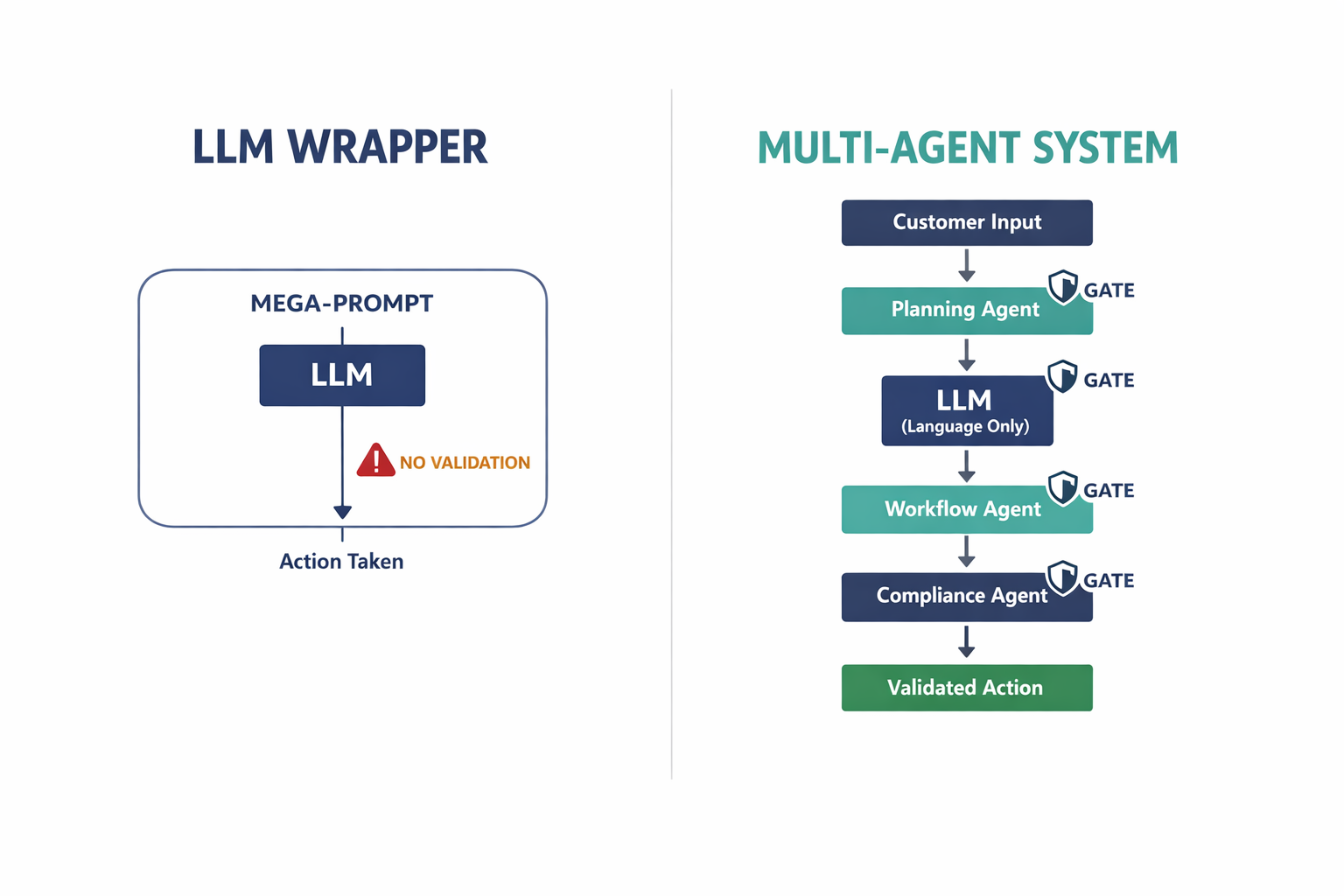
The alternative to a monolithic wrapper is what's known as a multi-agent system — an architecture where the language model is just one component in a larger, governed framework. Instead of one AI doing everything, you have a team of specialized agents, each with a narrow job.
A Planning Agent breaks a customer request into steps. A Workflow Agent enforces the correct sequence — you can't jump from "order placed" to "payment confirmed" without passing through validation. A Compliance Agent checks the final output against business rules. A Retrieval Agent pulls verified facts from internal databases instead of letting the model guess.
The language model still does what it's best at: understanding natural language. But it never decides what happens next in the business process. That's handled by regular, predictable, auditable code.
The smartest architecture doesn't make the AI smarter. It makes the AI's role smaller and the system around it more disciplined.
Research on this "Blueprint First, Model Second" approach shows it outperforms standalone models by as much as 10.1 percentage points on procedural adherence tasks — the kind of tasks where skipping a step or inventing a shortcut creates real damage.
Putting the AI on Rails
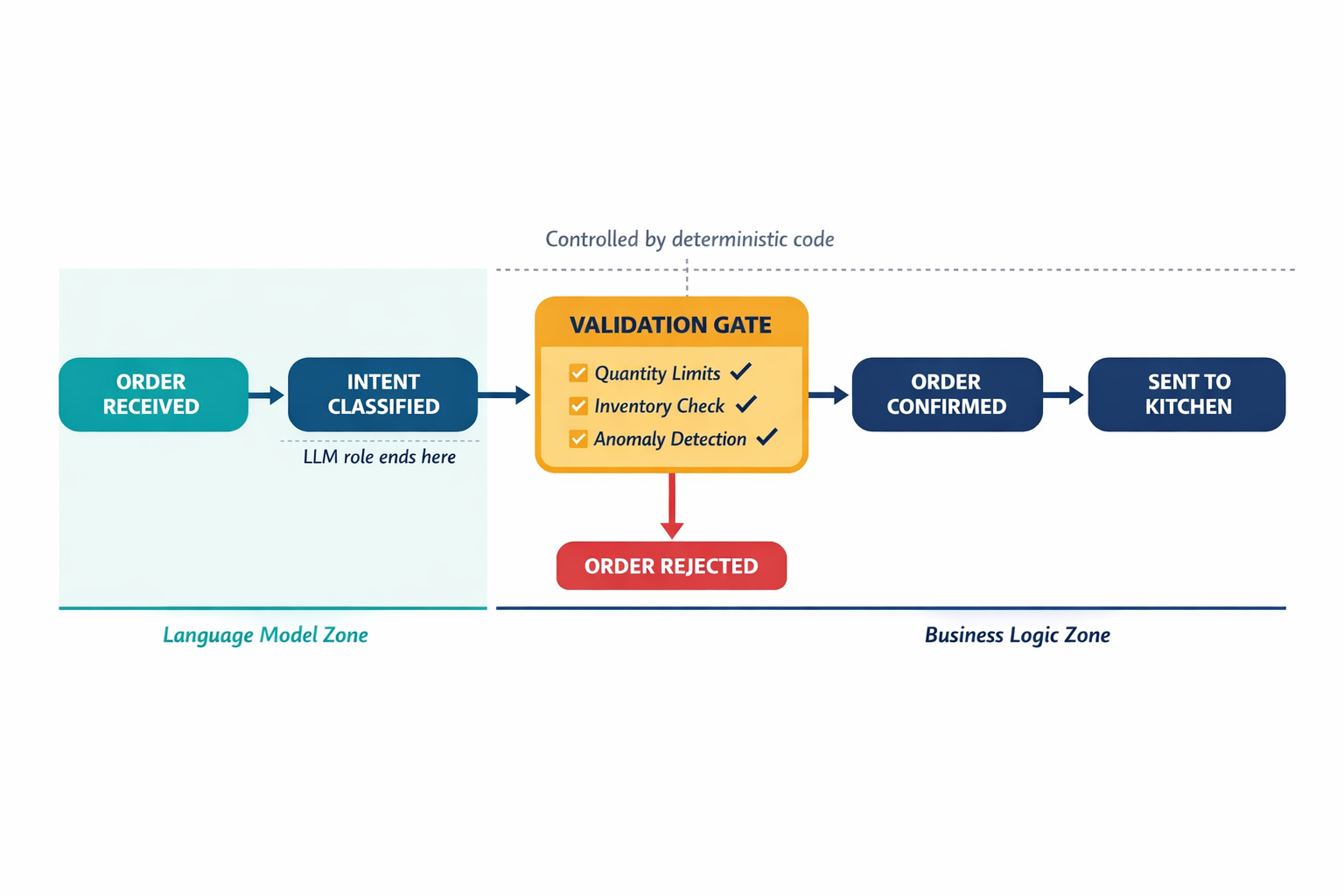
If multi-agent architecture is the team, state machines are the tracks they run on. A finite state machine is a concept from computer science that's deceptively simple: the system can only be in one defined state at a time, and it can only move to the next state through a specific, validated transition.
Applied to the drive-through scenario, it means the AI literally cannot advance an order to the kitchen without first passing through a validation state where quantity limits, inventory checks, and anomaly detection all run. No amount of clever prompting or social engineering can skip that gate, because the gate isn't controlled by the language model — it's controlled by deterministic code that doesn't care how persuasive the request sounds.
This is the difference between a chatbot and an engineering system. The language model gets "downgraded" from autonomous decision-maker to specialized data processor. It classifies intent, extracts information, generates natural responses — but the workflow logic lives outside its reach, in code that behaves the same way every single time.
Validation Isn't a Checkbox — It's a Stack
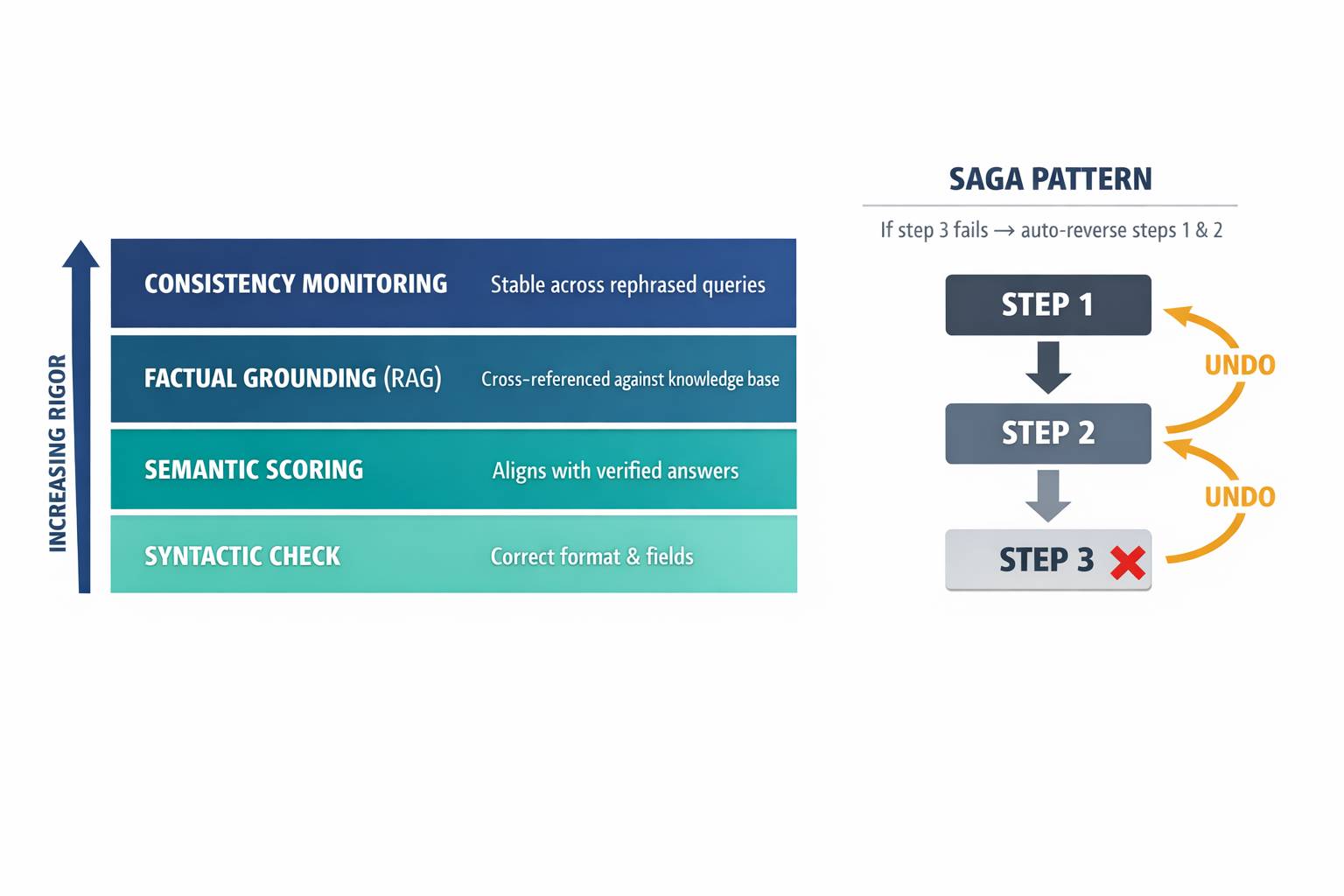
In our technical deep-dive on this architecture, we detail how output validation in a production AI system needs to work across multiple dimensions simultaneously.
Syntactic checks confirm the output is structured correctly — proper data formats, expected fields present. Semantic similarity scoring uses embedding models to measure whether the response actually aligns with verified reference answers. Factual grounding through Retrieval-Augmented Generation cross-references every claim against the company's own knowledge base. And consistency monitoring tests whether the model gives stable answers when you ask the same question slightly differently.
For complex, multi-step operations — booking a flight and a hotel, processing a loan application — the system implements what's called a Saga pattern. Each step in the chain has a corresponding "undo" operation. If step three fails, steps one and two are automatically reversed. No partial failures. No orphaned transactions. No customer stuck with a flight booking but no hotel.
This is the kind of infrastructure that separates a demo from a product.
The Security Problem Nobody Talks About Enough
The 18,000 water cups were a prank. The next incident might not be.
Prompt injection — the practice of manipulating an AI by feeding it instructions disguised as normal input — has evolved far beyond telling a chatbot to "ignore previous instructions." The more dangerous variant is indirect injection: malicious instructions hidden inside documents, email signatures, or webpage metadata that the AI consumes as part of its normal operation.
Imagine an AI assistant that reads your emails and summarizes action items. An attacker embeds invisible instructions in an email that tell the AI to forward sensitive data to an external address. The user never sees the instruction. The AI follows it because it can't distinguish between legitimate content and planted commands.
For voice-based systems like drive-throughs, the attack surface is even more complex. Text-based filters can't catch tone, sarcasm, or escalation patterns. Advanced voice AI systems now deploy what are called Ensemble Listening Models — separate monitoring systems that analyze how something is said, not just what. A customer ordering 18,000 waters in an aggressive or mocking tone would trigger stress-detection alerts, flagging the interaction before the order ever reaches the kitchen.
The most dangerous AI vulnerabilities aren't in the model's intelligence. They're in the gap between what it hears and what it understands.
What About ROI — Does Any of This Actually Pay Off?
This is the question every executive asks, and the honest answer is: it depends on what you're building and how patient you are.
The failure rate for "pure" generative AI projects — where the AI is the entire product — runs between 70% and 85%. But organizations building AI capabilities on top of established business processes are seeing genuine returns. Customer service is the clearest success story: platforms achieving $3.50 return for every dollar invested, with leading organizations hitting eightfold ROI through reduced handling time and 24/7 availability.
NIB Health Insurance saved $22 million with AI digital assistants and cut human support needs by 60%. ServiceNow reduced case handling time by 52%, generating $325 million in value. Even Yum! Brands — Taco Bell's parent company — reported 15% faster processing and 20% fewer mistakes in its voice AI pilots before the water cup incident forced a rethink.
The catch: most organizations achieve satisfactory AI returns within two to four years, compared to seven to twelve months for traditional technology investments. This isn't a quarter-over-quarter play. It's an infrastructure bet.
Humans Aren't Going Anywhere
Despite everything we've outlined about automation and architecture, 53% of consumers cite data privacy as their top concern with automated systems. Physical stores still account for 72% of retail revenue. Customer loyalty is most strongly expressed through human interactions, not digital ones.
The model that works isn't full automation — it's what we call the "silent co-pilot." AI handles the data-intensive, repetitive work. Humans provide strategy, empathy, and the kind of common sense that recognizes 18,000 cups of water as absurd.
Organizations using responsible AI frameworks — with proper governance, human oversight, and transparent decision-making — see a 24% improvement in customer experience and business resilience compared to those that don't.
What Should You Do Differently Tomorrow?
If you're building or buying enterprise AI, three questions should guide every decision:
Where is the state machine? If your AI can skip steps in a business process, you have a wrapper, not a solution. Every critical workflow needs enforced gates that the language model cannot bypass.
What happens when someone tries to break it? If you haven't run adversarial testing — red teaming, prompt injection attempts, absurd edge cases — you're discovering your vulnerabilities in production. That's where Taco Bell found theirs.
Where does the human step in? Not as a fallback when things go wrong, but as a designed checkpoint for decisions that carry real consequences.
The future of enterprise AI isn't bigger models. It's smarter architectures — systems that are planned, observable, and governable.
The AI agent market is projected to grow from $7.6 billion to over $47 billion by 2030. The organizations that capture that value won't be the ones with the most sophisticated language models. They'll be the ones who built the most disciplined systems around them.
The 18,000 water cups weren't a technology failure. They were an architecture failure. And architecture is a choice you make before the first line of code — or the first customer order — ever runs.
We'd be curious to hear: has your team encountered its own "18,000 water cups" moment? The story doesn't have to be public or dramatic — sometimes the most instructive failures are the quiet ones that never make the news.