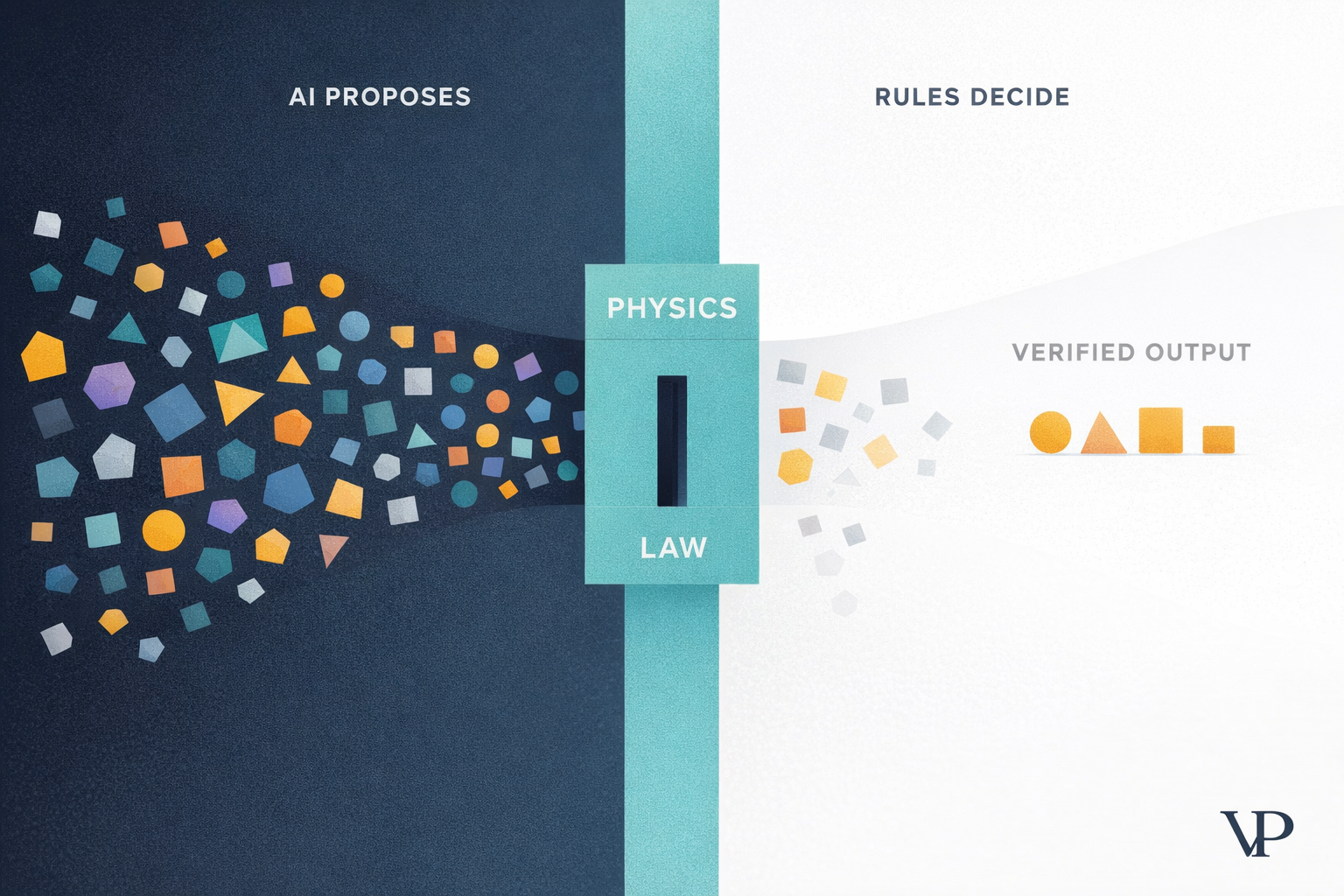
A lithium-ion battery that catches fire doesn't care that the AI said the electrolyte was "probably stable." A copyright lawsuit doesn't care that the generative model "didn't mean" to reproduce a protected melody. In high-stakes enterprise AI, probably right is functionally wrong. Our team has spent the last two years building AI systems where neural networks propose answers — but physics and law get the final vote. We call this approach deterministic AI, and it represents a fundamentally different philosophy from the chatbots and wrapper apps that dominate today's AI conversation.
The gap between consumer-grade AI and what critical industries actually need has never been wider. Most enterprise AI today is built as a thin interface on top of a general-purpose language model — useful for drafting emails, dangerous for designing battery materials or generating licensed media. We published an in-depth analysis of this divide to lay out what a different architecture looks like in practice.
The Wrapper Economy Has a Ceiling
The vast majority of AI products shipping today are what the industry quietly calls "wrappers" — applications that put a custom interface on top of someone else's large language model. They're fast to build, easy to demo, and genuinely useful for tasks where being approximately right is good enough: summarizing meeting notes, suggesting marketing copy, answering general knowledge questions.
But these systems share a fundamental trait: they predict what sounds right rather than verifying what is right. An LLM that has "read" millions of chemistry papers can still hallucinate a molecular structure that violates basic bonding rules, because it predicts text tokens, not electron behavior. A diffusion model trained on internet audio can reproduce a copyrighted melody without knowing it, because it has no concept of ownership — only statistical patterns.
For a battery manufacturer, a hallucination is a fire. For a media company, a hallucination is a lawsuit.
The question isn't whether these models are impressive. They are. The question is whether "impressive" is the same as "safe to deploy in your R&D lab or production studio." For a growing class of enterprise problems, the answer is no.
What Deterministic AI Actually Means
We use the term deterministic AI to describe a specific architectural pattern: let the neural network generate candidates from a vast search space, then subject every candidate to validation by immutable rules — the laws of physics, the rules of copyright, the constraints of formal logic.
Think of it like a hiring process. The AI is the recruiter who identifies a thousand promising résumés from a pool of millions. But the final hiring decision goes to a panel of domain experts who check credentials, run background checks, and verify every claim. The recruiter's speed is valuable. The panel's rigor is non-negotiable.
This isn't a philosophical preference. It's a practical response to the fact that in materials science, energy storage, and intellectual property, the cost of a single wrong answer can be measured in millions of dollars, regulatory penalties, or human safety.
When Batteries Fail: A Predictable Cascade
To understand why this matters concretely, consider the problem of thermal runaway in lithium-ion batteries — the self-reinforcing chemical chain reaction that turns a battery pack into a fire.
Thermal runaway isn't random. It follows a deterministic sequence. Around 80–100°C, the protective layer on the battery's anode begins to decompose. By 110–135°C, the separator melts and the electrolyte breaks down into flammable gases. Above 200°C, the cathode collapses, releases oxygen, and combustion takes over.
The electrolyte — the liquid that carries lithium ions between electrodes — is the critical weak link. Traditional electrolytes based on lithium hexafluorophosphate dissolved in carbonate solvents become the fuel in that final combustion stage. To prevent thermal runaway in next-generation batteries, the industry needs electrolytes that remain thermodynamically stable well beyond 200°C.
The problem? The chemical space of possible inorganic crystals contains an estimated 10¹⁰⁰ combinations. Testing them one at a time in a lab — the traditional approach — is impossibly slow. Human researchers also tend to explore variations of materials they already know, missing entirely novel compounds that might perform far better.
How AI Proposes and Physics Decides
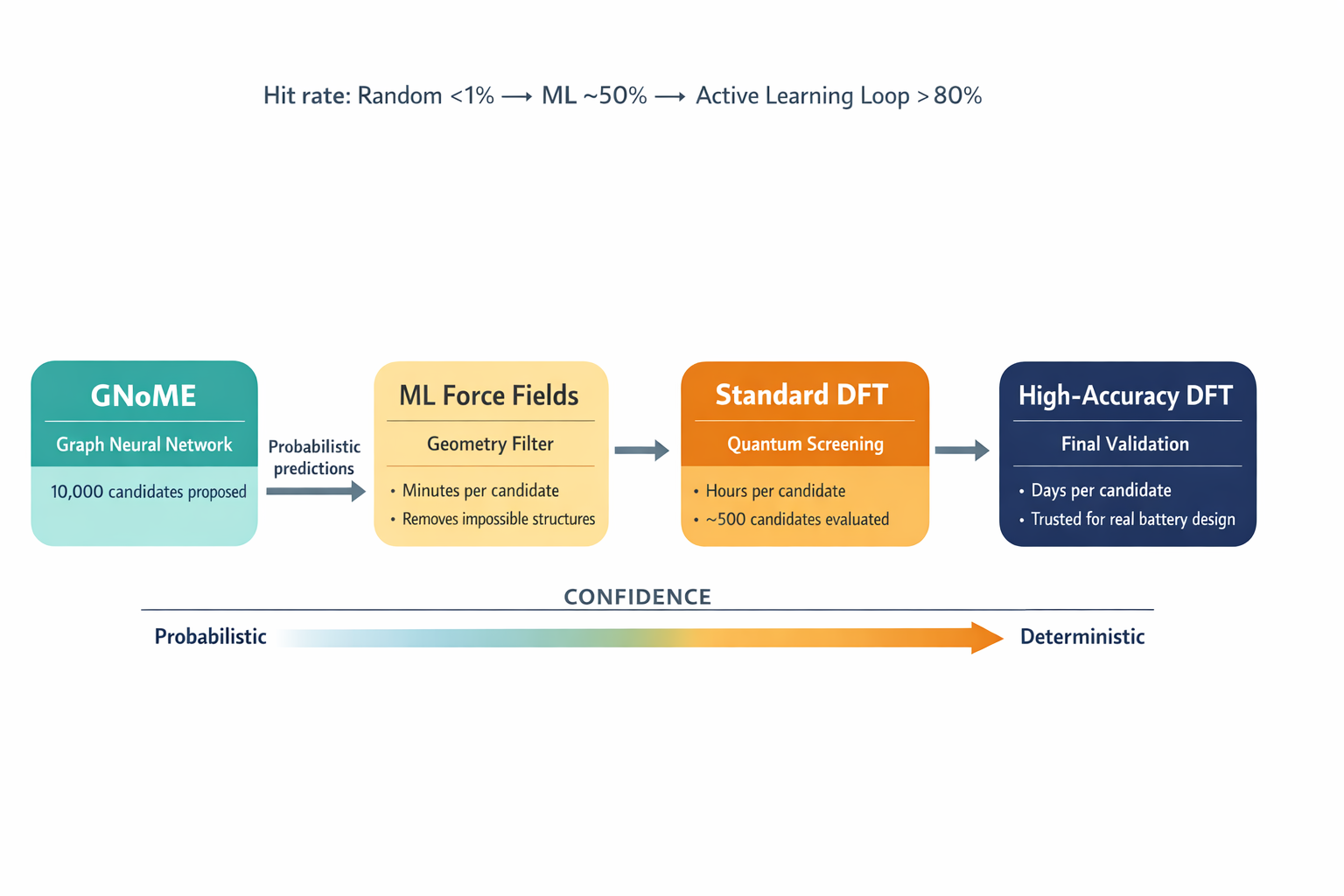
Our workflow uses Google DeepMind's GNoME (Graph Networks for Materials Exploration) to navigate this enormous search space. Unlike language models that process text as linear sequences, GNoME treats crystal structures as three-dimensional graphs — atoms are nodes, chemical bonds are edges, and the network learns how local atomic environments determine a material's properties.
GNoME runs two parallel strategies. One takes known stable crystals and proposes intelligent substitutions — swapping one element for a chemically similar neighbor to find improved variants of existing material families. The other is more radical: it generates entirely new chemical compositions and predicts whether a stable crystal structure exists for them. Together, these pipelines balance refinement of the known with exploration of the unknown.
For every candidate, GNoME predicts a critical number: the decomposition energy, which measures how far a material sits from the thermodynamic ground state. A material on the ground state is stable. One sitting far above it will spontaneously fall apart — releasing heat in a battery, contributing to exactly the thermal cascade we're trying to prevent.
But GNoME is still a neural network. Its predictions are probabilistic. So every promising candidate gets sent to the Oracle.
We don't use AI to guess the answer. We use AI to propose candidates, then let physics have the final word.
That Oracle is Density Functional Theory (DFT) — a quantum mechanical method that calculates a crystal's electronic structure and energy from first principles. DFT is computationally expensive (a single calculation can take days), but it's grounded in the Schrödinger equation, not in training data. It doesn't hallucinate.
We run this as a tiered process. Fast machine-learning force fields filter out geometrically impossible structures in minutes. Standard DFT methods screen the survivors in hours. The most promising candidates get validated with high-accuracy methods that take days but deliver numbers you can trust when designing a real battery.
The Flywheel That Gets Smarter
The real power isn't in any single cycle — it's in the loop. GNoME proposes 10,000 candidates. We select the 500 most promising (or most uncertain — sometimes the model's confusion points toward unexplored territory). DFT calculates their true energies. Those results feed back into GNoME's training data, and the model retrains.
Each cycle, the model's hit rate — the percentage of proposed materials that turn out to be genuinely stable — climbs. Traditional random screening finds stable materials less than 1% of the time. Standard machine learning reaches roughly 50%. Our GNoME-driven active learning loop exceeds 80%.
That's the difference between searching for a needle in a haystack and having a metal detector that improves every time it finds one.
The Same Problem, Different Domain: Audio and Copyright
The second half of our research applies the same architectural philosophy — AI proposes, deterministic rules validate — to a completely different domain: enterprise audio and intellectual property.
Generative AI models for audio and music are trained on massive datasets scraped from the internet, containing billions of copyrighted works. When these models create something new, the output is a mathematical blend of that training data. This creates a problem the industry calls provenance obfuscation: you literally cannot trace which source materials influenced the output.
The risks are concrete. A model might "overfit" and reproduce a recognizable four-bar melody from its training data. The enterprise using that output is liable for infringement — even if the copying was unintentional. And the legal standing of training on copyrighted data is being actively litigated in cases like Andersen v. Stability AI and New York Times v. OpenAI. An enterprise that builds on these tools risks having its assets invalidated if courts rule against the model providers.
For a global ad agency or film studio, "we didn't know it was copyrighted" is not a defense. They need to prove chain of title for every component of every asset.
Building Audio from Verified Parts
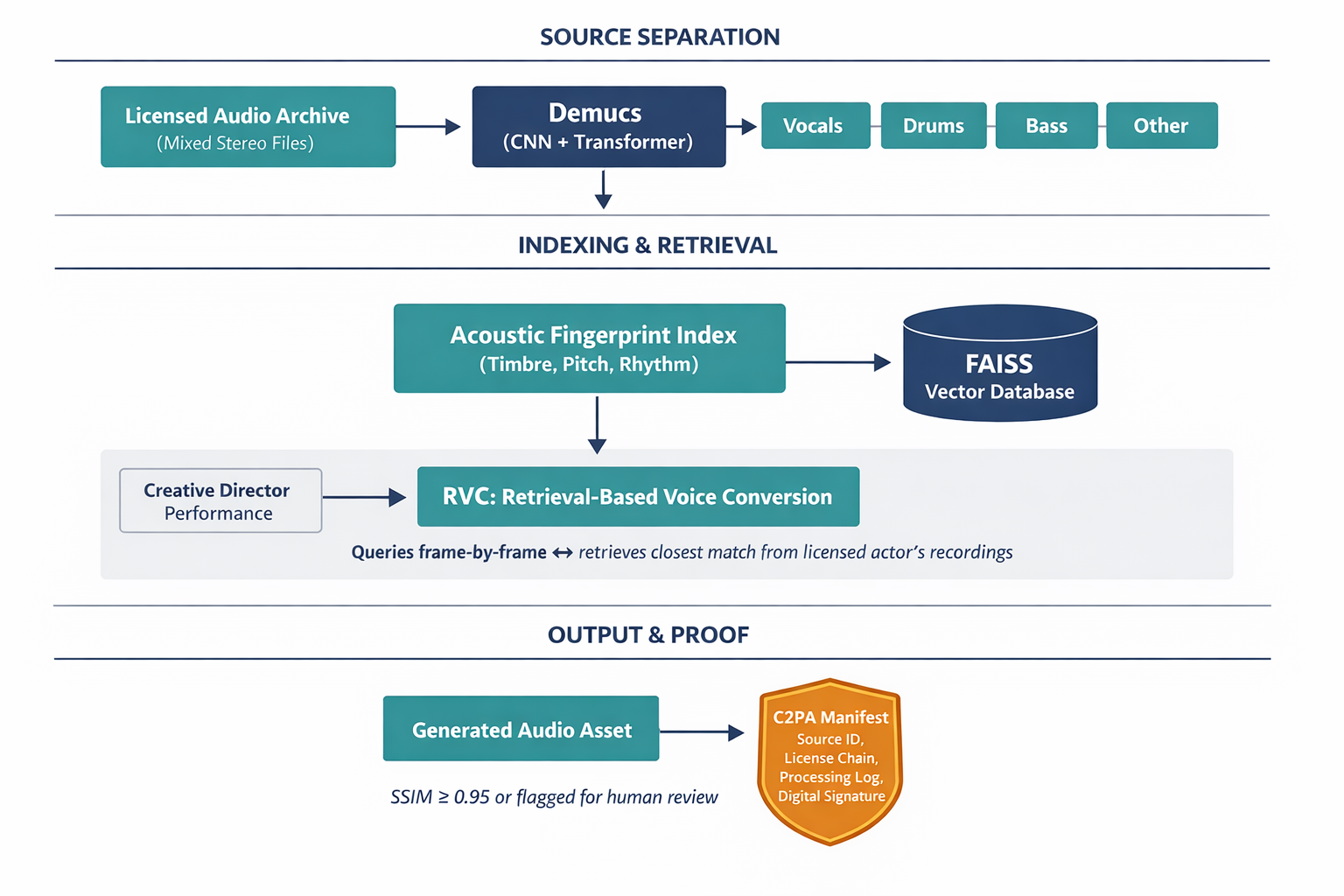
Our approach rejects the "generate from noise" paradigm entirely. Instead, we've built what amounts to retrieval-augmented generation for audio — every sound in the output traces back to a specific, licensed source.
The process starts with deep source separation. Most media companies sit on vast archives of owned or licensed content locked in mixed stereo files. Using an architecture called Demucs — which combines convolutional neural networks with transformer attention mechanisms — we separate mixed recordings into isolated stems: vocals, drums, bass, and other instruments. The latest version processes audio simultaneously in both the time domain (the raw waveform) and the frequency domain (the spectrogram), achieving near-studio-quality separation.
These isolated stems get indexed not just by metadata but by their acoustic fingerprints — timbre, pitch, rhythm — creating a massive library of copyright-clear building blocks.
For voice generation, we use Retrieval-Based Voice Conversion (RVC), which works fundamentally differently from text-to-speech. Instead of generating a voice from scratch, RVC takes a real human performance — say, a creative director reading a script — and transforms the vocal quality to match a licensed voice actor, while preserving the original performance's timing and emotion.
The critical mechanism is explicit retrieval. For every frame of audio, the system queries a database of feature vectors extracted from the licensed actor's recordings using FAISS (Facebook AI Similarity Search) and pulls the closest matching acoustic data. The breathiness, the resonance, the specific character of the voice — none of it is "dreamed up" by the AI. It's retrieved from data point #4,592 in the licensed actor's index.
The acoustic details aren't invented by the model. They're retrieved from a specific, authorized recording. If the output sounds like Actor A, it's because we pulled real data from Actor A's licensed index.
For the full technical methodology behind both the materials and audio pipelines, our detailed research walks through the architecture end to end.
Every Asset Carries Its Own Papers
Generation is half the problem. The other half is proof. We implement the C2PA standard (Coalition for Content Provenance and Authenticity) — an open protocol that embeds tamper-evident provenance data directly into media files using public-key cryptography.
Every audio asset we generate carries a signed manifest documenting its source recording, the licensed voice model used, every processing step applied, and the software version that produced it. Any downstream user — a streaming service, a broadcaster, a legal team — can verify that signature and confirm the asset was built entirely from authorized IP.
We also adapted the Structural Similarity Index (SSIM) — traditionally an image quality metric — for audio quality control. By comparing spectrograms of the input performance and the converted output, we catch cases where the AI has distorted the performance: skipped words, altered rhythm, introduced artifacts. Any asset scoring below a 0.95 threshold gets automatically flagged for human review.
What About Companies Already Using Generative AI?
The most common pushback we hear: "We're already using generative AI tools and haven't had problems." That's survivorship bias. The litigation wave is still building. The battery failures from poorly validated materials haven't hit scale production yet. The absence of a disaster so far is not evidence that your architecture is sound — it's evidence that you haven't been unlucky yet.
The transition doesn't require ripping out existing AI investments. It requires adding a validation layer — the Oracle — between what the AI proposes and what reaches production. In materials, that's DFT. In media, that's provenance tracking and retrieval-based generation. The neural network stays. The unchecked trust in its output goes.
Does This Slow Things Down?
Counterintuitively, no. The active learning flywheel in materials discovery means each cycle is faster and more accurate than the last — an 80%+ hit rate means dramatically less wasted computation and lab time compared to brute-force approaches. In audio, retrieval-based generation eliminates the months of legal review that "black box" generated assets would require before any enterprise could safely use them.
Speed without verification isn't fast. It's reckless on a delayed fuse.
The real bottleneck in enterprise AI was never generation speed. It was the time and cost of cleaning up after wrong answers.
What This Means for Your Organization
The divide between probabilistic and deterministic AI isn't a technical curiosity — it's a strategic decision that will define which enterprises can deploy AI in their core operations and which remain stuck using it for peripheral tasks.
Three things worth considering:
Audit your AI stack for "Oracle gaps." Where are neural networks making decisions that go directly to production without deterministic validation? Those are your highest-risk points.
Treat provenance as infrastructure, not compliance. Whether it's the origin of a crystal structure prediction or the licensing chain of an audio asset, traceability isn't overhead — it's what makes the asset usable.
Invest in hybrid expertise. The people who will build the next generation of enterprise AI aren't pure machine learning engineers or pure domain scientists. They're the ones fluent in both — capable of managing the conversation between the neural network and the Oracle.
The era of experimenting with AI as a novelty is closing. The era of engineering AI as infrastructure — accountable to physics, accountable to law — is what comes next. We'd welcome hearing how your organization is navigating that transition.