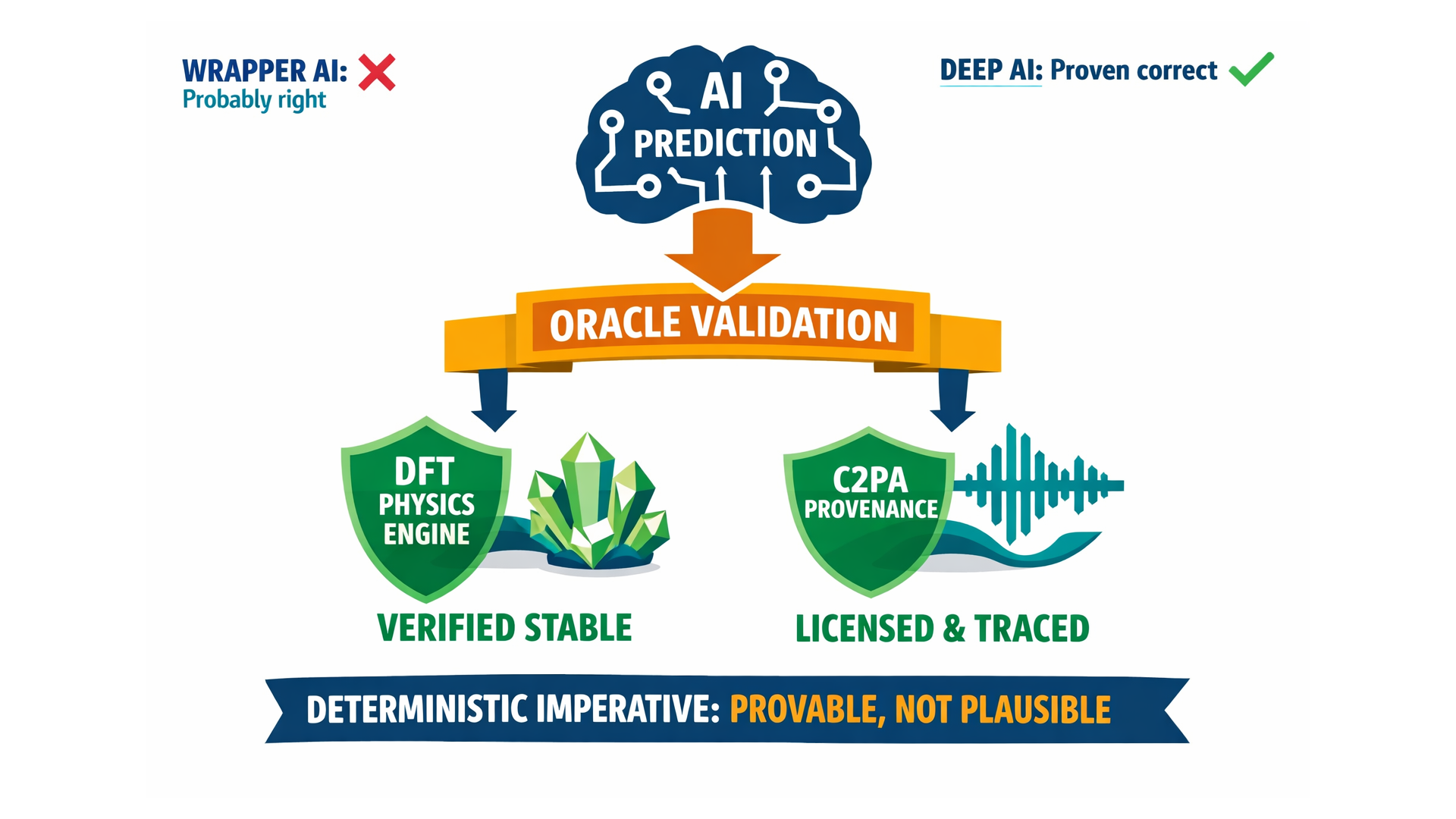
A battery explodes because an AI predicted a material was "probably stable." A media company gets sued because a generative model unknowingly reproduced a copyrighted melody. Both failures share the same root cause: the AI was designed to be plausible, not provable.
I have been building systems at Veriprajna that reject this tradeoff entirely. We call it the Deterministic Imperative -- the principle that in any enterprise application where failure has real consequences, AI's generative power must be governed by something that cannot hallucinate. A physics engine. A cryptographic audit trail. An oracle of ground truth that says "this answer is not just likely -- it is verified."
This is the line between what I call the Wrapper Economy and Deep AI. Most corporate AI today is a wrapper -- a chatbot skin over a general-purpose language model. It works brilliantly for drafting emails. It is catastrophically insufficient for designing battery electrolytes or clearing audio for broadcast.
Why Does "Probably Right" Fail in the Real World?
The wrapper approach fails the moment you leave the world of text and enter the world of atoms or intellectual property. A large language model that has read millions of chemistry textbooks might propose a molecular structure that violates basic bonding rules. It predicts tokens, not electron densities. A diffusion model trained on the open internet might generate audio that statistically resembles a copyrighted song, because it has no concept of ownership or provenance.
For a battery manufacturer, a hallucination is a fire. For a media company, a hallucination is a lawsuit.
When my team first started working on materials discovery, I assumed the hard part would be getting AI to propose good candidates. I was wrong. The hard part is knowing which candidates to trust. That realization reshaped everything we build.
How Do You Engineer Battery Materials That Cannot Lie?
Modern lithium-ion batteries operate on a thermodynamic knife edge. Thermal runaway -- the cascading chemical failure that turns a battery into a fire -- is not random. It follows a deterministic sequence: the protective layer on the anode breaks down around 80-100 degrees Celsius, the separator melts at 110-135 degrees, and above 200 degrees the cathode collapses, releasing oxygen into a combustion event.
The electrolyte is the critical variable. Traditional liquid electrolytes act as fuel in that final stage. To prevent thermal runaway, we need materials that remain stable well beyond that 200-degree threshold. The problem? The chemical space of possible inorganic crystals contains an estimated 10^100 combinations. You cannot test your way through that experimentally.
We use GNoME (Graph Networks for Materials Exploration), developed by Google DeepMind, to treat crystal structures as graphs -- atoms as nodes, bonds as edges. Unlike language models that process text as linear sequences, GNoME understands 3D geometry. It respects physical symmetry mathematically, so rotating a crystal in space does not change the prediction. The network proposes candidates through two pipelines: one that intelligently modifies known stable structures, and one that generates entirely novel compositions from scratch.
But GNoME's predictions are still probabilistic. A neural network saying a material is stable is not the same as a material being stable. This is where the oracle comes in.
What Makes Our Validation Oracle Different?
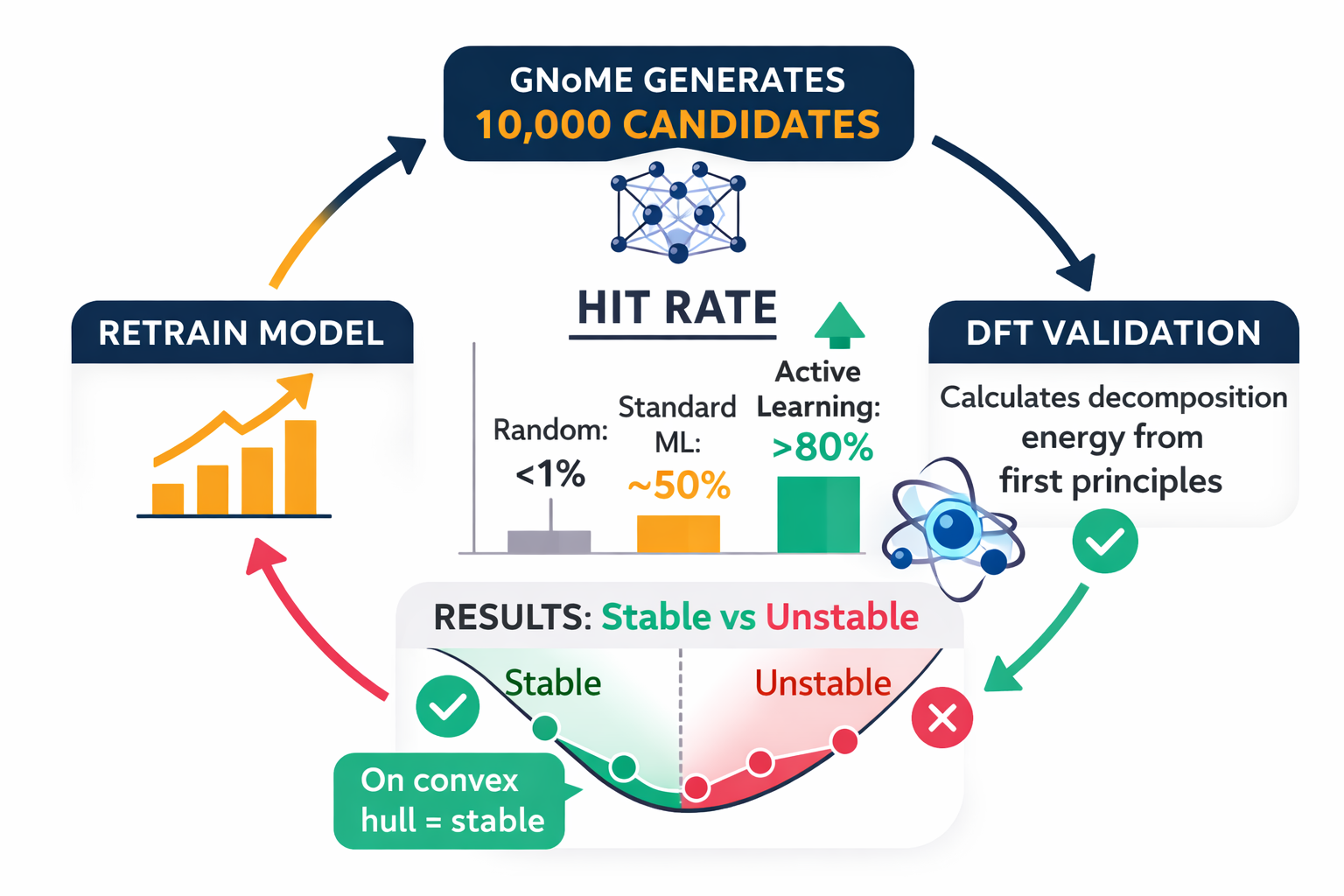
We validate every promising candidate using Density Functional Theory (DFT) -- a quantum mechanical method that calculates electron density and total energy from first principles. Think of it as asking the laws of physics directly, rather than asking a model that learned about physics from data.
The key metric is what we call Decomposition Energy -- how far a material sits from the thermodynamic ground state. A material on the "convex hull" -- the lowest-energy boundary for a given composition, like the floor of a valley where everything rolls downhill to rest -- is stable. A material far above it will spontaneously decompose, releasing heat. In a battery, that heat is the beginning of thermal runaway.
The last three breakthroughs in our materials pipeline came not from the AI proposing something brilliant, but from the physics engine vetoing something dangerous that looked promising on paper.
This is not a one-shot process. We run an active learning loop: GNoME generates 10,000 candidates, we select the most promising (and the most uncertain) for DFT validation, feed the true energies back into the model, and retrain. Each cycle, the model gets sharper. Traditional random screening hits stable materials less than 1% of the time. Standard machine learning gets to about 50%. Our GNoME-driven active learning exceeds 80% hit rates. We explored this architecture in depth in our interactive analysis.
I remember the first time we ran a full cycle and watched the hit rate jump from the second iteration to the third. My team's reaction was not celebration -- it was a quiet "okay, this actually works." That moment of trust in the system was harder to earn than any technical milestone.
The Copyright Time Bomb in Generative Audio
The same "probably right" problem plagues creative industries, just with legal consequences instead of physical ones. When a diffusion model generates audio, it moves through what researchers call a latent space -- essentially a compressed mathematical map of everything the model learned from billions of copyrighted works scraped from the internet. The output is a mathematical blend of that training data. If a generated track contains a 4-bar loop identical to a Beatles song, the user is liable for infringement -- even if the copying was unintentional.
The legal landscape is actively hostile. Cases like Andersen v. Stability AI and New York Times v. OpenAI are testing whether training on copyrighted data constitutes fair use. An enterprise that builds its audio pipeline on these models is betting its assets on the outcome of litigation that has not been decided.
My view: hope is not a legal strategy. We need systems where every component of the output can be traced to a verified, licensed source.
How Does White-Box Audio Replace Generation With Retrieval?
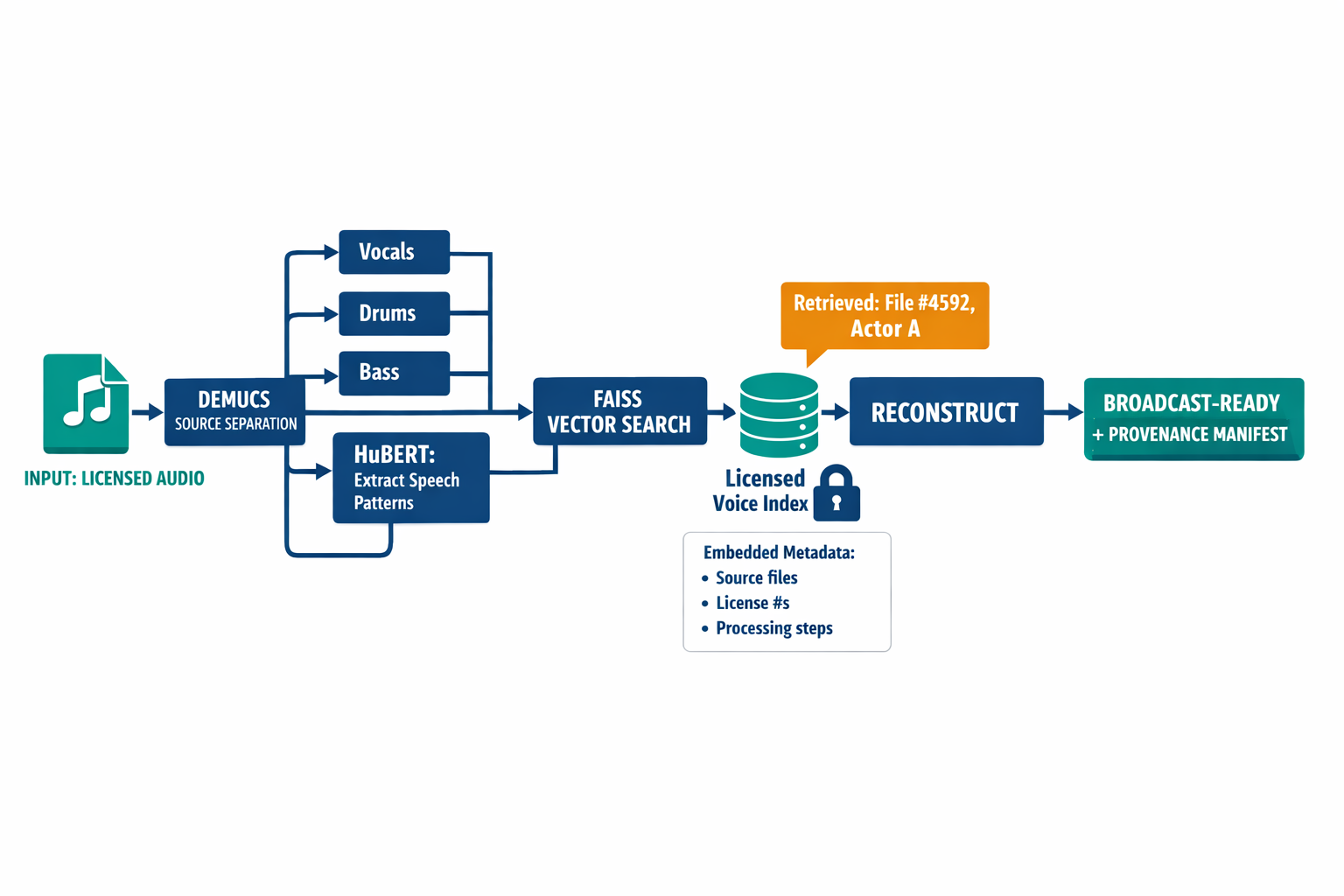
We built what I think of as Retrieval-Augmented Generation for audio. Instead of generating sound from noise, we deconstruct and reconstruct from known, licensed parts.
The first step uses Demucs, a deep source separation model that splits mixed audio files into isolated stems -- vocals, drums, bass, instruments -- with near-studio quality. We process a client's entire owned or licensed audio archive, creating a massive database of "building blocks" indexed by their acoustic features.
For voice, we use Retrieval-Based Voice Conversion (RVC). Unlike text-to-speech, which generates audio from text, RVC is speech-to-speech. A creative director reads a script into their phone. Our system strips the speaker identity using HuBERT -- a self-supervised model that extracts the raw speech patterns (pitch, rhythm, pronunciation) while discarding who is speaking -- then uses FAISS vector search, a fast nearest-neighbor lookup that finds the closest matching speech features from a licensed voice actor's database. The acoustic details -- breathiness, resonance, texture -- are not dreamed by the AI. They are retrieved from specific, authorized recordings.
I still remember the first time we demo'd voice conversion to a client's legal team. The general counsel listened to the output, paused, and asked: "Can you show me exactly which recordings this came from?" When we pulled up the provenance trail -- specific file names, timestamps, license numbers -- the room shifted. That was the moment I understood that for enterprise audio, traceability is not a feature. It is the product.
The output sounds like Actor A because we pulled data point #4592 from Actor A's licensed index -- not because a neural network hallucinated a voice.
Every generated asset then gets signed with the C2PA (Coalition for Content Provenance and Authenticity) standard -- tamper-evident cryptographic metadata that records exactly which source material, which licensed voice model, and which processing steps produced the output. Any downstream user can verify the chain of title. For the full technical methodology behind this pipeline, see our detailed research.
"But Doesn't This Limit What AI Can Do?"
This is the objection I hear most often. If you constrain AI with physics validation or copyright tracing, are you not sacrificing the creative power of generative models?
The honest answer: yes, partially. An unconstrained model will explore a larger space of possibilities. But most of that space is garbage -- thermodynamically unstable materials, legally indefensible audio. Constraints do not limit useful output. They focus it.
The better question is whether your organization can afford the alternative. If you are a battery manufacturer, can you ship a product based on "the AI said it was probably safe"? If you are a media company, can you broadcast a track whose provenance is "a neural network made it from internet data"?
The infrastructure requirements are real. DFT validation needs high-performance computing clusters. Source separation and vector retrieval need GPU-dense infrastructure with scalable storage. This is not something you bolt onto a web server. But the cost of getting it wrong -- a thermal event, a copyright judgment -- dwarfs the infrastructure investment.
What Does This Mean for Enterprise AI Strategy?
The split between wrapper AI and deep AI is going to define the next decade of enterprise technology. Wrappers will continue to dominate productivity tooling -- summarization, drafting, code assistance. They are excellent for that.
But every organization has domains where "plausible" is not good enough. Where the output touches physical safety, legal liability, or financial materiality. In those domains, the question is not "can AI do this?" but "can AI prove it did this correctly?"
That proof requires an oracle -- something outside the neural network that validates the output against ground truth. Physics. Law. Cryptography. The specific oracle varies. The principle does not.
I have started asking every team that brings me an AI use case a simple question: "What is your oracle?" If they do not have one, we are not ready to ship.
If you are building AI systems for high-stakes domains, I would genuinely like to hear how you are thinking about validation. The industry needs more honest conversation about where generative AI ends and engineering begins.