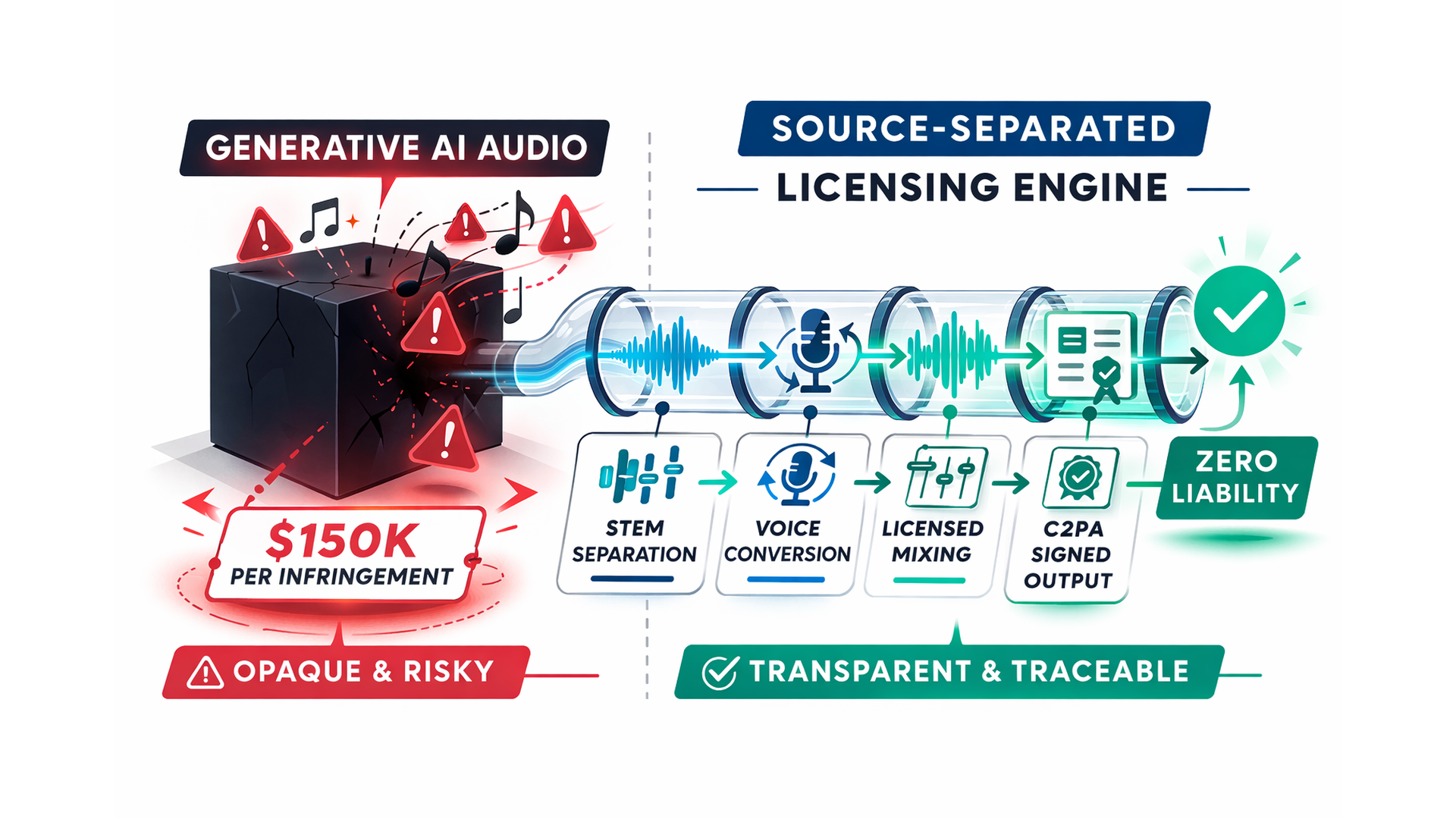
Last year, a major ad agency asked my team to help them figure out why their AI-generated jingle sounded suspiciously like a Mariah Carey track. It did, because the model that made it had been trained on her entire catalog without permission. That agency was sitting on what I now call a "rented lawsuit" -- content that looks like an asset on the balance sheet but is actually an uncapped liability.
The RIAA (Recording Industry Association of America)'s landmark lawsuits against Suno and Udio allege exactly this: these platforms circumvented YouTube's encryption to stream-rip millions of copyrighted recordings, then trained models that mathematically reconstruct those recordings on demand. Statutory damages run up to $150,000 per infringed work. If you're an enterprise using these tools for commercial content, you're not saving money. You're gambling it.
I founded Veriprajna because I believed there had to be a way to use AI in audio production that doesn't require crossing your fingers on copyright. What we built is fundamentally different from the "prompt and pray" approach -- and I want to explain why.
How Bad Is the Black Box Problem, Really?
Most people assume generative AI audio tools create music from scratch. They don't. They decompress it.
A diffusion model -- essentially a system that learns to reverse-engineer audio from noise -- works by taking clean spectrograms (visual snapshots of sound frequencies over time) of copyrighted songs, adding noise until they become static, and then learning to reverse that process. When you prompt "make a jazz song," the model traverses a latent space -- a mathematical map built entirely from its training data -- to reconstruct audio that statistically matches your request. If the training data was scraped illegally, the output carries that taint. Courts call this the "fruit of the poisonous tree" doctrine.
You cannot build a business on a Black Box. If you don't know what data the model was trained on, you don't own the IP.
What shocked me was how thin the legal protections are. Suno's Terms of Service include clauses that shift liability back to the user if your prompt "causes" the infringement. Prompt "in the style of [Artist]" and the platform argues you misused the tool. Their indemnification isn't worth the pixels it's printed on -- especially when many of these startups don't have the capital to honor it in a mass-tort scenario.
What Did the Udio Settlement Actually Reveal?
When Universal Music Group settled with Udio, the terms created what I call a "walled garden" trap. Legacy content generated on Udio's original model was locked inside the platform -- users couldn't download or export their creations. An ad agency that built a campaign on Udio jingles suddenly couldn't use them off-platform.
That moment crystallized something for my team. The issue isn't just legal risk. It's operational risk. You build workflows, campaigns, entire brand identities on these tools, and the rug can get pulled retroactively. We decided to solve this at the architecture level, not the Terms of Service level.
What We Built: Separation Instead of Generation
The core insight behind Veriprajna's approach is simple: don't generate audio from stolen data. Transform licensed audio with transparent tools.
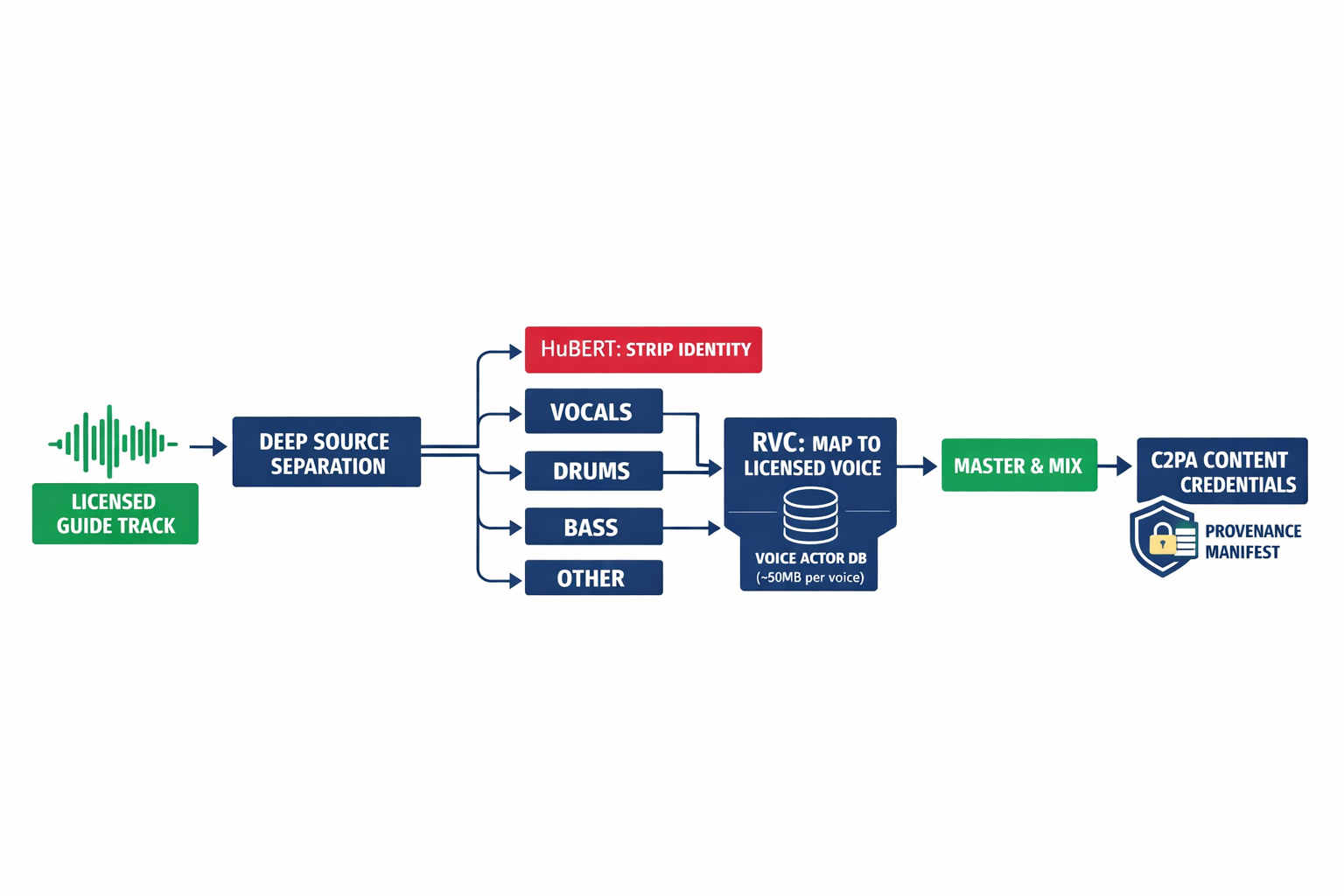
We call it the Source-Separated Licensing Engine, or SSLE. Instead of a text prompt, we take audio input -- a guide track the client owns or has licensed -- and run it through a pipeline where every step has clear provenance.
The guide track gets deconstructed into isolated stems -- vocals, drums, bass, other instruments -- using Deep Source Separation. Think of it like separating eggs: once mixed, traditional methods can't undo it, but neural networks can identify which frequencies belong to which instrument and pull them apart cleanly. Then the vocal stem goes through Retrieval-Based Voice Conversion, or RVC, which decouples what is being sung from who is singing it. A HuBERT model (a neural network that understands speech structure the way autocorrect understands text) strips the singer's identity down to pure linguistic and melodic content, then maps it onto a licensed voice -- trained on 30-60 minutes of audio from a voice actor who signed a commercial release.
I'll be honest: when we first tested this pipeline, I assumed the voice conversion would sound robotic, like a glorified vocoder. I was wrong. The first time I heard a converted vocal that was indistinguishable from a natural performance, I sat in our studio for ten minutes just replaying it. That was the moment I knew this wasn't a research project anymore -- it was a product.
We trade the magic of hallucination for the certainty of engineering. Input A plus Licensed Model B always equals Output C. No random seed traversing a latent space of stolen copyrights.
The converted vocal gets mixed back with the instrumental stems, mastered, and stamped with C2PA Content Credentials -- a cryptographic signature that embeds the complete history of the file. If Spotify or YouTube questions the copyright, the client presents the manifest as proof. We explored this architecture in detail in our interactive analysis.
Why Does This Solve the Copyright Ownership Problem Too?
There's a second issue that doesn't get enough attention. Copyright offices in the US and EU have increasingly ruled that purely AI-generated works aren't copyrightable. Typing "make a jazz song" is an idea, not an expression. If your competitor rips your AI-generated jingle, you may have no legal recourse.
Our approach flips this. The human creates or selects the guide track. The human directs the transformation -- choosing which voice, which arrangement, which stems to modify. AI is the tool, not the author. This maintains the "human in the loop" requirement that copyright registration demands. The output is a derivative work of a licensed input, processed through licensed models, with human creative direction at every decision point.
What About Deleting a Voice If Consent Is Revoked?
This is the question I get most often from compliance teams, and the answer is what convinced me we'd built something fundamentally better.
In large generative models like Suno's, removing a specific artist's influence from the weights is technically near-impossible without expensive retraining -- and even then, you risk "catastrophic forgetting" where the model loses its broader capabilities. In our architecture, every voice is a separate file, roughly 50MB. Voice actor revokes consent? We delete that file. The rest of the system -- separation engines, other voice models -- remains completely unaffected. Instant compliance with "Right to be Forgotten" requests, something Black Box models simply cannot offer.
For the full technical methodology behind our separation and conversion pipeline, see our detailed research.
Does This Really Scale for Enterprise?
Fair question. When I first pitched deterministic audio pipelines -- where the same input always produces the same output, no randomness involved -- to media companies, the pushback was always: "But generative AI is so fast and cheap." It is. It's also free to jaywalk until you get hit by a bus.
The cost comparison isn't "licensed pipeline vs. free generator." It's "upfront licensing cost with zero liability vs. zero upfront cost with uncapped liability at $150,000 per work." We partner with ethically sourced dataset providers like Rightsify and Gramosynth -- 100% owned or licensed for ML training. We align with Fairly Trained certification. The compliance department signs off once, not every time a new lawsuit drops.
The future of AI audio belongs to systems that respect the physics of sound and the laws of property. Provenance is the product.
What Happens When Regulators Catch Up?
The EU AI Act and emerging US legislation will demand training data transparency. The RIAA lawsuits are just the opening act. Every enterprise using generative audio today needs to answer one question: can you prove, cryptographically, where every element of your AI-generated content came from?
If you can't, you're not using a tool. You're holding a liability.
I'd genuinely like to hear from anyone navigating this in their own organization -- whether you're in media production, advertising, gaming, or anywhere else AI audio is creeping into the workflow. What's your current approach to provenance, and does your legal team know what your creative team is using?