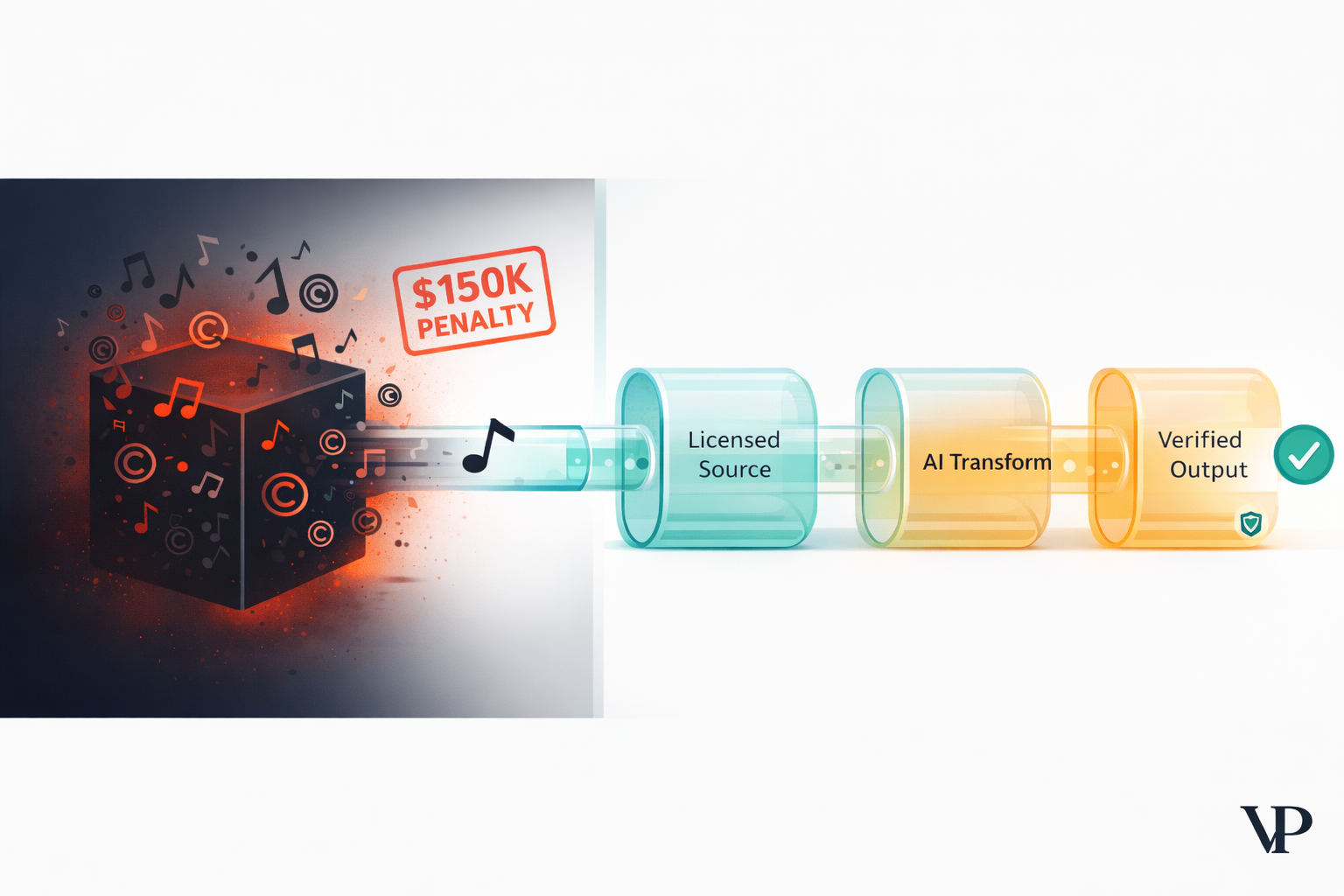
Every major record label is suing the two most popular AI music generators. If your company used either one to create content, you may already be exposed.
The Recording Industry Association of America (RIAA) has filed landmark lawsuits against Suno and Udio—the two leading AI music platforms—alleging they illegally scraped millions of copyrighted songs to train their models. The statutory damages? Up to $150,000 per work infringed. And the legal theory isn't just targeting the platforms. It's targeting anyone who built commercial content on top of them.
This isn't a niche legal dispute. It's a structural reckoning with how AI-generated audio works, who owns it, and whether enterprises can trust "black box" AI music tools in their production pipelines. Our team has spent the past year building what we believe is the alternative: a sovereign audio architecture that delivers AI-transformed music with full copyright clearance, cryptographic provenance, and zero reliance on scraped training data. We published our full technical methodology in our detailed research whitepaper, but this article breaks down the core problem—and the engineering solution—for anyone running a media operation.
The "Prompt and Pray" Problem
When you type "make an upbeat pop song" into Suno or Udio, the AI doesn't compose music from nothing. It reconstructs statistical patterns it learned from copyrighted recordings.
These models work by converting songs into visual representations called spectrograms—essentially heat maps of sound frequencies over time—and then learning the mathematical relationships between millions of them. When the RIAA alleges that these platforms captured the "expressive features" of specific artists, they mean something precise: the model learned that a specific pattern of frequency modulation in the 2kHz–4kHz range correlates with, say, Mariah Carey's vocal style. It quantified her singing into a mathematical probability.
The model isn't "inspired by" copyrighted music. It's decompressing it from noise.
The underlying technology—called a diffusion model—literally works by learning to reverse the process of adding static to a song. Take a clean recording, add noise until it's pure static, then train the AI to reverse that process guided by a text prompt. If the prompt is specific enough, the output converges on something dangerously close to the original copyrighted work. That's not creation. It's reconstruction.
For consumer use, this might be a curiosity. For enterprise use—ad campaigns, game soundtracks, branded content—it's a liability time bomb.
Your Indemnification Clause Probably Won't Save You
Most enterprise teams assume their paid subscription covers them. It doesn't.
We reviewed the terms of service for major generative audio platforms and found significant gaps. Many include clauses that disclaim liability if the user's prompt "causes" the infringement. Typing "in the style of [Artist]" effectively shifts the legal burden back to you. The platform's argument: "We provided the tool; you provided the infringing instruction."
It gets worse. Many of these AI startups have limited capital reserves compared to the damages being demanded. Even if they offer indemnification on paper, they may not be solvent enough to honor it in a mass-tort scenario involving thousands of infringed works.
The Udio settlement with Universal Music Group illustrates another trap. As part of the deal, users of the original platform reportedly cannot download or export their creations—the content is locked in a walled garden. An ad agency can't use a jingle if it's trapped on a website and can't be exported for broadcast. Every piece of content created on that platform before the settlement became commercially useless for off-platform applications overnight.
If you built enterprise workflows on a legally unstable AI platform, you didn't save money on music licensing. You deferred the cost—with interest.
Can You Even Copyright AI-Generated Music?
This is the question most teams never think to ask. And the answer, right now, is probably no.
Copyright offices in the US and EU have increasingly ruled that purely AI-generated works are not copyrightable. To claim copyright, there must be "sufficient human authorship." Courts have indicated that typing a prompt—"make a jazz song"—doesn't qualify. It's an idea, not an expression.
The practical consequence is devastating: if your company uses a black box generator to create a jingle, you likely don't own the copyright to it. A competitor could take that exact jingle and use it in their own advertising. You'd have no legal recourse.
This creates a paradox. You're paying for a tool that generates content you can't legally own, built on training data the tool's creator may not have legally acquired, with indemnification that may not hold up in court. Three layers of risk, zero layers of protection.
What We Built Instead: Transform, Don't Generate
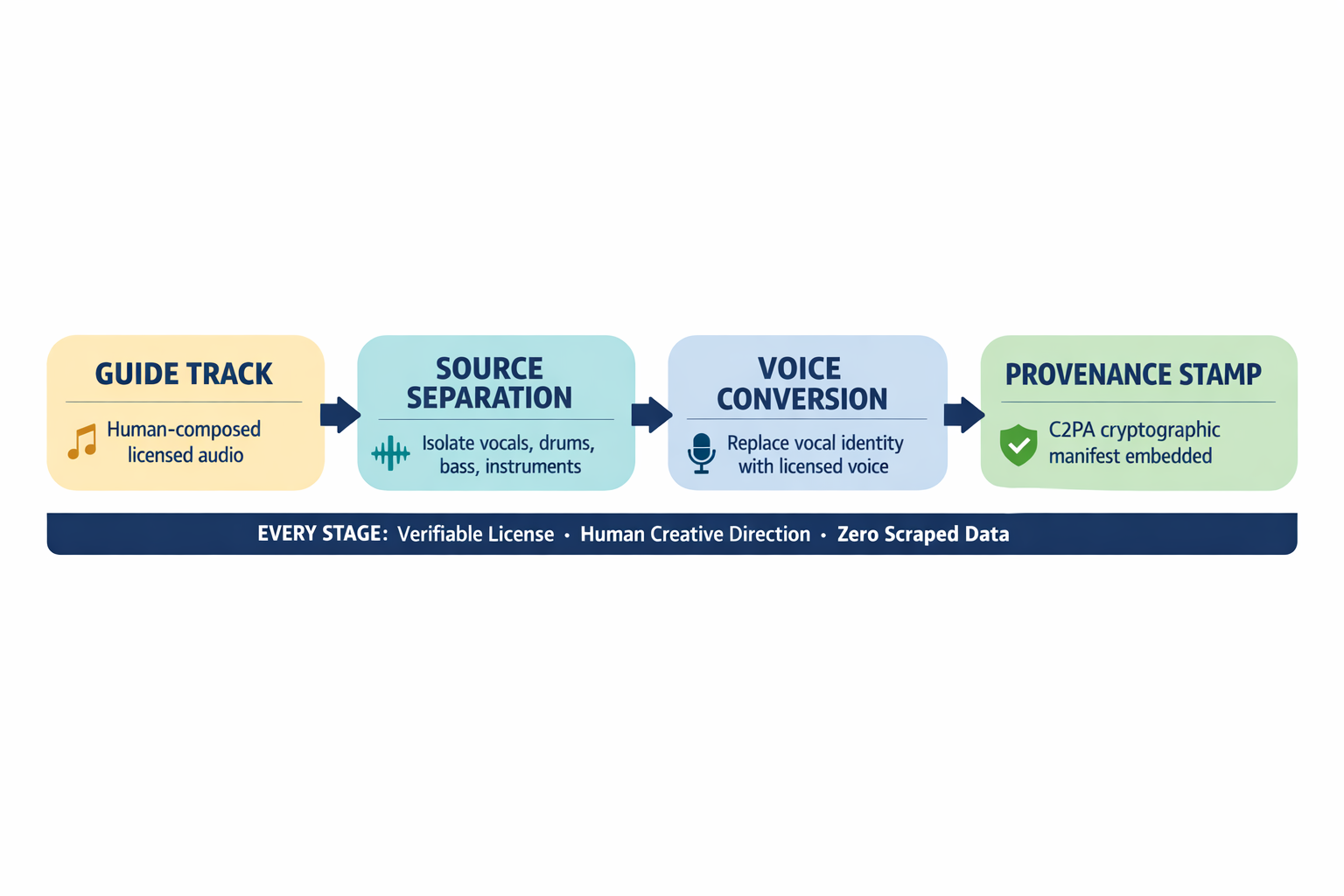
Our approach starts from a fundamentally different premise. Instead of asking an AI to hallucinate music from a latent space of scraped recordings, we use AI to transform licensed audio assets in predictable, auditable ways.
We call this a Source-Separated Licensing Engine. It works in four phases, and every phase maintains a clear chain of copyright ownership.
The process begins with a human-created "guide track"—a rough demo, a licensed stock track, or a legacy catalog recording. This is the creative input, and the client owns or licenses it. AI never makes the compositional decisions. A human does.
Next, we use Deep Source Separation to take that mixed recording and isolate its individual components: vocals, drums, bass, and other instruments. Think of it like reverse-engineering a smoothie back into its individual fruits. The AI identifies which sound frequencies belong to which instrument—even when they overlap—and separates them into clean individual tracks called stems. We run the audio through multiple separation models simultaneously and average the results to minimize artifacts, a technique that produces studio-quality isolation.
Then comes the transformation that makes this commercially powerful. Using a technology called Retrieval-Based Voice Conversion (RVC), we can change who is singing without changing what they're singing. The system strips the original singer's vocal identity from the performance—preserving melody, rhythm, lyrics, and emotion—and replaces it with the voice of a licensed performer from our curated voice bank.
We don't generate audio from nothing. We transform licensed assets with licensed tools. Every artifact in the signal chain has a verifiable, licensable origin.
Finally, the converted vocals are mixed back with the instrumental stems, mastered, and stamped with C2PA Content Credentials—a cryptographic standard that embeds the complete history of the file. Who created the source material, which AI tools processed it, which licensed voice model was applied. It's a digital chain of custody that travels with the file forever.
We explored this architecture in depth in our interactive analysis, including the specific neural network architectures and licensing frameworks involved.
Why Voice Conversion Is Legally Clean When Generation Isn't
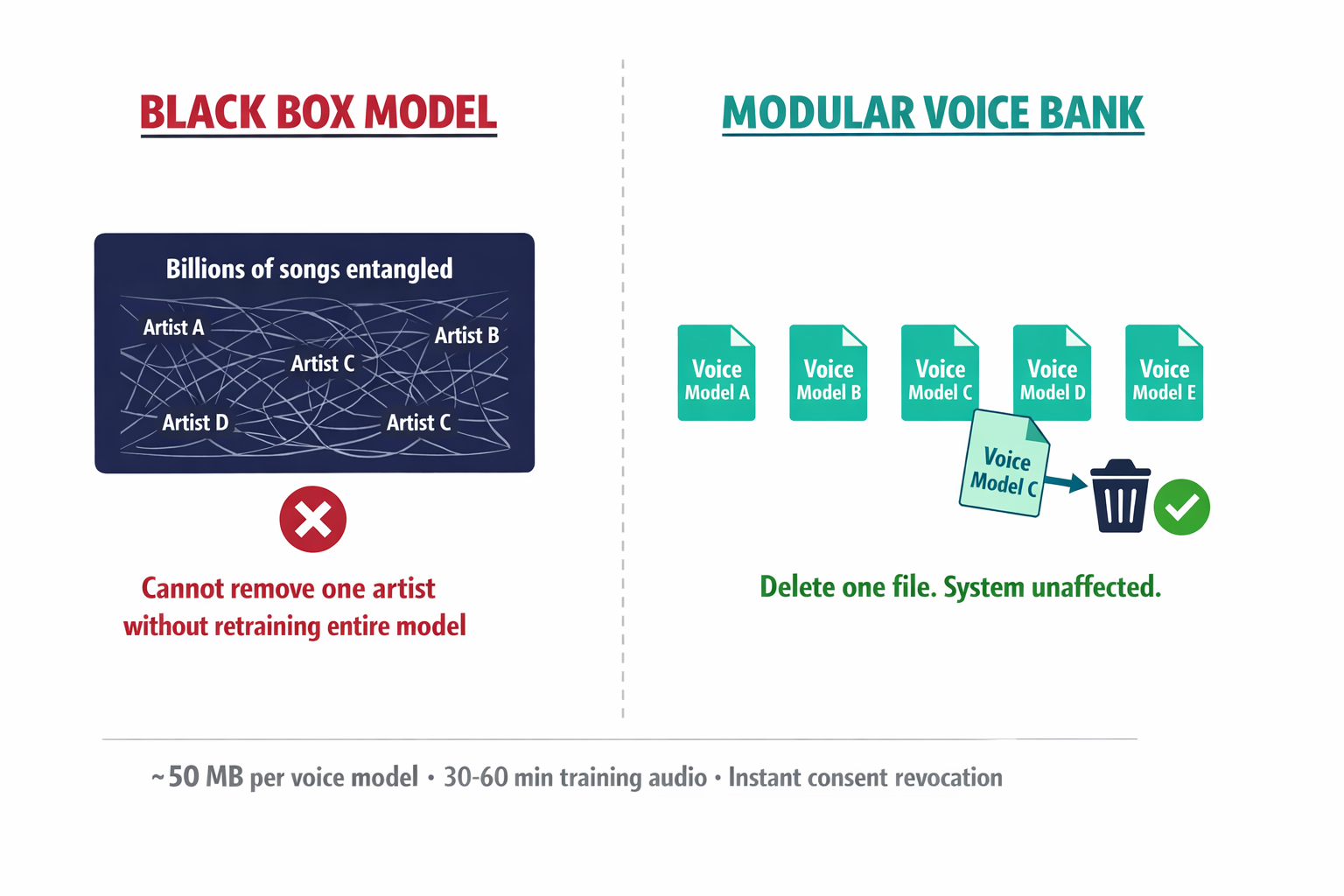
The legal safety of our approach comes down to one word: modularity.
A black box model like Suno requires billions of copyrighted songs to learn what "music" sounds like. An RVC voice model needs only 30 to 60 minutes of clean audio from a single speaker. We commission voice actors to provide high-quality singing data under commercial release agreements. Each actor becomes a separate model file—roughly 50 megabytes—that encapsulates their unique vocal identity.
This modularity solves a problem that plagues large AI models: consent revocation. In a massive transformer model trained on millions of songs, removing a specific copyrighted work is technically nearly impossible without retraining the entire system from scratch—a process that risks destroying the model's capabilities entirely. Researchers call this "catastrophic forgetting."
In our architecture, if a voice actor revokes consent or a contract expires, we delete one file. The rest of the system—every other voice model, the separation engine, the mixing pipeline—remains completely unaffected. Instant compliance with "right to be forgotten" requests, no retraining required.
The Provenance Layer: A Digital Nutrition Label for Audio
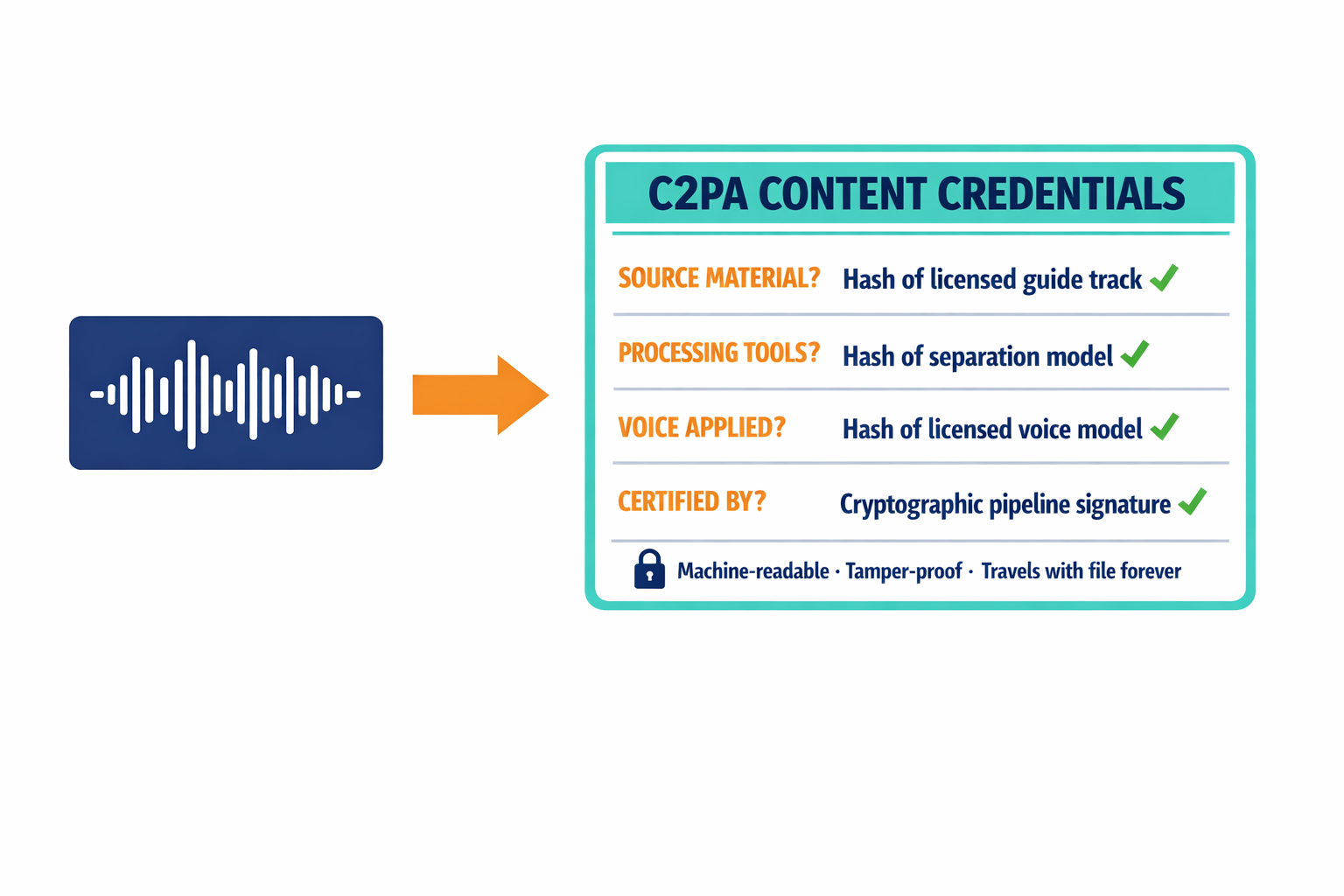
Regulation is coming fast. The EU AI Act will demand transparency about training data. Potential US legislation is moving in the same direction. We designed our system to be regulation-ready from day one.
Every file we export contains a C2PA manifest—a cryptographically signed header that answers four questions:
What was the source material? (A hash of the licensed guide track)
What tools processed it? (A hash of the separation model)
Whose voice was applied? (A hash of the specific licensed voice model)
Who certifies this pipeline? (Our cryptographic signature)
If a platform like YouTube or Spotify questions the copyright status of a track, the client presents the C2PA manifest as definitive, machine-readable proof of authorized creation. No ambiguity. No "trust us." Cryptographic verification.
In an era of synthetic media, provenance isn't a feature. It's the product.
What About Cost? And What About Creative Quality?
Two objections come up consistently when we present this architecture.
The first is cost. Training on scraped data is free. Licensing training data and commissioning voice actors introduces real upfront expense. But the comparison isn't "free vs. expensive." It's "uncapped liability vs. capped cost." Statutory damages of $150,000 per infringed work, multiplied across a catalog of generated content, can dwarf any licensing budget. The math isn't close.
The second objection is creative quality—the assumption that "real" generative AI produces more interesting, more surprising output than transformation-based approaches. In practice, we've found the opposite. Because our clients start with a human-composed guide track and make deliberate choices about voice, arrangement, and instrumentation, the output reflects genuine creative intent. Black box generators optimize for statistical averages—the most probable next note given the training data. That's how you get music that sounds impressive for five seconds and generic for five minutes.
The deeper issue is ownership. A track generated by a black box may sound good, but you probably can't copyright it, you can't prove it doesn't infringe, and you can't guarantee it won't be locked in a walled garden next year when the next settlement lands. A track produced through our pipeline has clear copyright lineage, cryptographic provenance, and no dependency on any third party's legal battles.
What This Means for Your Team
The lawsuits against Suno and Udio aren't the end of AI audio. They're the end of the unregulated phase. What comes next will reward companies that built on clean foundations and punish those that treated copyright compliance as someone else's problem.
If your organization produces commercial audio content—ads, games, podcasts, branded media—three things are worth doing now:
Audit your AI supply chain. Do you know what training data your tools were built on? If the answer is "no" or "probably scraped," that's a risk your legal team needs to evaluate.
Demand provenance. Any AI audio tool you use should be able to produce a verifiable record of where every component of the output came from. If it can't, you're operating blind.
Separate creation from generation. The strongest copyright claims come from human-directed creative decisions augmented by AI tools—not from typing a prompt and hoping for the best.
The wild west phase of generative audio was exciting. It was also unsustainable. The companies that thrive in the next phase will be the ones that traded the magic of hallucination for the certainty of engineering.
If your team is navigating this transition, we'd welcome the conversation. The problems are real, but so are the solutions.