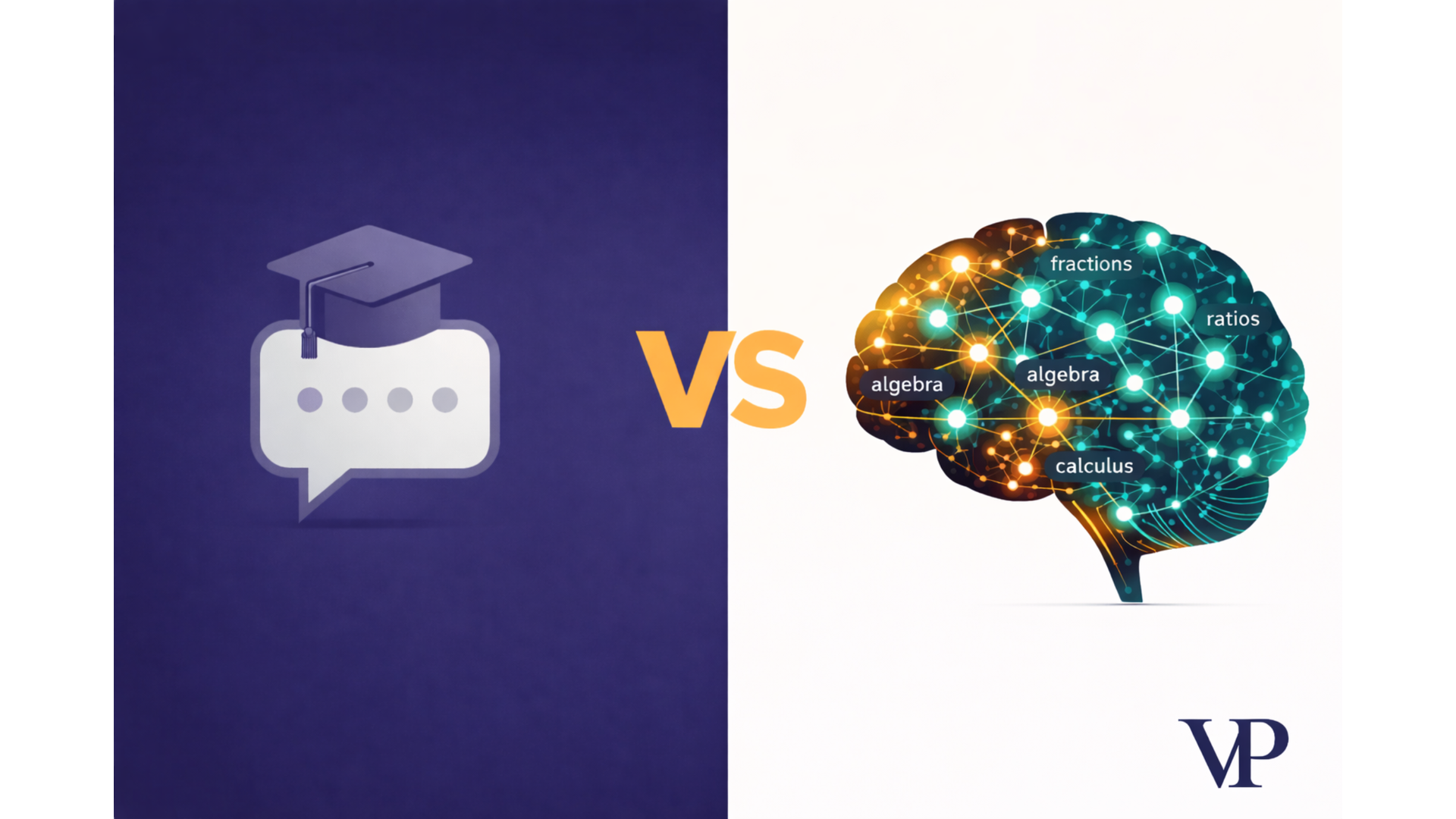
Most "AI tutors" don't actually know anything about the student they're teaching. They don't remember that you bombed fractions last month. They can't predict that you'll struggle with ratios today because of it. They generate a plausible-sounding explanation, and then they forget you exist.
We've spent the past year studying why educational AI keeps failing learners — and the answer isn't what most people expect. The problem isn't the language model. It's the absence of something far more fundamental: a persistent model of what each student actually knows. The field calls this Deep Knowledge Tracing, and it's the difference between a chatbot that roleplays as a teacher and a system that genuinely teaches.
The Wrapper Problem: A Teacher Costume on a Chatbot
The current wave of "AI-powered" education tools follows a depressingly common pattern. Take a large language model like GPT-4 or Claude. Wrap a nice interface around it. Add a system prompt that says "act like a supportive math tutor." Ship it.
These wrapper applications can sound remarkably like a teacher. They use encouraging language, ask Socratic questions, and explain concepts with impressive fluency. But fluency isn't pedagogy.
A chatbot knows what you just typed. A mentor knows what you've been struggling with for three months.
The core limitation is statelessness — the model has no memory of the learner beyond the current conversation window. A student's learning journey spans months or years, involving thousands of micro-interactions. But the AI treats every session as if the student just walked in the door. It can't connect an algebra misconception from October to a calculus failure in January because it has no structured, persistent model of that student's knowledge.
Our research found three specific failure patterns. First, LLMs frequently provide correct final answers through incorrect intermediate reasoning steps — or flag correct student work as wrong. A novice learner can't tell the difference between a valid explanation and a confident hallucination. Second, the "act like a teacher" prompt controls tone, not strategy. It simulates a persona without the cognitive model needed to make real decisions about what to teach next. Third, every student gets essentially the same experience regardless of their unique knowledge gaps.
For EdTech companies, this creates an uncomfortable strategic reality: if your product's intelligence lives entirely in a prompt that anyone can copy, you've built a commodity, not a product.
What Deep Knowledge Tracing Actually Does
Knowledge Tracing is the machine learning task of modeling what a student knows over time to predict what they'll get right or wrong next. It's been around for decades, but the early approaches were crude.
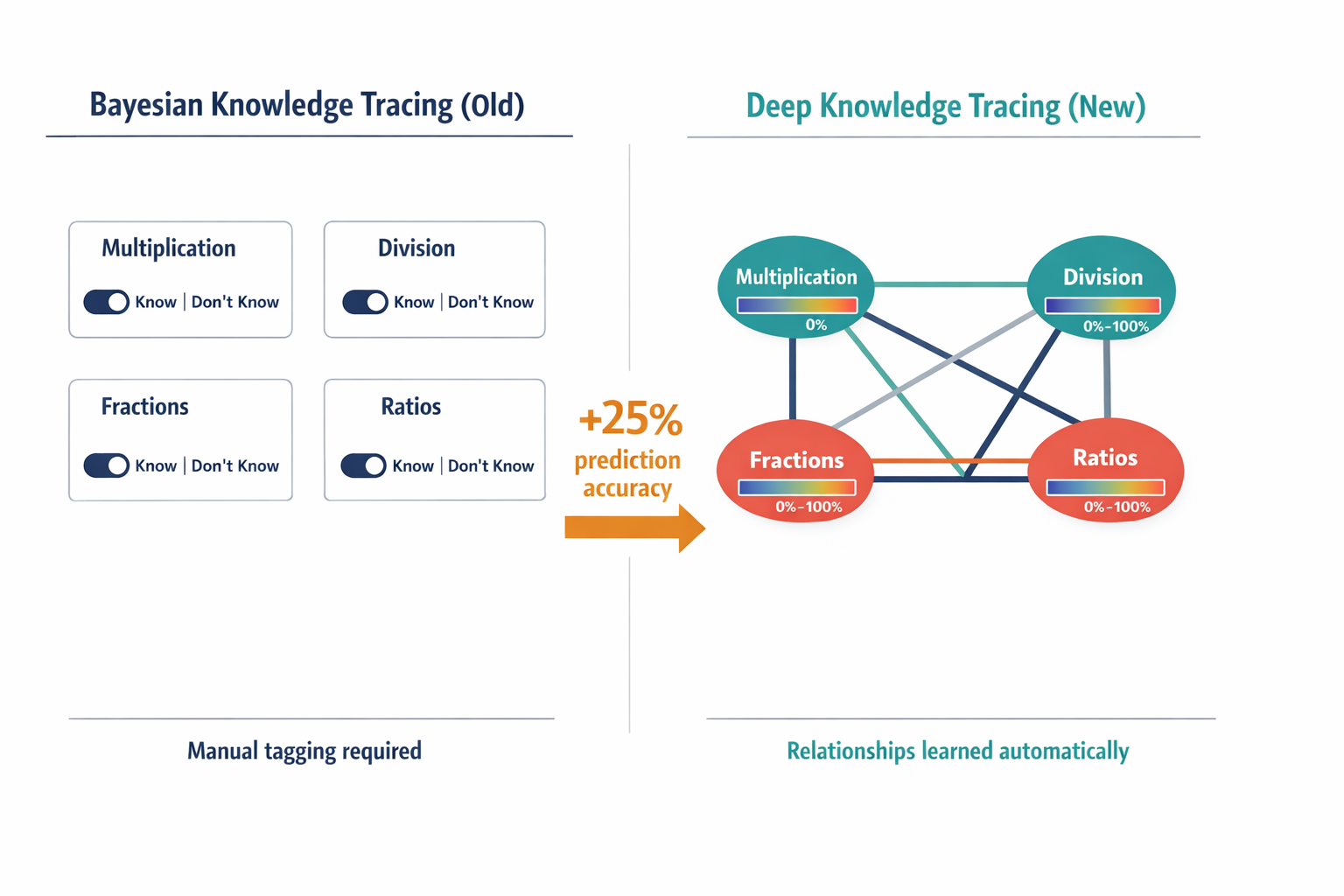
The older method, called Bayesian Knowledge Tracing, treated knowledge as binary — you either "know" something or you don't. It required human experts to manually tag every question with a skill label. And it assumed concepts were independent silos: your understanding of multiplication had no bearing on your understanding of division unless someone explicitly hard-coded that relationship.
Deep Knowledge Tracing, introduced in foundational research by Piech et al. at Stanford, threw out those constraints. Instead of binary labels, it uses a type of neural network called an LSTM — Long Short-Term Memory — to maintain a rich, continuously evolving representation of each student's knowledge. Think of it as a high-dimensional "brain state" that updates with every single interaction.
When a student answers a question, three things happen. The system records the attempt. The neural network updates its internal model based on this new evidence combined with everything it already knows about the student. Then it generates predictions — the probability that this student will answer every other question in the database correctly.
This is profoundly different from a grade book. A grade book records what happened. A brain state predicts what will happen next.
Deep Knowledge Tracing doesn't ask "did the student pass?" It asks "what does the student know right now, and what are they ready to learn?"
The results are striking. In benchmarking studies, DKT models achieved a 25% improvement in predictive accuracy over traditional Bayesian approaches. More importantly, the model discovers relationships between concepts on its own. If students who fail Question A consistently fail Question B, the model encodes that dependency automatically — no human expert labeling required.
Keeping Learners in the Flow Zone
Prediction alone isn't the point. The real power is in what you do with those predictions.
Psychologist Mihaly Csikszentmihalyi identified a state he called Flow — complete absorption in an activity that happens only when challenge and skill are precisely balanced. Too easy, and you're bored. Too hard, and you're anxious. Education researchers call the sweet spot the Zone of Proximal Development: the gap between what a learner can do alone and what they can do with the right guidance.
In a traditional classroom or a standard chatbot, finding this zone is guesswork. With Deep Knowledge Tracing, it's arithmetic.
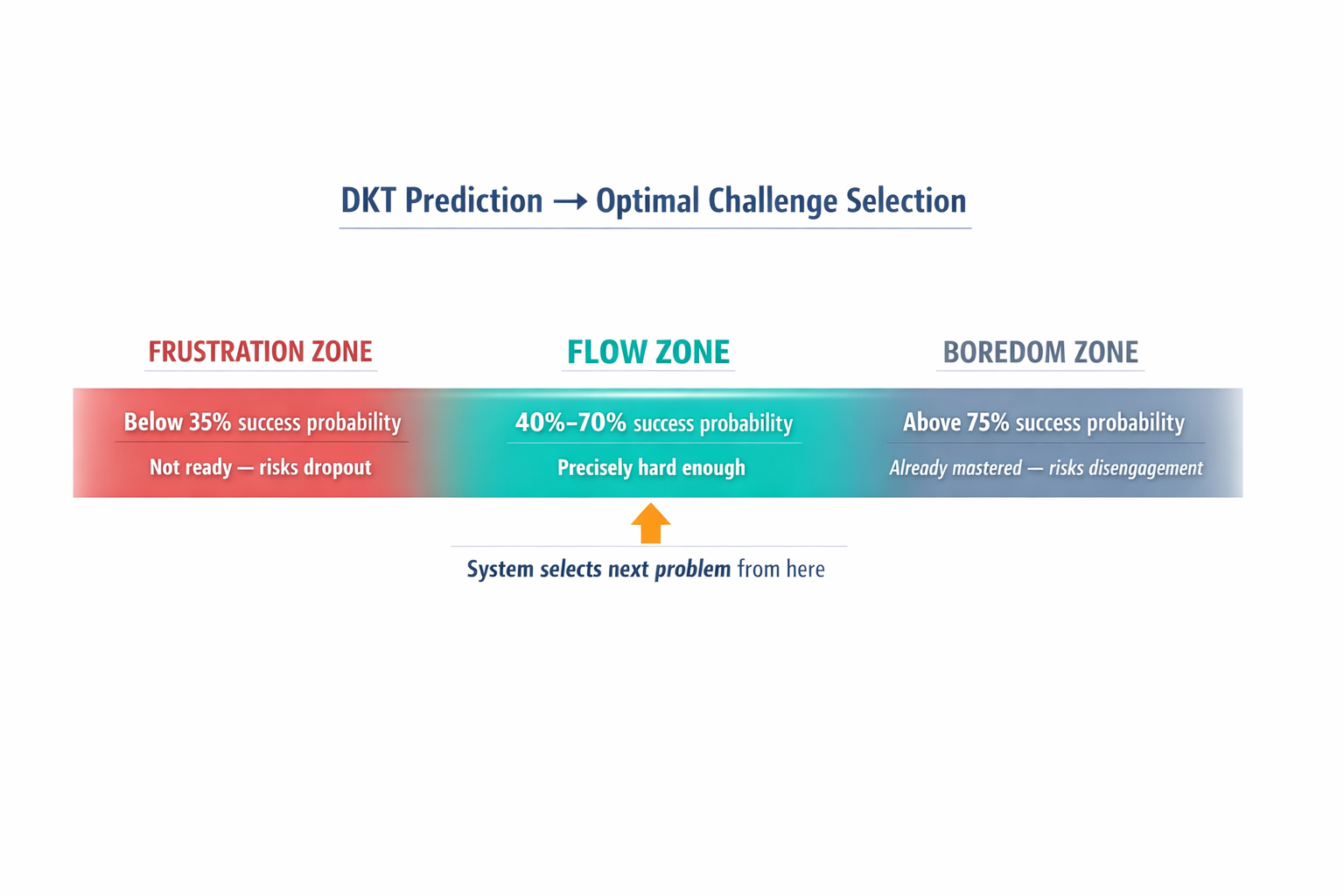
The model's prediction vector tells you the probability of each student getting each possible question right. We map those probabilities directly to psychological states:
Above 75% probability of success: The student has already mastered this. Serving it risks boredom.
Below 35% probability: The student isn't ready. Pushing this risks frustration and dropout.
Between 40% and 70%: The student has enough foundation to attempt the problem but needs real cognitive effort to succeed. This is the Flow Zone.
The system then selects the next problem from that zone — every time, for every student, automatically. If a student stumbles, the model adjusts in real time, serving simpler scaffolding content to rebuild confidence before returning to complexity. If they surge ahead, the difficulty rises to match.
The goal isn't to make learning easy. It's to make it precisely hard enough.
This is what we mean by Dynamic Difficulty Adjustment — a curriculum that reshapes itself around each learner in real time, not a fixed path that every student walks regardless of where they actually are.
The Architecture: How a Chatbot Becomes a Mentor
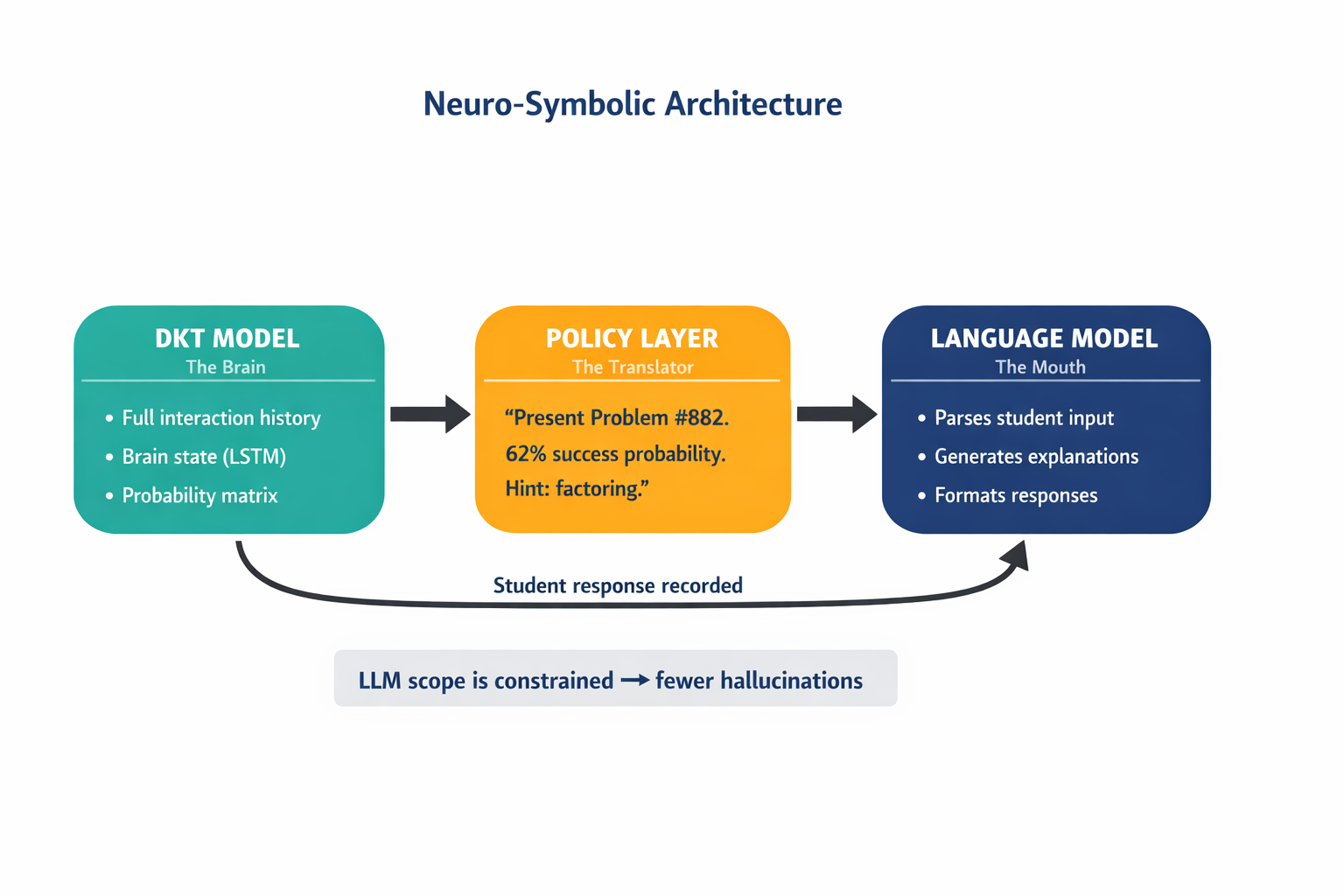
Making this work requires something we call a neuro-symbolic architecture — a system where the language model and the knowledge-tracing model each do what they're best at, and neither tries to do the other's job.
The language model handles conversation. It parses what the student says, generates explanations, and formats responses in natural language. But — and this is critical — it doesn't decide what to teach. It's the mouth, not the brain.
The DKT model handles cognition. It processes the full history of interactions, maintains the brain state, and outputs the probability matrix for every concept in the curriculum.
A policy layer sits between them, translating the brain's analysis into specific instructions for the mouth. Instead of the vague "be a helpful tutor" prompt, the language model receives something like: "The student is in the Flow Zone for linear equations with a 62% success probability. Present Problem #882. Do not reveal the answer. If they hesitate, provide a hint related to factoring."
This constraint actually reduces hallucinations. By narrowing the language model's scope to a specific, verified exercise chosen by the DKT model, we shrink the space where the AI can go wrong. It's not freestyling an explanation about whatever the student asks — it's executing a precise pedagogical move.
For the full technical methodology behind this architecture, including our approach to cold-start problems and transfer learning, see our detailed research.
The Business Case: Why This Matters Beyond the Classroom
For EdTech companies and corporate L&D teams, the shift from wrapper AI to Deep Knowledge Tracing isn't academic. It directly impacts the metrics that matter.
Retention and churn. In subscription-based education, people quit for two reasons: boredom (too easy) or frustration (too hard). A system that mechanically keeps learners in the Flow Zone attacks both causes simultaneously. Adaptive tutoring research shows completion rates of 60–80% compared to the 15–20% typical of standard online courses — a difference that translates directly to customer lifetime value.
Training efficiency. In corporate environments, a DKT-powered system identifies mastery instantly and lets employees skip what they already know. Our analysis suggests this can reduce total training time by 40–50%, returning people to productive work faster.
Competitive moat. As language models become commoditized, anyone can build a chat tutor in a weekend. But a DKT system builds a proprietary model of student behavior that improves with every interaction. The more learners use the system, the better it predicts learning trajectories. That data flywheel — the aggregated brain-state intelligence — is an asset no competitor can replicate by calling an API.
What About Students Who Are Brand New to the System?
The obvious objection: if the model needs interaction history to work, what happens with a new student who has no history?
This "cold start" problem is real, and we address it through a combination of approaches. The DKT model is pre-trained on anonymized data from thousands of historical learning traces, establishing a baseline. New users take a brief diagnostic assessment that assigns them to a cluster of similar learners, seeding their brain state with a reasonable starting point. From there, the LSTM is designed to converge rapidly — within roughly 10–20 interactions, the model has diverged from the generic baseline into a genuinely personalized state.
It's not perfect from interaction one. But it's dramatically better than a system that never personalizes at all.
Does This Replace Teachers?
No. And that framing misses the point entirely.
The "2 Sigma" problem in education — Benjamin Bloom's famous finding that one-on-one tutoring produces learning gains two standard deviations above classroom instruction — has been unsolved for forty years because we can't give every student a personal tutor. Deep Knowledge Tracing doesn't replace the tutor. It scales the tutor's most critical skill: knowing exactly where each student is and what they need next.
The language model provides the conversational interface. The knowledge-tracing model provides the pedagogical intelligence. Together, they approximate something that has never been economically viable at scale: a mentor who remembers your struggles, anticipates your gaps, and meets you exactly where you are.
We think the era of "personalized learning" as a marketing buzzword is ending. The era of actually building it is just beginning.
If your team is wrestling with how to move beyond wrapper AI in education or training, we'd welcome the conversation.