Most "AI tutors" on the market right now couldn't tell you what a student struggled with last Tuesday. They don't know. They literally can't — because they're chatbots with a system prompt that says "act like a teacher." That's not personalized learning. That's roleplay.
I've spent the past year obsessed with a question that sounds simple but turns out to be brutally hard: what would it take to build an AI that actually teaches? Not one that generates explanations on demand — any LLM can do that — but one that remembers a student's journey, anticipates where they'll stumble, and adjusts in real time. The gap between those two things is enormous, and almost nobody in EdTech is talking about it honestly.
The Wrapper Problem Nobody Wants to Admit
The EdTech market is flooded with what I call "wrapper" applications. They take GPT-4 or Claude, wrap a nice interface around it, add a prompt like "You are a patient math tutor," and ship it. The AI sounds like a teacher. It uses encouraging language, asks Socratic questions, breaks things into steps.
But it doesn't know the student.
Standard LLMs are stateless. Every conversation starts mostly from scratch. They can't link a misconception in algebra from three months ago to a failure in calculus today, because they have no persistent model of what the learner actually understands. Research on LLMs in math tutoring found something alarming: models frequently provided correct final answers through incorrect intermediate steps, or flagged correct student work as wrong. A beginner can't tell the difference between a valid explanation and a confident hallucination.
A chatbot that sounds like a teacher is not a teacher. A teacher remembers that you struggled with fractions last week — and uses that to help you with ratios today.
I remember the moment this clicked for my team. We were testing a popular AI tutor with a simulated student profile — someone who consistently confused the distributive property with order of operations. The AI gave beautiful, clear explanations every single time. And every single time, it explained as if it had never met this student before. There was no accumulation of understanding. No strategy. Just a fresh, stateless response to each question.
That's when we stopped building a better chatbot and started building something fundamentally different.
What Deep Knowledge Tracing Actually Does
Deep Knowledge Tracing (DKT) is a machine learning approach that models what a student knows — and predicts what they'll get right or wrong next — by tracking their entire history of interactions over time.
Think of it like this. A traditional grade book tells you a student scored 70% on last week's test. That's a snapshot. DKT maintains something more like a living map of the student's mind — what we call a "Brain State" — that updates with every single interaction. It doesn't just record that you got Question 42 wrong. It encodes why that matters: which related concepts are probably shaky, which skills are solid, and where you're likely to stumble tomorrow.
The technology underneath is a type of neural network called an LSTM (Long Short-Term Memory), which is specifically designed to track patterns across long sequences. It's the same family of architecture that powers speech recognition and language translation — problems where context from far in the past matters for what's happening right now.
Older approaches to knowledge tracing, like Bayesian Knowledge Tracing, treated knowledge as binary: you either know something or you don't. And each concept lived in its own silo — understanding multiplication was treated as completely independent from understanding division unless a human expert manually connected them. DKT throws both of those assumptions away. It learns the hidden structure of a curriculum from raw data, captures partial mastery, and — critically — models forgetting. If you haven't practiced a skill in two weeks, the system knows your grip on it has loosened.
In benchmark testing, DKT showed a 25% improvement in predictive accuracy over traditional Bayesian methods. That's not an incremental gain. That's the difference between guessing and knowing.
The Flow Zone: Why the Right Level of Difficulty Changes Everything
Tracking what a student knows is only half the problem. The real question is: what do you do with that information?
The answer comes from psychology, not computer science. Mihaly Csikszentmihalyi's research on "flow" — that state of complete absorption where you lose track of time — showed it only happens when the challenge in front of you closely matches your current skill level. Too easy, and you're bored. Too hard, and you're anxious. Either way, you quit.
People don't drop out of learning platforms because the content is bad. They drop out because the content is wrong for them — too easy or too hard at that specific moment.
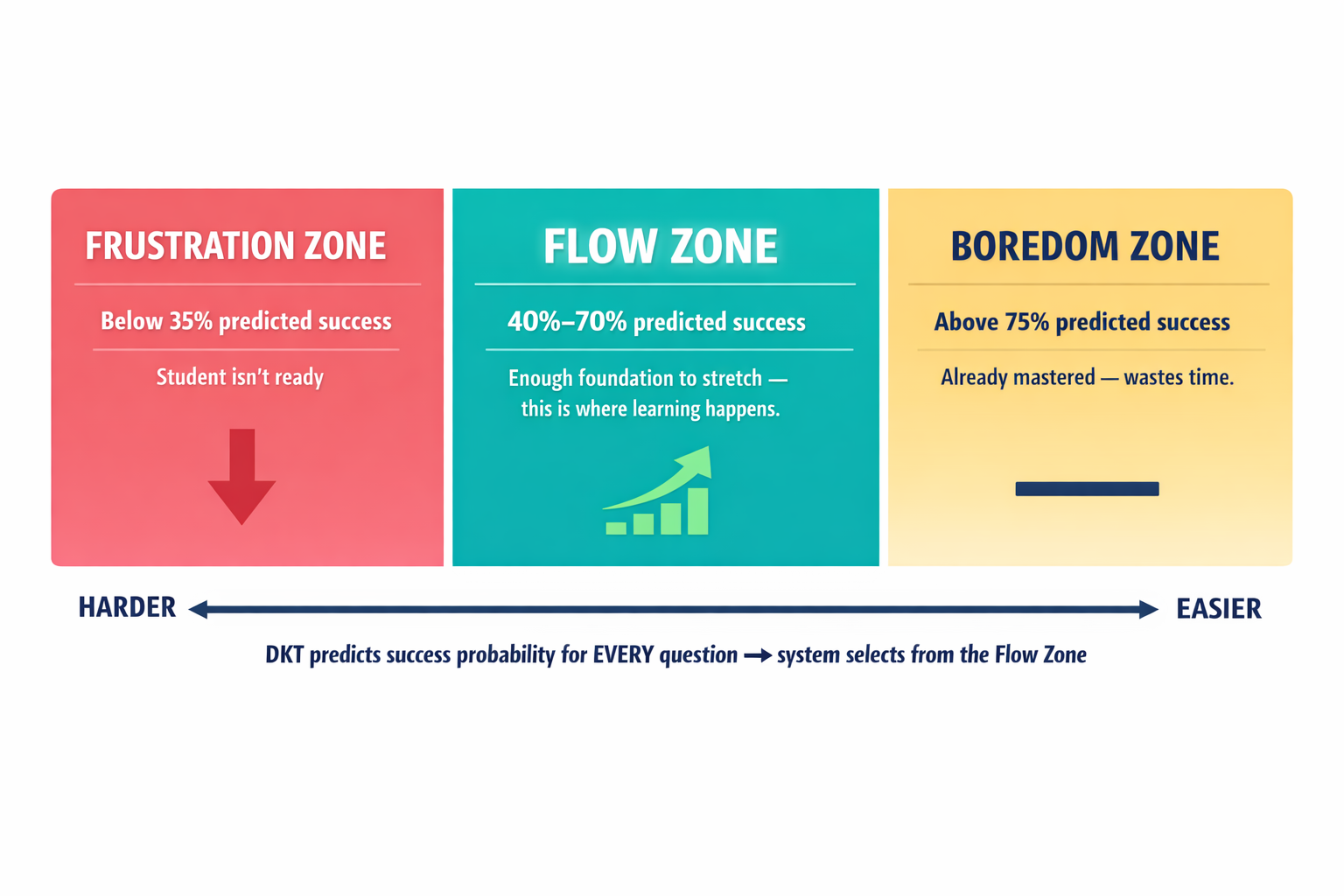
This is where DKT becomes genuinely powerful. The model doesn't just predict whether a student will get a question right — it generates a probability for every question in the database. We can map those probabilities directly to psychological states:
Above 75% chance of success: The student has already mastered this. Showing it to them wastes their time and breeds boredom.
Below 35% chance of success: The student isn't ready. Throwing this at them creates frustration.
Between 40% and 70%: This is the sweet spot. The student has enough foundation to attempt the problem but has to stretch to solve it. This is where actual learning happens.
We use this to drive what's called Dynamic Difficulty Adjustment. Instead of every student marching through the same linear curriculum, the system continuously selects the next problem that keeps each individual learner in that productive zone. If someone struggles, the difficulty drops automatically — not to the beginning, but to exactly the right remedial concept. If they're cruising, it pushes them further.
I explored this architecture in depth in our interactive analysis of educational AI, including how the probability thresholds map to Vygotsky's Zone of Proximal Development.
How the Pieces Fit Together
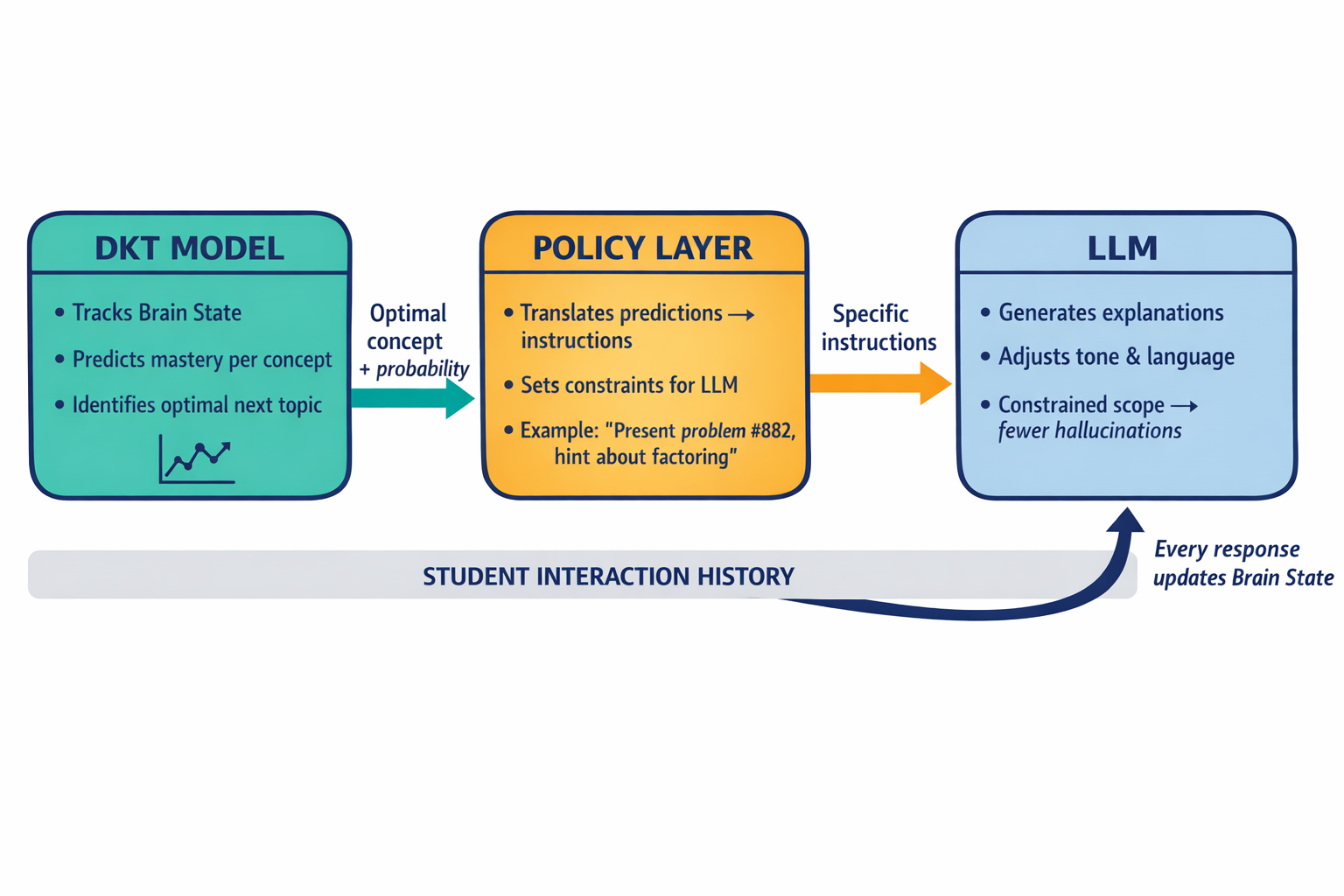
Building something that talks like a teacher and thinks like a data scientist requires a specific kind of architecture. We call ours neuro-symbolic — a hybrid that combines the conversational ability of large language models with the cognitive precision of Deep Knowledge Tracing.
The LLM handles language. It parses what the student says, generates clear explanations, adjusts tone. But it doesn't decide what to teach. That decision comes from the DKT model, which maintains the Brain State and identifies the optimal next concept. A policy layer sits between them, translating the DKT model's output into specific instructions for the LLM: "The student is in the flow zone for linear equations. Present problem #882. Don't reveal the answer. If they hesitate, give a hint about factoring."
This constraint is actually what makes the system more reliable. By narrowing the LLM's scope to a specific, verified exercise chosen by the DKT model, we dramatically reduce hallucinations. The language model isn't freestyling about math — it's explaining a particular problem that the cognitive model has already validated as appropriate.
Restricting what the LLM talks about doesn't make it less useful. It makes it trustworthy.
One challenge we had to solve early: the cold start problem. When a new student shows up, you have zero interaction history. No Brain State to work with. We handle this through transfer learning — pre-training the model on anonymized data from thousands of learning traces, then assigning new users to a learner cluster based on an initial diagnostic. Within 10 to 20 interactions, the model diverges from the generic baseline into a genuinely personalized state. It's not perfect on day one, but it converges fast.
The Business Case That Surprised Me
I expected the strongest argument for DKT to be learning outcomes. It is — adaptive tutoring research consistently points to what's known as the "2 Sigma" effect, where personalized instruction roughly doubles learning gains compared to standard classroom teaching. But the argument that resonates most with the EdTech executives and L&D leaders I talk to is actually about retention and efficiency.
In subscription-based education products, completion rates for standard online courses hover around 15-20%. Adaptive systems push that to 60-80%. The reason isn't better content — it's better calibration. Students stop quitting because the experience stops being either boring or overwhelming.
In corporate training, the metric that matters is time to proficiency. A DKT-powered system identifies what an employee already knows (predicted correctness above 90%) and skips it entirely, focusing only on genuine knowledge gaps. Early data suggests this can cut total training time by 40-50% — returning people to productive work faster.
And then there's the strategic moat. When your core intelligence is a system prompt, any competitor can replicate your product in a weekend. When your core intelligence is a proprietary model of student cognition trained on millions of interactions, you have something that gets more valuable over time and can't be cloned through an API. For the full technical methodology behind this architecture, including the LSTM gating mechanisms and flow calibration approach, we've published a detailed research paper.
What About Students Who Don't Fit the Model?
A fair objection: not every learner behaves predictably. Some students guess randomly. Some have test anxiety that makes their performance inconsistent with their actual knowledge. Some learn in bursts after long plateaus.
This is actually where DKT's continuous, high-dimensional representation shines compared to older binary models. The Brain State isn't a simple "knows it / doesn't know it" flag — it's a dense vector with hundreds of dimensions that can encode exactly these kinds of nuances. A student who consistently gets the right answer slowly (high latency, high accuracy) looks different in the model than one who answers quickly but inconsistently. The LSTM's forget gate handles plateaus naturally — it learns which signals to preserve and which to let decay.
Is it perfect? No. We're still improving how the model handles genuinely erratic interaction patterns. But it's orders of magnitude better than a chatbot that starts fresh every session.
What This Means If You're Building in EdTech
If you're building or buying educational technology right now, ask one question: does this system maintain a persistent, evolving model of what each learner knows?
If the answer is no — if the "personalization" is just prompt engineering on top of a general-purpose LLM — you're building on sand. The technology will sound impressive in demos and fail quietly at scale, because it can't do the one thing that actually matters: remember the student.
The hard work of educational AI isn't generating explanations. LLMs solved that. The hard work is knowing which explanation to give, when to give it, and what to do when the student still doesn't get it. That requires a cognitive architecture underneath the language model — one that tracks, predicts, and adapts.
We've been building that architecture at Veriprajna, and I'm genuinely curious how others are approaching this problem. If you're working on adaptive learning — whether in K-12, higher ed, or corporate training — I'd love to hear what's working and what isn't.