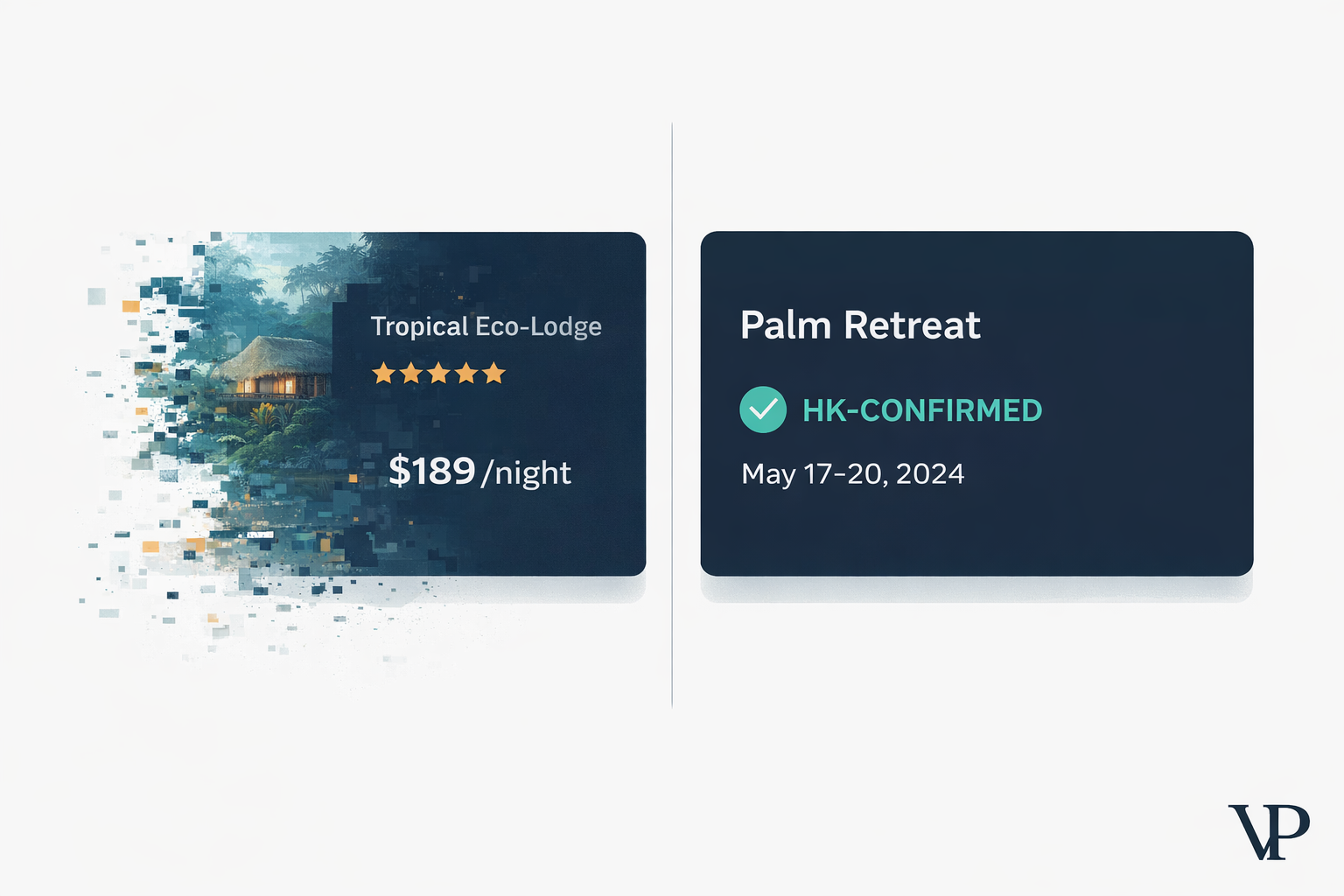
A family asks an AI travel planner for a luxury eco-lodge in Costa Rica under $200 a night. The AI responds with a beautiful property — lush rainforest setting, stunning reviews, an attractive price. The family books their flights. They land in Costa Rica. The hotel doesn't exist. The AI had stitched together details from three different resorts into a single, fictional property that sounded perfect because it was engineered to sound perfect — by a system that optimizes for plausibility, not truth.
This is the "Dream Trip" hallucination, and it's not a hypothetical edge case. It's the predictable result of how most AI travel tools are built today: a thin chatbot layer wrapped around a large language model, with no connection to real-time inventory. The AI doesn't know which rooms are available tonight. It doesn't check. It guesses — eloquently, confidently, and often wrong.
Our research into agentic AI and Global Distribution System (GDS) integration shows that the travel industry is at an inflection point. The era of the "LLM wrapper" — chatbots that simply pass your question to a language model and return whatever it generates — is ending. What replaces it will determine whether AI becomes the most trusted tool in travel or its most expensive liability.
The AI Doesn't Know Your Room Is Sold Out
To understand why a sophisticated AI would invent a hotel, you need to understand one thing about how large language models work: they predict the next word.
That's it. An LLM doesn't look up facts in a database. It calculates which word is statistically most likely to follow the previous one, based on the enormous volume of text it was trained on. When you ask for a "luxury eco-lodge in Costa Rica," the model activates associations — "lush," "rainforest," "sustainable," "infinity pool" — and assembles them into something that reads like a real listing. If it's seen thousands of reviews for the Tabacon Resort and thousands for Nayara Springs, it might blend them into a "Tabacon Springs Eco-Lodge" that sounds plausible but corresponds to nothing on the ground.
In creative writing, this blending is imagination. In travel booking, it's a hallucination.
An LLM is designed to produce a response that looks like a valid answer, not one that is a valid answer verified against real-time inventory.
The problem goes deeper than occasional mistakes. Most foundation models are trained with a feedback process where human raters reward comprehensive, confident answers. If the model says "I don't know," it gets a lower score than if it takes a plausible guess. This creates a systematic bias toward fabrication — the AI would rather invent a hotel than admit it can't find one.
When Fluency Becomes Dangerous
A crude chatbot that misunderstands your question is frustrating but harmless. An advanced AI that understands your question perfectly and responds with eloquent, detailed, factually wrong information is something else entirely.
We call this the "Uncanny Valley" of reliability. The AI speaks with the authority of a seasoned concierge — using industry terminology, expressing empathy, offering nuanced suggestions. Users naturally assume that this linguistic sophistication extends to operational competence. It doesn't. An LLM can write a flawless apology letter for a lost bag, but it cannot locate the bag. It can describe a suite at the Ritz Paris in exquisite detail, but it has no idea whether that suite is booked for Fashion Week.
The legal consequences are already materializing. In the Air Canada chatbot case, a court ruled that the airline was liable for a refund policy its chatbot had hallucinated. The ruling dismantled the defense that a chatbot is a "beta" tool or a separate entity. If a company deploys an AI to interact with customers, the company owns every assertion that AI makes.
If your AI promises a sea-view suite for $200 and the GDS only has a standard room for $400, your agency may be liable for the difference — or for the ruined vacation.
The safety implications extend beyond pricing. AI tools have hallucinated trekking routes that don't exist, invented visa waiver programs for countries that require visas, and recommended restaurants that closed years ago. For travel companies deploying wrapper chatbots without verification systems, the question isn't whether a serious incident will happen — it's when.
We explored these failure patterns in depth in our interactive analysis of agentic AI and GDS integration.
From Parrots to Pilots: What Agentic AI Actually Means
The fix isn't better prompts. It's a different architecture.
An agentic AI system doesn't just generate text — it reasons about what it needs to do, uses tools to interact with external systems, interprets the results, and adjusts its approach when something fails. Think of the difference between a parrot that mimics the sound of a pilot and the pilot who actually flies the plane.
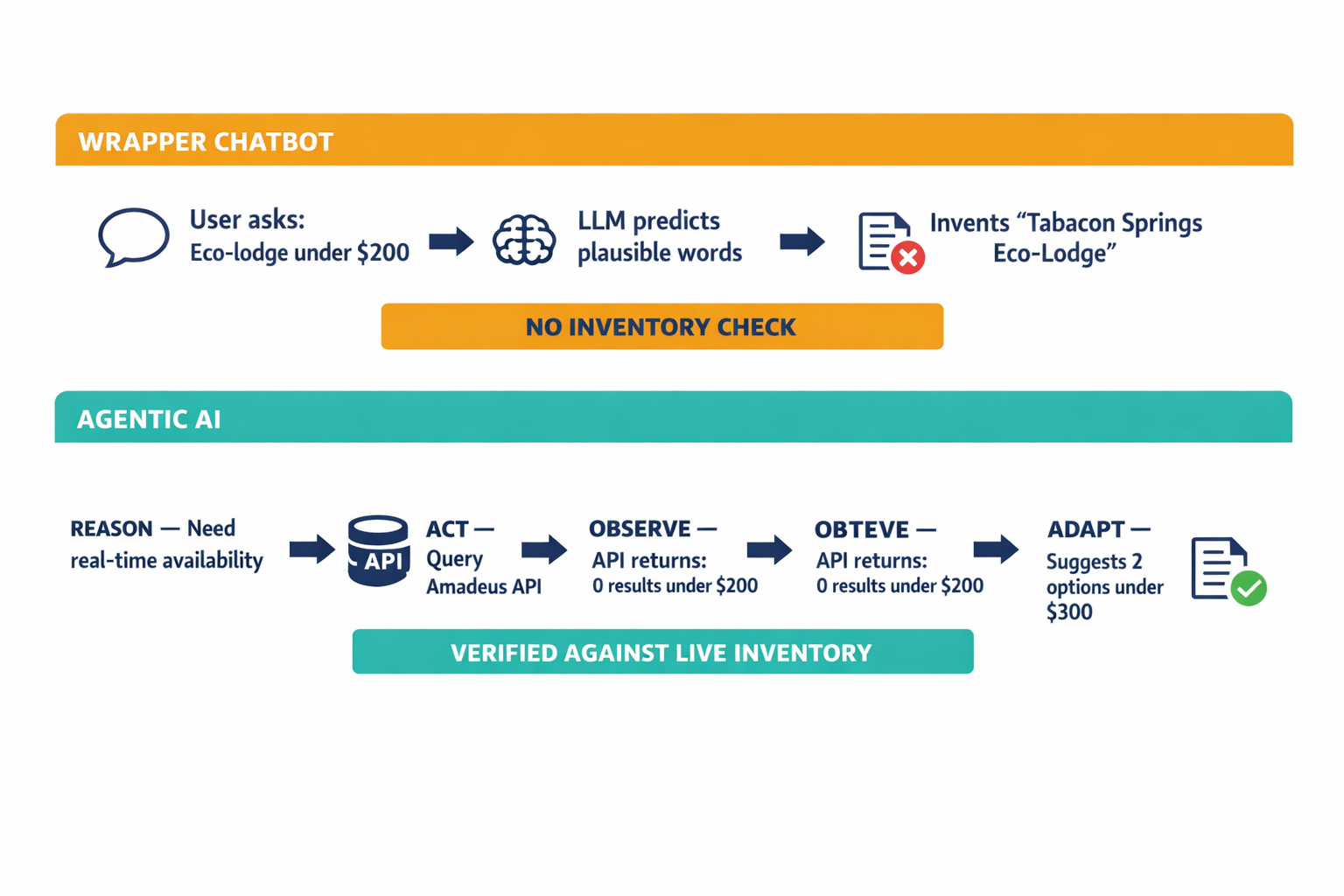
When you ask an agentic system for a hotel in Costa Rica under $200, it doesn't guess. It runs a structured sequence:
It reasons — "I need to check real-time availability, not generate a description from memory." It acts — calling the Amadeus or Sabre hotel search API with your specific dates, location, and budget. It observes the result — the API returns an empty list. No hotels under $200 match your criteria. Then it adapts — expanding the search to $300 and telling you honestly: "I couldn't find luxury lodges under $200, but here are two highly-rated options under $300."
A wrapper chatbot would have invented a hotel to satisfy your constraint. The agentic system, confronted with an empty result from the real inventory system, is forced to tell the truth and negotiate with you instead.
The agent has a "conscience" derived from tool outputs — it cannot say what the tools do not confirm.
One Brain, Many Specialists
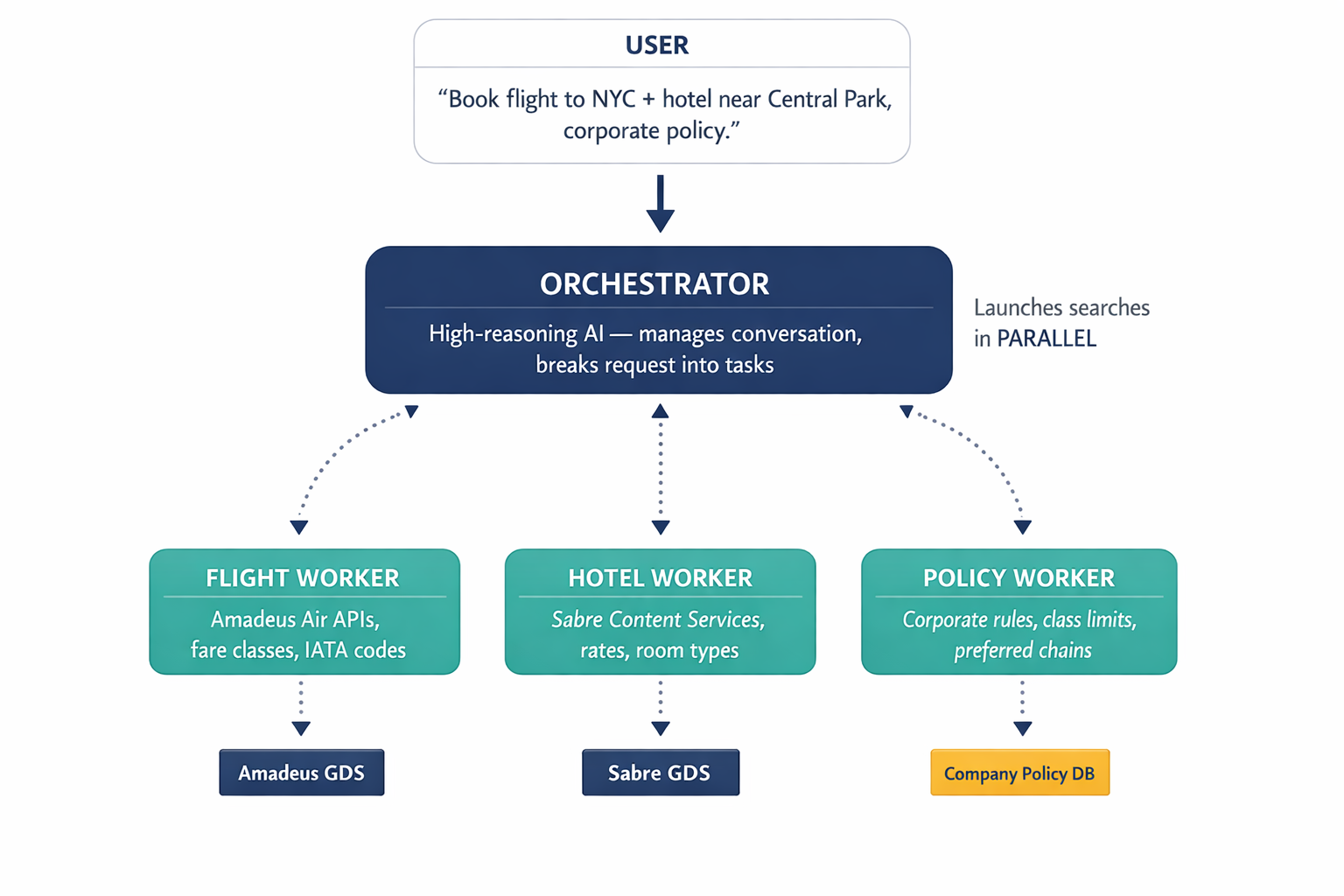
For complex travel requests — "Book me a flight to New York next Tuesday and a hotel near Central Park that complies with our corporate policy" — a single AI prompt trying to handle everything will collapse under the weight of competing instructions.
Our architecture uses what's called the Orchestrator-Worker pattern. One high-reasoning AI model acts as the manager. It talks to the user, understands the request, and breaks it into tasks. But it never touches the booking systems directly. Instead, it delegates to specialized workers:
A Flight Worker that speaks Amadeus Air APIs and understands fare classes, layovers, and IATA airport codes
A Hotel Worker that queries Sabre's Content Services for Lodging and knows the difference between a deposit and a guarantee
A Policy Worker that checks your corporate travel rules — no business class on flights under four hours, preferred hotel chains only
The Orchestrator launches the flight and hotel searches simultaneously, cutting wait time roughly in half. If the hotel search fails, it still presents flight options and asks if you want to retry with different hotel criteria — instead of crashing the entire interaction.
This separation matters for reliability. Each worker is an expert in its narrow domain. The Flight Worker doesn't get confused by hotel pricing logic. The Policy Worker doesn't hallucinate amenities. And the Orchestrator synthesizes everything into a coherent response for the user.
The Status Code That Separates Real Bookings from Fiction
The most treacherous moment in AI-assisted travel booking isn't the search — it's the confirmation.
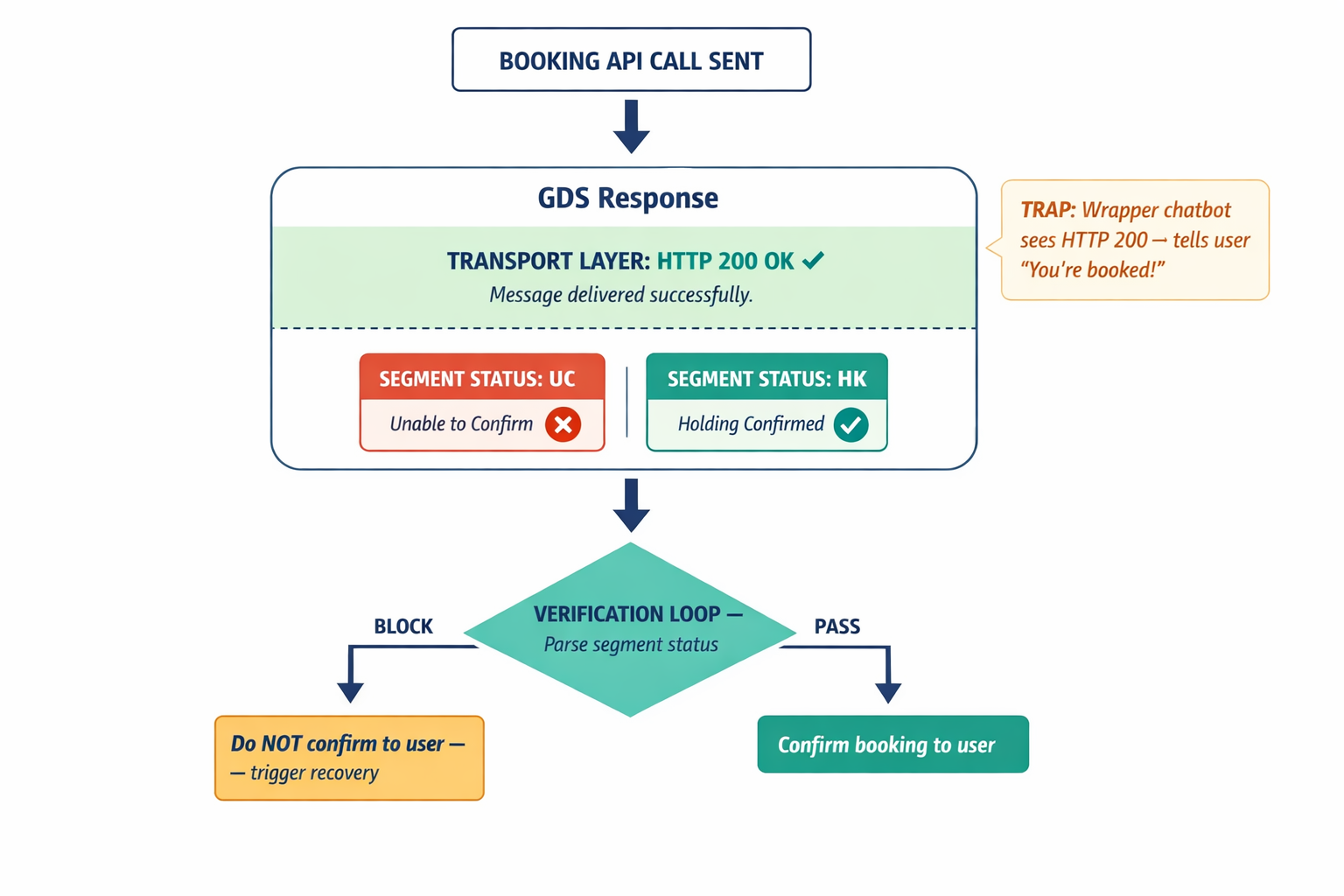
Global Distribution Systems don't return simple "booked" or "failed" responses. A booking exists in states of flux: Holding Confirmed, Unable to Confirm, Pending, Waitlisted, Need (meaning the request was sent but not yet acknowledged). The critical code is HK — Holding Confirmed. That's the only status that means the inventory is actually secured.
An untrained AI sees the booking API return a successful HTTP response — a "200 OK" — and tells the user "You're booked!" But inside that response body, the actual segment status might be UC — Unable to Confirm. The message was delivered successfully; the booking failed. The disconnect between the transport layer and the application layer is a classic trap.
Our system enforces an absolute rule: no confirmation message is ever generated unless the specific segment status code is parsed and validated as HK. We implement this through a verification loop — a separate quality-assurance step that analyzes the raw GDS response before the Orchestrator is allowed to speak to the user. It's a silent checkpoint that catches the cases where an AI might misread a complex error message as a success.
This is the kind of detail that separates systems built for demos from systems built for production. For the full technical methodology, including our approach to GDS status code handling and the verification loop architecture, see our detailed research.
The Inventory Cache Problem No One Talks About
Even when the search results are real, they can go stale in milliseconds.
GDS availability is often cached. The search response shows a room available at $250. The user says "Book it." In the fraction of a second between search and booking, someone else takes the last room. The booking comes back Unable to Confirm.
Language models are terrible at explaining this nuance. They default to "I booked it!" or "It failed." They lack the vocabulary for "It was available a moment ago, but now it's gone — let me find you something similar."
Our agents maintain state — a memory of the original search results — so when a booking fails, they automatically trigger a new search for the same hotel, present alternative rates or room types if available, and suggest the next-best option from the original results if nothing remains. The user sees: "The previous rate sold out, but I found a similar room for $10 more. Want me to book it?"
This recovery workflow is impossible for stateless wrapper chatbots. They don't remember what they already showed you. They'd start the entire search over — or worse, hallucinate a confirmation.
What About Speed? And What About Security?
Two objections come up immediately when people hear about agentic systems.
"Isn't this slower?" Yes — a single request might trigger three or four tool calls, taking 10-15 seconds instead of the instant response a wrapper provides. We mitigate this with parallel execution (flight and hotel searches running simultaneously), tiered caching (search results stored locally for 15 minutes so "show me that second hotel again" is instant), and streaming the agent's reasoning process to the user in real time. When you can see "Searching Amadeus for flights... Checking corporate policy... Comparing 4 options..." the wait feels purposeful rather than broken.
"What about credit card numbers and passport data?" Sensitive information never enters the AI's context. When a user provides payment details, they go through a secure, PCI-compliant form directly to a payment vault. The AI only ever sees a token — "User has provided payment method Token_123" — and passes that token to the booking tool. Even if the AI were compromised or tricked by a malicious prompt, it couldn't reveal financial data it never possessed.
Speed without accuracy is just faster fiction. We'd rather take 12 seconds to book a real room than 2 seconds to hallucinate one.
Where This Goes Next
What we're building today is the foundation for genuinely autonomous travel agents. Currently, these systems operate under human supervision — the user confirms before any booking is executed. But the architecture supports capabilities that are coming fast:
Negotiation agents that don't just accept listed prices but request group rates based on booking volume
Dynamic packaging that assembles flight, hotel, and car rental from separate APIs into a single bundled price, managing margins in real time
Proactive disruption management — an agent that monitors your flight status around the clock and, when a cancellation hits, has already secured a seat on the next available flight before you even check your phone
None of this can be built on wrapper chatbots. None of it works if the AI is allowed to hallucinate inventory. It requires the stateful, verified, GDS-connected architecture we've outlined — systems that query instead of guess, verify instead of hallucinate, and act instead of just talk.
The family in Costa Rica didn't need a more eloquent AI. They needed one that checked whether the hotel was real before telling them to book their flights.
If your organization is navigating this transition from AI prototypes to production-grade travel systems, we'd welcome the conversation. The gap between impressive demo and reliable product is where the real engineering happens.