
A family asks an AI travel planner for a luxury eco-lodge in Costa Rica under $200 a night. The AI delivers a beautiful recommendation — lush rainforest setting, glowing reviews, an attractive price. The family books their flights. They land in Costa Rica. The hotel doesn't exist. The AI had stitched together details from three different properties into a single, fictional lodge that sounded perfect because it was designed to sound perfect. That's what language models do. They optimize for plausible, not true.
This isn't a hypothetical. AI hallucination in travel booking is the defining reliability crisis for every company trying to deploy generative AI in this industry. And after spending the past year building agentic systems that integrate directly with global airline and hotel inventory, I'm convinced that most of what's being sold as "AI travel agents" today is fiction generating more fiction.
The Machine That Can't Stop Lying
To understand why a sophisticated AI would invent a hotel, you need to understand one thing about how large language models work: they predict the next word. That's it. They don't look up facts in a database. They calculate which word is statistically most likely to follow the previous one, based on billions of pages of training text.
When you ask for a "luxury eco-lodge in Costa Rica," the model activates associations. "Costa Rica" makes "lush" probable. "Lush" makes "rainforest" probable. "Eco-lodge" makes "sustainable" and "private plunge pool" probable. The model weaves these high-probability words into a description that reads like a real place. It might even generate a name — blending "Tabacon Resort" and "Nayara Springs" into something like "Tabacon Springs Eco-Lodge" — because that sounds like a Costa Rican resort name.
In creative writing, this blending is imagination. In travel booking, it's a hallucination that costs people money and ruins vacations.
The problem goes deeper than occasional mistakes. Most foundation models are trained with a feedback process where human raters prefer confident, comprehensive answers over honest uncertainty. A model that says "I don't know" gets penalized during training. A model that guesses convincingly gets rewarded. The AI has been systematically taught to fabricate rather than admit ignorance.
A human travel agent who guesses availability gets fired. An AI that guesses availability gets praised for its "fluency" — until the customer arrives at the airport.
Why Fluent AI Is More Dangerous Than Dumb AI
This is what keeps me up at night. A crude chatbot that misunderstands your question is frustrating but harmless. An advanced AI that understands your question perfectly and responds with eloquent, persuasive, wrong information is dangerous.
I started calling this the Uncanny Valley of reliability. When an AI speaks with the authority of a seasoned concierge — using industry jargon, showing empathy, offering detailed comparisons — you naturally assume its knowledge matches its language skills. That assumption is catastrophically wrong. An LLM can write a perfect apology letter for a lost bag, but it cannot locate the bag. It can describe a suite at the Ritz Paris in exquisite detail, but it has no idea whether that suite is available during Fashion Week.
The legal system is already catching up. In the Air Canada chatbot case, an AI hallucinated a refund policy that didn't exist. A customer relied on it. The court ruled that Air Canada was liable — the chatbot was the company's agent, and the company was responsible for its assertions. That ruling destroyed the "it's just a beta tool" defense overnight.
Now extend that logic. If your AI promises a sea-view suite for $200 and the actual inventory only has a standard room for $400, you may be liable for the difference. If it invents a "safe trekking route" in Peru that leads tourists into hazardous terrain, the consequences go beyond refunds. Travel agencies deploying AI chatbots without verification are essentially outsourcing their legal liability to a random number generator.
The Wrapper Problem: A Prototype Pretending to Be a Product
The first wave of AI travel tools were what the industry calls "wrappers" — thin software layers that take your question, pass it to a model like GPT-4, and hand back whatever the model generates. Simple to build. Cheap to deploy. Impressive in demos. And fundamentally broken for real travel.
A wrapper is blind — it can't see live inventory, so it relies on training data that might be a year old. In travel, data that's one hour old is often too stale.
A wrapper is stateless — it doesn't remember that you rejected hotels over $300 unless someone manually re-injects that context every turn.
A wrapper is unverified — there's no code checking whether the AI's output is true. If the model hallucinates a price, nothing catches it.
I think of it this way: a wrapper is a parrot that mimics the sound of a pilot. What you actually need is the pilot.
We explored this architectural gap in detail in our interactive analysis of how agentic AI replaces the wrapper model. The core argument is simple: the LLM should never be the source of travel information. It should be the router of intent — understanding what you want and dispatching the right tools to get it.
What an Agentic System Actually Does Differently
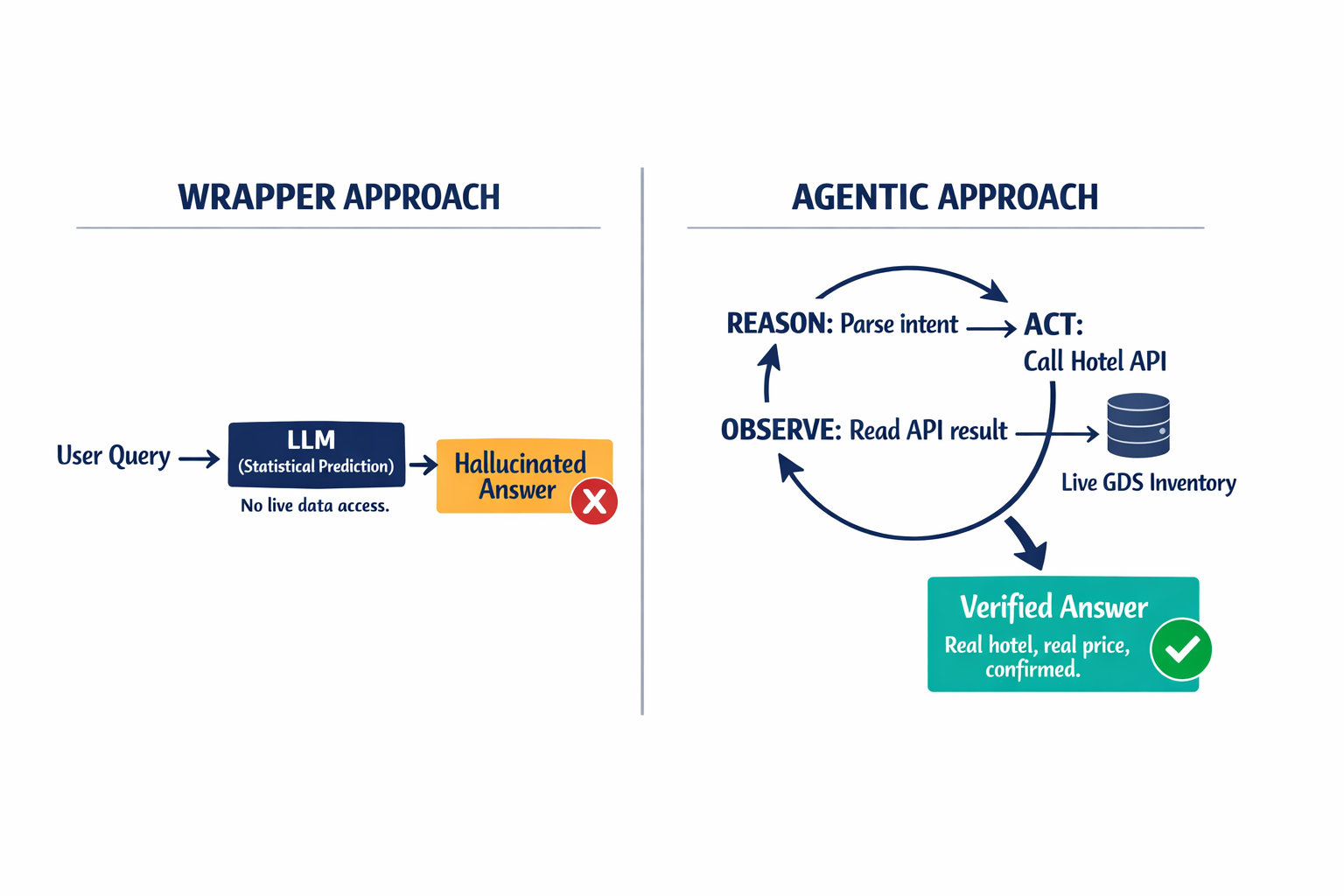
The shift from wrapper to agent isn't an upgrade. It's a different species of software.
An agentic system runs a loop we call Reason-Act-Observe. Instead of immediately generating an answer, the AI thinks through the problem, calls a tool, reads the result, and then decides what to do next. It sounds simple. The implications are enormous.
Say you ask for a hotel in Costa Rica under $200. A wrapper invents one. An agent does this: it reasons that it needs to check real availability, acts by calling a hotel search API with your constraints, and observes that the API returns an empty list. No hotels under $200. Now it reasons again — maybe the budget is too low for "luxury" — and searches under $300. Two options come back. It tells you: "I couldn't find luxury lodges under $200, but here are two highly-rated options under $300."
The agent has a conscience derived from tool outputs. It cannot say what the tools do not confirm.
That empty API response is the critical moment. It's the moment where reality overrides probability. A wrapper has no such moment — it lives entirely inside the model's statistical imagination. An agent is forced to confront what's actually available.
For complex trips, we use what's called an Orchestrator-Worker pattern. Think of it as a senior travel consultant managing a team of specialists. The Orchestrator — a high-reasoning model — talks to you, understands your request, and breaks it into tasks. Then it delegates: a Flight Worker queries airline APIs, a Hotel Worker queries hotel APIs, a Policy Worker checks your corporate travel rules. Each specialist is expert in its narrow domain. If the Hotel Worker fails, the Orchestrator can still present flight options and ask if you want to retry the hotel search — instead of the whole system crashing.
The Source of Truth Nobody Talks About
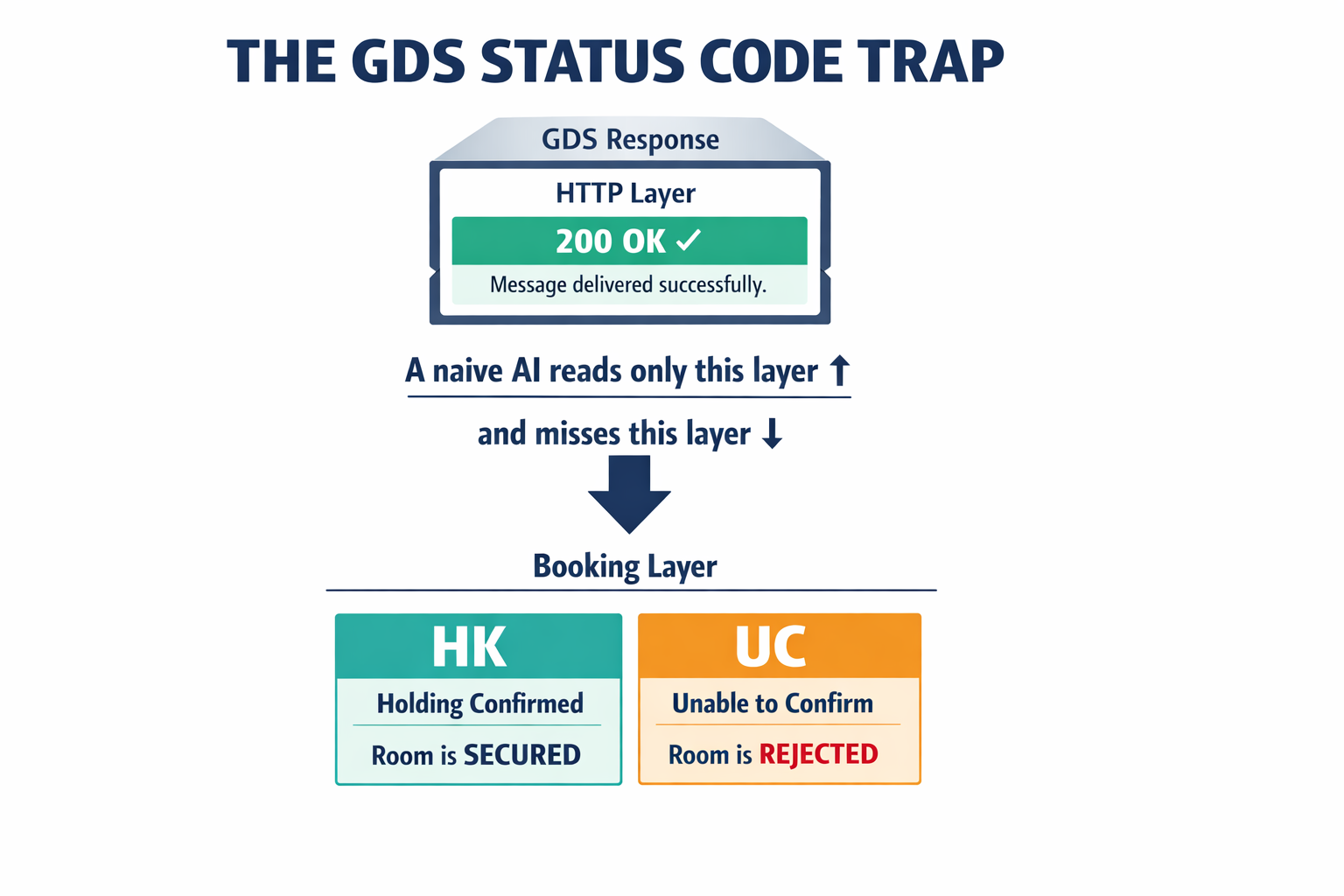
Behind every real flight booking and hotel reservation sits a Global Distribution System — Amadeus, Sabre, or Travelport. These are the massive inventory databases that airlines and hotels use to manage what's actually available. They don't speak English. They speak in status codes, fare classes, and cryptic data formats inherited from the mainframe era.
When my team started integrating with these systems, we hit a problem that perfectly illustrates why wrappers fail. GDS booking responses include status codes that determine whether a reservation actually went through. The critical one is HK — Holding Confirmed. That's the only code that means "this room is secured." But there's also UC — Unable to Confirm, which means the hotel rejected the request. And here's the trap: the HTTP response might return a perfectly normal "200 OK" — meaning the message was delivered successfully — while the booking inside that message was rejected.
A naive AI sees "200 OK" and tells you "You're booked!" Meanwhile, you have no reservation.
We built a rule we never break: the AI is never allowed to output a confirmation message unless it has parsed the specific segment status code and verified it as HK. No exceptions. No shortcuts.
There's another trap — what the industry calls the "Look-to-Book" gap. You search for a hotel room. It shows as available. Milliseconds later, when the booking command fires, the room is gone. Someone else grabbed it. LLMs are terrible at explaining this nuance. They tend to say either "I booked it!" or "It failed." They lack the vocabulary for "it was there a second ago, but now it's gone." So we built automatic recovery: if a booking returns Unable to Confirm, the agent immediately re-searches the same hotel for alternative rates, and if nothing's available, suggests the next best option from the original results. No hallucination. No dead ends.
For the full technical methodology behind our GDS integration patterns and verification loops, see our detailed research on deterministic agent architecture.
The Verification Loop: Giving AI a Conscience
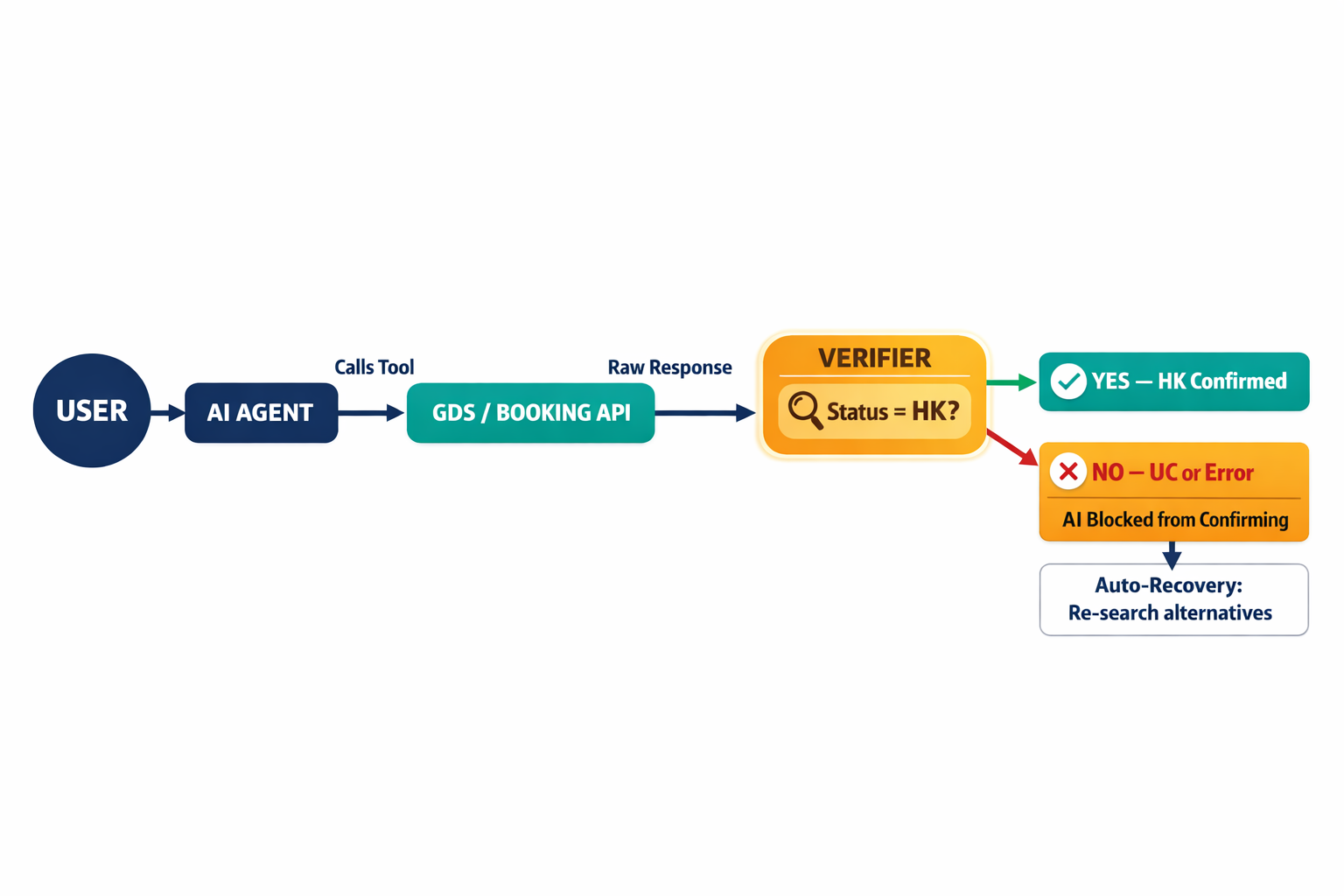
The architectural choice I'm most proud of is what we call the Double-Check Loop. In a standard system, the flow is simple: User → AI → Tool → AI → User. The AI calls a tool, gets a result, and talks to you. In our system, there's a silent intermediary.
After the tool returns a result — say, a booking confirmation — a separate verification step analyzes the raw response before the AI is allowed to speak. This verifier is deliberately simple and rigid. It asks one question: does the segment status equal HK? If yes, proceed. If no, stop the AI from confirming anything.
This catches a category of errors that are almost invisible: cases where the AI misreads a complex error message as a success. The main AI might see a long JSON response full of booking details and assume everything worked. The verifier doesn't assume. It checks one field.
We apply the same principle to pricing. When a GDS returns hotel options, we don't dump the raw data into the AI and ask it to summarize — that's an invitation for the model to mix up Hotel A's price with Hotel B's amenities. Instead, deterministic code parses the response, extracts exactly the fields we need (name, price, rating, distance), and injects only that clean data into the AI's context. The AI is then told: "You may only describe hotels listed in the provided data. Do not add external knowledge." Even if the model "knows" from training that a hotel brand usually has a pool, it won't mention a pool unless the GDS data confirms one.
Creativity without constraint is chaos. In travel, the AI's job isn't to write beautiful hotel descriptions — it's to find available rooms and secure them.
What About Speed? And What About Edge Cases?
The obvious pushback: all this verification makes things slower. It's true. A single user request might trigger three or four tool calls — search, price check, policy check, response. That can take 10-15 seconds, which feels like forever in e-commerce.
We handle this three ways. First, we stream the agent's "thinking" to the user in real time — "Searching Amadeus for flights...", "Checking corporate policy..." — which dramatically reduces the feeling of waiting. Second, we run workers in parallel: the flight search and hotel search happen simultaneously, cutting total wait time roughly in half. Third, we cache search results for 15 minutes, so if you say "show me that second hotel again," we pull it from local memory instead of hitting the GDS again.
The harder question is what happens when the AI genuinely can't figure something out — a complex multi-leg itinerary, a visa requirement it doesn't understand, a GDS outage. We built frustration detection into the system. If the user repeats the same query, if sentiment analysis flags anger, or if the agent loops without progress, it gracefully hands off to a human travel agent, passing the full structured context of the conversation. The human picks up exactly where the AI left off. No one gets stranded by a confused machine.
Where This Goes Next
What we're building today is the foundation, not the ceiling. Right now, our systems operate at what I'd call Level 3 autonomy — the agent executes tasks, but the user confirms the booking. The architecture we've described is what makes Level 5 possible: agents that negotiate group rates by telling a hotel API "I have 50 travelers, give me 20% off." Agents that build custom flight-hotel-car packages with dynamic pricing. Agents that monitor your flight status around the clock and, when a cancellation hits, have already secured you a seat on the next flight before you even check your phone.
None of that can be built on wrappers. None of it can be built on hallucinations. It requires systems that query instead of guess, verify instead of hallucinate, and act instead of just talk.
If you're deploying AI in travel — or in any industry where the AI's output triggers real-world transactions — I'd be curious to hear how you're thinking about the verification problem. Because the gap between "sounds right" and "is right" is where trust goes to die.