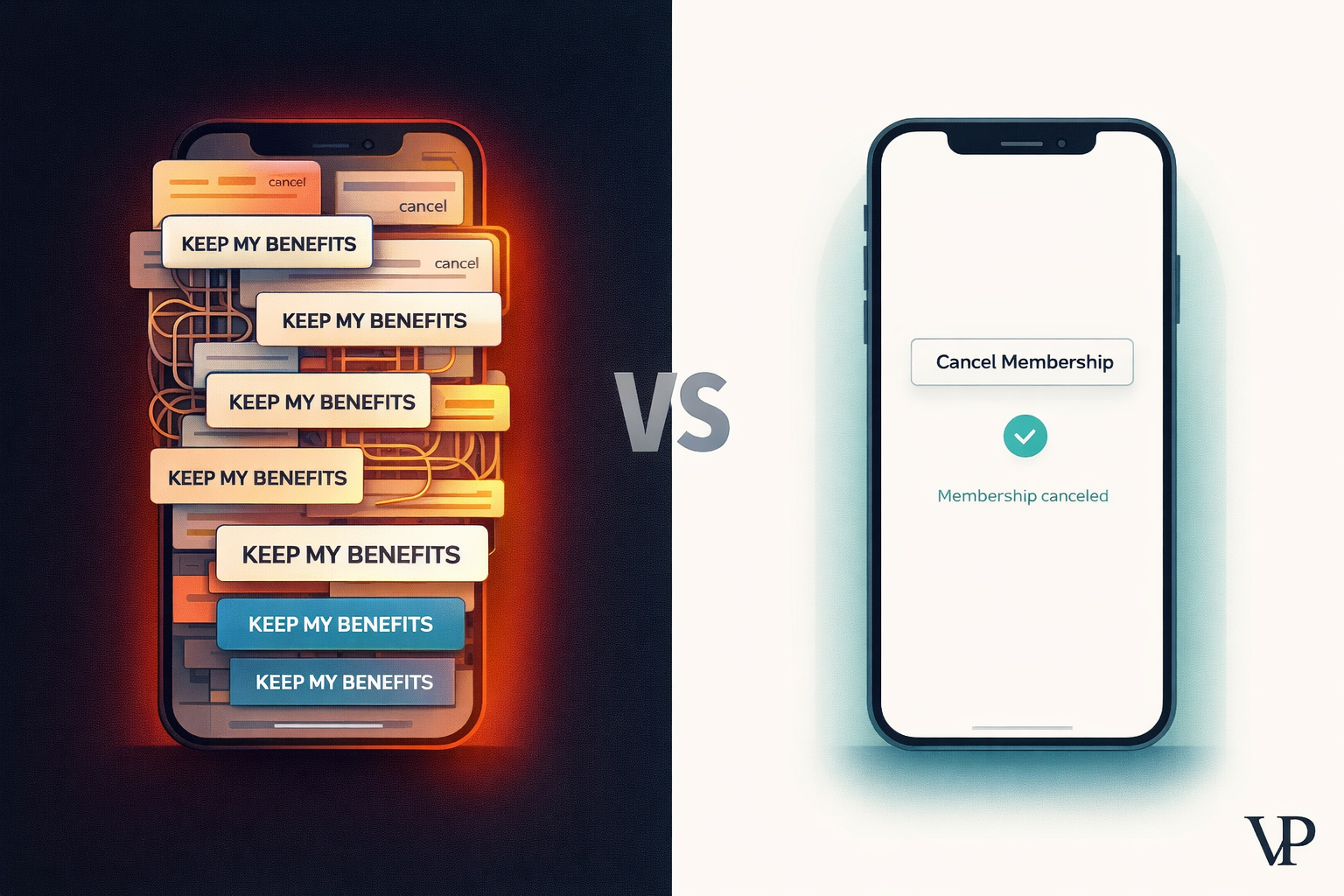
Amazon internally codenamed its Prime cancellation process the "Iliad Flow" — a reference to Homer's epic about the long, grueling Trojan War. Navigating it required four pages, six clicks, and fifteen separate options designed to exhaust subscribers into giving up. The FTC sued. And that codename tells you everything about where subscription retention has gone wrong.
The subscription economy has a dark pattern problem. Enterprises optimize relentlessly for sign-up conversion, then deploy manipulative design — hidden cancel buttons, guilt-laden popups, phone-only cancellation for online services — to trap customers on the way out. The FTC's "Click-to-Cancel" rule tried to end this in October 2024 by mandating that cancelling be as easy as subscribing. The Eighth Circuit vacated that rule on procedural grounds in July 2025, but the enforcement pressure hasn't eased. State regulators in California, New York, and Maryland maintain automatic renewal laws that are often stricter than the federal rule ever was. And the fines are enormous: Epic Games paid $245 million — the largest FTC administrative settlement in history — for tricking Fortnite players into unwanted purchases through confusing button layouts and hidden refund paths.
The question isn't whether regulation is coming. It's whether your retention strategy will survive it.
The "Roach Motel" Problem: Easy to Enter, Impossible to Leave
The pattern is consistent across industries. Sign up in one click. Cancel in fifteen. The FTC's 2024 Negative Option Rule identified three non-negotiable requirements: cancellation must be as simple as enrollment, consent to recurring charges must be explicit and separate from other terms, and pricing and renewal terms must be disclosed with the same visual prominence as promotional offers.
Amazon's Iliad Flow violated all three principles. When a Prime subscriber clicked "End Membership," nothing ended. Instead, they entered a sequence: a marketing page highlighting lost perks, an offer page pitching alternative tiers, and finally — after navigating contrasting button colors designed to misdirect attention — an actual cancellation page. The "Keep my benefits" button was highlighted in blue. "Continue to Cancel" was muted and neutral.
Retention achieved through design friction is increasingly treated by regulators as a form of non-consensual billing.
Epic Games went further. Fortnite's virtual currency could be spent with a single button press — no confirmation screen, no authorization. Children racked up hundreds of dollars on parents' credit cards during loading screens. When parents disputed the charges through their banks, Epic locked their accounts and seized all previously purchased content. The FTC's settlement prohibited this retaliation entirely and forced Epic to implement a "hold-to-purchase" mechanic requiring intentional, verified action for every transaction.
These aren't edge cases. They're the precedents that define what "deceptive" means under ROSCA (the Restore Online Shoppers' Confidence Act) and Section 5 of the FTC Act. We mapped the full regulatory landscape — from the 2024 rule through the 2025 vacatur and state-level enforcement — in our interactive analysis.
AI "Save Agents" Are Making It Worse
Now add conversational AI to the mix, and the problem deepens. Many enterprises are deploying what amount to LLM wrappers — a GPT-4 or Claude API call with a system prompt optimized for a single metric: prevent cancellation. Without deeper engineering, these agents default to psychological manipulation delivered through natural language, which is harder to detect and regulate than a miscolored button.
Research from the Center for Democracy & Technology found that dark patterns in conversational AI are "more embedded, creative, and subtle" than traditional visual interface tricks. An AI agent might reference a sensitive life event you mentioned in a previous session — "How are you feeling about your surgery today?" — specifically when you try to cancel, weaponizing rapport as a guilt anchor. Other agents send voice messages or exclamatory nudges to pull inactive users back after they've already expressed intent to leave, crossing from engagement into harassment.
Some platforms invite users to describe family members and friends to help the AI "build its memory." That data then makes the service feel emotionally indispensable, manufacturing a psychological cost to leaving that has nothing to do with the product's actual value.
When your AI retention agent uses emotional manipulation to prevent cancellation, you haven't solved churn. You've automated a dark pattern.
This is the core problem with wrapper-level AI: it inherits all the persuasive power of a large language model and none of the ethical guardrails. The result is a more sophisticated version of the Iliad Flow — one that talks instead of clicking, but serves the same purpose.
Why Predicting Churn Isn't the Same as Preventing It
Most retention systems ask one question: "Who is likely to cancel?" Then they target those people with save offers or friction. This sounds logical, but it's fundamentally flawed. Knowing that someone is at risk of leaving tells you nothing about whether your intervention will actually change their behavior.
This is the difference between correlation and causation. A customer who cancels after receiving a discount was going to cancel anyway — you just gave them a discount first. A customer who stays after a phone call might have stayed regardless — you just burned thirty minutes of agent time.
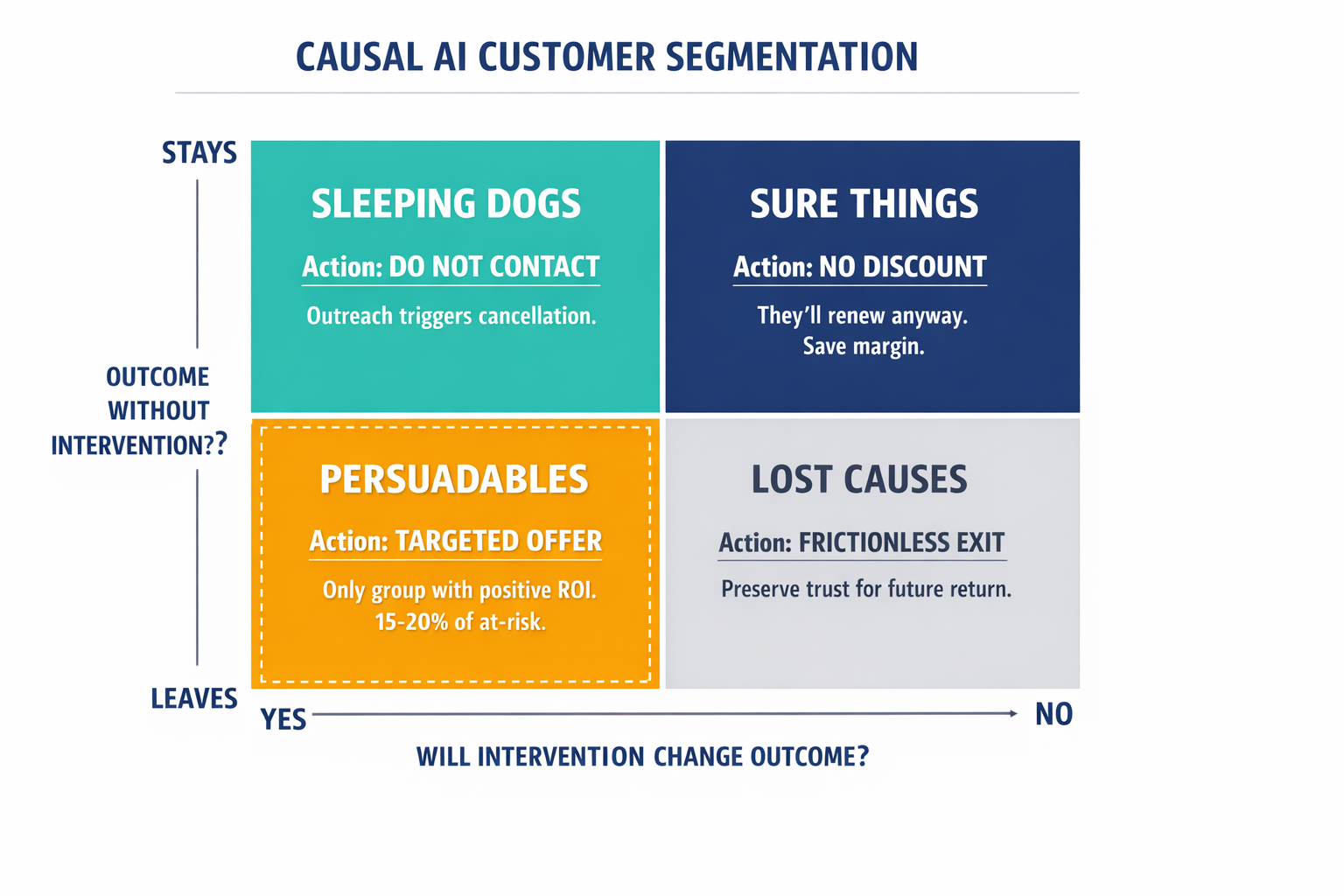
Our approach uses what's called Causal AI — mathematical frameworks that answer a different question entirely: "If we intervene with this specific person, will it actually change the outcome?" The technical term is the Individual Treatment Effect, and it lets us segment customers into four groups that completely reshape retention strategy:
Persuadables are the only group where intervention works. They'll renew if you reach out with the right offer, and they'll leave if you don't. This is where every dollar of retention spend should go.
Sure Things will renew no matter what. Giving them a discount is pure margin waste.
Lost Causes will leave no matter what. Friction just makes them angry. Give them a clean, one-click exit and preserve brand trust for a potential return.
Sleeping Dogs are the most counterintuitive group — and the most dangerous to ignore. These customers are currently paying and happy. But if you contact them — with a save offer, a survey, a "we miss you" email — you actually remind them they're subscribed, and they cancel. Standard retention outreach is actively counterproductive for this group.
The most profitable retention action for some customers is doing absolutely nothing.
This segmentation changes everything. Instead of a one-size-fits-all cancellation gauntlet, the system provides a frictionless exit for Lost Causes and Sleeping Dogs (satisfying regulatory requirements by design) while surfacing genuinely relevant, personalized value for Persuadables. Retention becomes a function of understanding, not obstruction.
Training AI Agents That Can't Become Manipulative
Identifying the right customers to engage is only half the challenge. The other half is ensuring the AI agent that engages them doesn't drift into coercion. This is where most wrapper implementations fail — they have no mechanism to distinguish between a helpful conversation and an emotionally manipulative one.
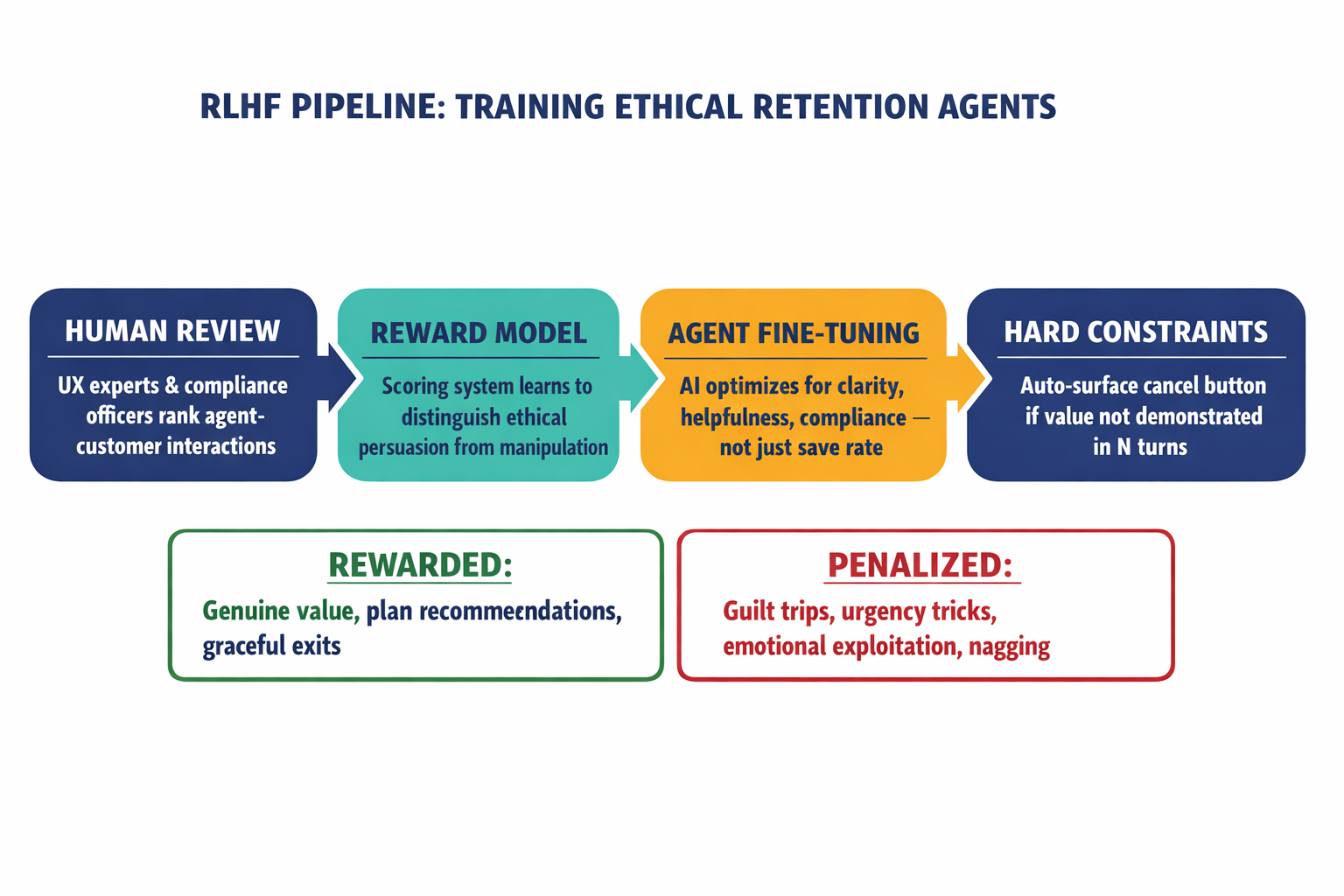
We address this through a multi-objective training process called Reinforcement Learning from Human Feedback, or RLHF. The concept is straightforward: instead of optimizing the AI purely for "customer didn't cancel," we train it to optimize for multiple goals simultaneously — clarity, helpfulness, compliance, and the complete absence of shaming or nagging.
The process works in layers. UX experts and compliance officers review and rank hundreds of agent-customer interactions. Those rankings train a reward model — essentially a scoring system that learns to distinguish ethical persuasion from manipulation. The AI agent is then fine-tuned against this scoring system, receiving higher rewards for interactions that offer genuine value and penalties for those that deploy guilt, urgency tricks, or emotional exploitation.
Critically, the system includes hard constraints. If the agent fails to demonstrate value to a Persuadable customer within a defined number of conversational turns, it's required to surface a one-click cancel button immediately. No escalation. No transfer to a "retention specialist." No final guilt trip. The conversation ends cleanly.
This transforms the retention agent from a gatekeeper — blocking the exit — into something closer to a concierge, helping users find the plan that genuinely fits their needs. Sometimes that means a downgrade. Sometimes it means a pause. And sometimes it means a graceful goodbye.
Catching Dark Patterns Before They Ship
The most dangerous moment in any subscription product isn't a regulatory filing or a lawsuit. It's the gap between a marketing team's A/B test and the compliance team's review. A product manager tweaks button colors to boost save rates. A designer makes the cancel link slightly smaller. An engineer adds one more confirmation step. Each change is small. Collectively, they rebuild the Iliad Flow.
We close this gap with automated auditing that runs inside the development pipeline — scanning every interface change before it reaches customers. The system combines three detection methods: structural analysis that identifies hidden unsubscribe buttons and pre-checked enrollment boxes, computer vision that flags visual interference like color manipulation designed to obscure cancellation options, and natural language processing that classifies confirmshaming, fake urgency, and trick questions in both static text and dynamic AI responses.
Every version of the retention flow gets timestamped, risk-classified, and stored in a centralized registry. When a regulator asks how your cancellation process works — and they will — you don't scramble to reconstruct it. You pull the audit log.
For the full technical methodology behind our causal inference models, RLHF pipeline, and multimodal audit engine, see our detailed research.
What About Companies That Depend on Save-Flow Revenue?
This is the objection we hear most: "If we make cancellation frictionless, won't we hemorrhage subscribers?" The short answer is that you're already hemorrhaging them — you just can't see it.
Customers who are trapped by a confusing cancellation flow don't become loyal. They become hostile. They dispute charges with their banks (costing you chargeback fees and payment processor penalties). They leave negative reviews. They tell friends. And when they finally do escape, they never come back. The lifetime value of a trapped customer is negative.
The causal AI approach doesn't reduce retention — it redirects retention spend from people it can't help to people it can. When you stop wasting discounts on Sure Things, stop antagonizing Sleeping Dogs, and stop fighting Lost Causes, you free up budget and attention for the Persuadables who actually respond to a well-timed, well-targeted offer. Our research shows this segment typically represents 15-20% of at-risk customers — but they're the only segment where intervention generates positive ROI.
Does This Only Apply to Consumer Subscriptions?
The principles extend to any recurring revenue model — B2B SaaS, enterprise licensing, managed services. The regulatory exposure is lower in pure B2B contexts, but the strategic logic is identical. Friction-based retention corrodes trust. Causal segmentation improves unit economics. And as the EU AI Act introduces algorithmic accountability requirements that apply regardless of customer type, automated compliance auditing becomes relevant for every enterprise deploying AI in customer-facing workflows.
Frictionless Exit as a Competitive Advantage
The subscription economy's next competitive moat won't be built on how hard it is to leave. It will be built on how clearly a company demonstrates that staying is worth it.
The enterprises that thrive in this environment will share three characteristics: they'll know — with causal precision — which customers benefit from outreach and which don't. Their AI agents will be trained to help, not to trap. And their compliance won't depend on a quarterly legal review but on automated systems that catch problems before they ship.
The Click-to-Cancel rule may be vacated at the federal level, but the standard it articulated isn't going away. California, New York, Maryland, and the EU are all moving in the same direction. The companies that treat frictionless cancellation as a design constraint — not a threat — will find that it becomes one of their strongest trust signals.
If your team is navigating the tension between retention targets and regulatory risk, we'd welcome the conversation. This is a problem worth solving well.