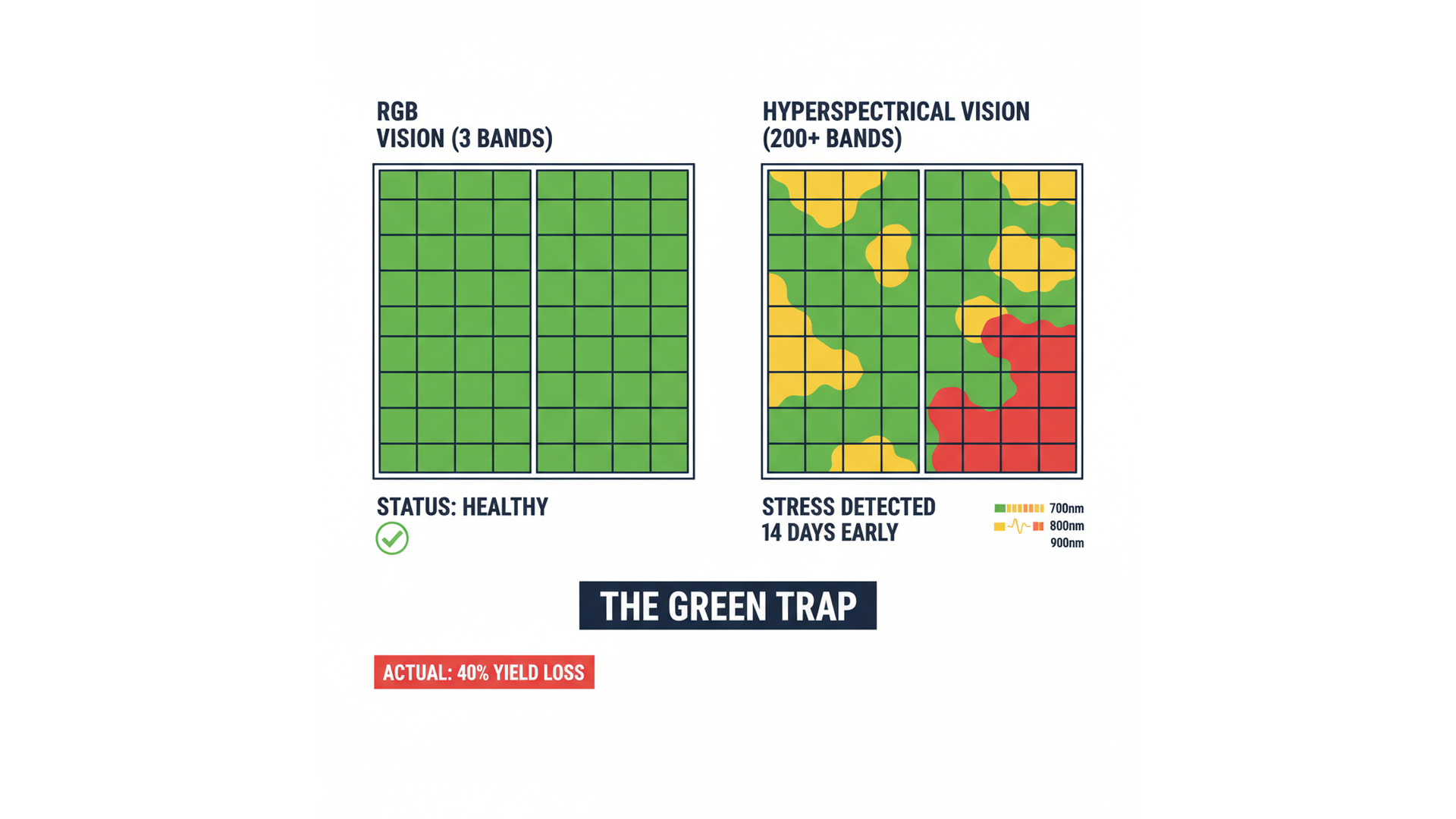
A soybean field can be dying and still look perfectly green.
I learned this the hard way. My team was reviewing satellite imagery of fields that had been flagged as "healthy" by a standard RGB-based computer vision model. Weeks later, the same fields reported catastrophic yield losses. The AI had looked at the crops. It had seen green. And it had been completely, confidently wrong.
That moment forced me to confront an uncomfortable truth about the entire AgTech industry: we have been treating scientific instruments like iPhone cameras. And it is costing farmers billions.
The problem is not the satellites. Modern radiometers capture photon radiance across dozens or hundreds of wavelengths. The problem is what happens next. Most AgTech platforms compress that rich spectral signal into three channels -- Red, Green, Blue -- and feed it to a neural network designed to recognize cats in YouTube videos. They are actively destroying data before analysis even begins.
This is what I call the industry's original sin. And hyperspectral deep learning is the correction.
Why Does the "Green Trap" Fool Every Standard Model?
A plant does not turn yellow the moment it gets sick. Chlorophyll production drops gradually, and for days or weeks, the leaf stays visually green while its internal chemistry is already in crisis. Researchers call this the "Green Trap" -- the window where RGB sensors and the human eye see health, but the biochemistry tells a different story.
Standard vegetation indices like NDVI (Normalized Difference Vegetation Index) fare only marginally better. NDVI uses two broad spectral bands and saturates in dense canopies, meaning a field at 60% health and a field at 95% health can return nearly identical readings. When my team ran the numbers, the detection latency was staggering: RGB-based models typically identify crop stress 10 to 15 days after visible symptoms appear. By then, treatment options are limited and expensive.
Your AI is diagnosing crops with a blindfold on.
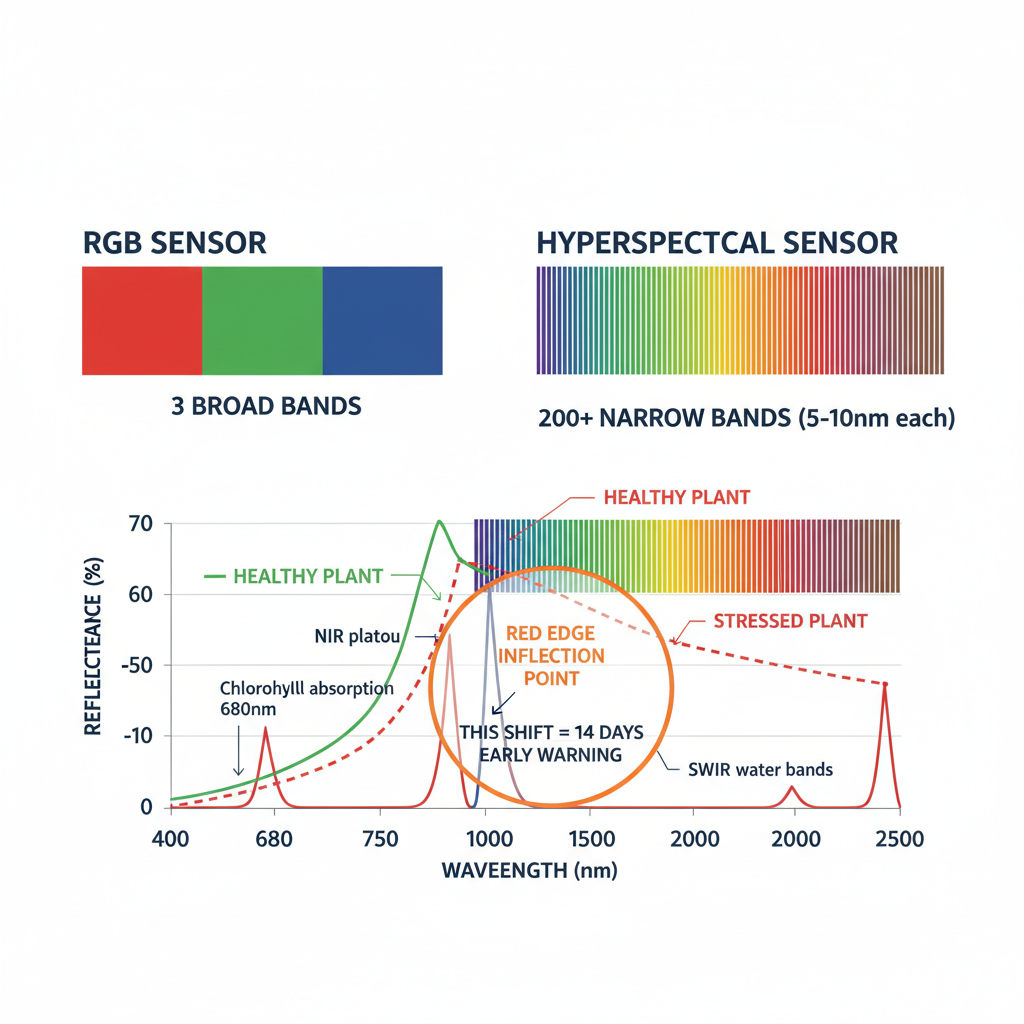
Hyperspectral sensors change this equation entirely. Instead of three broad bands, they capture 200 or more narrow bands spanning the visible, Near-Infrared, and Short-Wave Infrared spectrum. Each band is only 5 to 10 nanometers wide. At that resolution, you can detect something called the "Blue Shift" of the Red Edge Inflection Point -- a nanometer-scale migration in where a plant's spectral reflectance curve transitions from absorbing red light to reflecting infrared. This shift happens days or weeks before any color change is visible. Our models use it as a primary diagnostic feature, detecting stress 7 to 14 days before symptoms appear to the naked eye.
Maps Are Not Pictures. They Are Data.
This distinction matters more than any algorithm choice. When I explain what we do at Veriprajna, I keep coming back to one idea: a satellite image of a farm is not a photograph. It is a three-dimensional data cube -- two spatial dimensions and one spectral dimension -- where every pixel contains a continuous curve of reflectance values across the electromagnetic spectrum.
Standard computer vision treats that cube like a flat picture. It throws away the spectral axis. A ResNet (a deep neural network architecture commonly used for image recognition) model trained on ImageNet (a massive image dataset used as the standard benchmark for computer vision) has no concept of chlorophyll absorption at 680nm or water stress signatures in the SWIR region. It knows edges, textures, and shapes. And for agriculture, that is almost useless at the stage where intervention actually saves money.
By the time a crop field changes shape enough for an RGB model to notice, the damage is already done.
I spent months trying to make standard architectures work on spectral data. We tried transfer learning from ImageNet models, fine-tuning on multispectral composites, every shortcut in the book. None of it worked because the fundamental representation was wrong. You cannot retrofit spatial pattern recognition onto a chemical analysis problem.
How Does Hyperspectral Deep Learning Read Crop Biochemistry?
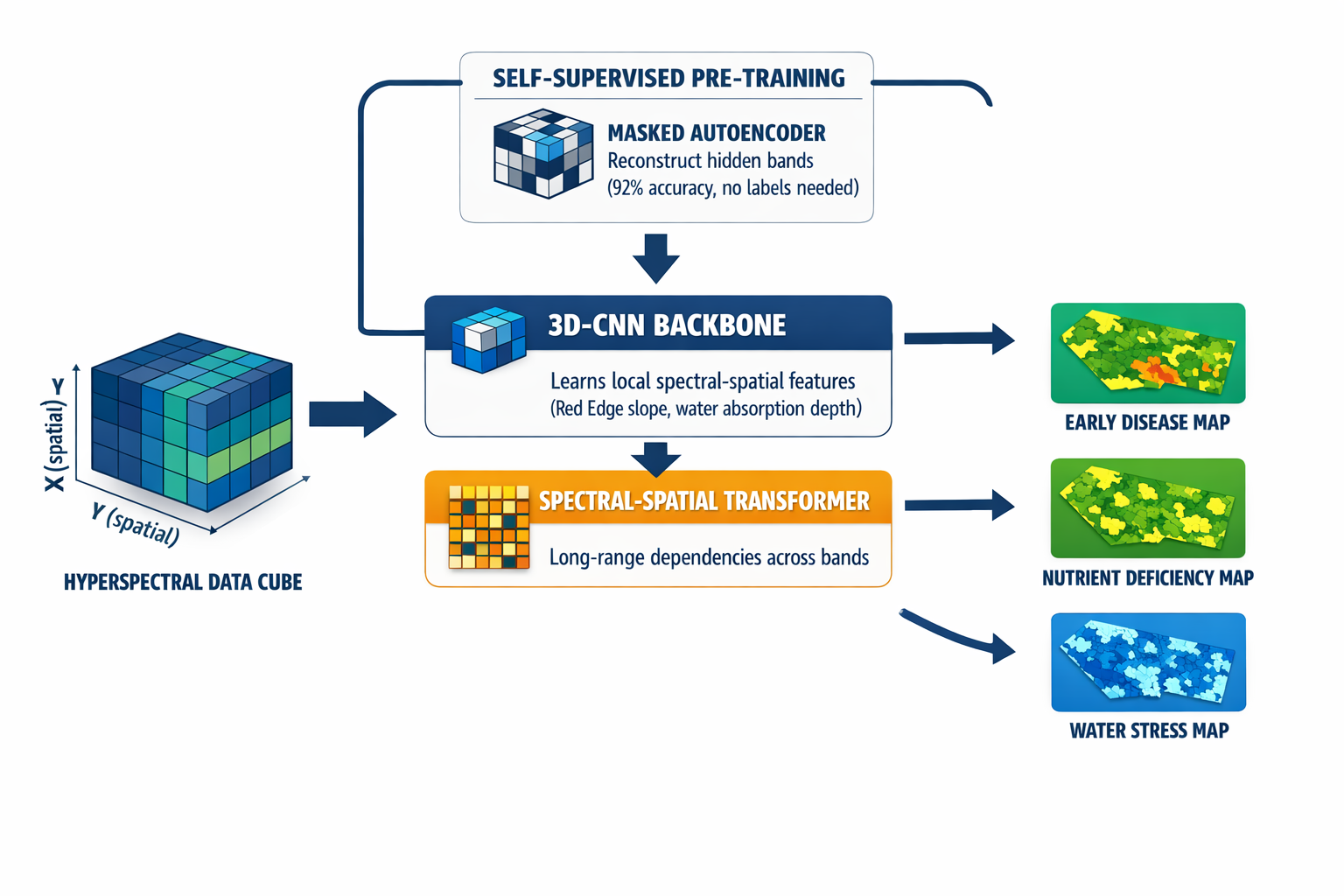
The architecture that works looks nothing like standard computer vision. We use 3D Convolutional Neural Networks that process the full hyperspectral cube -- spatial and spectral dimensions simultaneously. The 3D kernels slide across both the image and the spectrum, learning local spectral features like the slope of the Red Edge or the depth of a water absorption band directly from raw data. Research confirms that 3D-CNNs significantly outperform their 2D counterparts on hyperspectral classification because they preserve the inter-band correlations that define material properties.
But local patterns are not enough. A drought signature might connect a spectral pattern in the visible range with one in the SWIR range, hundreds of bands apart. To capture these long-range dependencies, we layer Spectral-Spatial Transformers on top of the CNN backbone. The attention mechanism treats each pixel's spectral vector as a sequence of tokens and dynamically focuses on whichever bands matter most for a given prediction. When the model is diagnosing drought, it learns to attend to the relationship between Red Edge bands and SWIR water absorption bands while ignoring noise in irrelevant wavelengths.
One thing that genuinely surprised me: this hybrid approach also solves the "Curse of Dimensionality" problem that has plagued hyperspectral analysis for decades. With 200+ bands but limited training samples, traditional classifiers fall apart. The transformer's selective attention acts as a learned dimensionality reduction, focusing only on what matters for each specific task.
What Happens When You Have Petabytes of Data and Almost No Labels?
The biggest bottleneck in agricultural AI is not compute or algorithms. It is labeled data. "Ground truthing" means physically sending an agronomist to a field to verify whether a plant is stressed. It is expensive, slow, and completely unscalable. We have petabytes of satellite imagery and almost none of it is labeled.
This is where Self-Supervised Learning changed everything for us. We train models using Masked Autoencoders adapted for spectral data -- we hide portions of the spectral bands and force the network to reconstruct what is missing. If the model sees high red reflectance, it learns to predict low NIR reflectance, because that is how plant physics works. The network teaches itself the rules of spectroscopy without a single human label.
We trained a model on plant physics by making it play fill-in-the-blanks with the electromagnetic spectrum.
Recent benchmarks show that these SSL frameworks achieve over 92% accuracy in early disease detection using unlabeled data, matching fully supervised baselines. We also use Distance-Based Spectral Pairing, which identifies spectrally similar and dissimilar pixels to create automatic training pairs -- an approach that improved accuracy by over 11% compared to traditional clustering. For a deeper look at these methods, I walked through the full technical pipeline in our detailed research.
What Does Early Detection Mean in Dollars?
The economics are straightforward. Information received after the point of intervention has zero value.
Reactive monitoring (RGB/visual): Detects damage after it occurs. Useful for insurance claims and postmortems. Economic value: low.
Predictive monitoring (hyperspectral AI): Detects stress before damage is irreversible. Enables targeted treatment. Economic value: high.
Studies indicate that AI-based early disease detection prevents yield losses of 15 to 40%, with ROI (Return on Investment) for the detection technology often exceeding 150%. For an enterprise managing thousands of hectares, that translates to millions in retained revenue. The ability to catch stress 10 to 14 days pre-symptomatically means targeted fungicide application instead of blanket spraying -- cheaper, more effective, and better for the soil.
Precision spectral maps also enable Variable Rate Technology. Instead of applying nitrogen uniformly across a field, farmers spray only the areas identified as spectrally deficient. Reducing nitrogen application by even 10% across a large portfolio improves margins and cuts environmental runoff. Water management shows similar gains: thermal and SWIR bands provide a direct proxy for crop water stress, and optimizing irrigation based on real-time plant need rather than a calendar can reduce water usage by 20 to 25%. I explored these economics in more detail in our interactive analysis.
Can Hyperspectral Deep Learning Actually Scale?
This is the question I get at every conference. Hyperspectral satellites are still relatively rare, and the data is massive -- a single hyperspectral image can be 50 to 100 times larger than an RGB equivalent. Is this actually deployable at scale?
The satellite gap is closing fast. Planet's Tanager mission, Germany's EnMAP, and NASA's upcoming Surface Biology and Geology mission are flooding the market with high-quality spectral data. The raw fuel for these models is becoming abundant.
On the compute side, we store data as chunked, compressed tensor arrays rather than image files, enabling parallel reads of specific spectral slices. We also use GANs -- Generative Adversarial Networks, a technique where two neural networks compete against each other, one generating synthetic data and the other trying to spot the fakes, until the generated samples are indistinguishable from real ones -- to produce synthetic hyperspectral samples for rare edge cases like unusual diseases or atypical lighting conditions. This lets our models generalize without needing perfect real-world coverage of every scenario.
The frontier I am most excited about is Edge AI: lightweight 3D-CNNs and quantized Transformers -- models that have been compressed and simplified so they can run on low-power hardware without losing meaningful accuracy -- running directly on satellite hardware. Instead of transmitting terabytes of raw data to Earth, the satellite transmits just the insight -- "Field A has rust." Latency drops from hours to minutes. That is where this is heading.
The Field Is Still Green. The Crop Is Already Lost.
That sentence captures everything wrong with how most agricultural AI works today. We built an industry on a computer vision paradigm imported from social media and consumer photography, then wondered why it could not diagnose plant disease.
The shift from spatial analysis to spectral-chemical analysis is not incremental. It is a category change. It is the difference between looking at a patient and running a blood test.
My conviction is that enterprises still relying on RGB-based crop monitoring will find themselves drowning in data while starving for insight within a few years. The satellites are getting smarter. The spectral data is getting richer. And the models that can actually read that data -- not just look at it -- will define who captures value in the next generation of precision agriculture.
If you are working on agricultural intelligence, remote sensing, or precision ag at scale, I would genuinely like to hear how you are thinking about the spectral dimension. Are you still in the RGB world, or have you started making the transition?