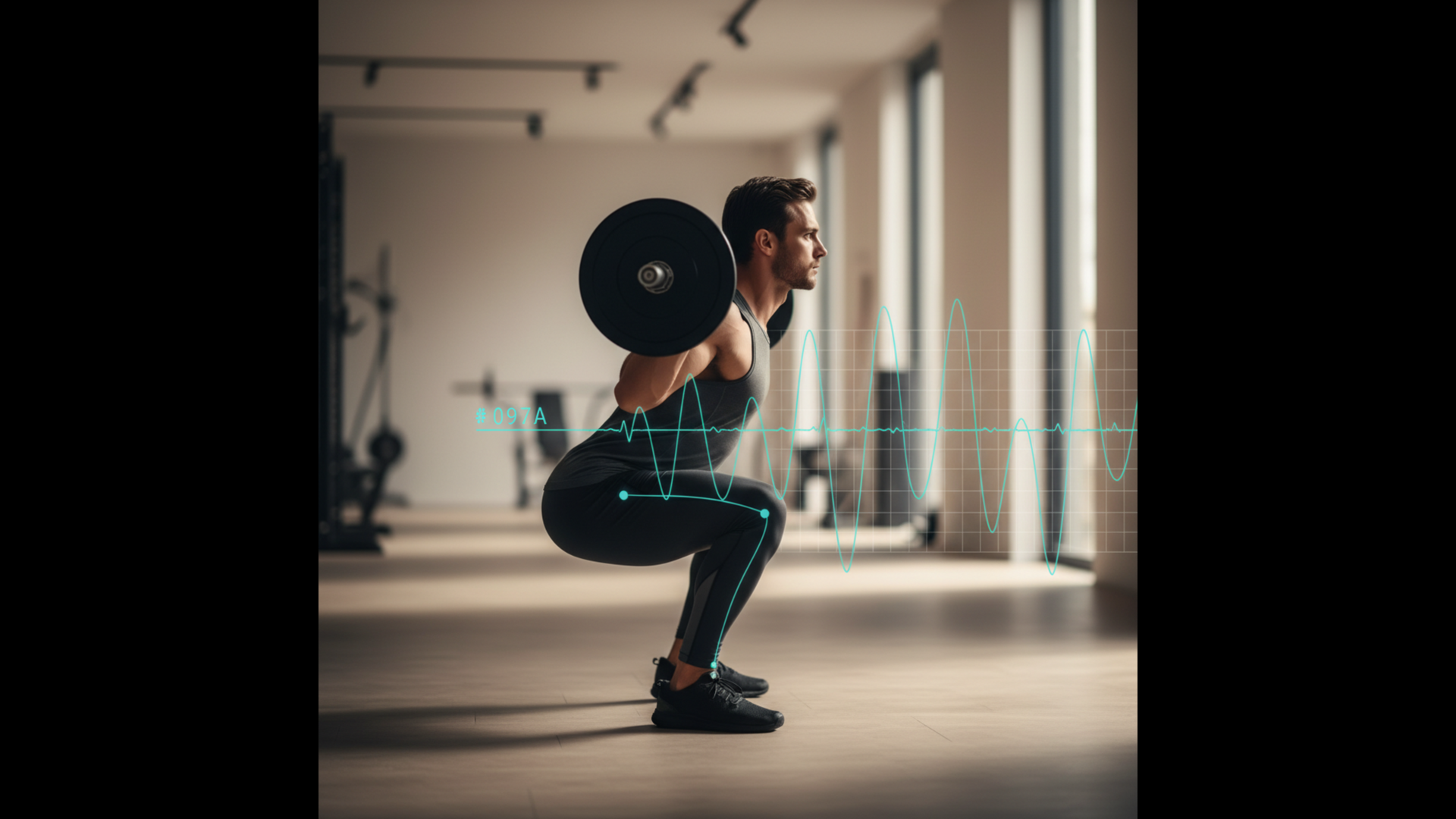
A $60 billion corporate wellness industry is paying for workouts that never happened. Employees shake phones to hit step targets. Users let exercise videos play while they eat dinner. Insurers offer premium discounts for gym check-ins that prove nothing beyond "this person walked through a door." The entire digital fitness economy runs on what we call "Vibes-based" data — self-reported, easily spoofed, and worthless under audit. Our team has spent years building the alternative: AI fitness verification that treats human movement not as video to be watched, but as a physics signal to be measured.
The problem is not laziness or bad intentions. It is a structural failure baked into how fitness technology works. And fixing it requires rethinking everything from the sensor to the algorithm.
Why Do Most "AI-Powered" Fitness Apps Never Check If You Moved?
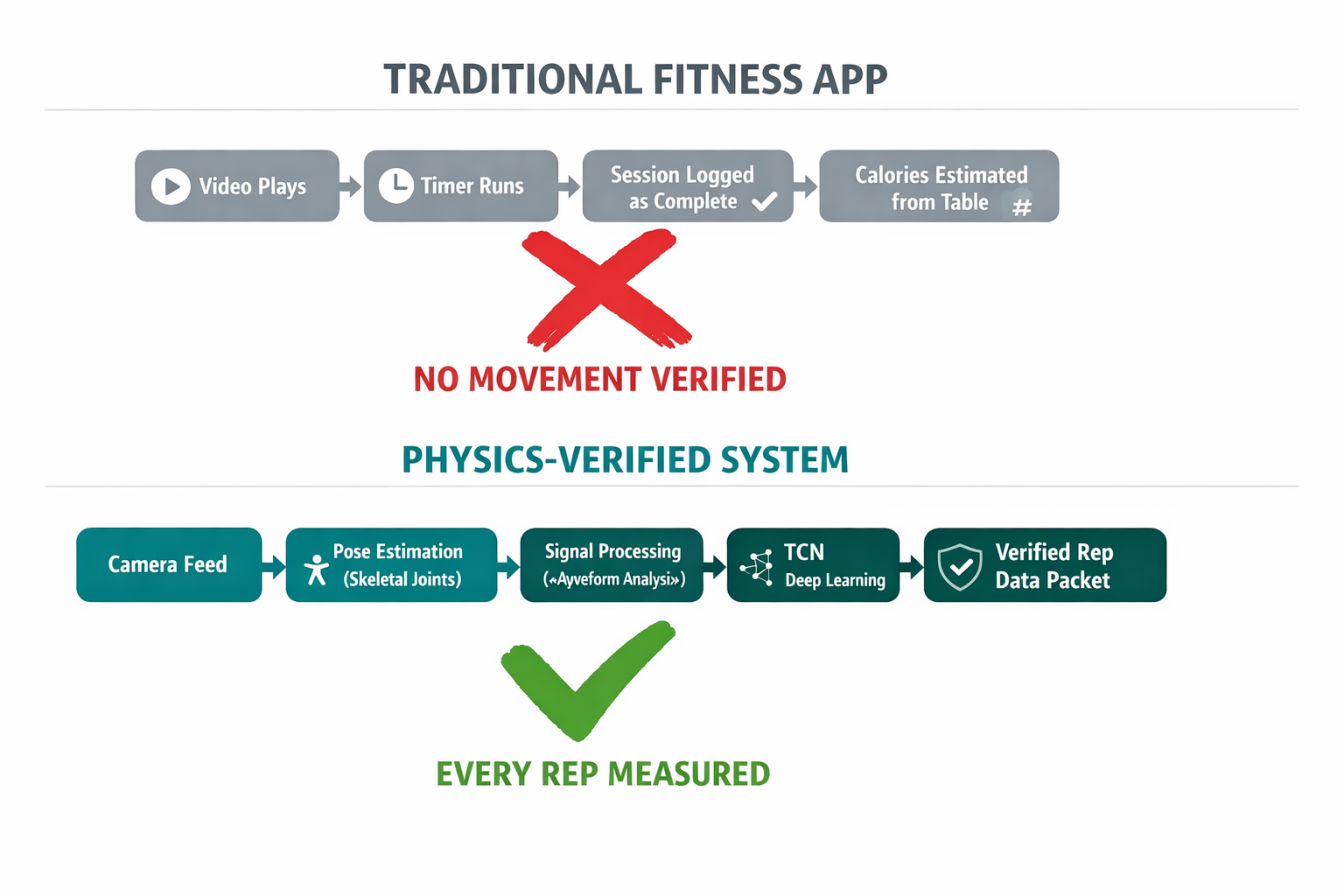
Most "AI-powered" fitness apps are, architecturally, glorified video players. They serve you a stream of an instructor doing pushups. You are expected to follow along. When the video ends, the app logs the session as "complete," estimates your calorie burn from a generic table, and hands you a badge.
The app never checked whether you moved at all.
This is the model that dominates digital health, from consumer apps to enterprise wellness platforms. The "intelligence" lives in the recommendation engine that picks the next video — not in any system that verifies what your body actually did. We explored this problem in depth in our interactive analysis.
You cannot gamify what you cannot verify.
When organizations attach real value to these unverified metrics — insurance discounts, wellness incentives, leaderboard rankings — they trigger what sociologists call Campbell's Law: the metric stops measuring health and starts measuring who is best at gaming the system. The collapse of early "Move-to-Earn" crypto projects like STEPN illustrated this perfectly. Users spoofed GPS signals with mechanical shakers, and the entire economy cratered because the verification layer could not distinguish real movement from simulated movement.
Pose Estimation Is a Sensor, Not a Solution
The fitness tech industry often conflates "pose estimation" with "AI verification." Libraries like OpenPose, BlazePose, and MoveNet can extract the x, y, z coordinates of your skeletal joints from video. That is genuinely useful — but it is a sensing step, not an intelligence step.
Think of it this way: a thermometer measures temperature, but it does not diagnose a fever. Similarly, raw joint coordinates are noisy, uninterpreted data. A single frame showing bent elbows tells you nothing about a pushup. Is the person lowering down? Pushing up? Holding an isometric position? Trembling with fatigue? The spatial snapshot lacks the one dimension that matters most: time.
Exercise is not a state. It is a process — geometry evolving through time. And that distinction changes everything about how verification should work.
What Happens When You Treat Movement as a Physics Signal?
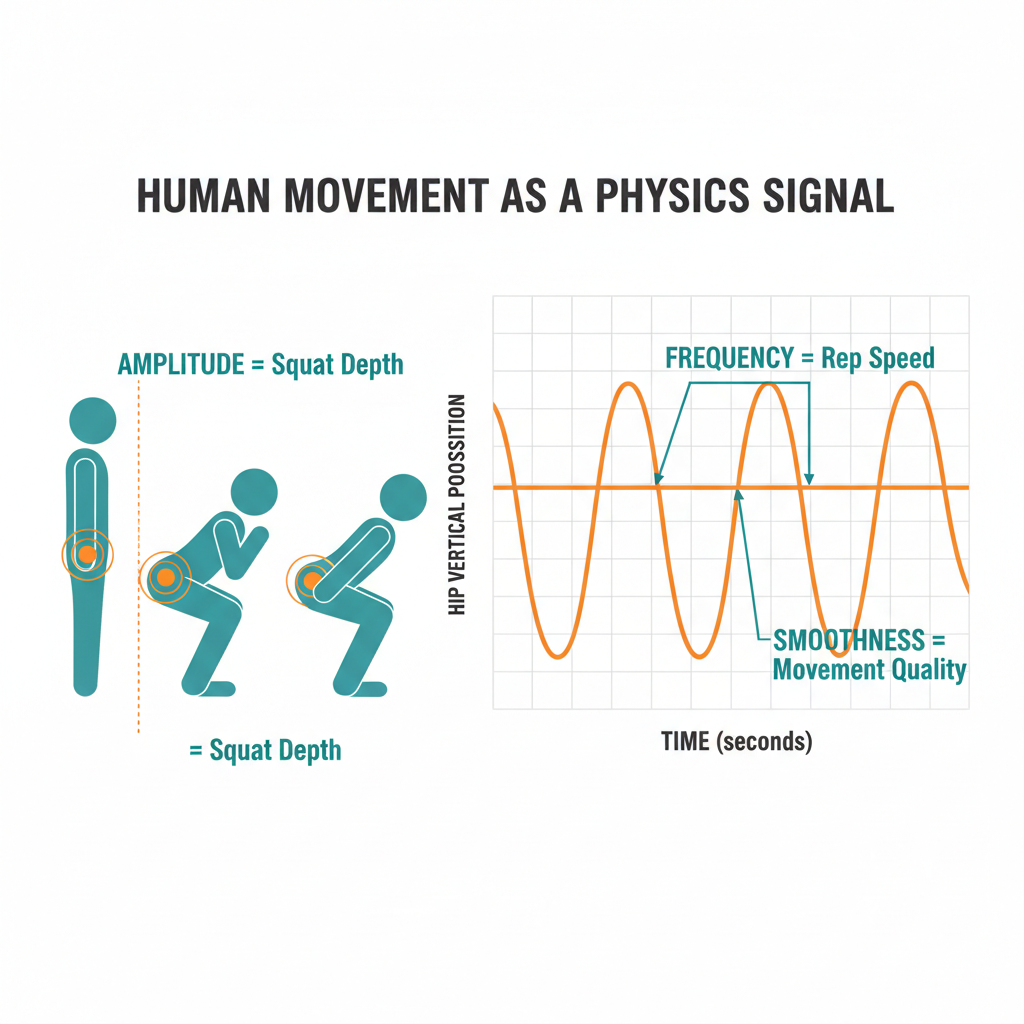
Our team reframed human activity recognition from an image classification problem to a Digital Signal Processing (DSP) problem. The insight is straightforward: when a person performs repetitive exercise, their body behaves like a mechanical oscillator.
The vertical displacement of your hips during squats traces a sinusoidal wave. Shoulder abduction during jumping jacks produces a periodic waveform. Walking generates complex, multi-harmonic signals across the lower body. Once you see movement as a signal, you can measure it with the same mathematical precision engineers use to analyze electrical circuits or acoustic waves — amplitude (how deep was the squat), frequency (how fast are the reps), phase (are left and right sides coordinated), and spectral purity (is the movement smooth or jerky).
We are not asking an AI to guess what exercise is happening. We are measuring the physics of the waveform.
This shift from "vision" to "signal" is what makes objective, fraud-resistant verification possible. But raw signal processing techniques like Fourier Transforms are brittle when applied to real-world human movement — people change speeds, camera angles shift, limbs get occluded. We needed a deep learning architecture purpose-built for temporal signals.
Why Do Temporal Convolutional Networks Outperform LSTMs for Real-Time Verification?
For years, the standard architecture for sequential data was the Long Short-Term Memory network (LSTM) — a type of recurrent neural network that processes data one step at a time. LSTMs were a breakthrough for text and audio, but they fail real-time fitness verification: serial computation creates unacceptable latency on mobile devices, they lose context over long sequences (a 50-rep set literally exceeds their effective memory window), and their complex internal states are prohibitively expensive at enterprise scale.
Our engine uses Temporal Convolutional Networks (TCNs) instead — adapting the convolutional architecture that revolutionized image recognition to the time dimension. The defining feature is dilated convolutions: filters with exponentially increasing spacing that let the network simultaneously attend to what is happening right now (is the knee collapsing inward on this frame?) and what has been happening over the past three minutes (is fatigue degrading form?). Because TCNs use convolutions rather than sequential state, all time steps process in parallel, training runs orders of magnitude faster, and gradient stability eliminates the vanishing gradient problem (where learning signals weaken and disappear as the network tries to remember further back in time) that plagues LSTMs. For the full technical methodology behind our TCN implementation, see our detailed research.
How Can You Count Reps Without Knowing the Exercise?
Traditional fitness apps train a separate model for every exercise — a "pushup counter," a "squat counter," a "lunge counter." Add a new exercise, and you need new training data and a new model. Our approach is fundamentally different.
We use Temporal Self-Similarity Matrices — a technique where the TCN maps the skeletal pose sequence into a compressed representation, then computes how similar any given moment is to every other moment in the session. Repetitive actions create a distinctive pattern: parallel lines of high similarity in the matrix. The distance between those lines is the duration of a single rep. The intensity of the lines tells us how consistent the reps are — how closely rep 5 matches rep 1.
A Veriprajna Verified Rep is not a checkbox. It is a data packet containing timestamp, skeletal keypoint hash, confidence score, and kinematic telemetry.
This class-agnostic approach means we can verify any periodic movement — kettlebell swings, rowing, jumping jacks, or specialized rehabilitation exercises — without ever training a specific classifier for that movement. The system detects the physics of repetition itself.
What Does Quality Scoring Actually Measure?
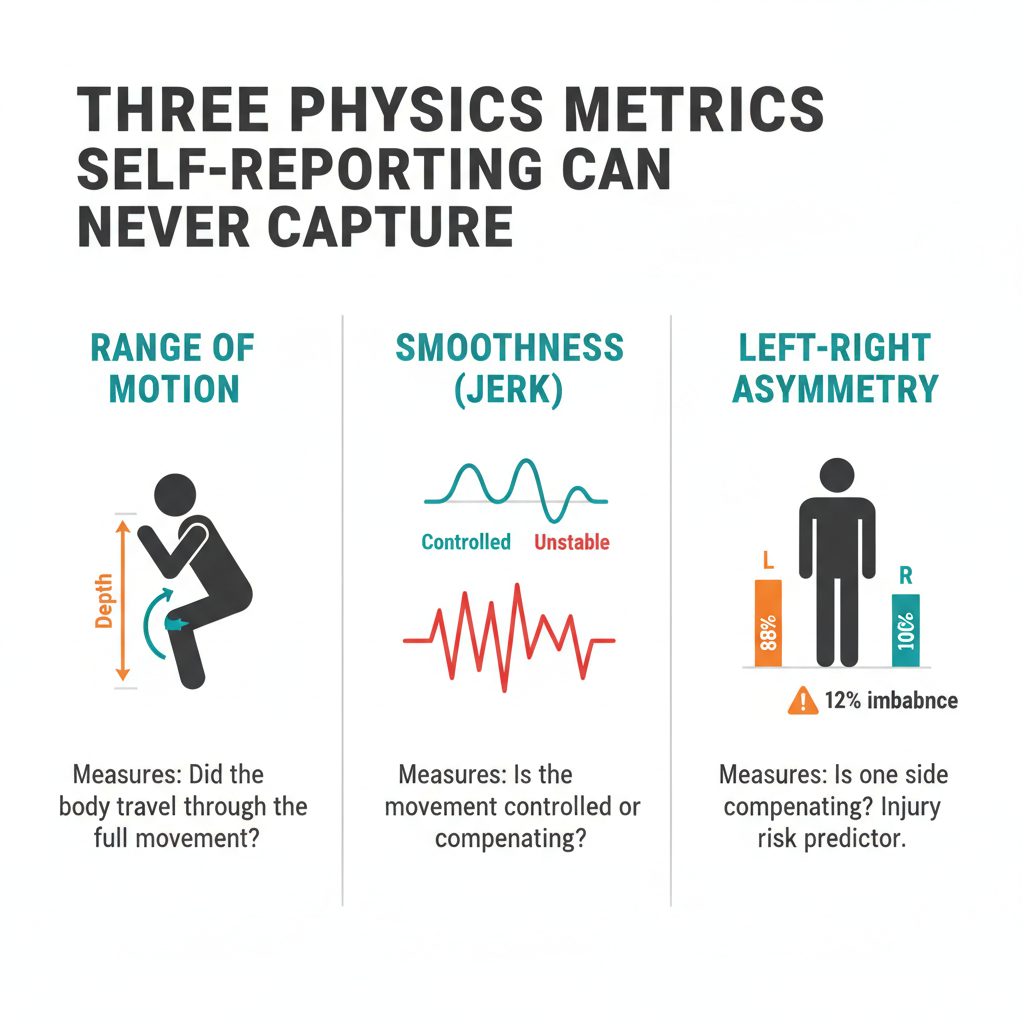
Counting reps is necessary but not sufficient. Someone can log 50 "pushups" with one-inch range of motion. Our quality scoring system extracts three physics-based metrics from the TCN-filtered signal, and each captures something self-reporting never could.
The first is range of motion. Peak detection on key joint trajectories measures whether the body traveled through the full movement — for a squat, whether the hip descended past the knee line. If the signal inflection point occurs too high, the rep is flagged as insufficient depth, not as an opinion but as a measurement of physical displacement.
Then there is smoothness, quantified through Log Dimensionless Jerk — a biomechanics metric that captures how controlled the movement is. Jerk is the third derivative of position (the rate of change of acceleration), and high values indicate tremors, instability, or momentum-cheating. This is a critical injury-risk predictor that no questionnaire could surface.
Finally, the system compares signal energy between left and right sides to produce an asymmetry index. When someone favors one leg during squats — often a precursor to injury or a sign of incomplete rehabilitation — the imbalance shows up in the data. You cannot self-report a 12% left-right power difference. It must be measured.
What This Changes for Insurers, Employers, and Clinicians
When exercise data becomes physics-verified, it transforms from a feel-good metric into an auditable asset — what we call Proof of Physical Work.
For insurers, this means moving from static risk tables to dynamic underwriting. A policyholder performs a two-minute functional movement screen through the insurer's app — five squats, five lunges, a balance hold. The TCN scores stability, range of motion, and symmetry. These correlate strongly with fall risk and general metabolic health, enabling premium adjustments based on verified functional capacity rather than age-and-gender tables.
For employers spending billions on corporate wellness, it eliminates the "cheater's dividend." When the only way to increment the counter is to perform the physical work, incentive budgets actually drive health outcomes instead of subsidizing phone-shaking.
For clinicians, it solves the compliance crisis in tele-rehabilitation. Musculoskeletal disorders are a top cost driver for employers, and home exercise adherence is notoriously below 50%. Our TCN monitors the specific joint angles prescribed by the clinician and delivers a dashboard of verified compliance and quality trends — enabling intervention when the data shows a patient struggling, not weeks later at the next appointment. Remote Therapeutic Monitoring is now a reimbursable CPT code (Current Procedural Terminology — the billing classification system for medical services) in the US, creating a direct revenue stream for providers using verified technology.
"But Can't Someone Still Game the System?"
The honest answer: the barrier to fraud becomes physical effort. To fake a pushup on a physics-verified system, you would need to build a biomechanically accurate humanoid robot — or just do the pushup. Our roadmap includes few-shot personalization, where the TCN adapts to an individual's specific movement signature after just a few reps, creating a biometric fingerprint that would reject a valid pushup if it determines someone else performed it.
Privacy is the other reasonable concern. Our architecture is edge-first by design. The mobile device runs a lightweight pose estimator on its neural processing unit, extracts skeletal coordinates, and immediately discards the video frames. No pixel data ever leaves the user's device. What gets transmitted is anonymous kinematic data — joint angles and trajectories — which is GDPR (the EU's General Data Protection Regulation) and HIPAA (the US health data privacy law) compliant by construction.
The digital health industry has spent a decade building systems that assume consumption equals completion. The correction is not more engagement features or better gamification. It is physics. When you can verify what the human body actually did, you can build incentive systems, insurance models, and clinical protocols that work — because they are grounded in measurement, not trust.
If your organization ties real value to physical activity data, the question worth asking is: how much of that data would survive an audit? If that question resonates — or if you are already navigating the gap between wellness spend and verified outcomes — we would welcome the conversation.