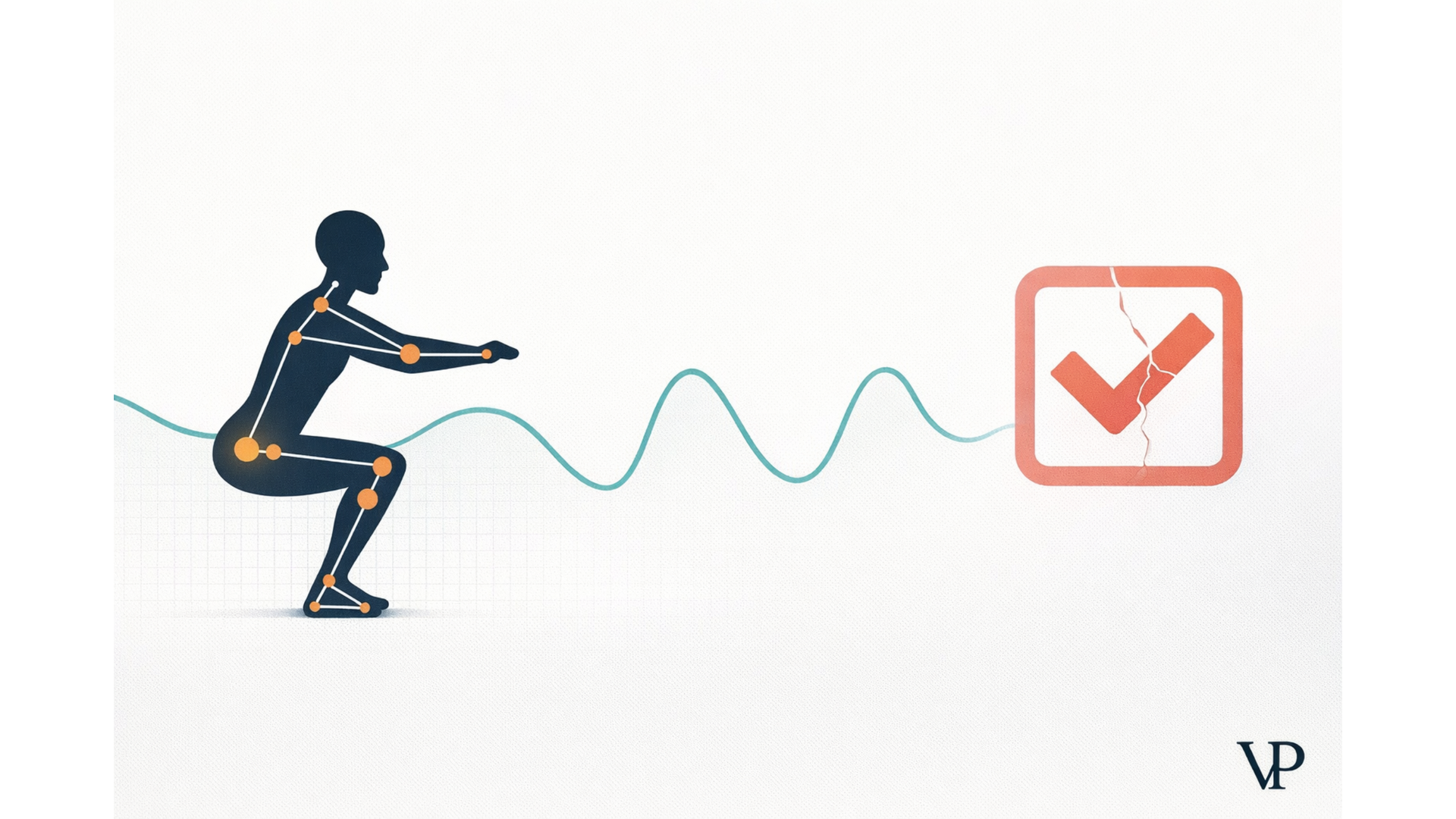
A billion-dollar industry is paying people for workouts they never did. Corporate wellness programs, insurance discount schemes, move-to-earn apps — they all share the same dirty secret: nobody is checking whether the exercise actually happened. The user clicks "complete," the app logs it, and everyone pretends the data is real.
I've spent the last two years obsessed with this problem. Not the AI problem everyone else is chasing — generating text, generating images, generating code. I'm focused on something less glamorous but, I'd argue, far more consequential: verifying physical reality. The question that drives everything we build at Veriprajna is deceptively simple. Did this person actually do the work?
The answer, for nearly every fitness app on the market today, is: we have no idea.
The Video Player Problem Nobody Talks About
Most "AI-powered" fitness apps are, architecturally, just video players. They serve you a workout video. You're supposed to follow along. When the video ends, the app marks it complete, estimates your calorie burn from a generic table, and hands you a badge.
Think about what's actually being measured here: consumption, not completion. You could watch that 20-minute HIIT session from your couch with a bag of chips. The app wouldn't know the difference. It logged the activity as done because the video finished playing, not because your body moved.
This isn't a minor UX flaw. It's a structural failure that cascades through every system built on top of that data — insurance pricing, corporate wellness ROI, rehabilitation compliance tracking. When the foundation is "vibes," everything above it is fiction.
I explored this problem in depth in our interactive analysis, and the pattern is consistent across every sector we examined.
When You Reward Metrics, People Hack Metrics
There's a principle in sociology called Campbell's Law that changed how I think about this entire space. It says: the moment you attach real value to a measurement — money, insurance discounts, status — that measurement stops reflecting reality and starts reflecting people's creativity at gaming it.
The evidence is everywhere. Employees strap Fitbits to ceiling fans to hit step targets and claim Health Savings Account contributions. Users in move-to-earn crypto projects spoofed GPS signals with mechanical shakers. The early Web3 fitness project STEPN collapsed in part because the arms race between detecting real movement and simulating it was unwinnable with GPS alone.
You cannot gamify what you cannot verify.
This isn't cynicism about human nature. It's just physics meeting incentives. If the only barrier between a user and a reward is clicking a button or shaking a device, a meaningful percentage will take the shortcut. And that "Cheater's Dividend" poisons the entire system — honest participants disengage, employers waste budgets, and the data becomes worthless.
Why Pose Estimation Alone Isn't the Answer
When I first started talking about this problem, the most common response was: "Just use pose estimation. OpenPose, BlazePose, MoveNet — they can track the body."
They can. But tracking and verifying are completely different things.
Pose estimation libraries extract the x, y, z coordinates of your skeletal joints from a video feed. That's it. They're sensors, not intelligence. Handing someone raw joint coordinates and asking "was that a good pushup?" is like handing someone a raw voltage reading from a heart monitor and asking for a diagnosis.
A single frame of someone with bent elbows tells you nothing. Are they lowering into a pushup? Pushing back up? Holding an isometric position? Trembling with fatigue? Exercise isn't a snapshot — it's a process that unfolds over time. The quality lives in the temporal pattern, not any individual frame.
This is where my team and I made a bet that felt counterintuitive at first. We stopped thinking about exercise as a computer vision problem and started treating it as a signal processing problem.
Human Motion Is a Waveform
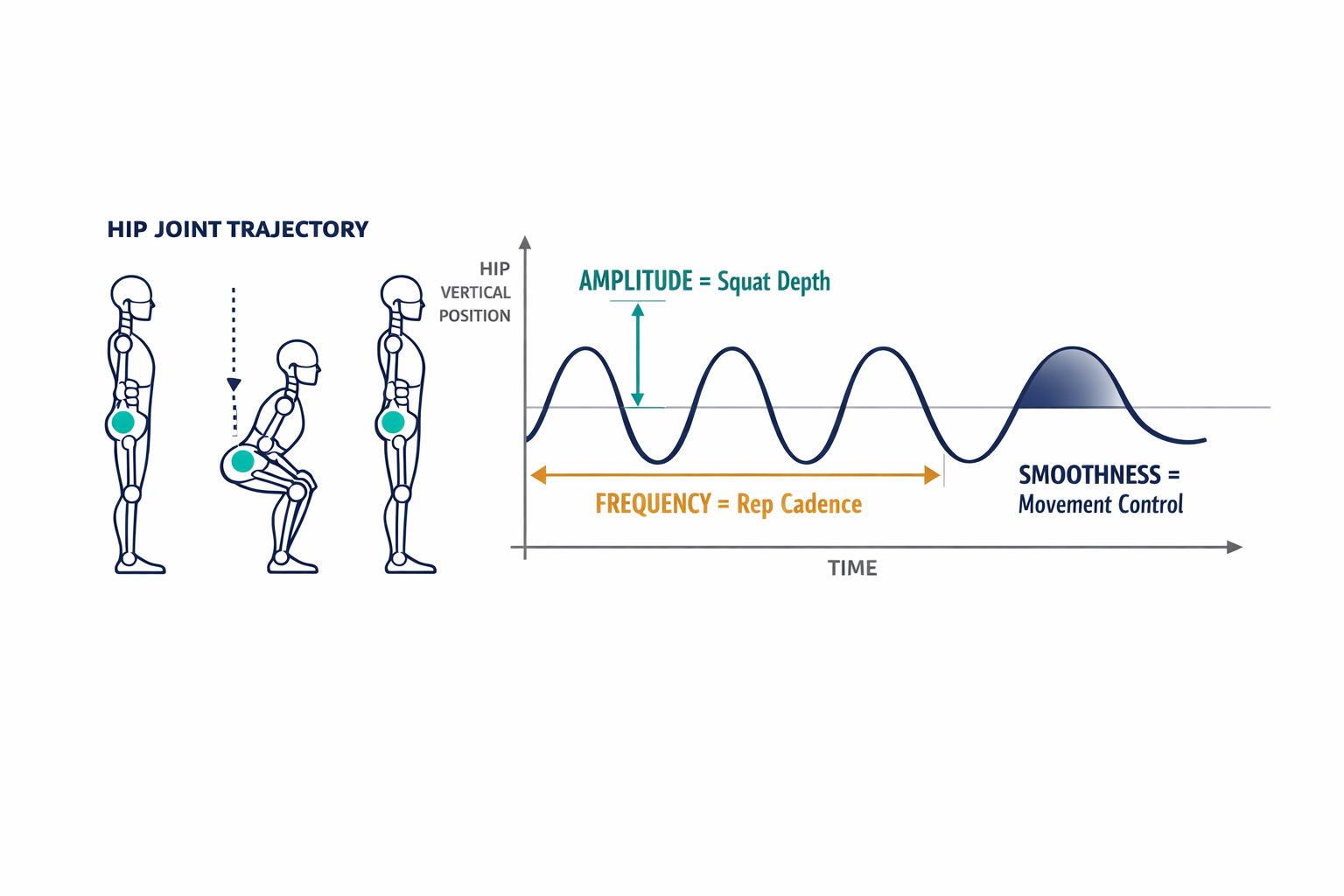
The moment that reframed everything for me was watching a squat on a graph instead of a screen. When you plot the vertical position of someone's hip joint over time during a set of squats, you don't see a series of images. You see a wave — a sinusoidal signal, rising and falling with each rep.
Jumping jacks produce a periodic waveform in shoulder angular velocity. Walking generates complex multi-harmonic signals across the lower body. The human body performing repetitive exercise is, mathematically, a mechanical oscillator.
Once you see movement as a signal, a powerful toolkit opens up. You can measure amplitude — how deep was that squat? Frequency — what's the cadence? Phase — are the left and right sides coordinated? Spectral purity — is the movement smooth and controlled, or jerky and compensating?
We stopped asking AI to guess what exercise was happening. We started measuring the physics of the waveform.
But raw signal processing techniques like Fourier Transforms are brittle in the real world. People change speeds mid-set. Camera angles shift. Limbs get occluded. We needed deep learning — not to classify images, but to learn temporal signals.
Why We Chose TCNs Over Everything Else
This is where I need to get slightly technical, but I promise it matters.
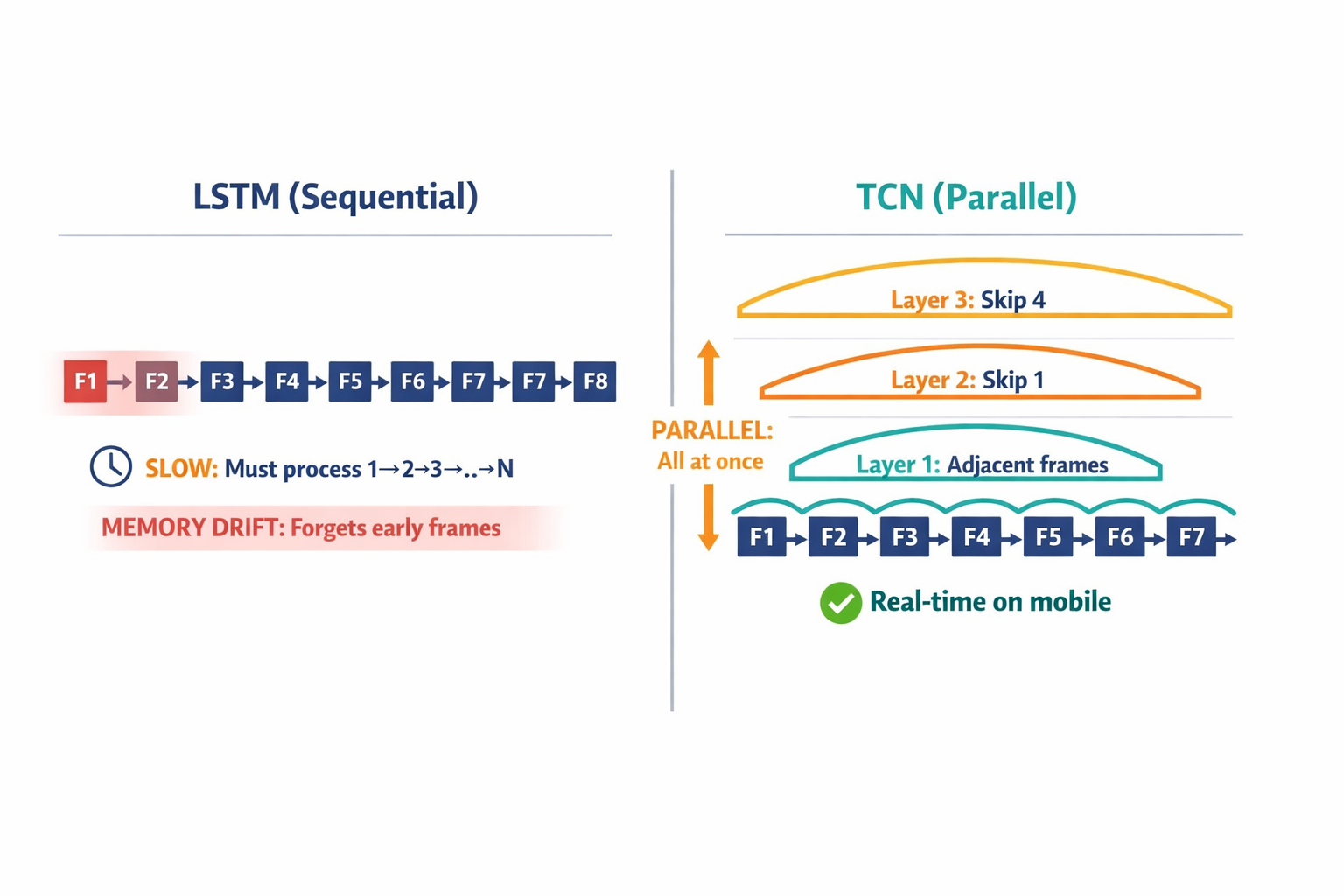
For years, the default architecture for processing sequences — text, audio, time-series data — was the LSTM (Long Short-Term Memory) network, a type of recurrent neural network. LSTMs process data one step at a time: to understand frame 100, they must first compute frames 1 through 99, sequentially.
We tried them. Three problems killed it for us.
Latency was unacceptable. That sequential processing creates a bottleneck on mobile devices. You can't give someone real-time feedback on their squat form if the model is still crunching frame 47 when they're on frame 100.
Memory drifted. LSTMs struggle to retain context over long sequences. A 5-minute yoga flow or a 50-rep pushup set generates thousands of frames. By the end, the model had effectively forgotten the beginning. The quality assessment became unreliable.
Scale was prohibitive. For enterprise clients processing thousands of concurrent user streams, the computational cost of maintaining LSTM hidden states made the economics impossible.
So we built our verification engine on Temporal Convolutional Networks — TCNs. Instead of processing the signal step-by-step, TCNs apply convolutional filters across the time dimension, similar to how image recognition networks scan across pixels. The critical innovation is something called dilated convolutions: the filter's field of view grows exponentially with each layer of the network. Layer 1 sees adjacent frames. Layer 2 skips one frame. Layer 10 spans 512 frames.
The practical result: our TCN can simultaneously evaluate whether your knee is collapsing inward right now (instantaneous physics) and whether your movement pattern is degrading compared to three minutes ago (long-term fatigue curve). It does this in parallel, not sequentially, which means it runs fast enough for real-time feedback on a phone.
For the full technical methodology behind our architecture choices, see our detailed research.
Counting Reps Without Knowing the Exercise
One of the things I'm most proud of is something that sounds mundane: counting.
Traditional fitness apps train a specific model for each exercise. A "pushup counter," a "squat counter," a "lunge counter." Every new exercise variation requires new training data, new models, new maintenance. It's brittle and doesn't scale.
We took a different approach using something called Temporal Self-Similarity Matrices. The TCN maps each frame's pose into a compressed representation, then computes how similar every frame is to every other frame. When someone performs a repetitive movement, a distinctive pattern emerges in that matrix — parallel lines of high similarity, like the teeth of a comb.
The distance between those lines tells us the duration of each rep. The intensity tells us how consistent the reps are. By integrating these signals over time, we get a precise count that's robust to speed changes, pauses, and non-standard form.
The system doesn't detect pushups. It detects the physics of repetition itself.
Kettlebell swings, rowing strokes, specialized rehab movements — the engine handles them all without exercise-specific training. That was the moment my team realized we'd built something fundamentally different from a classifier.
The Metrics That Actually Matter
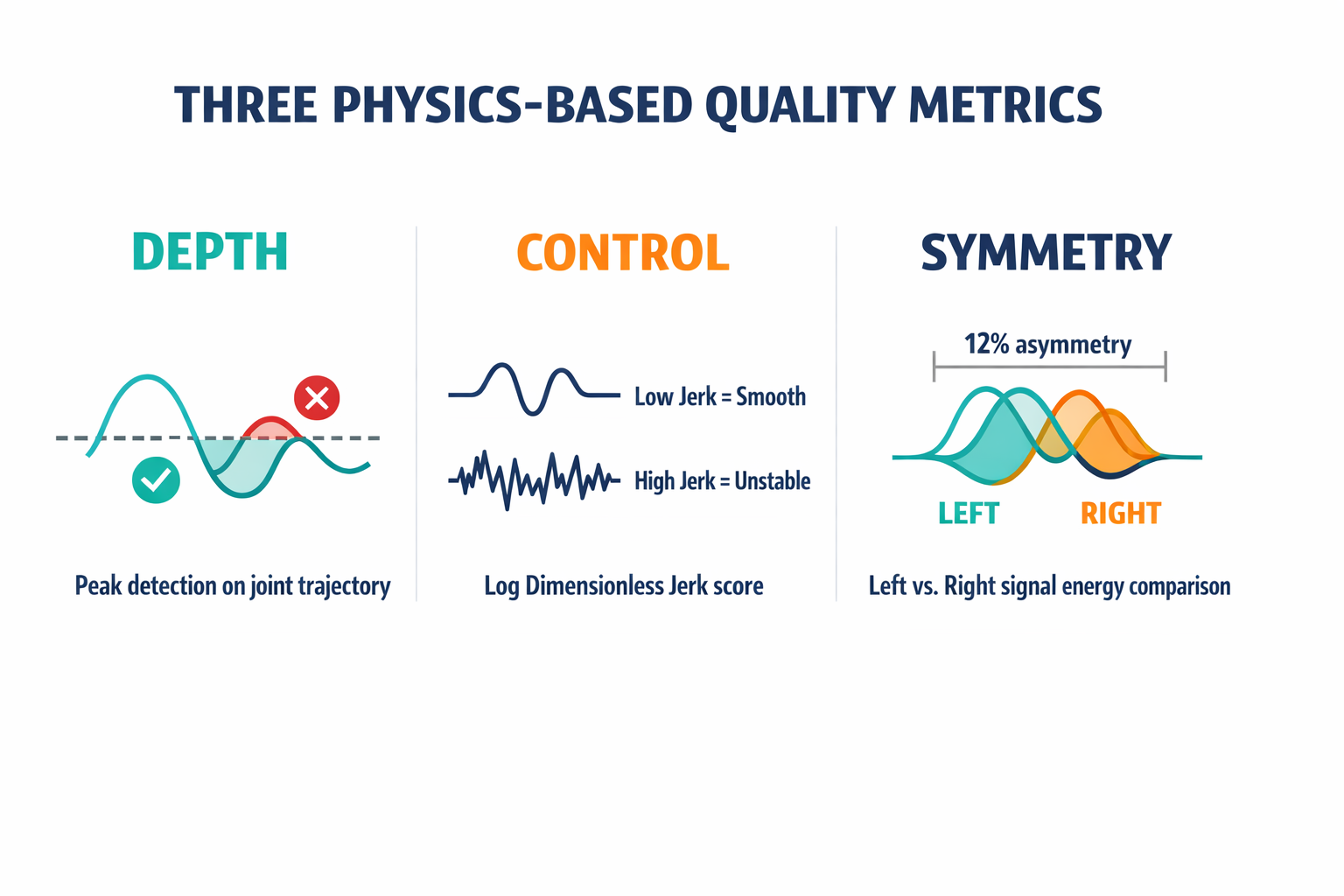
Counting alone isn't enough. Someone can do 50 "pushups" with one inch of range of motion. So we extract three physics-based quality metrics from the signal.
Depth is measured through peak detection on the joint trajectory. For a squat, the hip must descend below a biomechanical threshold relative to the knee. If the signal inflection occurs too high, the rep is flagged as insufficient. Not an opinion — a displacement measurement.
Control is quantified through something called Log Dimensionless Jerk — essentially, how smooth the movement is. Jerk is the rate of change of acceleration, and high jerk values indicate tremors, instability, or someone using momentum to cheat through a rep. This metric is a strong predictor of injury risk, which matters enormously in corporate wellness and rehabilitation.
Symmetry compares the signal energy between left and right sides. An asymmetry index reveals when someone is favoring one leg during squats — often a precursor to injury or a sign of incomplete rehabilitation. This is data that's impossible to self-report. You can't feel a 12% asymmetry. But the signal can measure it.
Privacy by Architecture, Not by Promise
I want to address something that comes up in every enterprise conversation: privacy.
We never see the video. Our system runs a lightweight pose estimator on the device's neural processing unit, extracts only skeletal coordinates — a few kilobytes of anonymous numerical data — and immediately discards the video frames. No pixel data ever leaves the user's phone.
What reaches our cloud engine (or stays on-device for high-end phones) is purely kinematic: joint angles and positions over time. You can't reconstruct a face from it. You can't identify a person from it. GDPR and HIPAA compliance isn't a feature we added — it's a consequence of the architecture.
What This Unlocks
The transition from unverifiable to verified exercise data isn't incremental. It creates entirely new economic possibilities.
For insurers, it means dynamic underwriting based on actual functional capacity. A two-minute movement screen — five squats, five lunges, a balance hold — scored by the TCN for stability, range of motion, and symmetry, correlates with fall risk and metabolic health far better than a gym membership receipt.
For employers, it eliminates the fraud that plagues the $60 billion corporate wellness industry. When incentives are tied to verified active minutes instead of self-reported steps, the barrier to cheating becomes physical effort. To fake a pushup on our system, you'd essentially need to build a humanoid robot — or just do the pushup.
For rehabilitation, it gives clinicians something they've never had: verified compliance data between appointments. Patient adherence to home exercises is notoriously below 50% when self-reported. Our system monitors the specific joint angles prescribed by the clinician and flags when form degrades. Remote Therapeutic Monitoring is now a reimbursable CPT code in the US, creating a direct revenue stream for providers using verified technology.
A verified rep isn't just a data point. It's an auditable asset — timestamped, scored, and immutable.
But What About Generative AI?
I get asked constantly whether we're "using ChatGPT" or building on top of LLMs. The honest answer: no, and deliberately so.
Large Language Models are designed to produce the most likely next token. They're probabilistic — optimized for plausibility, not truth. That's transformative for writing, coding, and creative work. But in physical health, plausibility is a liability. A rehabilitation protocol can't be based on a hallucination. An insurance premium adjustment can't rest on a prediction of what someone probably did.
We're building in the opposite direction. Not generation — verification. Not what's likely — what's physically true. I think the AI industry's overwhelming focus on generative models has created a blind spot around verification technology, and that blind spot is where some of the most important work needs to happen.
Can This Really Stop Sophisticated Fraud?
Fair question. No system is perfectly fraud-proof, but the economics shift dramatically. Spoofing GPS or shaking a pedometer costs nothing. Fooling a system that analyzes the biomechanical signature of your movement — joint trajectories, smoothness, symmetry, fatigue curves — requires replicating human physics. The cost-benefit calculation for cheating collapses.
We're also developing few-shot personalization: after a handful of reps, the system learns your specific biomechanics. Eventually, it won't just verify that a valid pushup happened — it will verify that you did it. That's the path toward what we're calling biometric movement fingerprinting.
The Bet We're Making
I'll be direct about our thesis: the digital health economy is sitting on a foundation of unverifiable data, and the companies that figure out verification will define the next decade of this industry. Not the ones generating the most engaging content. Not the ones with the best recommendation algorithms. The ones who can answer, with mathematical certainty, whether the physical work actually happened.
Physics is the only API that matters.
If you're building in health tech, insurance, or corporate wellness and wrestling with data integrity, I'd genuinely like to hear how you're approaching the verification problem. It's a harder conversation than most people want to have, but I think it's the right one.