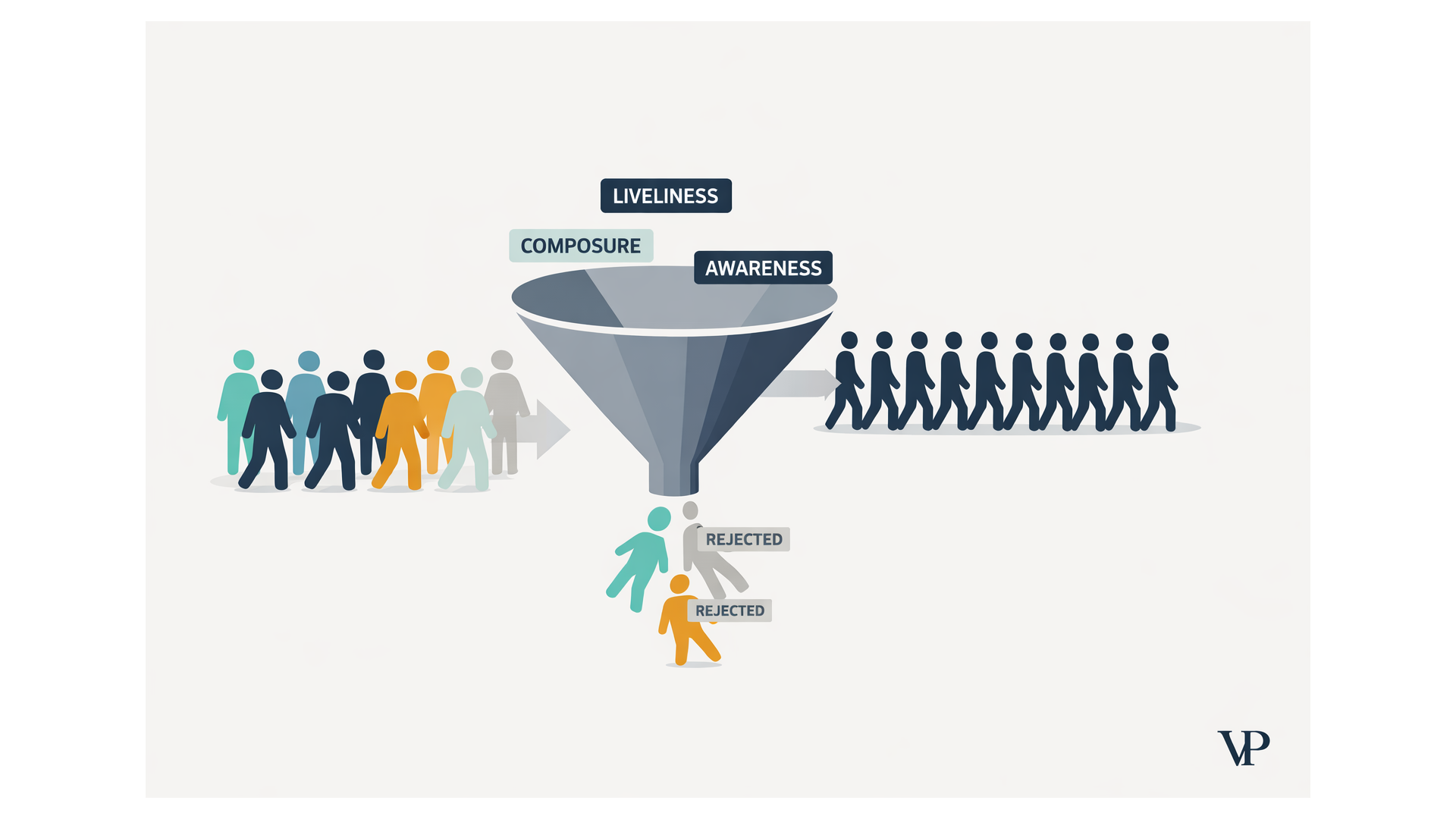
A hiring tool used by major corporations asks candidates whether they're "reserved" or "outgoing," "stoic" or "compassionate," "consistent" or "flexible." It scores their answers with an algorithm. Then it rejects qualified candidates — disproportionately those who are autistic, have ADHD, or live with anxiety disorders. The tool's marketing materials promise it "improves diversity" and has "no adverse impact."
That's the core allegation in a 2024 ACLU complaint to the Federal Trade Commission against Aon Consulting, one of the largest providers of AI-powered hiring assessments in the world. And it exposes a problem that goes far beyond one company: the personality traits these tools measure overlap so closely with clinical diagnostic criteria for autism and mental health conditions that they function as stealth medical exams — something the Americans with Disabilities Act explicitly prohibits.
We've spent months analyzing the technical architecture behind these tools, the regulatory response, and what it actually takes to build hiring AI that doesn't discriminate by design. What we found should concern every company using algorithmic screening in their talent pipeline.
The Tool That Scores You on Being Neurotypical
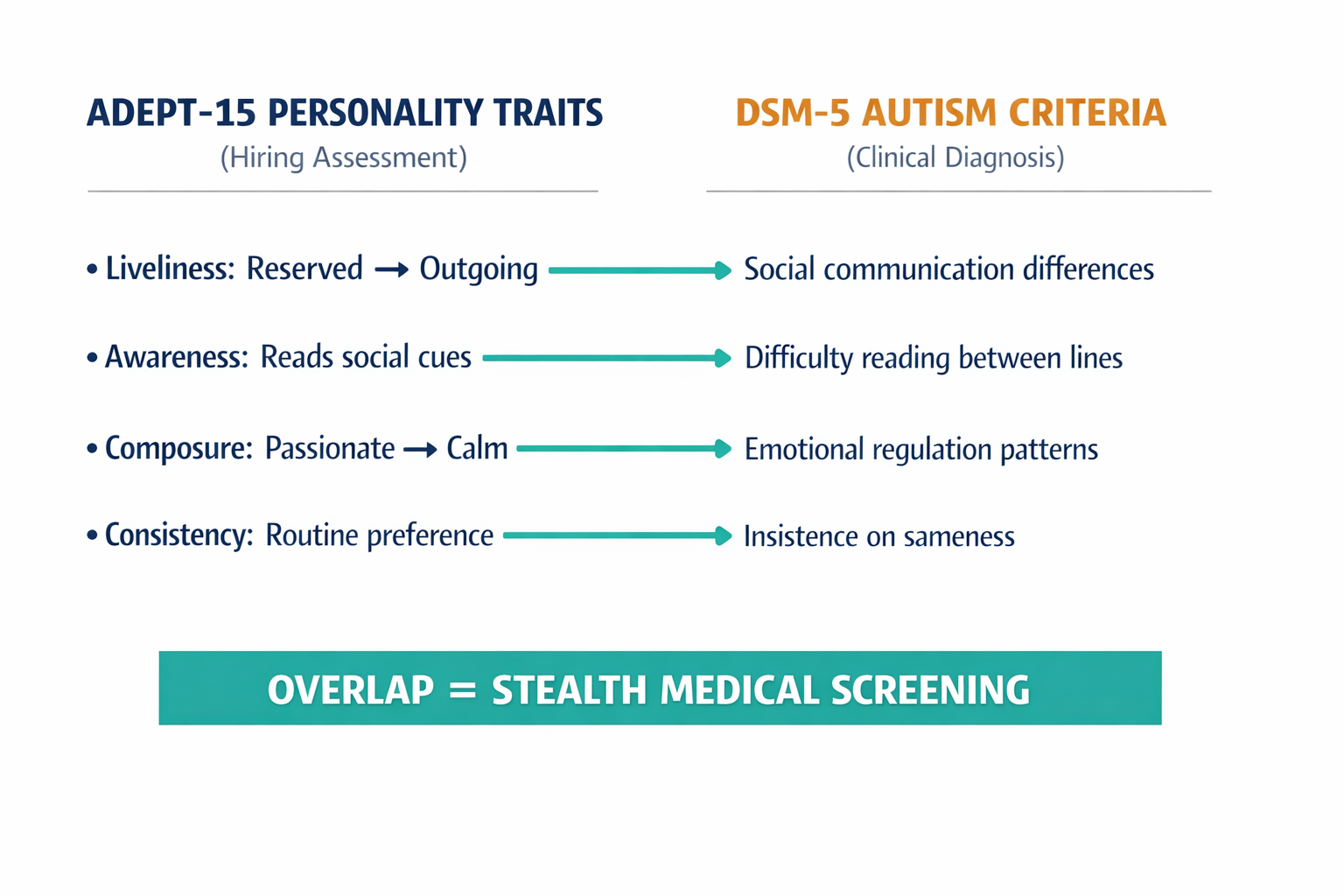
Aon's flagship assessment, ADEPT-15, evaluates candidates across 15 personality dimensions — traits like "Liveliness," "Awareness," "Positivity," and "Composure." It uses a technique called Computer Adaptive Testing, where the questions change in real time based on your previous answers, drawing from a pool of 350,000 unique items.
On the surface, it looks like a sophisticated personality quiz. Underneath, it's an algorithm that rewards a very specific kind of person.
Consider what "Liveliness" actually measures: the spectrum from "reserved" to "outgoing." Or "Awareness," which tracks how well someone reads social cues and "reads between the lines." Or "Composure," which scores you on a scale from "passionate" to "calm."
Now consider what the Autism Spectrum Quotient — a standard clinical screening tool — measures: social skills, communication patterns, attention shifting, and emotional regulation.
When an algorithm penalizes "reserved" and rewards "socially bold," it isn't measuring job performance. It's measuring how neurotypical you appear.
The overlap isn't subtle. The ACLU mapped Aon's personality constructs against DSM-5 diagnostic criteria and found that traits like flat affect, preference for routine, intense focus on details, and difficulty with social reciprocity — all hallmarks of autism — would systematically produce lower scores. A candidate could be perfectly qualified for the role and still get screened out because the algorithm interpreted their neurology as a personality deficiency.
The Video Interview Problem Gets Worse
Aon doesn't stop at questionnaires. Their vidAssess-AI platform records candidates answering interview questions on video, then uses natural language processing to score the responses against those same 15 personality dimensions.
This creates what researchers call "double jeopardy" for neurodivergent candidates. The AI judges both the content of your answer and a machine-interpreted version of your personality based on how you speak. NLP models are trained overwhelmingly on neurotypical speech patterns. An autistic candidate whose speech includes flat intonation or atypical pauses may be scored as "lacking confidence." A candidate with ADHD whose answers follow a non-linear structure may register as "disorganized."
The third tool in the suite, gridChallenge, is a gamified memory test that layers "distractor tasks" on top of cognitive exercises. It's marketed as increasing "candidate engagement." For someone with sensory processing differences, those distractors can trigger overload that has nothing to do with their ability to do the job.
We explored the full technical architecture of all three tools — including how adaptive testing, NLP scoring, and gamified cognition interact to compound bias — in our interactive analysis.
"Bias-Free" Is Now a Legal Liability
For years, AI hiring vendors operated in a regulatory gray zone. They could claim their tools were "bias-free" without providing evidence. That era is over.
The FTC complaint against Aon is part of a broader enforcement initiative called Operation AI Comply. The agency's position is now explicit: overstating an AI product's capabilities without adequate evidence is deceptive under Section 5 of the FTC Act. They've already fined DoNotPay $193,000 for unsubstantiated AI claims and taken action against Rytr for AI-generated fake reviews.
The EEOC has reinforced that employers — not just vendors — are legally responsible for discrimination caused by the AI tools they purchase. Under the ADA, any selection criterion that screens out individuals with disabilities must be "job-related and consistent with business necessity." Measuring "liveliness" for an accounting role doesn't meet that bar.
The "black box" defense — claiming a tool is fair because it was trained on big data — is no longer legally or ethically tenable.
State-level regulation is accelerating too. New York City's Local Law 144 already requires annual independent bias audits for automated employment decision tools. More jurisdictions are following.
The message to enterprises is blunt: if your vendor can't explain why their algorithm rejected a candidate, you're deploying a legal liability.
Why Off-the-Shelf AI Can't Fix This
Many companies assume they can solve bias by adding a fairness layer on top of an existing AI model — what the industry calls a "wrapper." Pass candidate data through GPT-4 or a similar foundation model, add some guardrails, and ship it.
This doesn't work, and the reason is structural.
Foundation models are trained on internet-scale data that reflects decades of neurotypical and racial preferences in hiring. Research from Duke University found that large language models systematically associate neurodivergent terms with negative connotations. In one striking finding, the phrase "I have autism" was rated by these models as more negative than "I am a bank robber."
When these same models power hiring tools through an API, they embed those associations into recruitment decisions without anyone intending it. And because the models learn from their own outputs over time, bias compounds. Marginalized groups get screened out, which produces training data showing they're "less qualified," which screens them out more aggressively in the next cycle.
A wrapper around a biased model doesn't remove bias. It scales it.
Breaking this cycle requires a fundamentally different approach — one that understands not just correlations in the data but the causal relationships between candidate traits, protected characteristics, and actual job performance.
What Rigorous AI Hiring Actually Requires
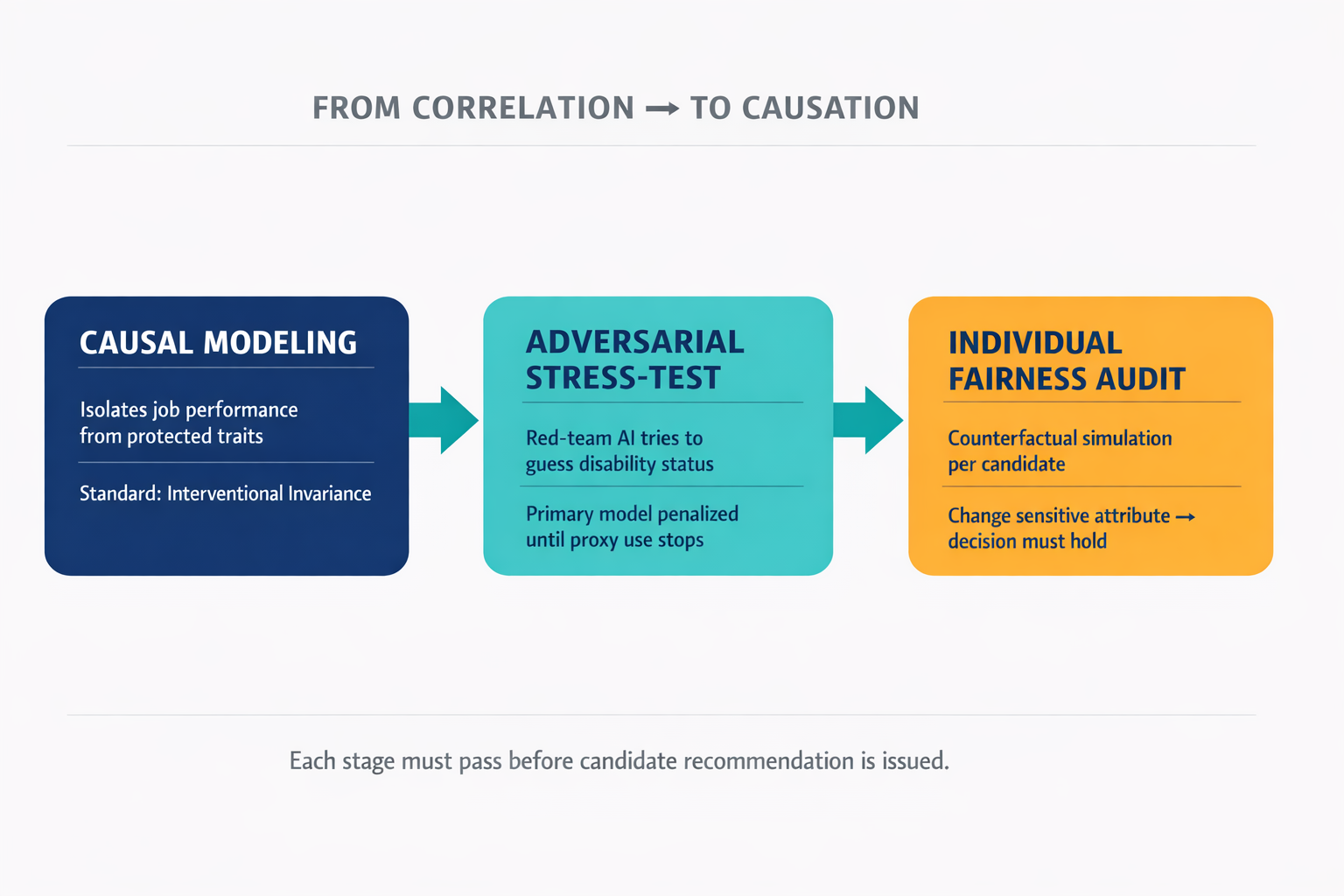
Our team has identified three technical capabilities that separate hiring AI built for compliance from hiring AI built for fairness.
Causal modeling instead of correlation. Traditional AI finds patterns: candidates who score high on "liveliness" tend to get hired, so the model learns to favor lively candidates. But that correlation may exist because hiring managers have historically preferred neurotypical social styles — not because liveliness predicts performance. Causal Representation Learning identifies these hidden pathways and mathematically isolates the decision from protected characteristics. The technical standard is called "interventional invariance": the model's recommendation shouldn't change even if you hypothetically altered a candidate's disability status while holding everything else constant.
Adversarial stress-testing. Think of it as a bias red team. A secondary AI model continuously tries to guess a candidate's protected characteristics from the primary model's internal data. If it succeeds, the primary model is still using disability or race as a hidden input — and gets penalized until it stops. This is especially critical for video and personality assessments where behavioral signals can serve as proxies.
Individual-level fairness auditing. Most bias audits check group-level statistics: "Did we hire roughly proportional numbers from each demographic?" That's necessary but insufficient. Counterfactual simulation generates synthetic variations of a real candidate's profile — changing only their sensitive attribute — to verify the AI's recommendation stays consistent for each individual, not just in aggregate.
For the full technical methodology behind these approaches, including our Structural Causal Model framework and adversarial debiasing architecture, see our detailed research.
Designing for Brains That Work Differently
Technical debiasing is necessary but not sufficient. The assessment experience itself needs to be rebuilt from the ground up.
Most AI hiring tools are designed around a "deficit model" of disability — they treat neurodivergent traits as problems to be scored down. A better approach starts from a different premise: neurological differences are natural variations in how human brains work, and many of them — intense focus, pattern recognition, creative problem-solving — are exactly what companies need.
Practically, this means several things:
Temporal flexibility. A longer response time in a video interview may reflect deeper cognitive processing, not incompetence. AI should learn what "normal" looks like for each individual candidate rather than comparing everyone to a neurotypical average.
Audio-only options. Disabling facial analysis and scoring only transcribed content removes the majority of bias against neurodivergent candidates while preserving the efficiency benefits of AI-powered interviews.
Genuine opt-out mechanisms. Every automated assessment should include a clear, penalty-free path to request a human alternative or reasonable accommodation. This isn't just ethical — it's what the ADA requires.
What About Companies Already Using These Tools?
If your organization currently uses AI-powered personality assessments or video interviews in hiring, the Aon complaint doesn't mean you need to shut everything down tomorrow. But it does mean you need to act.
Start with a simple question: can your vendor explain, for any specific rejected candidate, exactly which factors drove the decision? If the answer is no — or if the answer involves personality traits that sound like they came from a psychology textbook rather than a job description — you have a problem.
Demand independent bias audits, not vendor-provided "model cards." Aon published model cards for all three tools. The ACLU still found systemic discrimination risk. Self-reported fairness metrics are inherently conflicted.
And pressure-test your tools against neurodivergent candidates specifically. Most bias audits focus on race and gender. Disability — particularly non-visible disability like autism, ADHD, and mental health conditions — is routinely overlooked. Yet it may be where the most severe algorithmic discrimination is hiding.
The Talent You're Filtering Out
This isn't just a compliance story. It's a competitive intelligence story.
Neurodivergent individuals bring extraordinary capabilities in pattern recognition, sustained attention to detail, and creative problem-solving. Companies like SAP, Microsoft, and JPMorgan have built dedicated neurodiversity hiring programs precisely because they've discovered these employees outperform in specific roles.
An AI tool that systematically screens for neurotypical social performance isn't protecting your company from bad hires. It's filtering out the candidates most likely to see what everyone else misses.
The cost of "cheap" AI isn't the subscription fee. It's the talent you never knew you lost and the lawsuit you didn't see coming.
The ACLU complaint against Aon is a signal flare for the entire enterprise ecosystem. The question isn't whether your AI hiring tools contain bias — research suggests most of them do. The question is whether you've done the engineering work to find it, measure it, and remove it before a regulator or a plaintiff does it for you.
We'd welcome hearing from teams navigating this challenge — particularly those who've attempted bias audits on personality-based assessments and discovered gaps between vendor claims and reality.