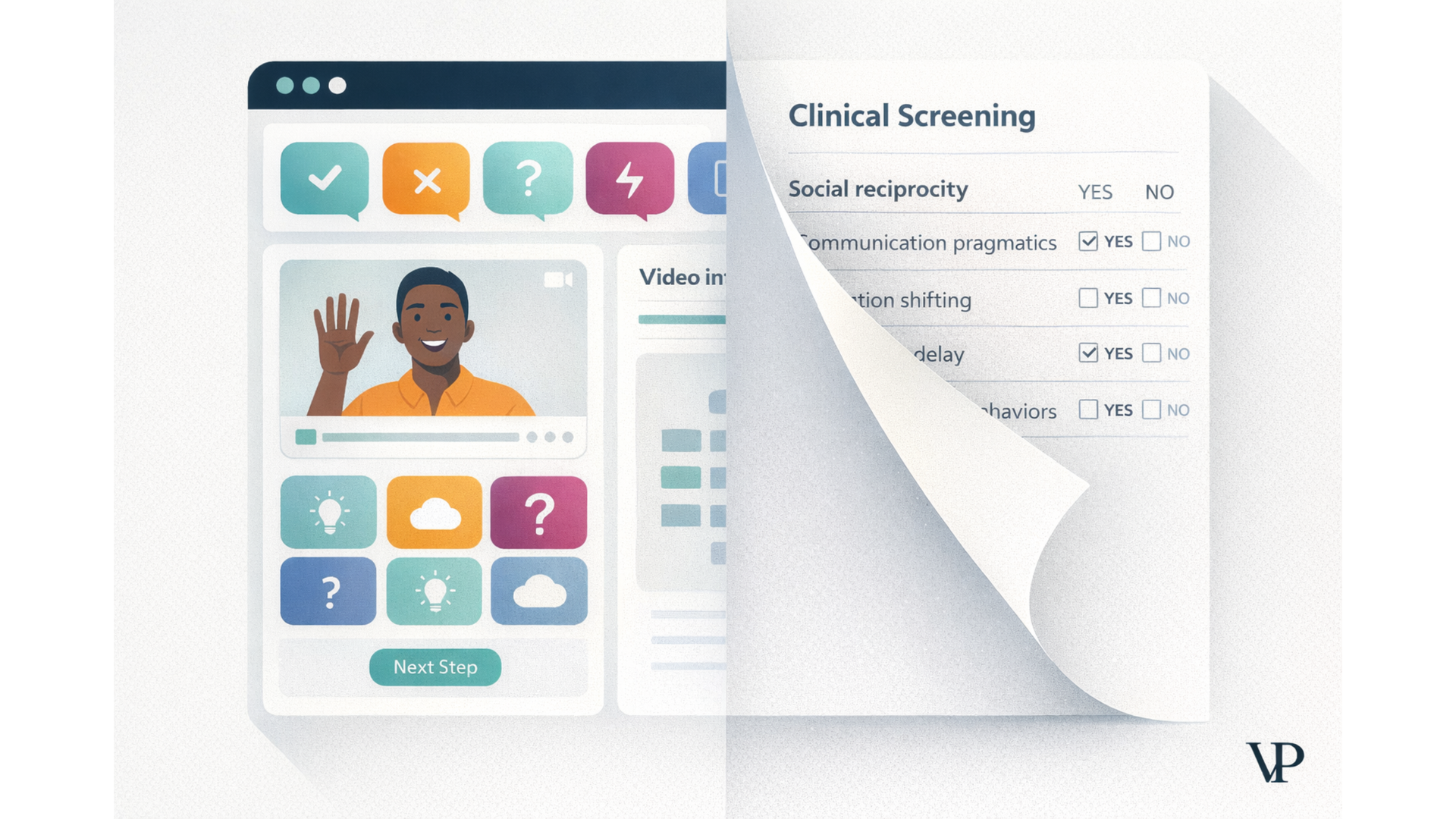
When the ACLU filed a formal complaint with the Federal Trade Commission against Aon Consulting in May 2024, they made a claim that stopped me cold: that Aon's AI-powered hiring assessments — used by major enterprises to screen thousands of candidates — were effectively running disguised disability diagnostics. Not personality tests. Not job-fit evaluations. Medical screenings dressed up as gamified questionnaires and video interviews, systematically filtering out autistic candidates and people with mental health conditions without ever asking about diagnosis.
I've spent years building AI systems that enterprises trust with high-stakes decisions. When I read the full complaint and Aon's own model documentation, I realized this wasn't a story about one vendor cutting corners. It was a structural failure baked into how the entire hiring-tech industry thinks about "personality" and "bias-free" AI. And it's a failure that most HR leaders and CTOs have no idea they're exposed to.
The "Bias-Free" Promise That Wasn't
Aon marketed its tools — a personality test called ADEPT-15, a video interview scorer called vidAssess-AI, and a gamified memory test called gridChallenge — with bold claims. "Improves diversity." "No adverse impact." The kind of language that makes a CHRO feel safe checking the responsible-AI box and moving on.
The ACLU's complaint alleges something different. It contends that these tools evaluate traits like "positivity," "emotional awareness," and "liveliness" — traits that aren't just vaguely subjective, but that track directly onto clinical diagnostic criteria for autism and various mental health conditions. When an algorithm rewards "socially bold" and penalizes "reserved," it isn't measuring job competence. It's measuring how well someone performs neurotypicality.
An algorithm that penalizes "reserved" behavior isn't measuring job fitness. It's measuring how neurotypical you seem.
That distinction matters enormously, both legally and practically. Under the Americans with Disabilities Act, employers can't use selection criteria that screen out people with disabilities unless those criteria are directly job-related. A "liveliness" score for a data analyst role? That's not job-related. That's a proxy.
When a Personality Test Becomes a Medical Exam
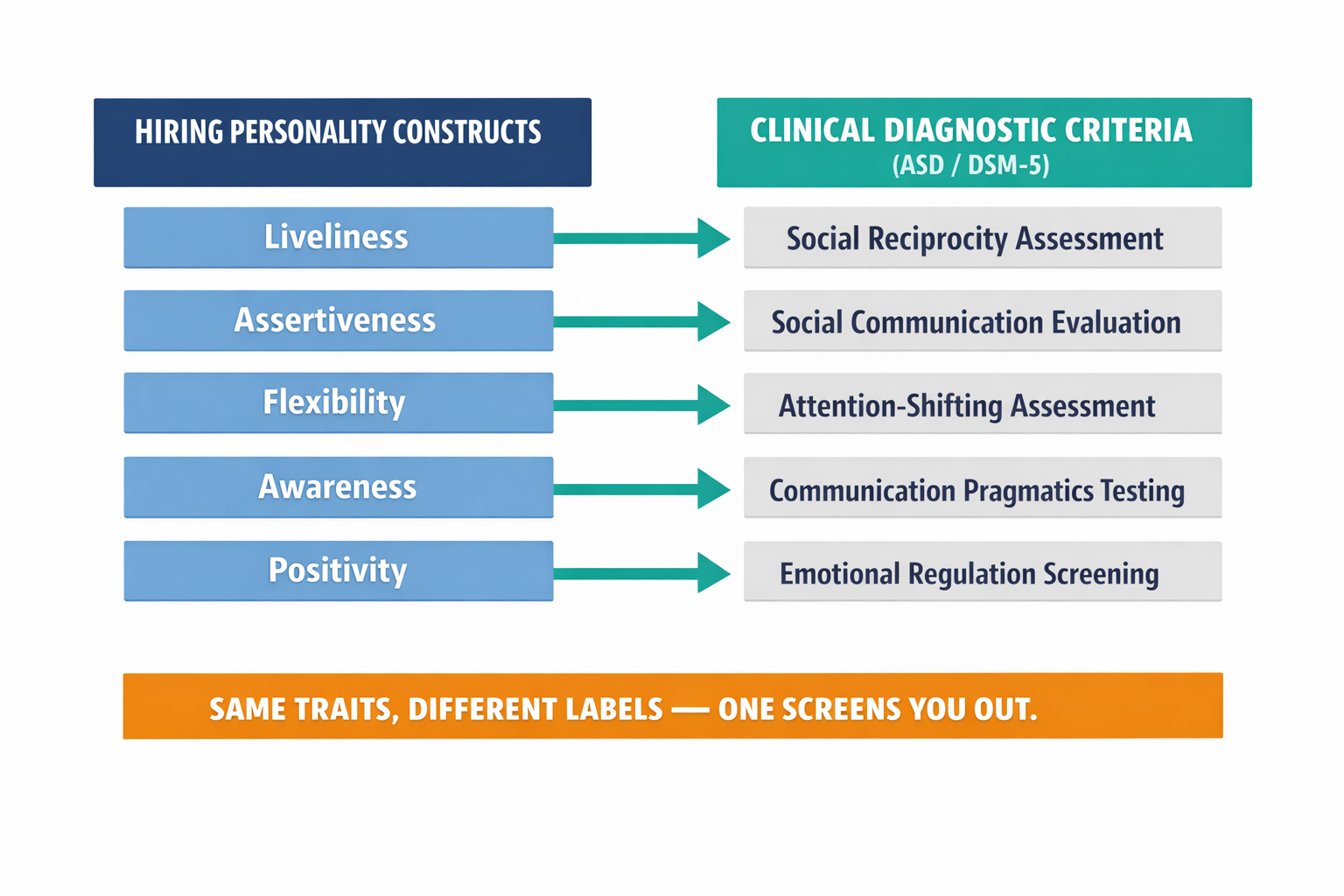
This is the part that kept me up at night. My team mapped Aon's 15 personality constructs against standard clinical tools — the Autism Spectrum Quotient and DSM-5 diagnostic criteria — and the overlap was striking. "Liveliness" and "Assertiveness" correspond to social reciprocity assessments. "Flexibility" maps to attention-shifting evaluations. "Awareness" mirrors communication pragmatics testing.
When a hiring tool asks candidates to choose between statements like "I focus intensely on details" and "I prefer working alone," and then scores those answers against a model trained to favor neurotypical response patterns, it has created a hidden pathway between someone's disability status and whether they get an interview. The algorithm never asks "are you autistic?" It doesn't have to. The math does the screening automatically.
I explored this mapping in depth in our interactive analysis, and the construct-by-construct alignment is difficult to dismiss as coincidence.
The video interview tool compounds the problem. vidAssess-AI uses natural language processing to score spoken responses against Aon's personality model. But NLP models are trained overwhelmingly on neurotypical speech. Flat intonation, atypical pauses, non-linear narrative structures — all common in autistic speech — get interpreted by the algorithm as "lack of confidence" or "disorganization." A candidate faces double jeopardy: judged on the content of their answer and on a machine's biased interpretation of how they said it.
The Regulatory Hammer Is Already Falling
Some executives still treat AI fairness as a reputation issue — something for the CSR report. That era is over.
The FTC's complaint against Aon is part of a broader enforcement initiative called "Operation AI Comply." The agency has made clear that overstating an AI product's capabilities without empirical evidence is legally deceptive under Section 5 of the FTC Act. They've already fined DoNotPay $193,000 for unsubstantiated AI claims and taken action against Rytr for AI-generated fake reviews. The message is consistent: prove your claims or face consequences.
The EEOC is moving in parallel. They've reinforced that employers — not just vendors — bear legal responsibility for discrimination caused by AI tools they purchase. Their recent public hearings explicitly framed automated hiring systems as a "new civil rights frontier," and algorithmic bias is now a top enforcement priority.
"Bias-free" is no longer a marketing claim. It's a legal assertion that regulators expect you to prove with data.
Here's what this means practically for any enterprise using AI in hiring:
Every "bias-free" claim must be backed by empirical evidence — not vendor marketing materials, but independent audits
Candidates must be offered reasonable accommodations — including the ability to opt out of AI screening without penalty
You need to be able to explain why your algorithm rejected someone — the "black box" defense is dead
Annual independent bias audits aren't optional — they're becoming regulatory requirements, as New York City's Local Law 144 already demonstrates
Why the "Wrapper" Approach Can't Fix This
I talk to enterprise leaders regularly who believe they've solved their AI bias problem by choosing a vendor that uses GPT-4 or a similar foundation model with some guardrails layered on top. This is what the industry calls a "wrapper" — you pass data through someone else's model and present the output with your branding.
Wrappers can't solve this problem, and understanding why matters.
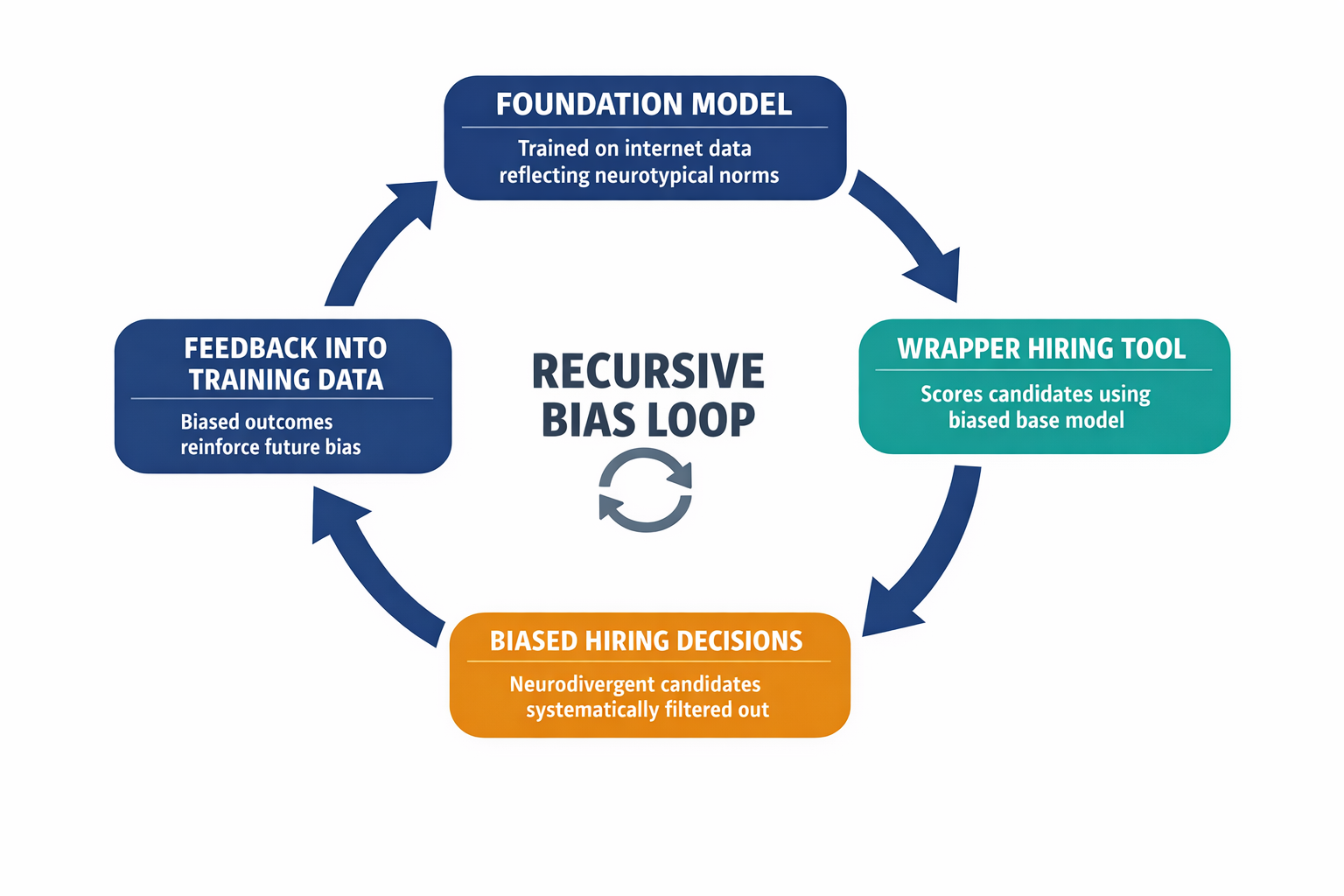
Foundation models inherit the biases of their training data — which is the internet, which reflects decades of neurotypical and racial preferences in hiring. When you deploy a wrapper-based hiring tool, its decisions feed back into future training data, creating what researchers call a recursive bias loop. Marginalized groups stay underrepresented because the model keeps learning from its own biased outputs.
Research at Duke University found something that crystallized this for me: large language models systematically associate neurodivergent terms with negative connotations. The phrase "I have autism" was rated by these models as more negative than "I am a bank robber." When these same language models power hiring tools through an API, they embed those associations into every candidate evaluation — without the developer ever intending it.
A wrapper can't break this cycle because it lacks the ability to distinguish between genuine job qualifications and noise that happens to correlate with someone's disability status. You need something architecturally different.
What Actually Works: Causal Reasoning Over Correlation
When my team started building our approach, we made a decision that felt counterintuitive at the time: we would treat fairness not as a filter applied after the model makes its decision, but as a structural property of how the model reasons in the first place.
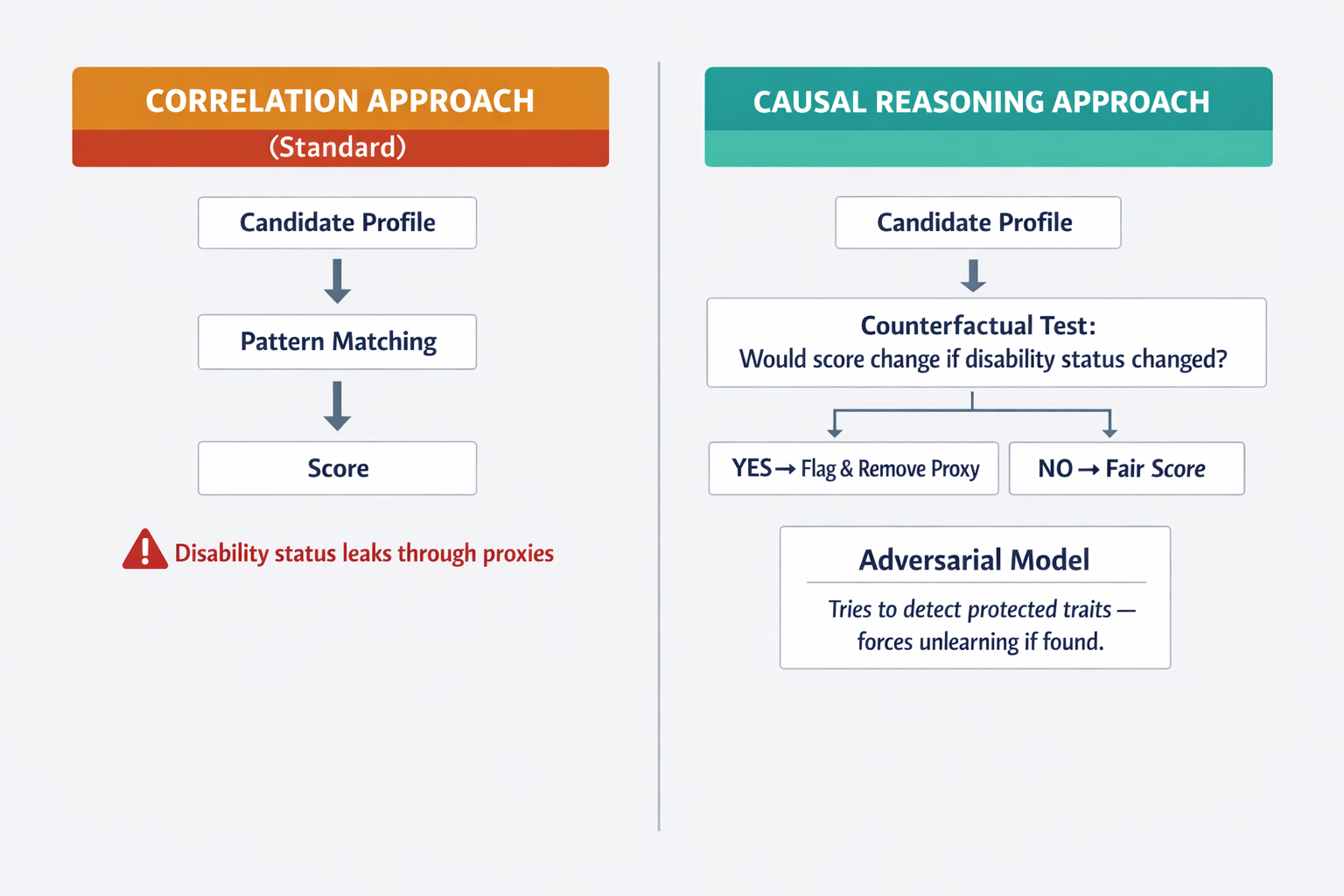
The core technique is called Causal Representation Learning. Instead of asking "does this candidate's profile correlate with success?" — which is where discrimination hides — we ask "would this candidate's evaluation change if we hypothetically altered their disability status while keeping everything else constant?" If the answer is yes, the model is using protected information as a proxy, and we know exactly where to intervene.
We pair this with adversarial training — essentially, we build two models that compete against each other. One model tries to identify the best candidate. A second model tries to guess the candidate's protected characteristics from the first model's internal reasoning. If the second model succeeds, it means the first model is still leaking biased information, and the system forces it to unlearn those patterns.
For the full technical methodology behind these approaches, including our counterfactual fairness auditing process, see our detailed research.
The practical result is a system that can provide mathematical evidence — not just marketing claims — that a hiring decision would have been the same regardless of a candidate's neurological profile.
Designing for Brains That Work Differently
Technical debiasing is necessary but not sufficient. The assessment experience itself needs to change.
Most AI hiring tools penalize candidates for slow response times, atypical pauses, or unconventional speech patterns. For someone with autism or ADHD, these aren't signs of incompetence — they're signs of a brain that processes information differently. A longer pause before answering might mean someone is thinking more carefully, not that they're unprepared.
We build what I'd call temporal elasticity into our systems. Instead of comparing every candidate against a neurotypical average, the AI establishes an individual baseline during the early stages of an interaction. It learns what "normal" looks like for that specific person.
We also advocate strongly for what I think of as the audio-only pivot for video tools. Disabling facial analysis and focusing only on transcribed content removes the vast majority of bias against neurodivergent candidates while preserving the efficiency benefits of AI-powered evaluation. It's a simple architectural choice that most vendors refuse to make because facial analysis is what they've marketed as their differentiator.
And every automated assessment should include a clear, unpunished path to request a human alternative. Not buried in terms of service. Prominent. Easy. Because reasonable accommodation isn't a footnote — it's the law.
What Should You Actually Do on Monday Morning?
If you're a CHRO, CTO, or general counsel at an enterprise that uses AI anywhere in your hiring pipeline, the Aon complaint is your wake-up call. Not because your vendor is necessarily doing what Aon allegedly did, but because you probably don't know whether they are or aren't.
Four things to do now:
Demand inference logic from your vendors. If they can't explain why their algorithm rejected a specific candidate in plain language, that's an unacceptable risk for a high-stakes decision like hiring.
Commission an independent bias audit — not one conducted by the vendor themselves. Specifically test for disability bias, not just race and gender. Most audits skip neurodivergence entirely.
Establish a cross-functional AI oversight committee that includes legal, HR, IT, and — critically — external disability advocacy voices. The people most affected by these systems need to be in the room where decisions are made.
Run a "bias fire drill." Take your current hiring tool and simulate what happens when an autistic candidate goes through the pipeline. If you can't test this scenario, you can't claim your system is fair.
The companies that will win the talent economy aren't the ones with the fastest AI screens. They're the ones who can prove their screens are fair.
What About the Talent You're Already Missing?
One objection I hear frequently: "Our current tool seems to work fine. Our hiring managers are happy with the candidates it surfaces." That's the problem. If your AI is systematically filtering out neurodivergent candidates before a human ever sees their application, you'd never know what you're missing. The system looks efficient precisely because you never see the talent it excluded.
Neurodivergent individuals frequently bring extraordinary capabilities in pattern recognition, sustained attention to detail, and creative problem-solving. A company running an assessment that penalizes "reserved" communication styles or "inflexible" work preferences is filtering out exactly the people who might transform their hardest technical challenges.
This isn't charity. It's a competitive disadvantage hiding behind a dashboard that shows green metrics.
The Real Question
The Aon complaint will work its way through regulatory proceedings. Other complaints will follow — against other vendors, in other industries. The legal landscape is tightening in one direction only.
But the question I keep coming back to isn't legal. It's architectural. Did we build AI hiring systems that find the best person for the job? Or did we build systems that find the person who best performs "normal" — and then call that merit?
I know which one I think it is. I'm curious whether your current vendor can prove otherwise.