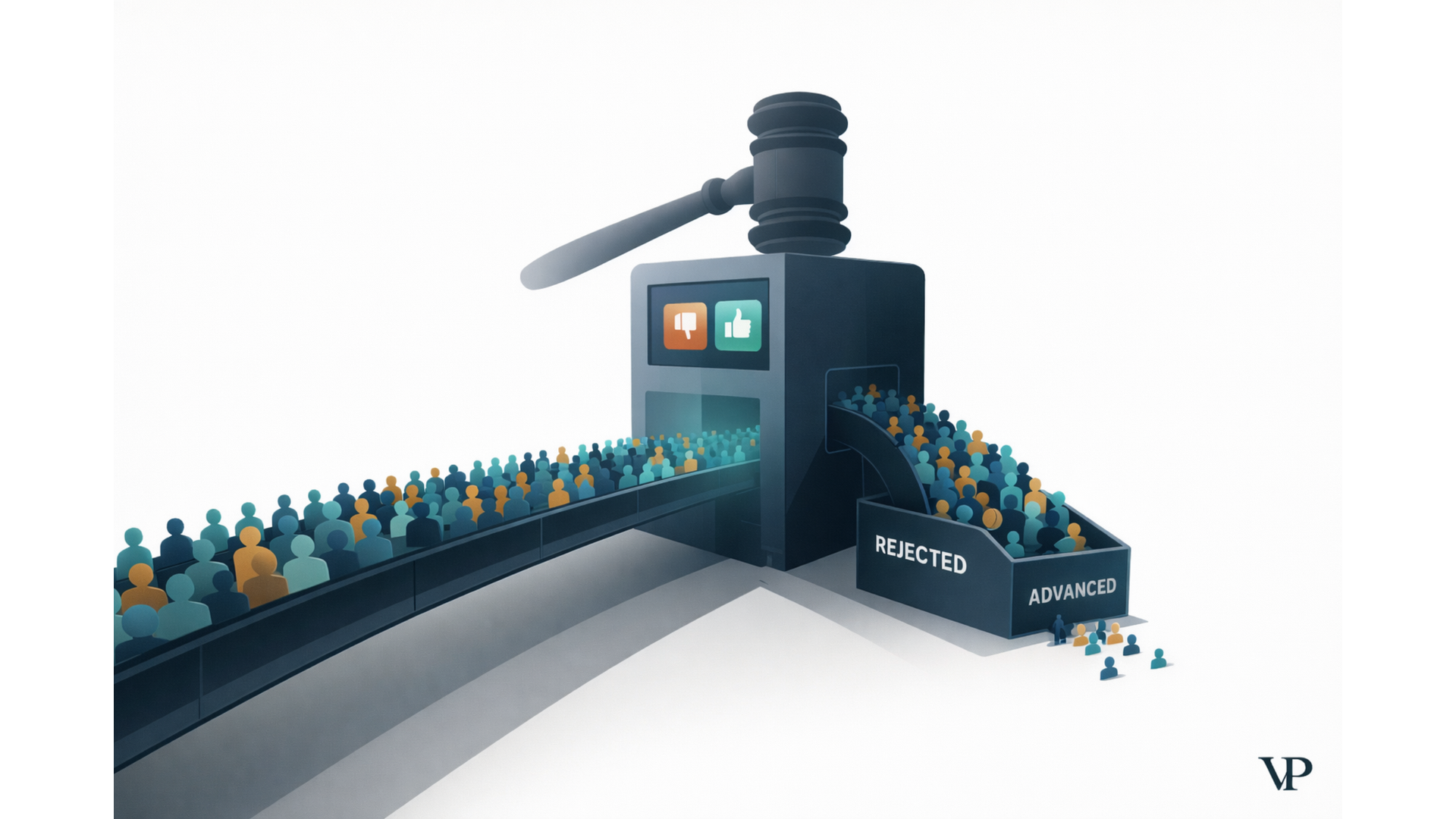
A federal court just gave permission to notify potentially millions of job applicants that they may have been illegally rejected by an algorithm. Not by a biased manager. Not by a flawed policy. By software that was supposed to eliminate bias in the first place.
The case is Mobley v. Workday, and in May 2025, it became a certified nationwide collective action — one of the largest AI discrimination cases in American history. Workday's own filings revealed that roughly 1.1 billion applications were rejected through its platform during the relevant period. And the court ruled something that should keep every executive using AI recruitment tools up at night: your AI vendor isn't just a tool provider. Legally, it's your agent. And agents carry liability.
I've spent the last several months pulling apart the technical and legal architecture of this case with my team. What we found isn't just a legal story — it's a structural failure in how the industry builds AI hiring systems. We published our full analysis here, but I want to walk through what I think matters most.
The Ruling That Killed the "We're Just a Software Vendor" Defense
Derek Mobley, an African American man over 40 with disabilities, applied to more than 100 jobs through Workday's platform. He was qualified. He was rejected from nearly all of them — often within minutes, and frequently outside of business hours. No human was reviewing his application at 2 a.m. A machine was.
In July 2024, Judge Rita Lin drew a line that the industry had been pretending didn't exist. She distinguished between "simple tools" — spreadsheets, email, basic filters — and what Workday's AI actually does: actively scoring, ranking, and recommending which candidates should advance and which should be rejected. That's not a tool. That's a hiring function. And under Title VII, the ADA, and the ADEA, anyone performing a hiring function is an agent of the employer.
When your software decides who gets rejected, it's not a tool anymore. It's making the decision your recruiter used to make — and it inherits the legal responsibility that comes with it.
The implications are enormous. If your AI vendor is your agent, then its discriminatory outcomes are your discriminatory outcomes. The vendor can't disclaim liability. And neither can you.
How an Algorithm Discriminates Without Ever Seeing Your Age
This is the part that surprised me most when we dug into the technical mechanics.
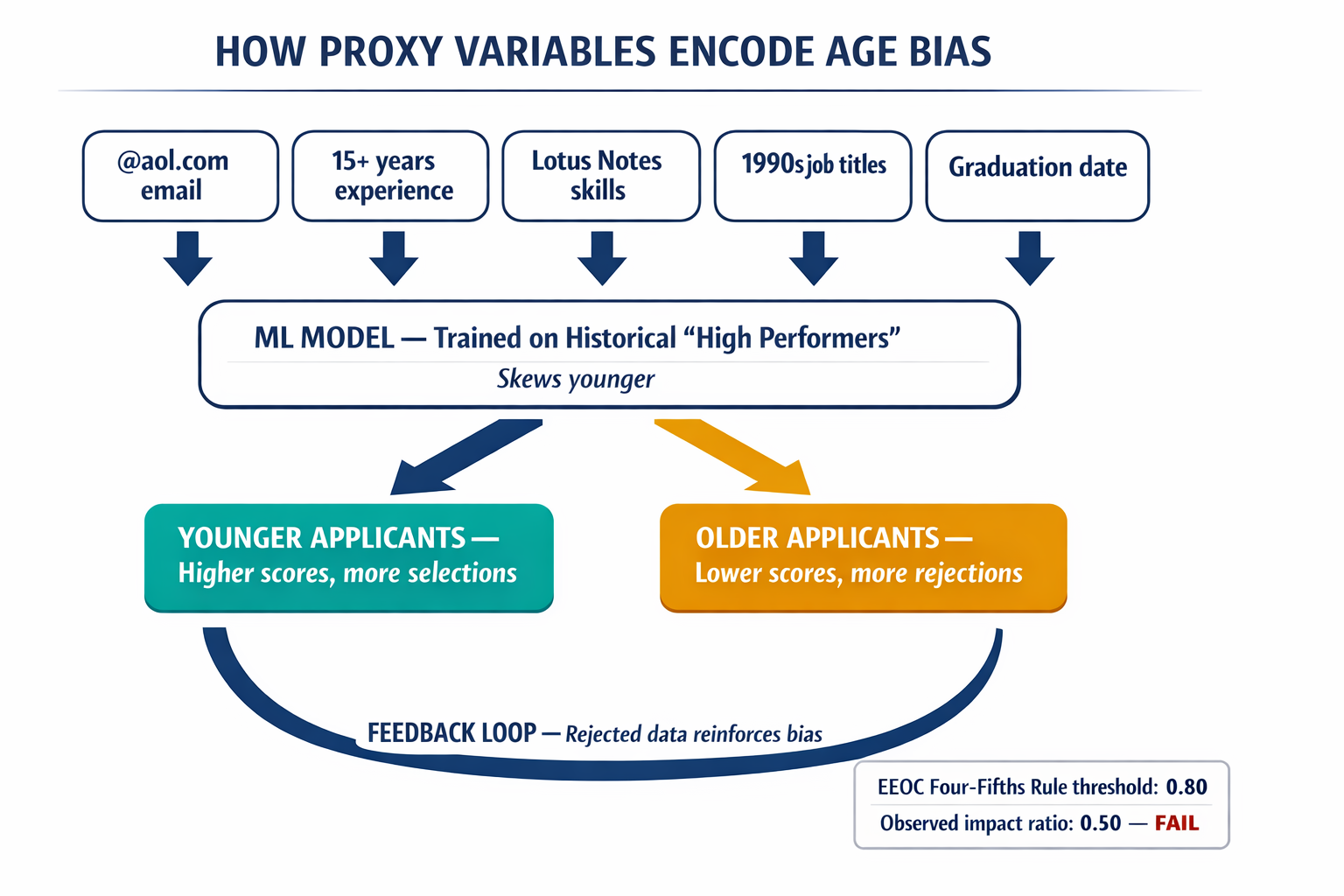
The system never asks "How old are you?" It doesn't need to. It learns to infer age through what researchers call proxy variables — seemingly neutral data points that are tightly correlated with protected characteristics. An @aol.com email address. Fifteen-plus years of experience. A reference to Lotus Notes. A job title from the early 1990s. Even a graduation date — and removing the date doesn't fully solve the problem, because the model can triangulate from everything else.
When a machine learning model is trained on a company's historical "high performers," and those performers skew younger, the algorithm treats these age-correlated patterns as success indicators. It doesn't just reflect past bias — it amplifies it through a feedback loop, rejecting older candidates at higher rates, which produces training data that further reinforces the pattern.
The EEOC uses something called the Four-Fifths Rule to flag this: if a protected group's selection rate falls below 80% of the highest-performing group's rate, that's adverse impact. In the illustrative scenarios we analyzed, older applicants were selected at half the rate of younger ones — an impact ratio of 0.50, far below the 0.80 threshold.
Why Most "AI Hiring Solutions" Can't Fix This
I need to be blunt about something. The vast majority of AI recruitment products on the market are what we call LLM wrappers — thin application layers built on top of foundation models like GPT-4 or Claude. They look impressive. They generate fluent text. And they are structurally incapable of solving the compliance problem the Workday ruling creates.
An LLM is a probabilistic engine. It predicts the most likely next word based on patterns in its training data. It doesn't reason. It doesn't verify. It doesn't follow rules in any legally defensible sense.
When we tested how these models handle long-form candidate documents, we found a well-documented failure called "lost-in-the-middle" syndrome — the model pays strong attention to the beginning and end of a document but drops accuracy in the middle. In a 10-page resume, that means critical certifications or recent accomplishments buried on page five are statistically more likely to be overlooked. Not because the candidate is unqualified, but because of how transformer attention mechanisms work.
And when the model can't find a specific qualification? It often generates a plausible-sounding assumption instead. A perfectly worded rejection email citing a reason that has nothing to do with the candidate's actual file.
The most dangerous AI system isn't the one that makes obviously wrong decisions. It's the one that makes confidently wrong decisions that sound perfectly reasonable.
There's also an economic problem. As foundation model providers keep releasing more capable base models, they absorb the features that wrappers depend on — resume parsing, sentiment analysis, basic matching. A company that merely wraps an API is building on rented land, training away its own competitive edge with every interaction.
What We Built Instead — And Why It Matters
When I saw the trajectory of the Workday case, I told my team: we need to build systems where the AI is never the decision-maker. It's the translator.
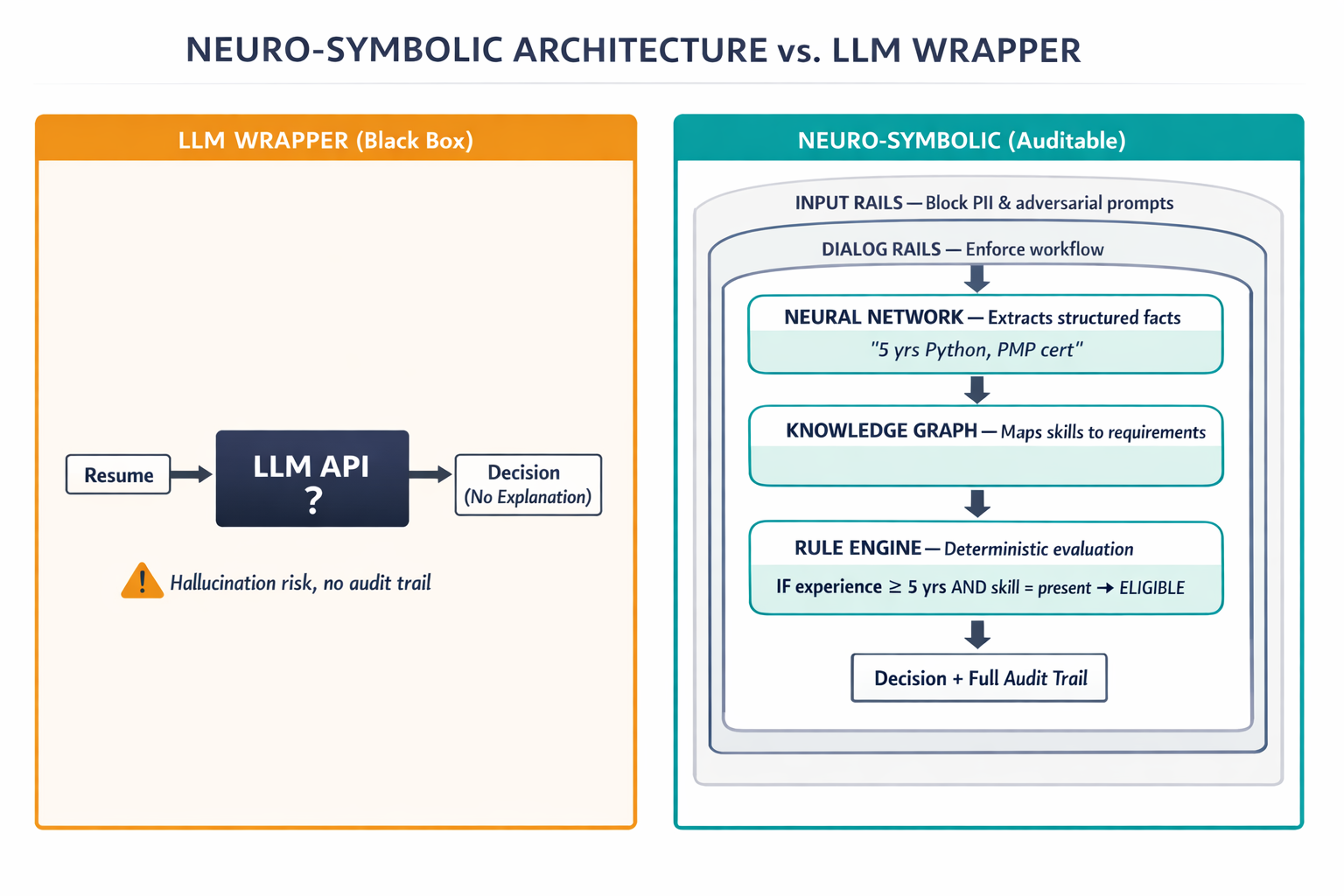
What we developed is a neuro-symbolic architecture — a system that combines the language capabilities of neural networks with the logical rigor of rule-based reasoning. The distinction matters enormously in a courtroom.
The workflow breaks down like this. First, a specialized model extracts structured information from a resume or transcript — "this candidate has five years of Python experience," "this candidate holds a PMP certification." Second, those extracted facts get mapped onto a knowledge graph that defines the relationships between skills, roles, and the company's actual requirements. Third — and this is the critical step — a deterministic rule engine evaluates the candidate against those requirements. Not probabilistically. Not "most likely." The rule either fires or it doesn't: if experience is at least five years AND the required skill is present, the candidate is eligible.
The LLM can't hallucinate the policy because it never touches the policy. It handles language. The rule engine handles logic. And every single recommendation generates an auditable trail showing exactly which rule was triggered by which specific data point.
We also built what we call constitutional guardrails — three layers of safety checks that aren't suggestions to the model but architectural constraints. Input rails catch adversarial prompts and personally identifiable information before they reach the core logic. Dialog rails enforce the intended workflow and prevent the system from being steered off course. Output rails scan every response for hallucinations, toxicity, or policy violations before anything reaches a recruiter or candidate. For the full technical methodology behind this architecture, we've published a detailed breakdown.
Beyond Audits: Building Bias Out of the System
One thing the Workday case made clear: annual bias audits aren't enough. NYC's Local Law 144 requires them, and they matter — but checking for bias once a year is like checking your brakes once a year while driving daily on mountain roads.
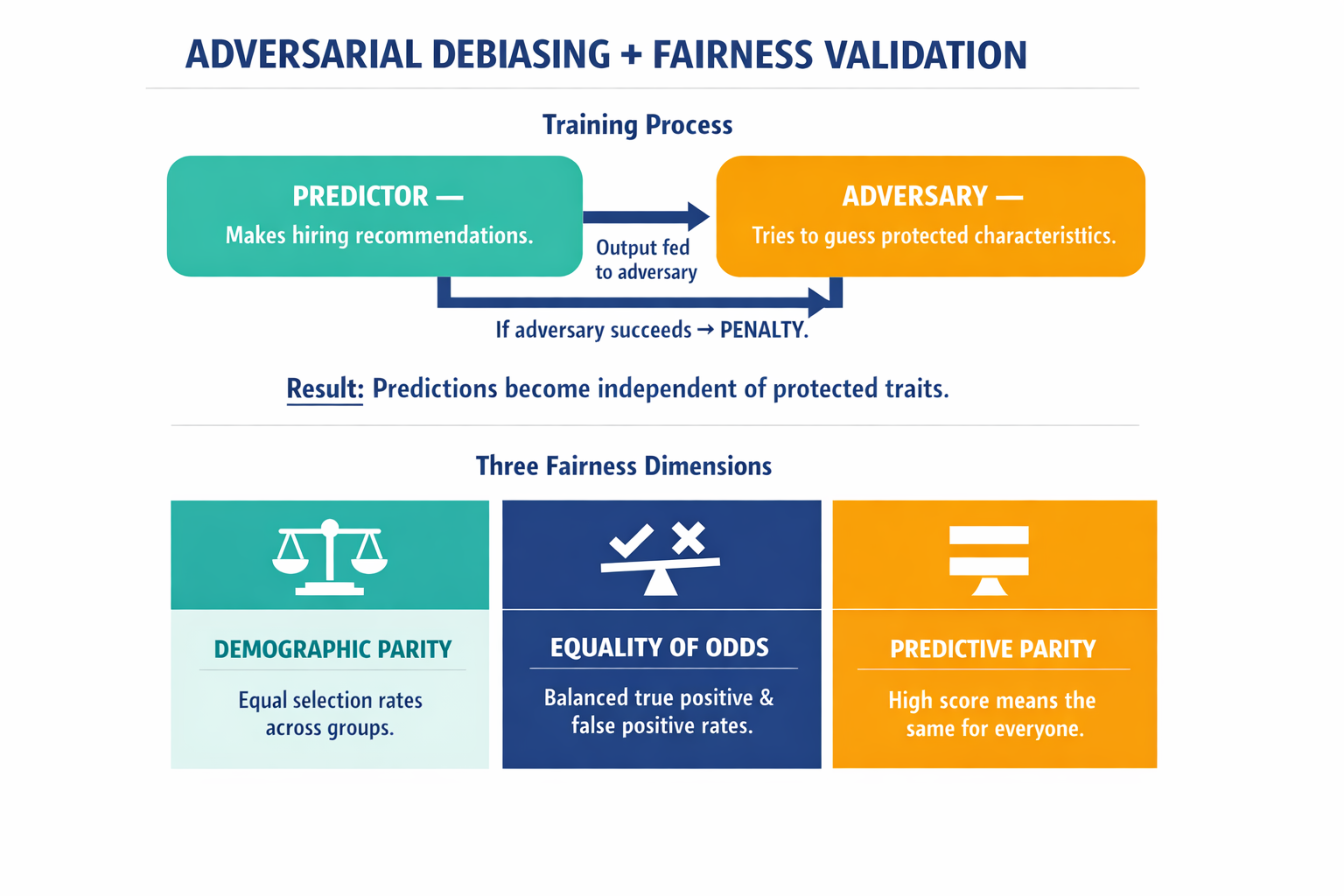
We use a technique called adversarial debiasing during model training. Imagine two models trained simultaneously: a predictor trying to make accurate hiring recommendations, and an adversary trying to guess the candidate's protected characteristics from the predictor's output. If the adversary succeeds, the predictor gets penalized. Over time, this forces the system to strip out discriminatory patterns — not by ignoring protected data, but by making its predictions genuinely independent of it.
We then validate across three fairness dimensions:
Demographic parity — are selection rates consistent across groups?
Equality of odds — are true positive and false positive rates balanced?
Predictive parity — does a high score mean the same thing regardless of who receives it?
And for courtroom defensibility, we implement explanation techniques like SHAP and LIME. SHAP assigns a specific contribution value to every feature in a decision — "this skill added 15 points, this experience gap subtracted 8." LIME tests what happens when you change individual data points — would altering the zip code have flipped the outcome? These aren't nice-to-haves. They're what your legal team will need when the EEOC comes calling.
What About Companies Already Using These Tools?
This is the question I get most often, and the honest answer is uncomfortable. If you're currently using an AI system that scores, ranks, or screens candidates — and you can't explain exactly why any given candidate was rejected — you're carrying significant legal exposure right now.
The Workday ruling established that employers can't hide behind vendor contracts. The EEOC's 2023 guidance made clear that you're responsible for algorithmic outcomes even if a third party designed the tool. And with collective certification now granted, the playbook for plaintiffs' attorneys is written.
I'm not saying this to sell fear. I'm saying it because I watched an industry convince itself that automating hiring decisions would reduce legal risk, when in many cases it concentrated and scaled that risk across millions of decisions simultaneously.
Workday processed 1.1 billion rejections through its platform. That's not an HR process. That's a class action waiting to happen.
What Should You Do Monday Morning?
If I were sitting across from your leadership team, here's what I'd recommend:
Audit your AI inventory this week. Identify every algorithmic tool touching candidate evaluation. Determine whether it "substantially assists" or replaces human judgment — that's the threshold for agency liability.
Demand explainability from your vendors. If they can't show you the decision logic behind a specific rejection, or if their contract disclaims all liability for bias, you're holding the entire bag.
Build a cross-functional AI governance team. HR, Legal, IT, and Security need shared ownership. This isn't an IT problem or an HR problem — it's an enterprise risk problem.
Start planning the transition to auditable systems. The era of black-box hiring AI is over. What replaces it needs to be architecturally transparent — not because transparency is a nice value, but because a federal judge in California just made it a legal requirement.
The promise of AI in recruitment is real. It can widen talent pools, reduce administrative burden, and free recruiters for the human work that actually matters — building relationships, understanding context, making nuanced judgments. But that promise depends entirely on whether the underlying system can be trusted, explained, and defended.
The question I keep coming back to: if your AI can't tell you why it rejected someone, how would you explain it to a judge?