A federal court just gave 1.1 billion rejected job applications a potential day in court.
In May 2025, a judge certified a nationwide collective action against Workday — not an employer, but the software vendor whose AI screening tools rejected those applicants. The ruling in Mobley v. Workday establishes something the HR technology industry has never faced: AI hiring vendors can be held directly liable for discrimination under the same federal laws that govern employers. If your company uses algorithmic screening to filter candidates, the legal ground beneath your recruitment process shifted overnight. And most enterprises haven't noticed yet.
We've spent months analyzing this case and its technical implications. What we found is that the problem isn't just legal — it's architectural. The way most AI hiring tools are built makes discrimination nearly inevitable, and compliance nearly impossible. We published our full analysis here, but the core argument deserves a broader audience.
The Ruling That Killed the "We're Just a Software Vendor" Defense
For years, companies like Workday maintained a clean separation: employers make hiring decisions, and software merely assists. That separation is now legally dead.
Derek Mobley, an African American man over 40 with disabilities, applied to more than 100 positions through Workday's platform. He was rejected from nearly all of them — often within minutes, often outside business hours. No human reviewed his application. The algorithm did the rejecting.
When software performs the traditional employer function of screening out candidates, it becomes an agent — with all the legal liability that entails.
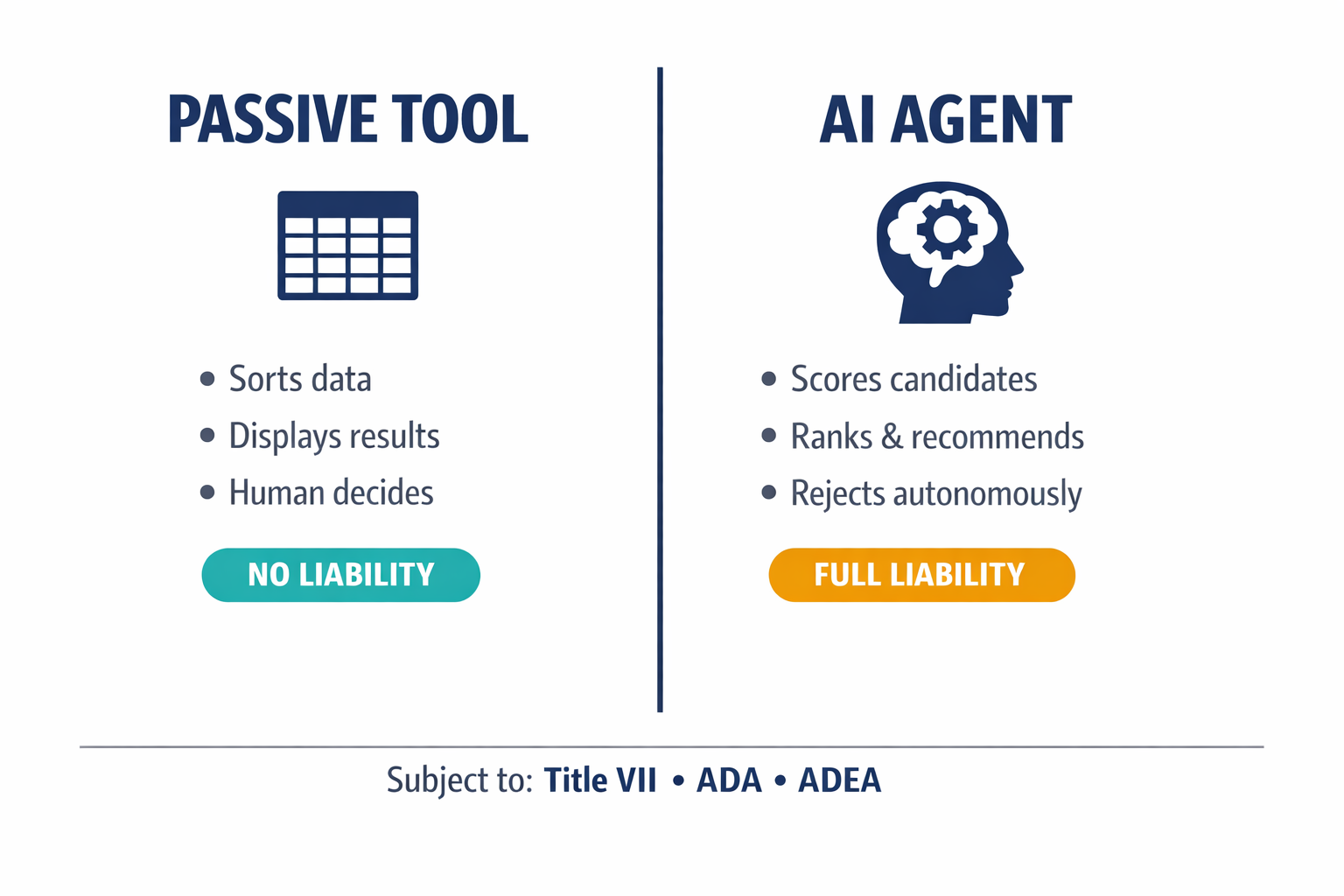
Judge Rita Lin drew a sharp line between passive tools and active decision-makers. A spreadsheet that sorts data? That's a tool. An AI system that scores, ranks, and recommends which candidates advance? That's an agent — subject to Title VII, the Americans with Disabilities Act, and the Age Discrimination in Employment Act. The distinction matters enormously: your company can't outsource hiring decisions to a vendor and outsource the liability along with them.
1.1 Billion Rejections, One Collective Action
The scale of this case is staggering. Workday's own filings revealed that approximately 1.1 billion applications were rejected through its platform during the relevant period. The court's preliminary certification allows notification of every applicant over 40 who was denied an employment recommendation through Workday since September 2020.
In July 2025, the court expanded the scope further to include applicants processed through HiredScore, an AI-driven HR tool that Workday acquired. This is a pattern we see repeatedly: large platforms absorb smaller AI modules, and each acquisition multiplies the algorithmic risk across millions of additional touchpoints.
For enterprise leaders, the math is uncomfortable. If your platform processes hundreds of thousands of applications per year and your AI screening has even a small discriminatory bias, you're not looking at isolated complaints. You're looking at class-wide exposure.
How AI Discriminates Without Anyone Telling It To
The legal theory driving this case is disparate impact — the idea that a policy can be discriminatory even if nobody intended it to be. You don't have to program an AI to reject older workers. You just have to train it on historical hiring data where older workers were already underrepresented.
The mechanism is subtler than most people realize. AI systems learn to use "proxy variables" — seemingly neutral data points that correlate with protected characteristics like age, race, or disability. An algorithm doesn't need to see your birthdate to estimate your age. It can infer it from:
Total years of experience listed on your resume
References to older technologies (Lotus Notes, COBOL)
Career progression markers from decades past
Graduation dates, even when partially obscured
When the training data says "successful hires tend to look like this," and "this" skews young, white, or able-bodied, the algorithm faithfully reproduces that pattern. Then it scales it across millions of decisions, faster and more consistently than any human recruiter ever could.
The algorithm doesn't have to be biased. It just has to be trained on a world that is.
The EEOC uses something called the Four-Fifths Rule as a benchmark: if a protected group's selection rate falls below 80% of the highest group's rate, that's evidence of adverse impact. When we modeled this against typical AI screening scenarios, the numbers were stark. A system trained on skewed historical data can easily produce selection rates for older applicants that are half the rate for younger ones — well below the four-fifths threshold.
Why Most AI Hiring Tools Can't Fix This
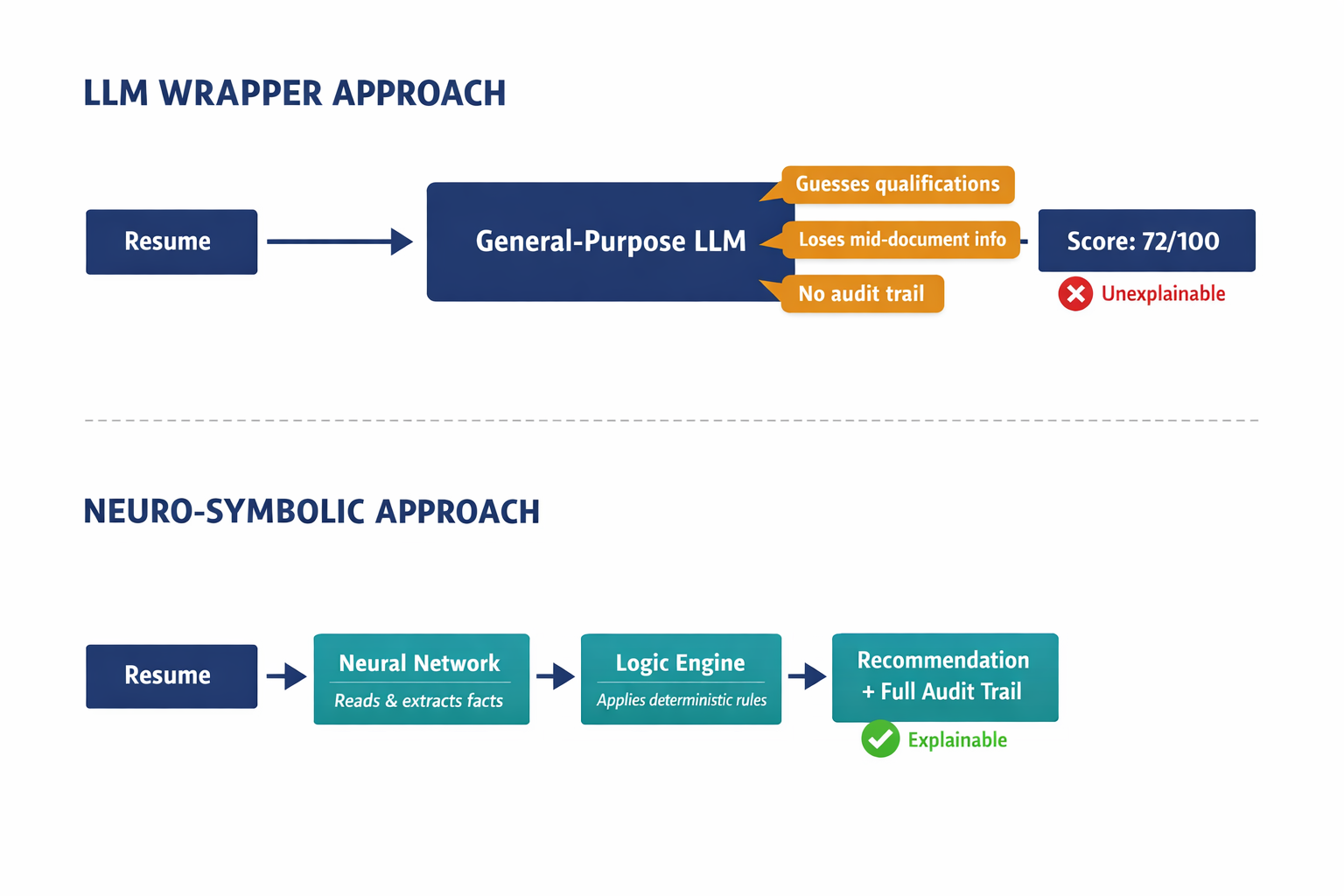
Most "AI hiring solutions" on the market today are what the industry calls LLM wrappers — thin application layers built on top of large language models like GPT-4 or Claude. They add a user interface and some prompts, but the core intelligence is a general-purpose language model that predicts the most likely next word based on its training data.
This architecture has three problems that matter for hiring:
It guesses when it should verify. When an LLM can't find a specific qualification in a resume, it often generates a plausible assumption based on surrounding context. In recruitment, "plausible" isn't good enough. A system that infers you probably have a certification because your job title suggests it is a system that will score candidates inconsistently.
It loses information in long documents. Research on standard transformer models shows they handle the beginning and end of long texts well but suffer significant accuracy drops in the middle — a phenomenon known as the "lost-in-the-middle" problem. In a 10-page resume, critical certifications or recent accomplishments buried in the middle sections are statistically more likely to be overlooked.
It can't explain itself. When a regulator or a judge asks why a candidate was rejected, "the model predicted a low relevance score" isn't an answer. There's no audit trail, no logic path, no way to reconstruct the reasoning. And under the new legal framework established by the Workday ruling, that opacity is a liability.
We detail the structural differences between wrapper-based approaches and what we call Deep AI architectures in our technical research. The short version: a system that can't show its work can't survive a courtroom.
Building AI That Can Defend Its Own Decisions
The solution isn't to abandon AI in hiring — it's to build it differently. Our approach uses what's called a neuro-symbolic architecture, which combines the language understanding of neural networks with the logical rigor of rule-based systems.
Think of it this way: the AI reads and understands the resume (that's the neural network part), but it doesn't make the decision. Instead, it extracts structured facts — "this candidate has 5 years of Python experience" — and passes them to a separate logic engine that applies deterministic business rules. The rule engine can't hallucinate. It can't guess. It either finds the qualification or it doesn't.
Every recommendation generates a complete audit trail: which rule was triggered, by which specific data point, from which section of the candidate's file. When a regulator asks "why was this person rejected?", the system produces a clear, reproducible answer — not a probability score.
We layer three types of safety controls on top of this:
Input controls that check for data manipulation, personally identifiable information leaks, and off-topic inputs before they reach the core logic
Process controls that enforce compliant conversation flows and prevent the system from being steered into discriminatory territory
Output controls that scan every recommendation for hallucinations, toxicity, or policy violations before it reaches a human recruiter
This isn't theoretical. These are production systems designed for environments where a single biased decision can trigger class-wide liability.
Bias Detection That Goes Beyond Annual Checkboxes
New York City's Local Law 144 requires annual bias audits for automated employment decision tools. That's a start, but annual audits catch problems after they've affected thousands of applicants. By the time you discover your model drifted into discriminatory territory, the damage — legal and human — is already done.
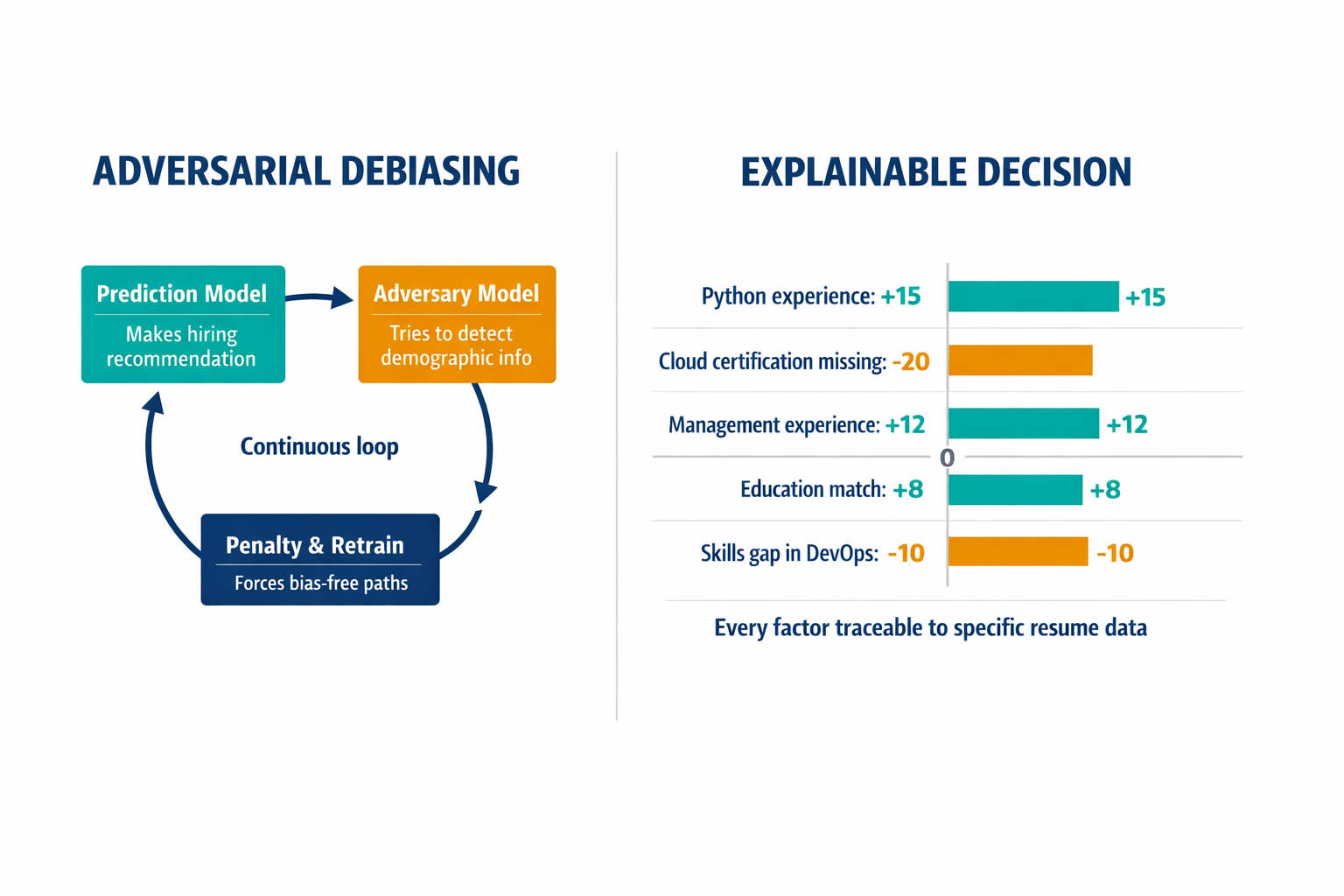
We use a technique called adversarial debiasing during model training. It works like an internal stress test: one model tries to make accurate predictions while a second model simultaneously tries to detect whether those predictions leak information about protected characteristics like race or age. If the second model succeeds, the first model is penalized and retrained. The system is forced to find decision paths that don't rely on demographic proxies.
If your AI vendor can't explain why a candidate was rejected, your company is carrying 100% of the legal risk.
We also implement post-hoc explanation tools — SHAP and LIME — that assign a specific contribution value to each factor in a decision. Instead of "this candidate scored 72 out of 100," the system shows "Python experience contributed +15, missing cloud certification contributed -20, and years of management experience contributed +12." That level of transparency turns a legal vulnerability into a defensible position.
What Should Enterprises Actually Do Right Now?
The Workday ruling isn't an edge case. It's a signal. Federal regulators, state legislatures, and plaintiffs' attorneys are all converging on the same conclusion: if your AI makes hiring decisions, you're accountable for those decisions.
Audit your AI inventory today. Identify every algorithmic tool that scores, ranks, or screens candidates. Determine whether it "substantially assists" or replaces human judgment — because that's the threshold for agent liability.
Build cross-functional governance. AI hiring risk isn't an HR problem or an IT problem. It requires legal, compliance, security, and business leadership at the same table, with clear decision rights across the AI lifecycle.
Demand explainability from your vendors. If your AI provider can't produce an audit trail for every candidate decision, or if their contract disclaims all liability for algorithmic bias, you need to understand what that means: your company absorbs the entire risk.
Move toward architectures that separate understanding from deciding. General-purpose language models are powerful translators, but they're unreliable judges. The systems that will survive this regulatory era are ones where AI reads and the logic decides — with every step documented.
The opportunity here is real. AI can widen talent pools, reduce unconscious human bias, and free recruiters to focus on relationship building. But only if the systems are built to be verified, not just deployed. The era of the algorithmic black box is over. What replaces it will define whether AI hiring becomes a force for fairness or the largest source of employment litigation in a generation.
We'd welcome hearing how your organization is navigating this shift — especially if you've already started auditing your algorithmic hiring tools.