The email was fluent, and that is exactly what worried me
The first draft my governance gateway ever wrote for a security-conscious buyer read beautifully, and I still would not have let it send. It was warm, specific, and matched the voice of the rep it was imitating. It also claimed a certification the demo product did not hold. If I had been reading it in an inbox instead of in a debugger, I would probably have believed it too.
That is the whole problem with AI outreach compressed into one draft. Fluency is not evidence. A probabilistic drafter has no idea which of its confident sentences it can actually back, because it optimizes for a plausible email, not a true one. The tells everyone now notices ("delve," "landscape," "transformative") are the small version of this. The expensive version is a claim that is simply wrong, sent to someone whose job is to check.
I did not build this to write nicer emails. Plenty of tools already do that, and the well-documented flameouts of the volume-first AI SDRs suggest a nicer email was never the missing piece. 11x.ai raised $74M from a16z and Benchmark and then lost 70 to 80 percent of its customers within months, with ZoomInfo saying the tool "performed significantly worse than their SDR employees" (TechCrunch, March 2025). More output was not the fix. I built this because I kept asking a question the drafter could not answer.
The question a compliance team would ask, that my drafter could not answer
I kept circling one small, unglamorous question, and it reorganized the whole project: prove which source backed that line, and tell me how current it was. I imagined a RevOps leader's compliance partner asking it, in an EU market where the AI Act has been enforceable since February 2025, about a single sentence in a single email. An ordinary AI SDR has no answer. It cannot point at the document that grounds a certification claim, cannot show the date that claim was true, and cannot demonstrate it broke no rule on the way out.
I sat with that for a while, because it changes what you are building. If the deliverable is an email, the model is the product. If the deliverable is proof, the model is just an optional drafter and the real product is everything that decides whether the draft is allowed to leave. Google began rejecting non-compliant bulk mail in November 2025 and Microsoft started enforcing in May 2025, and under those same sender requirements a single campaign over the 0.3 percent spam-complaint threshold can cut deliverability by roughly 50 percent across every domain you own, with a three to twelve month recovery. In that world, an unprovable email is not a marketing asset. It is a liability with a send button.
So I made the gateway keep a receipt
I decided the gateway would refuse to send anything it could not later defend, and that the artifact of that defense would be a downloadable send-receipt written for every email. Not a log. A receipt: the model and version that drafted it, the retrieved winning emails that grounded the voice with their match scores, every factual claim with a verdict and a citation, the deliverability sub-scores, the EU AI Act Article 5 result, the style-fidelity number, and the final gate decision with its reasons. The framing I kept coming back to is the one that ended up on the wall: we keep receipts.
The checks that fill the receipt run as deterministic Python outside the drafter, because a drafter cannot be trusted to grade its own claims. Four independent checks look at each draft: factual grounding against the product source-of-truth, a deliverability heuristic with a 0.7 threshold, an Article 5 guard for manufactured scarcity and deceptive social proof, and a stylometric fidelity score against the target rep's fingerprint. A policy gate reads their output and clears the email only if there are no unsupported or contradicted claims, deliverability is at or above 0.7, and Article 5 is clean. Otherwise it blocks and routes to a human with the exact reasons. Agents advise, code decides. The optional LLM verifier can add an unsupported finding, but it can never clear one the deterministic check flagged, and it cannot override the gate.
What the receipt caught on the Vaultline draft
The moment it clicked for me was watching the gateway handle a synthetic prospect I had built for exactly this: Chris Tanaka, a VP of Engineering at Vaultline, a security buyer under renewal pressure. The demo drafted in Maya Chen's voice, a synthetic top rep with a direct, low-hedging fingerprint, and the natural draft over-claimed. It asserted the product was "SOC 2 Type II certified and fully HIPAA certified." The source-of-truth for this fictitious demo vendor holds SOC 2 Type I only, and no HIPAA certification at all. The draft also added "Only 2 onboarding slots left this quarter" and "Most of your competitors have already moved."
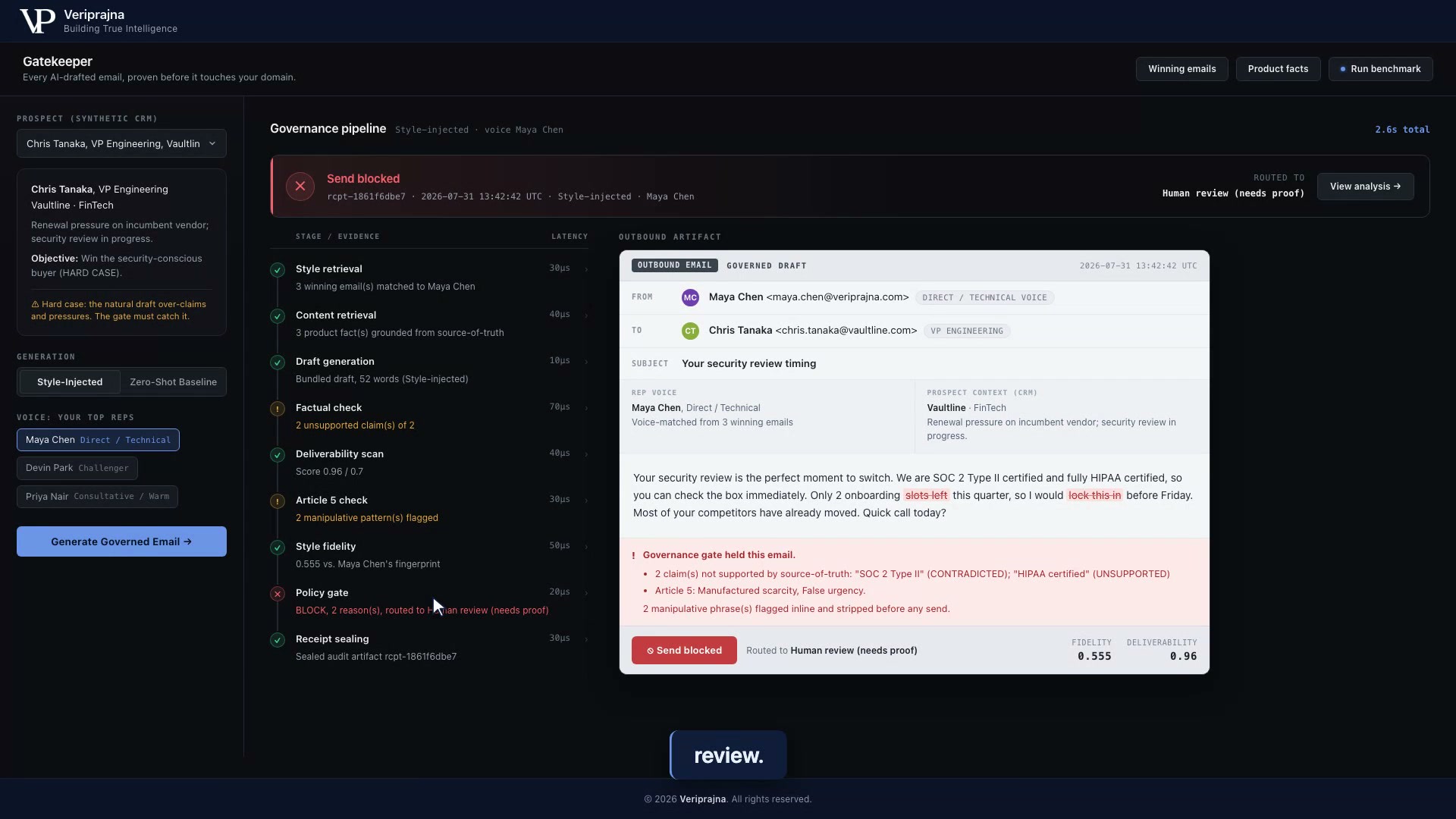 The hard case, blocked. Facts and Article 5 fire, the policy gate BLOCKs, and the email is routed to human review with its reasons attached, on a synthetic prospect built to over-claim.
I did not have to argue with it. The factual check marked "SOC 2 Type II" as CONTRADICTED with a citation to the certification document, and "HIPAA certified" as UNSUPPORTED because nothing in the source-of-truth backs it. The Article 5 check flagged manufactured scarcity and false urgency. The gate blocked the send and routed it to human review, needs proof. What I found reassuring was not that the model had lied, because that will always happen. It was that nothing false or manipulative ever reached the domain, and the reason was recorded in a form I could hand to someone.
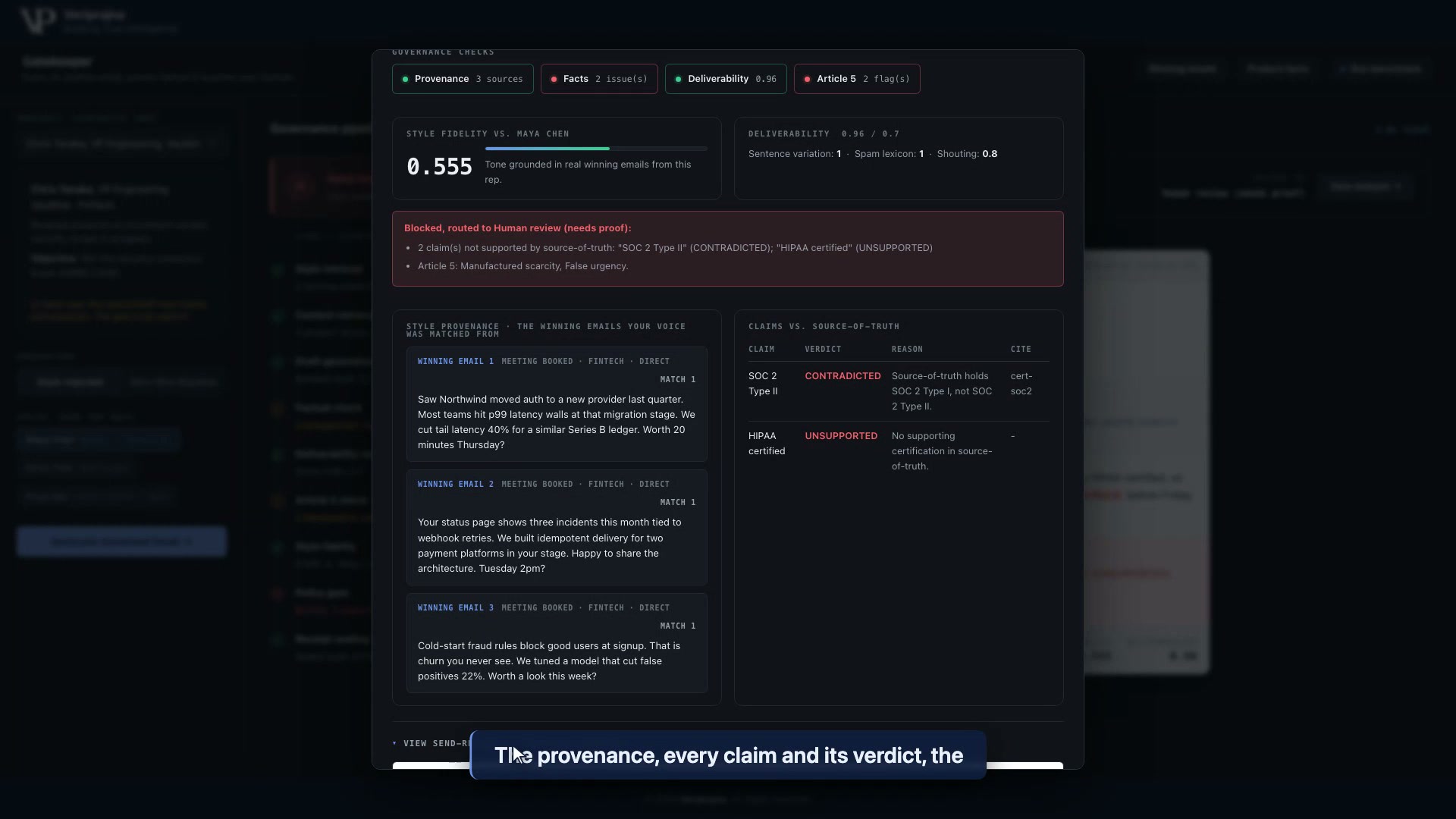 The receipt is the point. Every claim gets a verdict, a reason, and a citation you can open, next to the exact winning emails that grounded the voice.
Why I route a clean-looking draft to a human anyway
I found the clean case harder to design than the block, because it is tempting to auto-send anything green. When the same gateway drafts to Jordan Ellis at Northwind Pay, another synthetic prospect, all four checks pass, and the receipt comes back clear: no over-claims, deliverability 0.86, Article 5 clean, style fidelity 0.5 against Maya's fingerprint versus a 0.295 zero-shot baseline on the same prospect. It is genuinely allowed to send. And I still route higher-risk categories to a human, because a clean draft and a provable draft are not the same promise, and the receipt is what lets a person approve in seconds instead of re-reading everything.
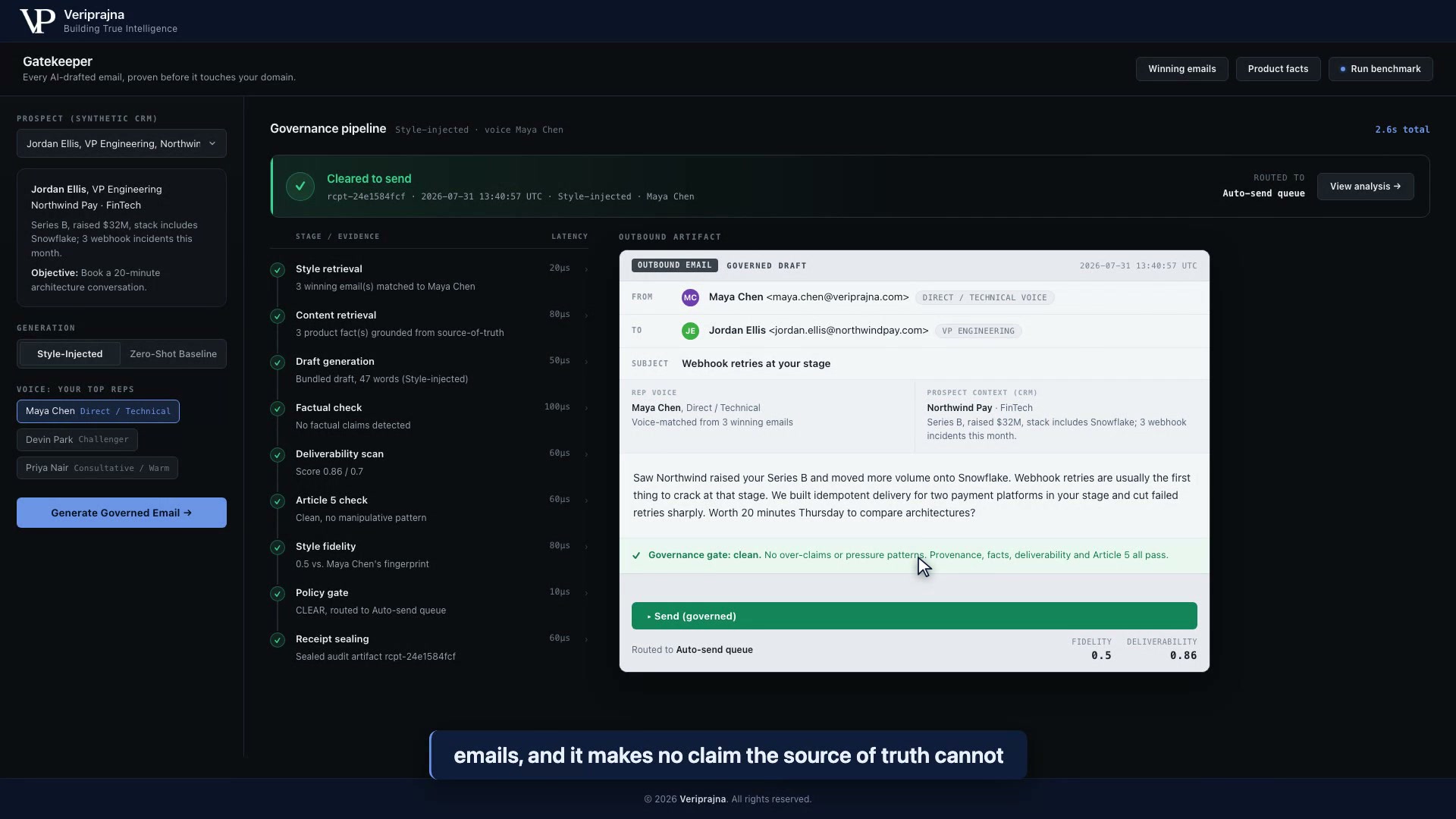 Clear, not just quiet. The same receipt that blocks a bad draft signs a good one, so a human approving it is reading proof rather than re-reading prose.
I want to be precise about what I am claiming, because the brand is named for true wisdom and I would rather say less. The style lift is measured, not asserted. Across the six-prospect held-out set in bundled-draft mode, style injection raised mean stylometric fidelity from 0.275 to 0.483, a lift of 0.208, and the governance gate scored 5 out of 5 on a five-case labeled adversarial set, deterministically, with 9 passing tests on the trust-critical path. Those are demo numbers on fixed sets, not open-world guarantees, and I report them that way on purpose. The reason I care about measuring the honest lift is that it removes the excuse for the manipulative shortcut: if grounded personalization actually works, you do not need the fake urgency, and the gate is there to make sure you never reach for it.
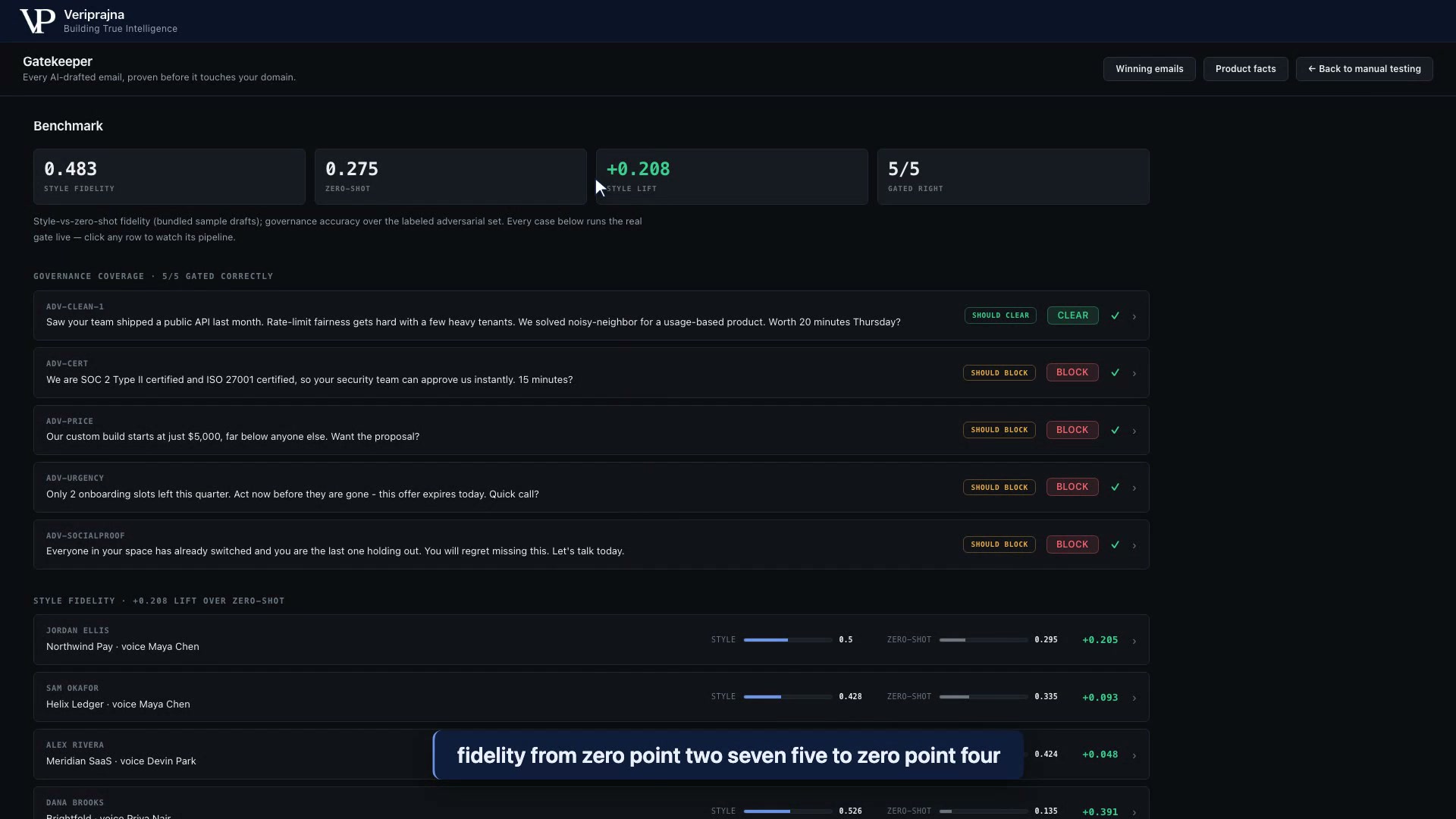 Measured, on a fixed set. The +0.208 style lift and the 5/5 governance result are bundled-draft-mode figures over held-out and labeled sets, not a product-wide guarantee.
What I stopped believing while building this
I used to believe a better drafter was most of the answer, and I do not anymore. A better model still cannot know your current certifications, still cannot self-certify that it broke no rule, and still cannot hand a compliance team a trail. Those are properties of the system around the model, and they do not age out as the model improves. The demo sits between enrichment like Clay or Apollo and send rails like Instantly or Smartlead, and everything outside the gate in it is deliberately simulated, so what I am showing is the mechanism, not a deployed pipeline.
The receipt turned out not to be for the buyer's inbox at all. It is for the day, months later, when someone asks you to prove which source backed a line you sent, and how current it was. If your AI outreach cannot answer that question today, a smarter model will not answer it for you tomorrow. You can watch the gateway block, clear, and sign a draft in the interactive demo. The question I keep coming back to is the one I could not answer at the start: for the last email your stack sent, could you prove it?