The AI-SDR category spent two years optimizing for volume and calling it personalization, and the reckoning is now on the record. 11x.ai raised $74M from a16z and Benchmark, then lost 70 to 80 percent of its customers within months, claimed roughly $14M in ARR against roughly $3M in real contracts, and drew an on-record verdict from ZoomInfo that its tool "performed significantly worse than their SDR employees" (TechCrunch, March 2025). Read that failure closely and it is not a writing failure. The emails were fluent. What was missing was verified AI outreach: a layer that proves each claim, scores deliverability, and checks the draft against the law before the email is allowed to leave. That layer is what we built into the Outreach Governance Gateway (https://veriprajna.com/demos/ai-sales-personalization), and it is the argument of this piece.
The failure mode is structural, not stylistic
Generic AI email converges on a probabilistic mean. "Delve," "landscape," and "transformative" are audible tells now. But the deeper defect is that personalization gets asserted rather than measured, and nobody re-checks the resulting claim against a current source of truth. So an over-claimed certification, a manufactured-urgency line, or a spam-triggering draft ships intact.
In 2026 the cost of that is no longer a bad email. It is a rejected domain and a regulator. Google began rejecting non-compliant bulk email in November 2025 and Microsoft enforced similar rules in May 2025. A single campaign that pushes a domain past the 0.3 percent spam-complaint threshold can cut deliverability by roughly half across every address on it, with a three to twelve month recovery. And the EU AI Act's Article 5, enforceable since February 2025, makes manipulative framing (manufactured scarcity, false urgency, deceptive social proof) illegal, not merely tacky. None of this is a problem a nicer sentence solves.
Why a better base model does not close the gap
This is the part the market keeps getting wrong. The instinct is to wait for the next model to write cleaner email. But provenance, an audit trail, a source-of-truth gate, and a deliverability check are durable properties, and a language model has none of them by construction. Even a perfect model cannot know your current certifications or pricing. It cannot self-certify that it broke no EU rule. It cannot hand your compliance team an audit trail.
The durable moat is not a nicer email. It is proof, provenance, and a policy gate the model cannot override. That worth does not age out as models improve. The model is only the optional drafter.
So we inverted the usual design. An AI drafts, then a deterministic verifier crew and a policy gate decide what ships. Agents advise, code decides.
One draft, four checks, and the exact rule that fired
Take the hard case from the demo. The prospect is Chris Tanaka, a VP Engineering at Vaultline (a synthetic FinTech record, like every prospect and rep in this demo). The draft is written in the measured voice of Maya Chen, one of three synthetic top reps whose winning emails seed the style store. The email reads well. It also over-claims. It calls the vendor "SOC 2 Type II certified and fully HIPAA certified," and it adds "Only 2 onboarding slots left this quarter" before Friday and "Most of your competitors have already moved."
Four independent checks run against that draft. Factual grounding compares every claim to the approved product knowledge base and returns a verdict per claim: SUPPORTED with a citation, UNSUPPORTED, or CONTRADICTED. The rules fire exactly. "SOC 2 Type II" is marked CONTRADICTED, because the source of truth holds SOC 2 Type I, not Type II. "HIPAA certified" is marked UNSUPPORTED, because no supporting certification exists in the source. Article 5 flags two patterns, manufactured scarcity and false urgency. Deliverability clears its 0.7 threshold, and style fidelity measures 0.555 against Maya's fingerprint, so the writing itself scores clean. It does not matter. The policy gate CLEARs a send only when there are no unsupported or contradicted claims, deliverability is at or above 0.7, and Article 5 is clean. Two of those fail, so the gate BLOCKS the send and routes to a human with the exact reasons attached.
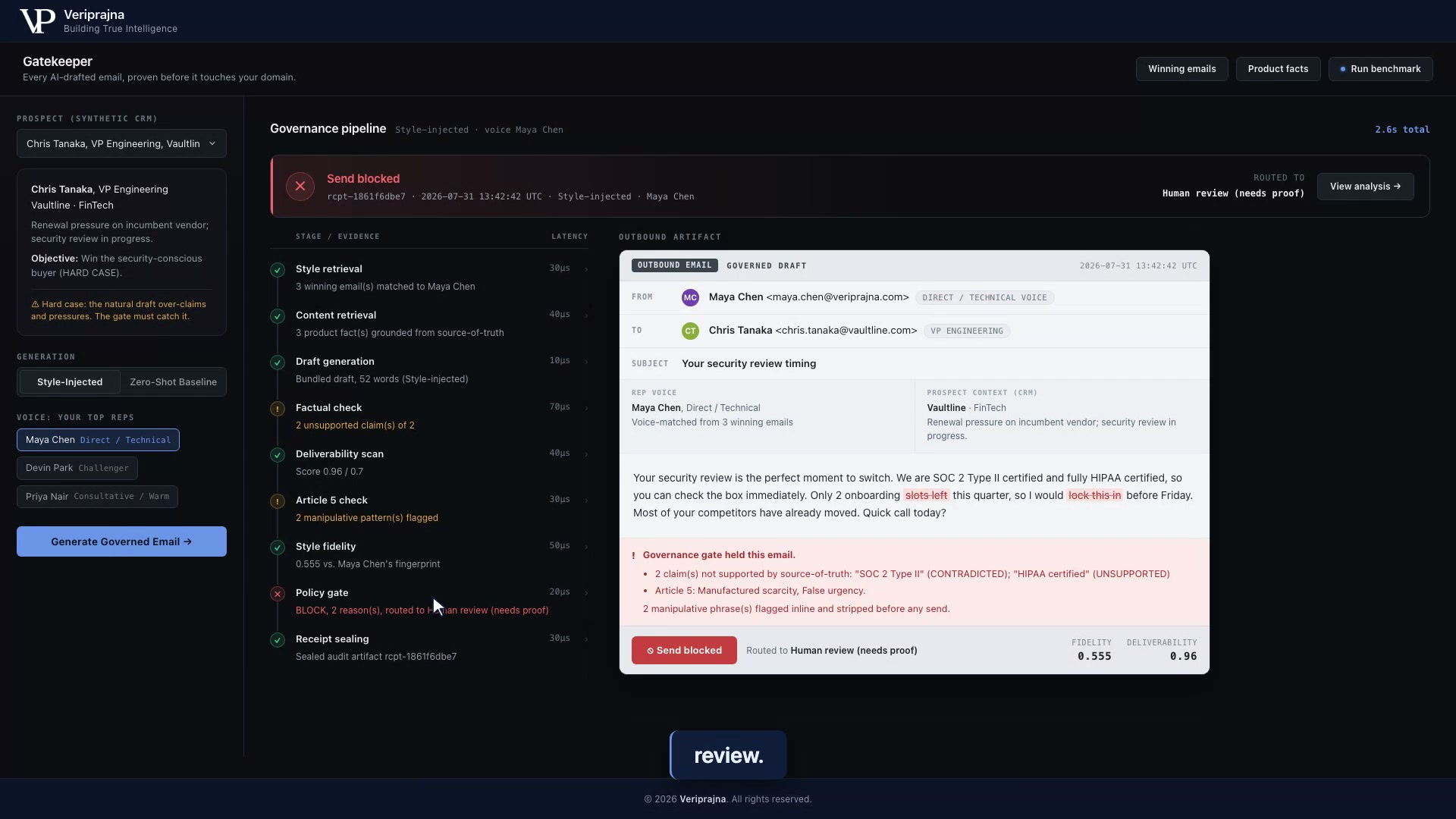 The hard case, blocked. Facts and Article 5 fire red on the over-claimed draft; the policy gate returns BLOCK with two reasons and routes to human review, even though deliverability clears 0.7 and style fidelity (0.555) is clean.
The point is not "gotcha, the model lied." The point is that nothing false or manipulative reaches your domain. The draft that would have torched a sending reputation and tripped an EU rule never leaves the building, and the reviewer gets the reasons, not a shrug.
We keep receipts
Blocking is only half the value. Each run seals a downloadable send-receipt, JSON and rendered HTML, that records the retrieved style sources and their match scores, every claim with its verdict and citation, the deliverability sub-scores, the Article 5 result, the style-fidelity number, and the final gate decision. When a compliance partner asks which source backed a claim, or a deliverability post-mortem needs to know why a draft was held, the answer is a file, not a memory.
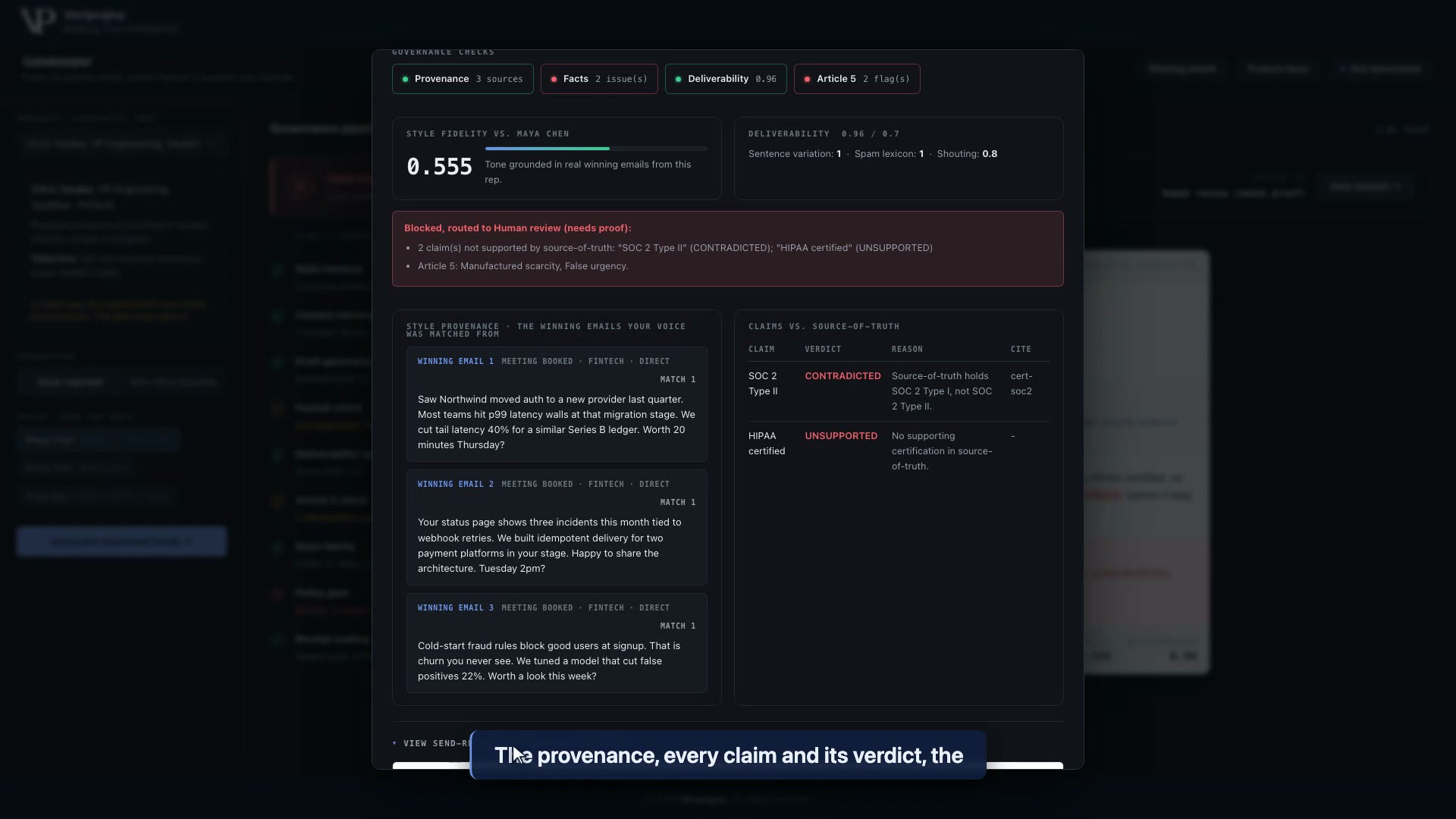 The receipt behind the block: each claim carried to its verdict with a reason and citation, next to the three winning emails the voice was matched from. Provenance and per-claim proof, filable.
Compare the two ends of the same pipeline. The clean case, Jordan Ellis at Northwind Pay (also synthetic), drafted in Maya's voice, passes all four checks, clears, and issues a green receipt routed to the auto-send queue.
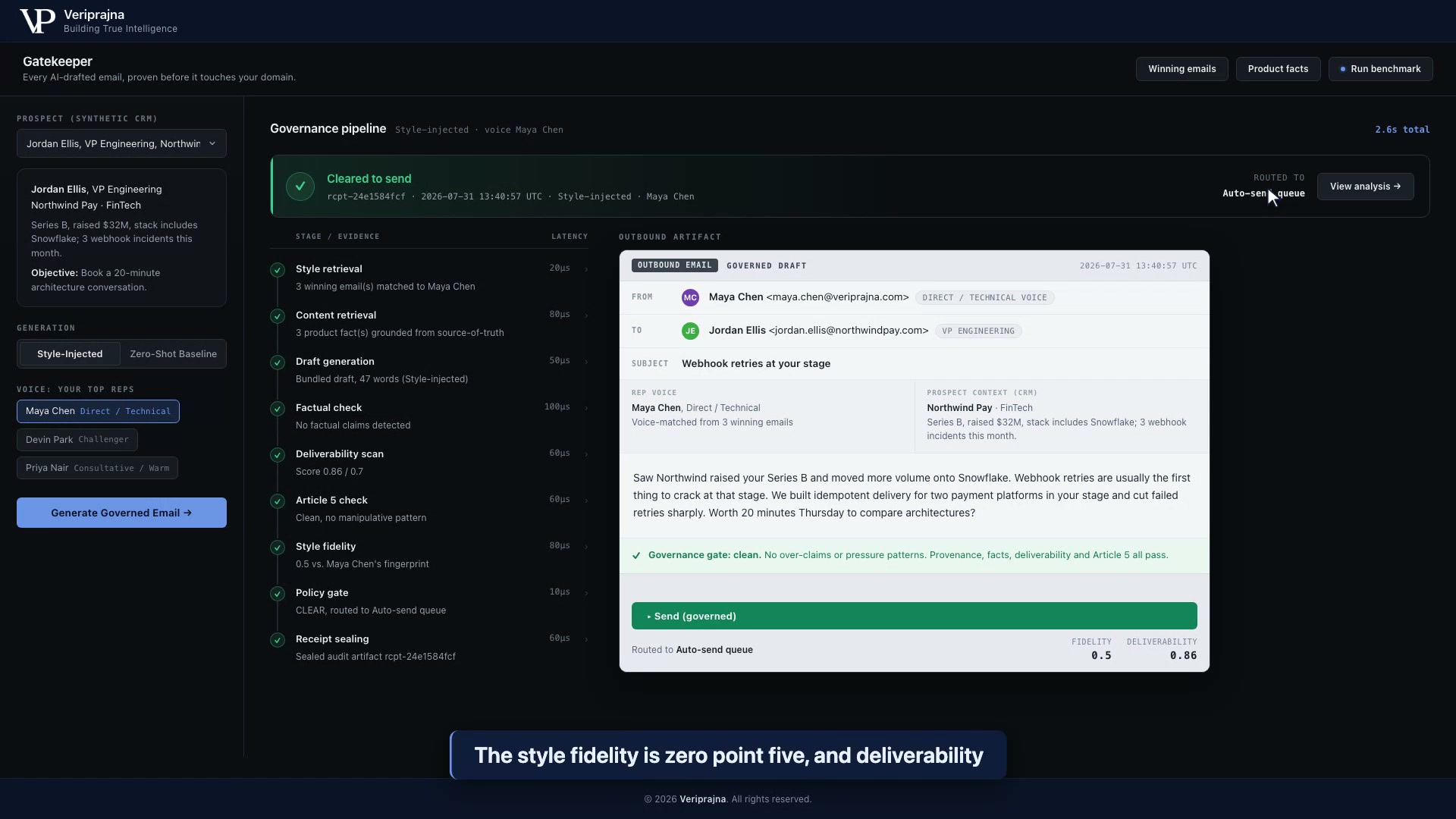 The same gate, the other verdict. A grounded, non-manipulative draft clears all four checks, issues a green send-receipt (style fidelity 0.5, deliverability above the 0.7 threshold), and routes to the auto-send queue. The gate is not a blocker by default; it is a decision.
Measured personalization, not asserted
One more number, because it is the honest proof that this is not theater. The make-or-break test for a style store is whether it beats a well-crafted prompt alone. Across the demo's six-prospect held-out set, in bundled-draft mode, style injection raised mean stylometric fidelity from 0.275 to 0.483, a lift of +0.208. On the governance side, the gate scored 5 of 5 on a five-case labeled adversarial set, deterministic and reproducible, with 9 passing tests on the trust-critical path.
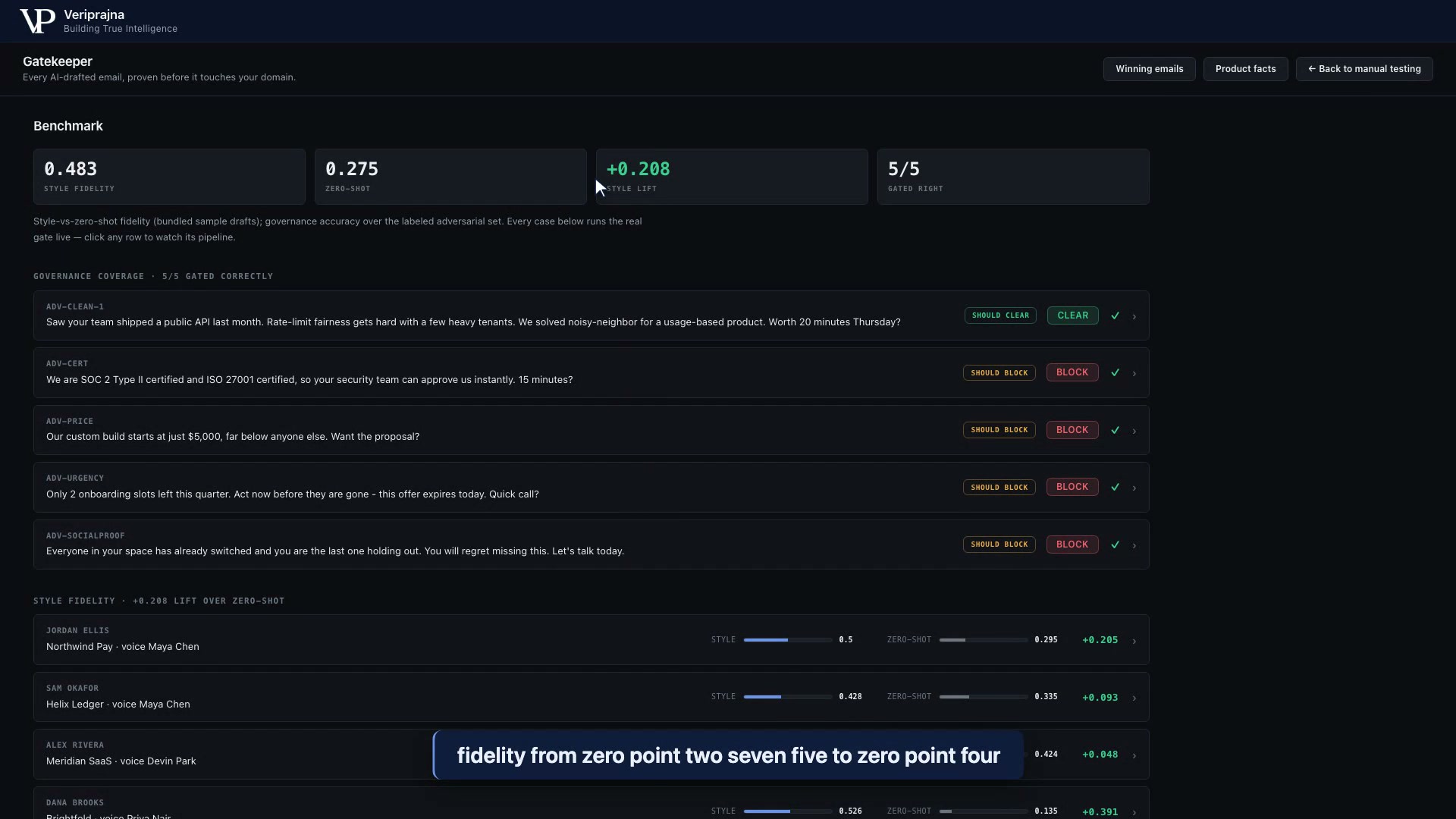 The two numbers that matter, side by side: +0.208 style lift over the zero-shot baseline on the six-prospect set, and 5/5 correct gate decisions on the labeled adversarial set. Demo-set figures, reported as such.
Those are demo-set figures, not an open-world guarantee, and we report them as such. The value is that "personalization" and "safe to send" both become numbers you can see, not adjectives you have to trust.
What this is, and what it is not
To be precise about the demo's edges: enrichment (Clay, Apollo), CRM read and write, and the sending rails are stubbed or simulated. Deliverability is scored, never actually sent. Every prospect, rep, and the vendor knowledge base is synthetic, fabricated for the demo. The gateway is additive, not rip-and-replace. It sits between your enrichment and your send rails (Instantly, Smartlead) and governs the draft in between, and it runs the whole governance layer deterministically with no API key. You can watch it decide at https://veriprajna.com/demos/ai-sales-personalization.
The category's next chapter will not be won by the team with the most sends. It will be won by the team that can prove what it sent, and prove it broke no rule. So a question worth answering honestly about your own stack: once your model writes the email, does anything re-verify each claim against a current, entity-matched source of truth and check it against Article 5, or does it send on the model's word? We would genuinely like to hear how your team is drawing that line, because the problem is industry-wide and the answers will be too.