A finance officer at a European energy company got a phone call from his CFO last year. The voice was unmistakable — the cadence, the slight impatience, the way he clipped his consonants. The CFO gave instructions to wire funds. The officer complied. The company lost $25 million. The CFO had never made that call. An AI had cloned his voice from earnings call recordings, and it was convincing enough to handle a live, back-and-forth conversation.
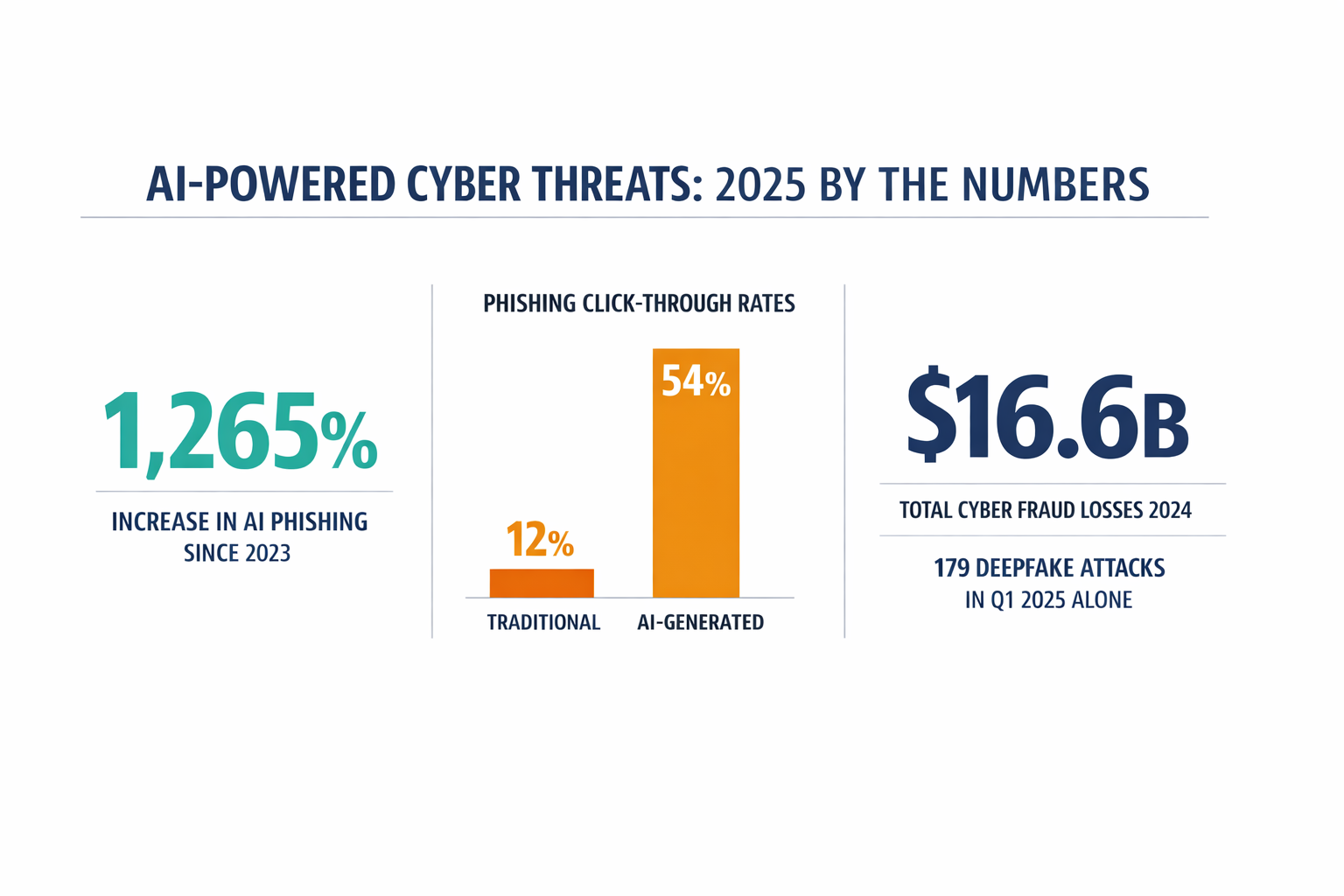
This isn't a hypothetical scenario from a cybersecurity keynote. It's one incident in a wave that saw 179 documented deepfake attacks in Q1 2025 alone — more than all of 2024 combined. And it forced me to confront something uncomfortable about the product category my company operates in: most enterprise AI tools aren't just failing to stop these threats. They're actively making organizations more vulnerable.
The Numbers That Changed How I Think About AI Risk
I've spent the last two years building AI systems for enterprises. When I first started tracking the threat data coming out of early 2025, I assumed the headlines were exaggerated. They weren't.
AI-generated phishing attacks have surged 1,265% since 2023. That's not a typo. And the reason is devastatingly simple: a phishing campaign that once took a skilled attacker 16 hours of research and drafting now takes five minutes and five prompts. The economics of cybercrime have fundamentally shifted.
But volume isn't even the scary part. The scary part is effectiveness. Traditional phishing emails — the ones with broken grammar and Nigerian prince stories — had a click-through rate of about 12%. AI-generated phishing emails? 54% click-through rates. That's nearly five times higher.
When 82.6% of phishing emails contain AI-generated content that perfectly mirrors your company's internal communication style, training employees to "look for red flags" is no longer a strategy. The red flags are gone.
The FBI's numbers tell the financial story: $2.77 billion lost to Business Email Compromise in 2024, with total cyber-enabled fraud reaching $16.6 billion. And these attacks are no longer single-channel. Attackers now orchestrate across email, Slack, Teams, and deepfaked voice calls simultaneously — creating an echo chamber of urgency that overwhelms anyone's judgment.
I walked my team through these numbers during a Monday standup, and the room went quiet. We'd been building what we thought was the right thing. But I realized we needed to have a harder conversation about what "enterprise AI" actually means.
Most Enterprise AI Is a Liability Disguised as Innovation
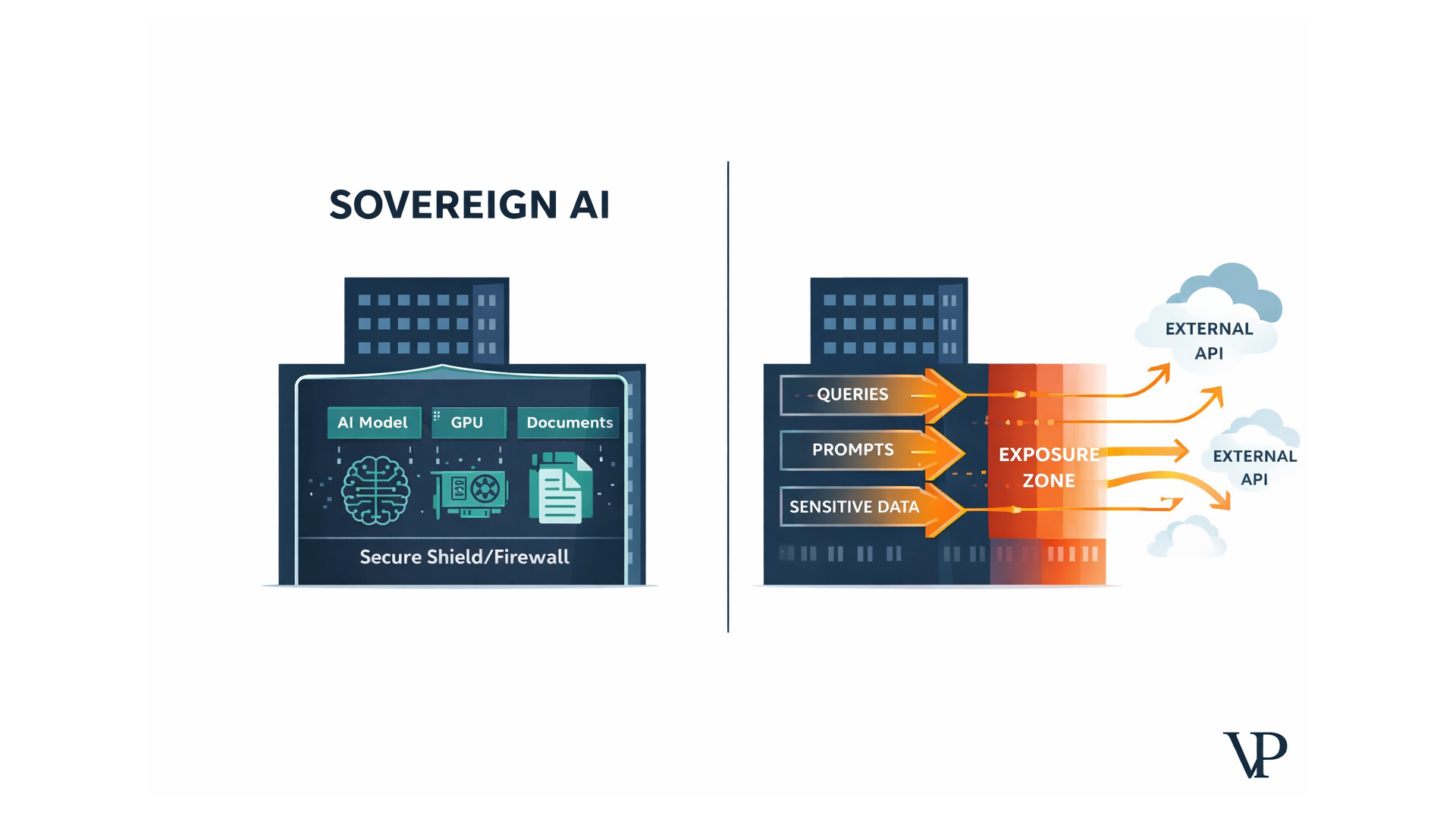
When the generative AI wave hit, companies scrambled to adopt it. The fastest path was what the industry calls an "AI wrapper" — a thin software layer on top of a public API like OpenAI's GPT-4 or Anthropic's Claude. You build a nice interface, pipe your employees' queries to someone else's model, and call it your "AI strategy."
I understand the appeal. We evaluated this approach ourselves early on. It's fast. It's cheap to start. And for low-stakes tasks — drafting marketing copy, summarizing meeting notes — it works fine.
But for anything touching sensitive data, the wrapper model has three problems that keep me up at night.
Every query leaves your building. When an employee asks your AI tool about a confidential merger or a customer's health records, that prompt travels across the public internet to someone else's servers. Even "enterprise" API tiers that promise zero data retention often maintain a 30-day monitoring window. For companies in defense, healthcare, or financial services, that's 30 days of liability with no technical way to verify the provider is keeping its promises.
The US CLOUD Act follows your data everywhere. Most major AI API providers are American companies. Under the CLOUD Act, US law enforcement can compel them to hand over data — even if that data is stored on servers in Frankfurt or Singapore. If you're a European or Asian enterprise using a US-based AI API, your "sovereign" data isn't sovereign at all.
Employees route around restrictions. This is the one that hit closest to home. When official AI tools feel limited, people use personal ChatGPT accounts instead. Samsung learned this the hard way when engineers leaked semiconductor source code through personal AI usage. Industry telemetry shows a 485% increase in source code pasted into generative AI applications, with 72% of that happening through personal accounts that IT can't see or control.
We explored this problem in depth in our interactive analysis of sovereign AI architecture, and the conclusion was clear: the wrapper model doesn't scale for serious enterprises.
What "Sovereign Intelligence" Actually Means
I started using the term "sovereign intelligence" after a conversation with a CISO at a defense contractor. She said something that stuck with me: "I don't want to rent intelligence. I want to own it."
That's the core idea. Sovereign intelligence means your AI models, your data, and your inference — the actual computation that generates answers — all live inside your walls. Not metaphorically. Literally inside your Virtual Private Cloud or your on-premises data center, behind your firewall, governed by your rules.
My team builds what we call "Deep AI" — which is the opposite of a wrapper. Instead of sending your data to someone else's model, we bring the model to your data.
This works because of a shift that happened in the open-source AI community over the past two years. Models like Llama 3 and Mistral now perform at levels that rival proprietary systems like GPT-4 for most enterprise tasks. And because they're open-weights — meaning you can download and own the model itself — you're not locked into any vendor's pricing, terms of service, or surprise model updates that break your workflows.
Owning your AI model is like owning your factory versus renting floor space. The upfront cost is higher, but the marginal cost of each additional unit approaches zero — and nobody can evict you.
The Pieces That Make Private AI Actually Work
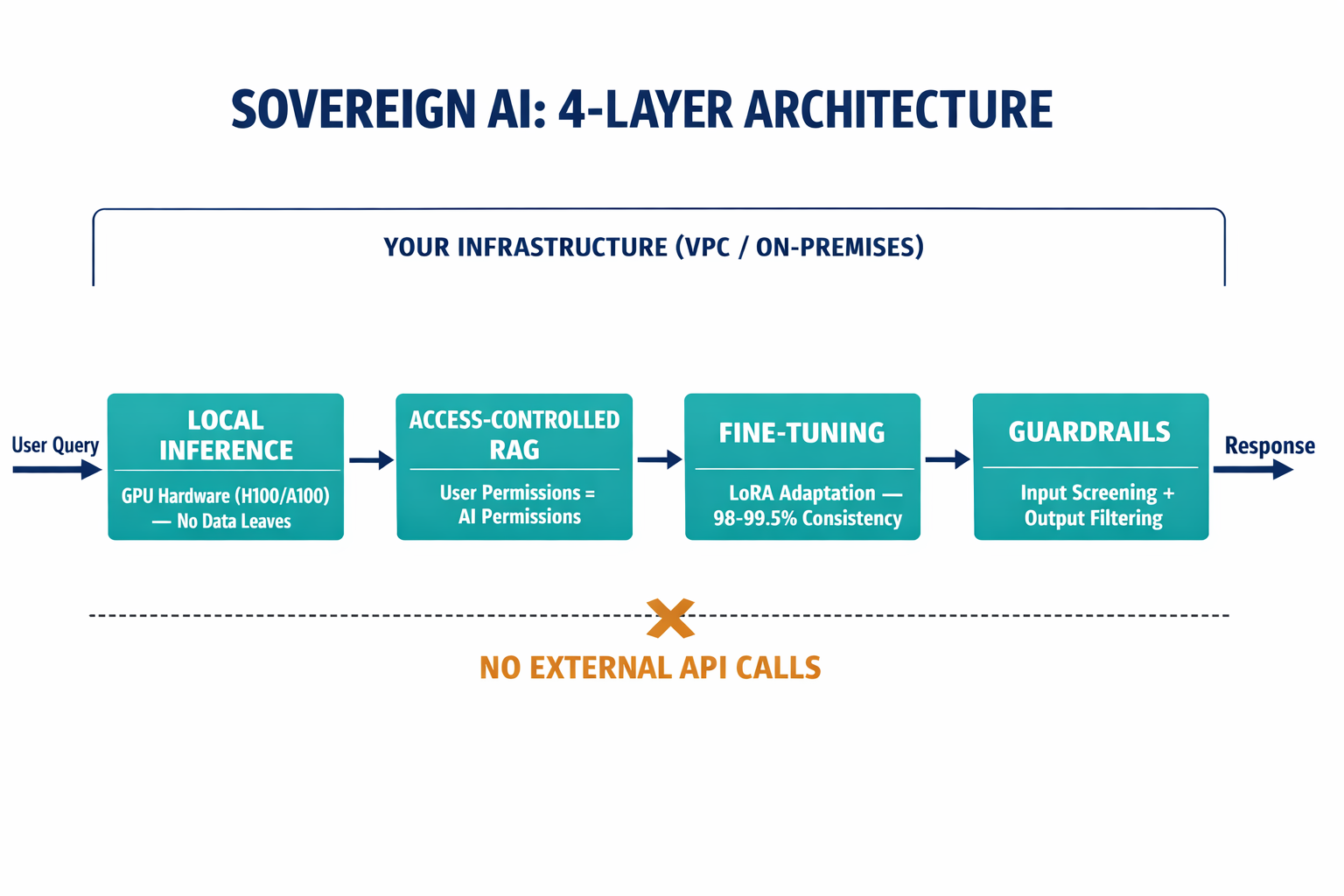
Deploying a model inside your infrastructure is necessary but not sufficient. Four things need to work together, and getting any one of them wrong creates a different kind of vulnerability.
The model runs on dedicated GPU hardware — NVIDIA H100s or A100s — inside your existing cloud environment. No data leaves. The inference engine processes queries locally, which also means faster response times since you're not waiting on an external API.
The knowledge layer is where most private AI implementations fail. Standard Retrieval-Augmented Generation (RAG) — where the AI pulls relevant documents to inform its answers — treats every user the same. If your intern and your CFO ask the same question, they get the same answer, drawn from the same documents. Our approach ties the retrieval system directly to your existing access controls. If a user can't see a document in your file system, the AI can't retrieve it for that user. Period. We call this preventing "contextual privilege escalation" — a fancy way of saying the AI shouldn't give people information they're not authorized to see.
Then there's fine-tuning. A general-purpose model knows a lot about the world but nothing about your company. Through a technique called Low-Rank Adaptation, we adapt the model's understanding to your specific vocabulary, processes, and standards. The result: output consistency jumps from roughly 85-90% with generic prompting to 98-99.5% with fine-tuning, and each query costs significantly fewer computing resources because the model already "knows" your context instead of needing it explained every time.
Finally, guardrails. Every input gets screened for prompt injection — attempts to trick the model into ignoring its safety rules. Every output gets checked for sensitive data leakage. The model is constrained to its professional purpose and can't be socially engineered into going off-script.
Why Attackers Are Now Targeting the AI Itself
Something I didn't fully appreciate until recently: as companies deploy AI for defense, attackers have started targeting the AI systems themselves. This is called adversarial machine learning, and it's subtle enough to be genuinely frightening.
An attacker can add invisible characters to an email — characters that a human can't see but that confuse an AI security model into classifying a malicious message as safe. They can poison a training dataset or a document repository so that the AI learns the wrong thing, creating a backdoor that activates only under specific conditions.
The most dangerous attack against an AI system isn't one that breaks it. It's one that makes it confidently wrong.
When your AI runs on someone else's infrastructure, trained on data you can't fully audit, you have no way to verify its integrity. A private deployment, trained exclusively on vetted internal data, is the only architecture where you can meaningfully defend against these attacks. For the full technical methodology behind our adversarial defense approach, see our detailed research on sovereign AI architecture.
The Deepfake Problem Needs Cryptography, Not Detection
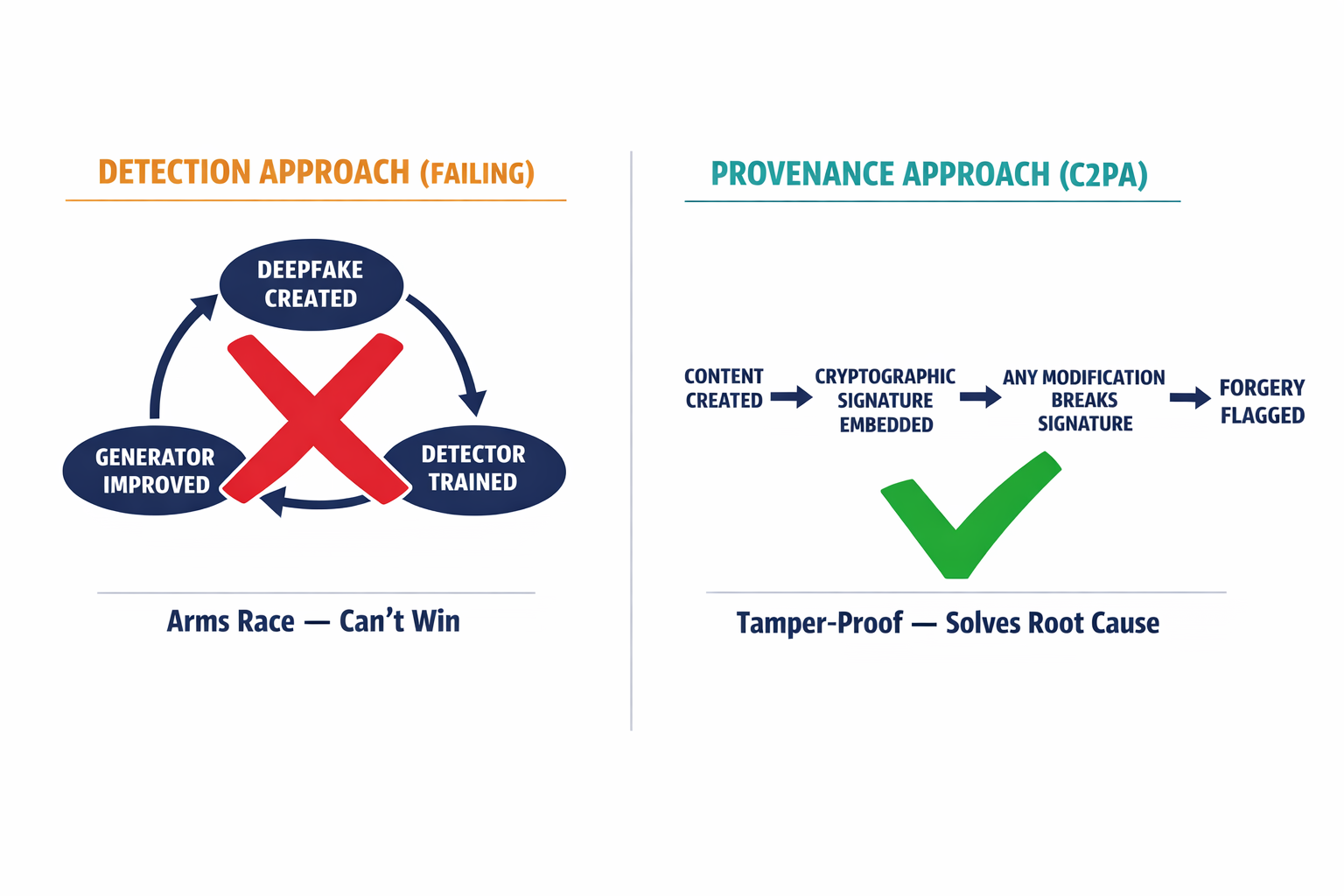
I wasted months exploring AI-based deepfake detection before arriving at a conclusion that should have been obvious: detection is an arms race you can't win. Every detector creates a training signal for the next generator.
The real answer is provenance, not detection. Think of it like this: instead of trying to determine whether a painting is a forgery by examining the brushstrokes, you create a tamper-proof certificate of authenticity at the moment the painting is created.
The C2PA framework — Coalition for Content Provenance and Authenticity — does exactly this for digital content. When an executive records a video authorization or signs off on a transaction, a cryptographic signature gets embedded in the file. If anyone modifies that file — even a single frame — the signature breaks and the system flags it. An attacker can clone your CFO's voice, but they can't forge the cryptographic signature tied to your CFO's verified identity.
We've started integrating this into enterprise communication workflows, and it solves the $25-million-phone-call problem at its root.
What About Cost? And Compliance?
Two objections I hear constantly.
"Isn't private AI dramatically more expensive?" At low volumes, yes. A public API looks cheap when you're running a few hundred queries a day. But costs scale linearly with usage on public APIs, while private infrastructure costs are mostly fixed. Our financial models show that for organizations processing around a billion tokens annually, self-hosting saves approximately $84,000 per year compared to top-tier API pricing. More importantly, you're building an asset — a model that understands your business — instead of paying rent on someone else's intelligence.
"How does this work with the EU AI Act and NIST?" Better than the alternative. The EU AI Act imposes strict requirements on high-risk AI systems: transparency, human oversight, data quality, and full audit trails. Non-compliance can cost up to €35 million or 7% of global revenue. A private deployment gives you immutable logs of every interaction, the ability to build human-approval checkpoints into automated workflows, and — critically — explainability that's nearly impossible to achieve with a proprietary black-box API. NIST's AI Risk Management Framework maps naturally to a sovereign architecture because you control every layer: governance, risk mapping, measurement, and response.
What This Means for Your Organization
If I could distill everything my team has learned into a single recommendation, it would be this: audit where your AI's data actually goes. Not where your vendor says it goes. Where it technically, verifiably goes.
Ask your AI vendors three questions:
Can you prove, technically, that our data never leaves our infrastructure?
What happens to our workflows if you update or deprecate your model?
Are you subject to the CLOUD Act or equivalent foreign data access laws?
If the answers make you uncomfortable, you have a sovereignty problem — and it's only going to get more expensive to fix as your AI usage scales.
The threat landscape of 2025 has made one thing clear: the organizations that will thrive aren't the ones with the most AI. They're the ones whose AI they can actually trust. And trust, in this context, isn't a feeling. It's an architecture.
I'd genuinely like to hear how other leaders are navigating this. Are you running into the same sovereignty concerns, or has your organization found a different path?