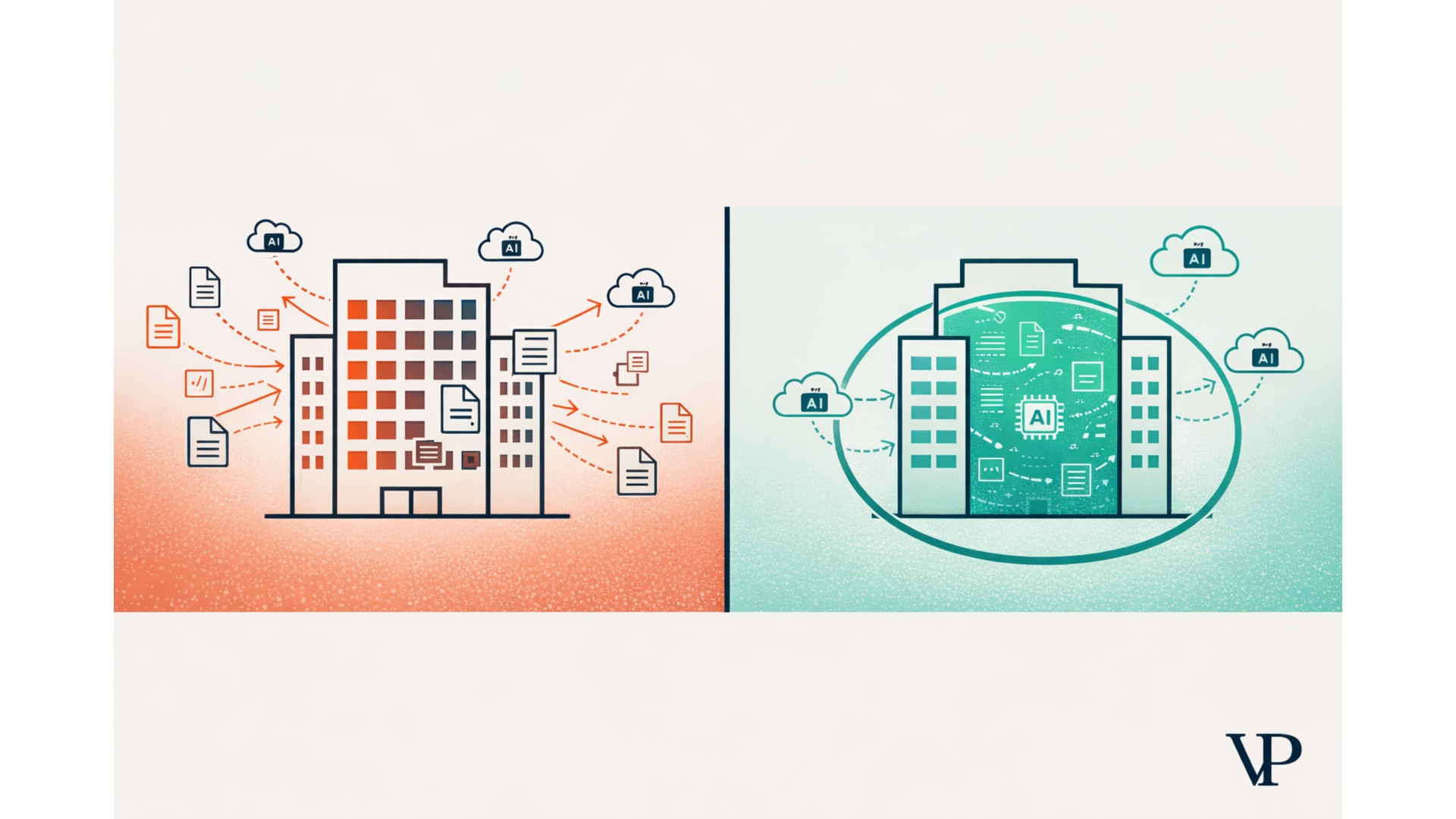
A Samsung engineer pastes proprietary chip fabrication code into ChatGPT to find a bug. A second uploads yield-defect detection logic — the kind of data that moves stock prices. A third feeds in a recording of a confidential strategy meeting. None of them are trying to harm the company. All of them are trying to do their jobs faster.
These weren't hypothetical scenarios. They happened in May 2023, and they exposed a truth that most enterprises still haven't fully reckoned with: the biggest threat to your data isn't a hacker. It's a high-performing employee who doesn't have secure AI tools. The Shadow AI crisis — employees using unauthorized AI on personal devices and accounts — isn't a future risk. It's happening now, at scale, and banning AI has only made it worse.
We spent months analyzing the data on enterprise AI adoption, security incidents, and the architectural options available to organizations trying to get this right. What we found is that the entire industry's initial instinct — prohibition — has backfired spectacularly. And the most popular "solution" being sold today — thin software wrappers over public APIs — doesn't actually fix the problem either.
The Ban That Backfired
Samsung's response to those 2023 leaks was the same as most large enterprises: ban generative AI across all company devices and networks, with threats of termination for anyone who violated the policy. It felt decisive. It looked like control.
It was neither.
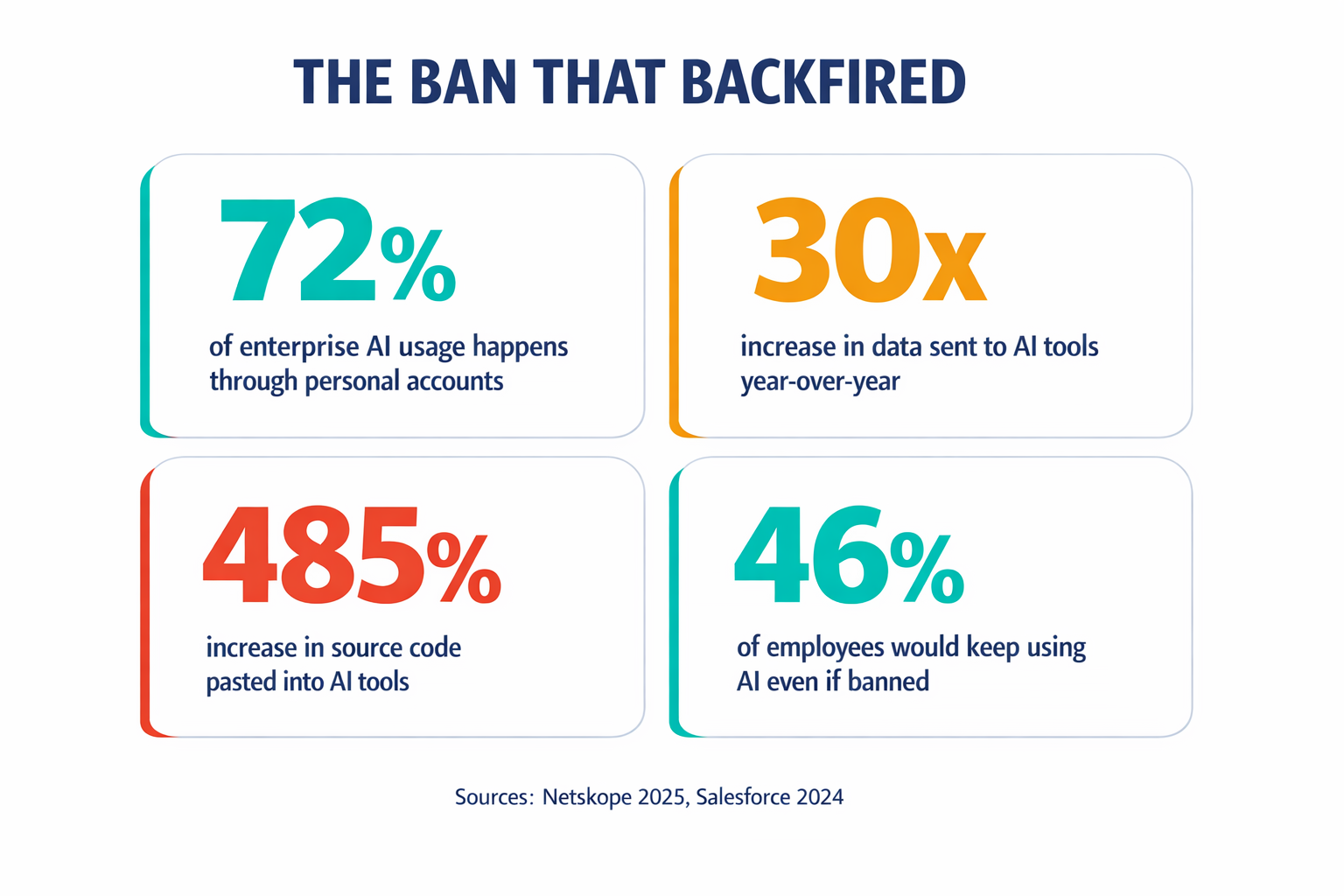
The data tells a different story. According to Netskope's 2025 Cloud and Threat Report, 72% of enterprise AI usage now happens through personal accounts — completely invisible to corporate IT. The volume of data flowing to generative AI applications has increased 30-fold year over year. And source code — the most sensitive category of intellectual property for many companies — has seen a 485% increase in being pasted into AI tools.
Banning AI didn't stop usage. It eliminated visibility.
Think of it like prohibition-era alcohol. When you outlaw something people desperately want, you don't eliminate demand — you just push it underground where you can't regulate it. Employees switch to personal phones on cellular networks. They use browser extensions that quietly scrape internal applications. They find smaller, less-known AI tools that aren't on the corporate blocklist — tools that often have far worse data privacy practices than the big providers.
The numbers on defiance are striking: 46% of employees say they would continue using AI tools even if their organization explicitly banned them. And 38% admit they've already shared sensitive work data — intellectual property, financial projections, personally identifiable information — with AI tools their employer doesn't know about.
We explored this dynamic in depth in our interactive analysis of the Shadow AI crisis, and the pattern is consistent across industries and geographies.
Why Your Best People Are Your Biggest Risk
This isn't about careless or malicious employees. That's what makes Shadow AI so difficult to address with traditional security thinking.
The engineers at Samsung weren't stealing data. They were debugging code — a task that AI can accelerate dramatically. They viewed ChatGPT the way most people view a calculator: type something in, get an answer, move on. They didn't realize their inputs could be retained for model training, effectively donating Samsung's trade secrets to a third-party provider's dataset.
This pattern repeats everywhere. When security policies feel like obstacles to competence, the most dedicated employees — the ones under the most pressure to deliver — become the primary violators. A developer thinks, "I'll just change the variable names so it's anonymous." A financial analyst tells herself the quarterly projections are "directional, not exact." The rationalizations are endless because the productivity gains are real.
The conscientious employee deprived of secure tools is a greater threat than the malicious outsider with a phishing kit.
And traditional cybersecurity tools can't solve this. Netskope tracks over 317 distinct generative AI applications in active enterprise use. You can block ChatGPT, Claude, and Gemini — and your employees will find number 318 by lunchtime.
The Wrapper Problem Nobody Talks About
So if banning doesn't work, the obvious next step is to provide a sanctioned AI tool. Many enterprises have done exactly this — and many have been sold what the industry calls an "AI wrapper."
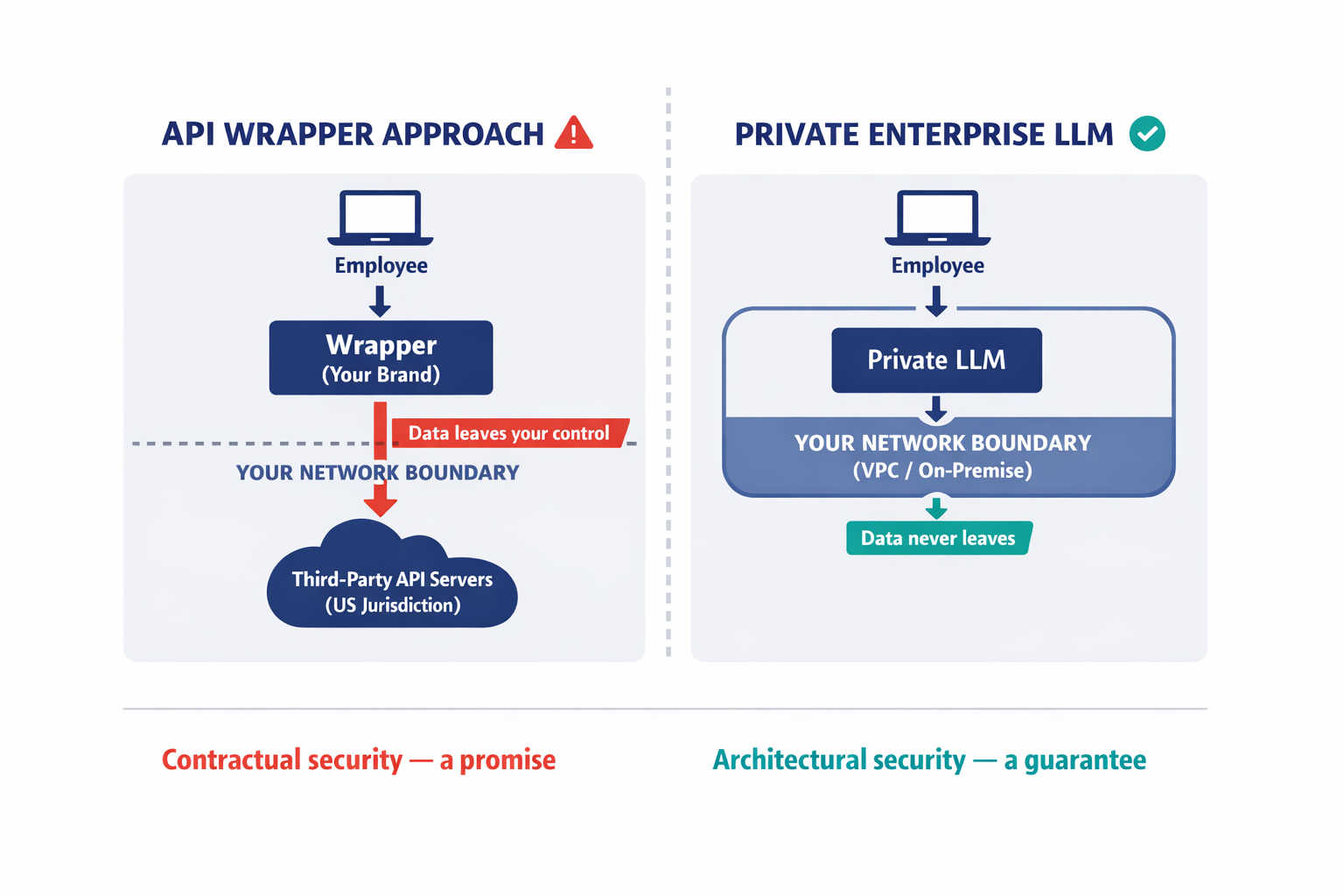
A wrapper is a software layer that sits on top of a public AI model's API. It takes your employee's question, maybe adds some instructions behind the scenes ("You are a helpful legal assistant"), sends it to OpenAI or Anthropic, and displays the result in a branded interface. It looks like a private tool. It feels like a private tool.
But the data still leaves your building.
Every prompt, every document excerpt, every code snippet travels across the public internet to someone else's servers. The wrapper hasn't solved the sovereignty problem — it has just made the data egress look more professional. For regulated industries, this distinction matters enormously. For anyone who cares about intellectual property, it should matter too.
Wrappers also create a dependency trap. The enterprise owns nothing — no model, no training data, no competitive moat. If the API provider raises prices, changes the model's behavior, or retires a version (which happens regularly), the wrapper breaks. And because wrappers are trivially easy to replicate — they're essentially a prompt and an API key — they offer almost no defensible value.
The Sovereignty Question Most Companies Are Ignoring
There's a legal dimension to this that many organizations haven't fully considered, particularly those operating outside the United States or with international operations.
The US CLOUD Act — the Clarifying Lawful Overseas Use of Data Act — gives US law enforcement the authority to compel US-based technology companies to hand over data stored on their servers, regardless of where those servers are physically located. If a German bank uses Azure OpenAI with data hosted in Frankfurt, the data center may be in Germany, but the controlling legal entity (Microsoft) is American. A US warrant can reach that data.
This creates a direct collision with GDPR and other local data protection frameworks. And it applies to every enterprise using US-based AI APIs — even the "enterprise" tiers that promise data residency. Data residency typically covers storage, not processing. When your prompt is being processed for inference, it may still route through US-controlled infrastructure.
True data sovereignty is impossible when your AI runs on someone else's servers under someone else's legal jurisdiction.
For industries with strict compliance requirements — defense, healthcare, finance, anything touching export controls — this isn't an abstract concern. It's a regulatory exposure that contractual promises ("we won't train on your data") cannot fully mitigate.
Private Enterprise LLMs: Owning the Intelligence
The alternative — and the approach we advocate — is deploying private enterprise LLMs directly within the organization's own cloud environment or on-premise data center.
The concept is straightforward even if the engineering isn't: instead of sending your data to someone else's AI, you bring the AI inside your walls. Open-source models like Meta's Llama 3 now rival GPT-4 on many benchmarks. You download the model weights, deploy them on GPU infrastructure you control, and run everything behind your own firewall.
When a developer prompts this model with proprietary code, that code travels from their laptop to an internal server sitting in your Virtual Private Cloud. It's processed in memory. The answer comes back. Nothing ever touches the public internet. There's no third-party retention, no training on your data, no legal exposure to foreign jurisdictions — not because of a contract, but because of physics. The data literally cannot leave.
This is what we mean by the shift from "contractual security" to "architectural security." A signed data processing agreement is a promise. An air-gapped network is a guarantee.
For the full technical architecture — including the inference engines, vector databases, and guardrail frameworks that make this production-ready — see our detailed technical deep-dive.
It's Not Just Safer. It's Cheaper at Scale.
A common objection: "GPUs are expensive. APIs charge pennies per token." This is true for small-scale usage. It inverts completely at enterprise volumes.
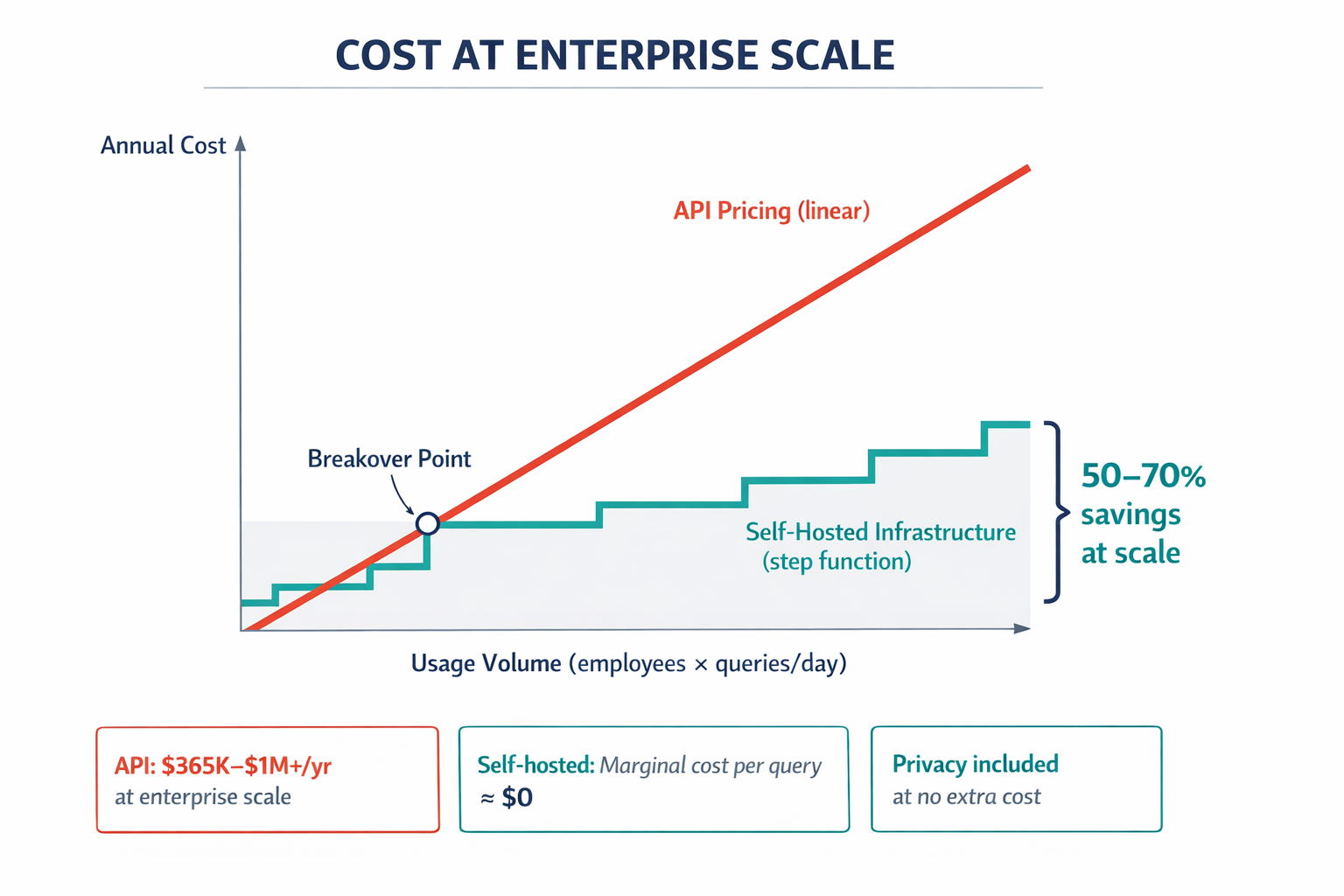
API pricing scales linearly — if usage triples, your bill triples. Enterprise AI applications are also token-hungry by nature. To answer a single question using company documents, the system might retrieve ten pages of context as input tokens. Multiply that by a thousand employees asking ten questions a day, and you're looking at $365,000 to over $1 million per year in API costs alone.
Self-hosted infrastructure costs are step functions. A single high-performance GPU node can handle thousands of requests per second. Until you saturate that capacity, the marginal cost of each additional query is effectively zero. Our analysis shows that self-hosting can be 50–70% cheaper than equivalent API usage at enterprise scale — and the privacy comes free.
There are hidden API costs too. Providers impose rate limits that can cause outages during company-wide rollouts. They deprecate model versions, forcing constant testing and prompt rewrites. A self-hosted model never changes unless you decide to upgrade it. That stability alone has significant operational value.
What About Model Quality? And What About Maintenance?
Two questions we hear constantly, and they're the right ones to ask.
On quality: the gap between open-source and proprietary models has narrowed dramatically. Llama 3's 70-billion-parameter version matches GPT-4 on many reasoning benchmarks. For domain-specific tasks — legal document review, code analysis in a particular language, compliance screening against internal policies — fine-tuning an open model on your own data can actually surpass general-purpose commercial models by up to 15%. A model that knows your company's terminology, your codebase, and your regulatory environment will outperform a brilliant generalist that knows nothing about you.
On maintenance: this is real work, and we won't pretend otherwise. Running private AI infrastructure requires expertise in GPU orchestration, model serving, vector database management, and security hardening. It's not a weekend project. But it's also not reinventing the wheel — the tooling ecosystem (Kubernetes for orchestration, vLLM for high-throughput inference, NVIDIA NeMo for guardrails) is mature and battle-tested. The question isn't whether your organization can do this. It's whether you want to build the capability internally or work with a partner who's done it before.
From Chatbot to Secure Workforce
The real opportunity goes far beyond replacing ChatGPT with a private version. Shadow AI is a signal — it tells you exactly where your employees are desperate for automation.
Once you have a secure AI foundation, you can build agents that actually do things inside your network. A compliance agent that scans every new vendor contract against your risk policy and flags deviations. A DevOps agent that analyzes server logs, identifies root causes, and opens a Jira ticket. An HR assistant that answers benefits questions using your actual policy documents — with access controls that ensure it only shares information each employee is authorized to see.
Shadow AI told you what your workforce needs. Private AI lets you deliver it without the risk.
None of this is possible — at least not securely — when your AI infrastructure depends on sending data to a third party. The moment you own the model, the knowledge layer, and the guardrails, the design space for what you can build expands enormously.
The Security Leader's Pivot
The Samsung incident was a warning, not an anomaly. Every organization with knowledge workers is experiencing some version of it right now — they just may not know it yet, because 72% of the usage is invisible.
The path forward isn't more restrictive policies. It's providing something better than what employees are finding on their own: AI tools that are faster, more integrated with internal systems, aware of company context, and — crucially — architecturally incapable of leaking data.
Security in the age of AI is no longer about the capacity to say "No." It's about the architectural capability to say "Yes, safely."
If your organization is navigating this tension between AI productivity and data security, we'd welcome the conversation. What's working? What isn't? The enterprises getting this right are the ones treating it as an infrastructure decision, not a policy one.