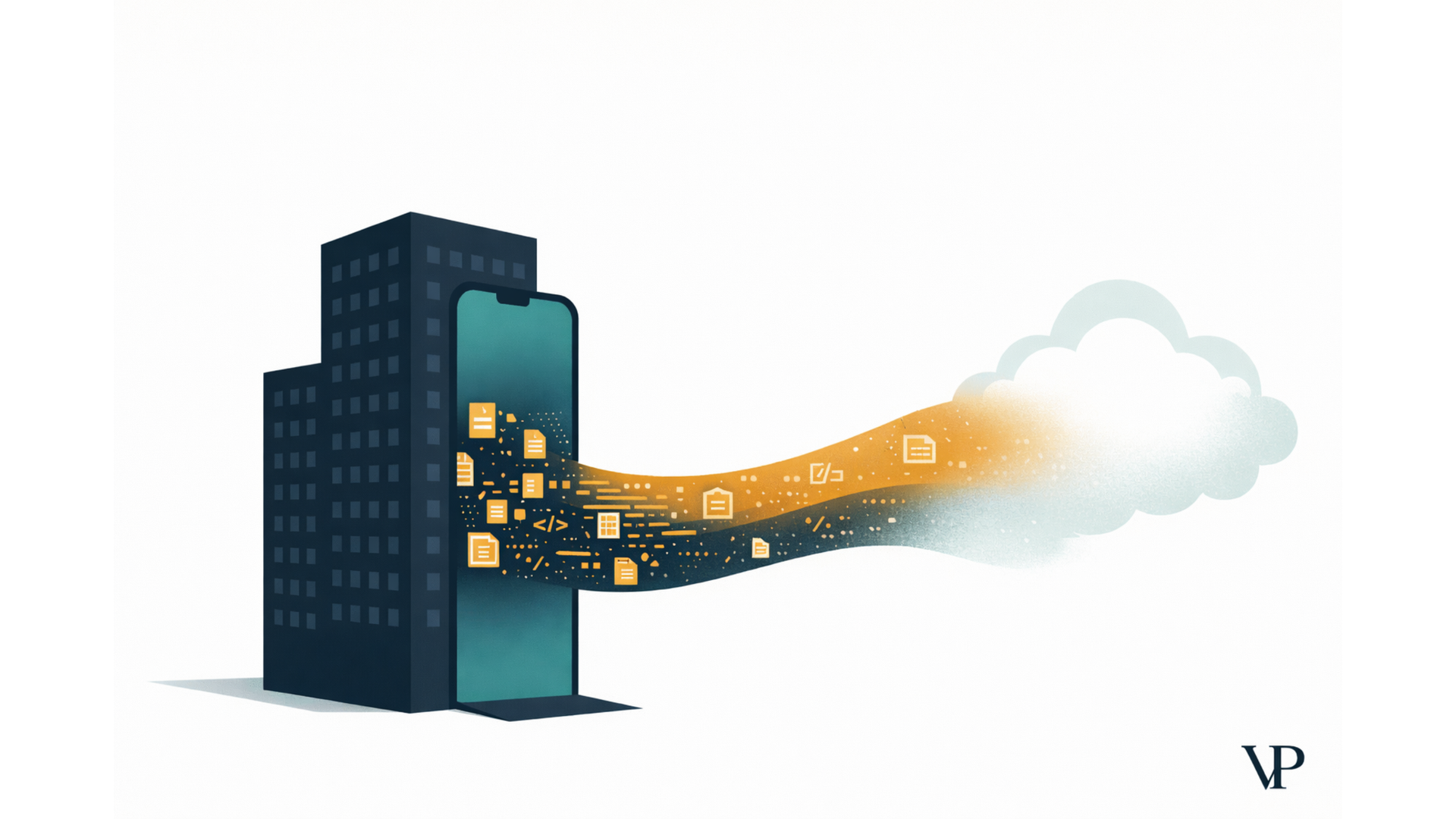
A Samsung engineer pastes proprietary chip fabrication code into ChatGPT to find a bug. A second uploads yield-defect data — the kind of number that moves stock prices. A third feeds in a recording of an internal strategy meeting. None of them are trying to hurt the company. They're trying to do their jobs faster.
Within weeks, Samsung bans generative AI across the entire organization. The problem? The data is already gone. It's sitting on OpenAI's servers, potentially folded into training pipelines, and Samsung's most sensitive intellectual property — semiconductor manufacturing logic — has left the building forever.
I've spent the last two years watching this exact pattern repeat across industries. A company discovers employees using public AI tools. Leadership panics. IT blocks ChatGPT, Claude, and Gemini. Everyone declares victory. And then the real crisis begins — because the employees don't stop. They just go underground.
We call this Shadow AI, and it's the most dangerous security threat most enterprises aren't measuring.
46% of Your Workforce Will Ignore the Ban
The numbers are brutal, and they keep getting worse.
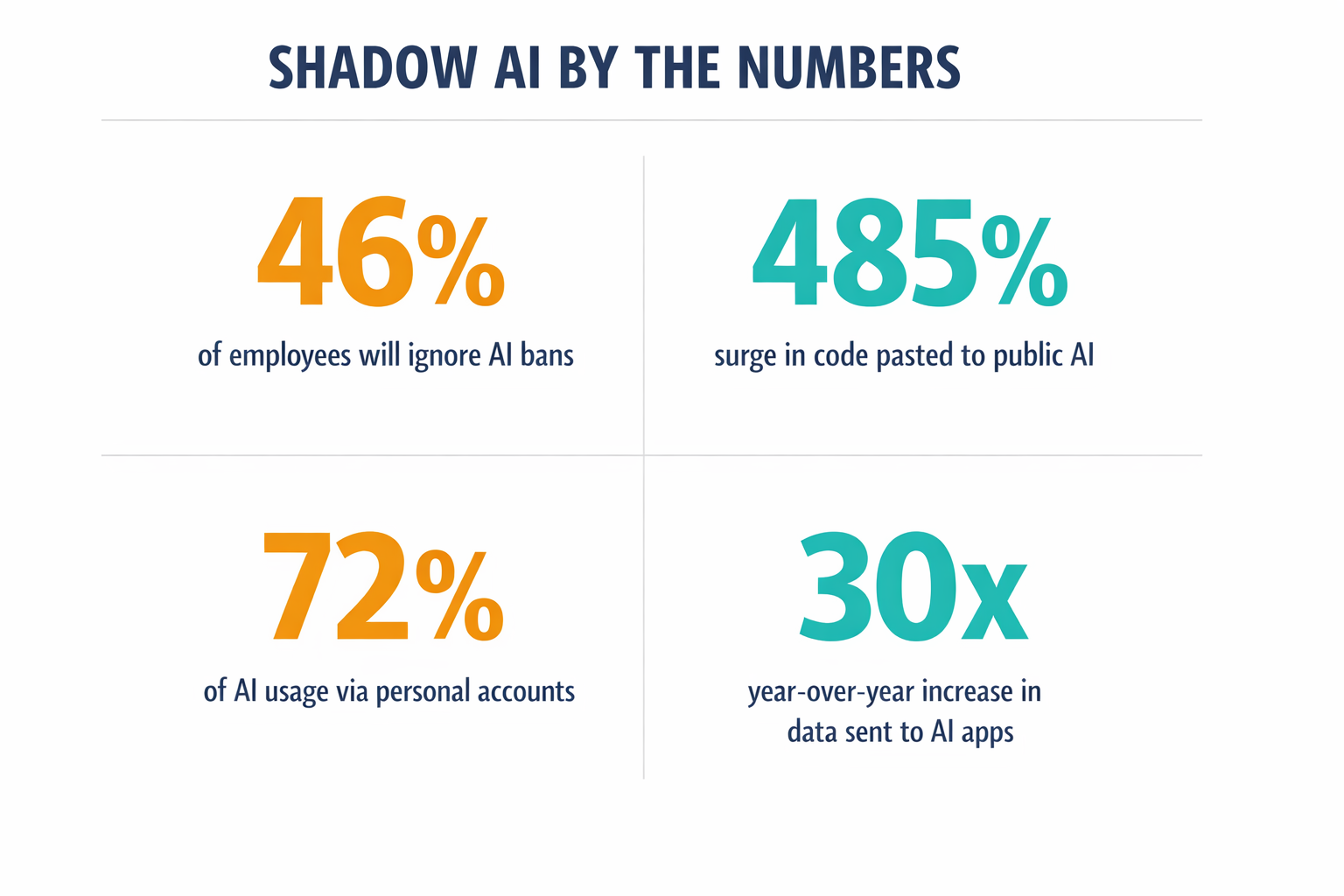
Roughly half of knowledge workers now use AI tools at work. Of those in organizations that have banned AI, 46% say they'll keep using it anyway. They're not being defiant for fun — they're under pressure to ship code, close deals, and hit quarterly targets. When a tool cuts hours off a task, a policy memo doesn't stand a chance.
What really caught my attention: 38% of employees admit to sharing sensitive data — proprietary code, financial projections, customer information — with public AI tools, without their employer's knowledge. And the volume of data flowing to generative AI applications has increased 30x year-over-year.
Shadow AI isn't a policy problem. It's a physics problem — data flows toward the path of least resistance.
The leakage vector that keeps me up at night is source code. Pasted code to public AI tools has surged by 485%. Every one of those pastes is a miniature Samsung incident, just without the headline. Engineers are uploading proprietary logic to debug, optimize, and refactor — and they're doing it through personal accounts that IT has zero visibility into. In fact, 72% of enterprise AI usage happens through personal accounts, completely outside corporate governance.
I wrote about this dynamic in depth in our interactive analysis of the Shadow AI crisis, and the research paints a picture that should alarm any security leader.
Blocking Domains Is Security Theater
After Samsung, the instinct across corporate America was predictable: block the domains. Lock down chat.openai.com. Add Claude to the firewall blacklist. Problem solved.
Except it wasn't. Not even close.
Your employees carry smartphones with independent 5G connections. A corporate network block means nothing when someone can photograph their screen or type a code snippet into their personal phone. The "air gap" between a locked-down work laptop and an unrestricted personal device is about eighteen inches of desk space.
And it gets worse. Netskope now tracks over 317 distinct generative AI applications in enterprise use. Block the three biggest names, and your employees migrate to smaller, less-known AI startups — tools with weaker security practices, vaguer privacy policies, and no enterprise agreements whatsoever. You've pushed the problem from a well-lit room into a dark alley.
Then there are browser extensions — the ones that promise to "summarize your emails" or "auto-complete forms." Many of these have read access to everything displayed in the browser, including your CRM, your ERP, your internal wikis. Data leaves without anyone explicitly pasting anything.
You cannot firewall your way out of a problem that fits in someone's pocket.
The Real Lesson from Samsung: Good Employees, Bad Architecture
What struck me most about the Samsung incident wasn't the leak itself — it was who did it. These weren't disgruntled insiders or careless interns. They were senior semiconductor engineers doing complex, high-value work. They turned to ChatGPT because it could genuinely help them solve hard problems faster.
They treated it like a calculator — put data in, get an answer, move on. They didn't realize they were feeding a learning system that could retain their inputs. The mental model was wrong, but the motivation was entirely rational.
This is the uncomfortable truth that most security strategies ignore: your highest-performing employees are your biggest Shadow AI risk, precisely because they're the ones most motivated to find better tools. When security policies feel like obstacles to competence, the people you most want to retain are the first to route around them.
Threatening termination, as Samsung did, doesn't fix the underlying architecture. It just makes people more careful about hiding what they're doing.
Why API Wrappers Don't Solve This
After the ban-everything phase, many organizations moved to what felt like a reasonable middle ground: approved AI tools built on top of public APIs. A vendor slaps a corporate interface on GPT-4, adds a system prompt that says "You are a helpful legal assistant," and calls it enterprise-ready.
My team calls these "wrappers," and they have a fundamental problem: your data still leaves the building. The wrapper beautifies the interface, but the backend is still a public API. Your prompts, your documents, your code — they all travel across the internet to someone else's servers.
Wrappers also create a false sense of ownership. The enterprise doesn't own the AI; it rents access to it. If the API provider raises prices, changes the model's behavior, or retires the version you've built around, you're scrambling. There's no defensible asset — just a dependency.
For regulated industries, the problem is even sharper. The US CLOUD Act allows American law enforcement to compel US-based technology companies to hand over data stored on their servers, regardless of where those servers are physically located. A German bank using an API hosted in a Frankfurt data center is still exposed if the provider is a US company. That creates a direct collision with GDPR and local data protection laws that no amount of contractual language can fully resolve.
The Architecture That Actually Works
About a year ago, my team stopped asking "How do we control what employees paste into ChatGPT?" and started asking a different question: "What if we gave them something better that never lets data leave?"
That shift changed everything for us.
The answer is what we call a Private Enterprise LLM — a full AI system deployed inside the organization's own cloud environment, behind its own firewall. Not a wrapper. Not an API call. The actual model, running on hardware the enterprise controls.
Open-source models like Meta's Llama 3 have closed the performance gap dramatically. The 70B-parameter version rivals GPT-4 on many benchmarks. When you deploy it inside a Virtual Private Cloud (VPC) — think of it as a sealed room within your existing cloud infrastructure — something powerful happens: data physically cannot leave. A developer's prompt travels from their laptop to an internal server, gets processed in memory, and the answer comes back. Nothing traverses the public internet. Nothing touches a third-party server.
We pair this with what I'd describe as a private knowledge layer. The company's documents — contracts, code repositories, internal wikis — get indexed into a secure database that the AI can search when answering questions. Critically, this system respects existing access controls. If an employee doesn't have permission to see a document in SharePoint, the AI won't use it to answer their question either. That's a capability most public tools and wrappers simply don't offer.
For the full technical architecture — the specific inference engines, vector databases, and guardrail frameworks involved — our detailed research covers the complete stack.
The Cost Argument Has Flipped
"GPUs are expensive" is the objection I hear most. And for a single developer running occasional queries, yes — an API is cheaper. But enterprise economics work differently.
Consider a mid-sized tech company processing a billion tokens per month across code generation, documentation, and log analysis. At API rates for a GPT-4-class model, that's roughly $5,000–$15,000 per month. The same workload on self-hosted Llama 3 70B running on two A100 GPUs costs approximately $2,000–$4,000 per month. That's a 50–70% reduction, and privacy comes free.
At enterprise scale, self-hosting isn't the expensive option. APIs are.
The savings compound when you factor in what I call the "token trap." Enterprise AI applications are hungry — answering a single question might require retrieving ten pages of context documents, all of which count as input tokens you're paying for. Multiply that by a thousand employees asking ten questions a day, and you're looking at $365,000 to over $1 million annually in API costs alone.
Self-hosted infrastructure costs in steps, not slopes. One powerful server handles thousands of requests per second. Until you saturate it, every additional query is essentially free.
There are hidden API costs too. Rate limits that cause outages when you roll out a company-wide tool. Model deprecations that force you to rewrite and retest your applications when the provider retires a version. A self-hosted model never changes unless you decide to upgrade it. That stability has real operational value.
What About Model Quality? And Customization?
A fair question. Two years ago, open-source models were clearly behind the proprietary leaders. That gap has narrowed to the point where, for most enterprise tasks — summarization, code assistance, document analysis, classification — the difference is negligible.
Where private models actually pull ahead is customization. You can fine-tune an open model on your organization's specific terminology, your legacy codebase, your legal templates. That "last mile" of domain adaptation can improve accuracy by up to 15% on specialized tasks. You can't do that with a public API — or if you can, you're sending your most sensitive training data to someone else's servers to do it.
And then there's the guardrails question. Raw AI models can be unpredictable. We wrap them in what amounts to a firewall for prompts — scanning inputs for sensitive data like Social Security numbers before they reach the model, restricting the AI's scope so an HR bot can't be tricked into discussing database passwords, and defending against jailbreak attempts. These controls are programmable and enterprise-defined, not imposed by a third-party provider with different priorities than yours.
The Pivot Security Leaders Need to Make
The Samsung incident wasn't an anomaly. It was a preview. Every organization with knowledge workers is experiencing some version of this right now — the only question is whether they can see it.
The pattern is clear:
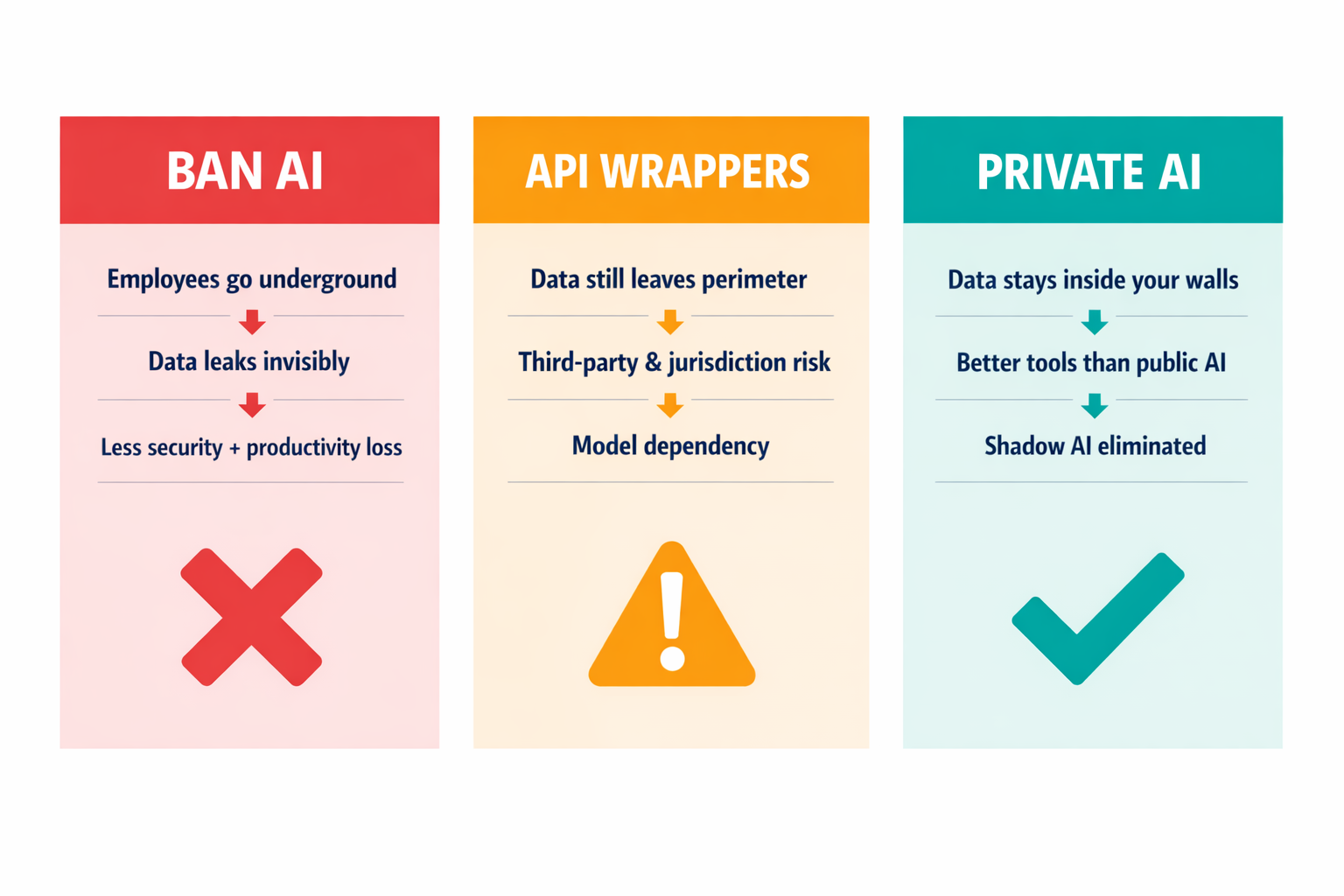
Ban AI → employees go underground → data leaks invisibly → you have less security than before, plus a productivity penalty
Use API wrappers → data still leaves the perimeter → you're exposed to third-party risk, foreign jurisdiction, and model dependency
Deploy private AI → data stays inside your walls → employees get tools that are faster and more integrated than what they were sneaking → Shadow AI dies because the sanctioned option is genuinely better
Security in the age of AI isn't about the ability to say "No." It's about the architecture to say "Yes, safely."
The technology exists today to run GPT-4-class models inside your own infrastructure, at lower cost, with zero data egress. The open-source ecosystem has made this possible in a way that wasn't true even eighteen months ago.
The organizations that figure this out first won't just be more secure. They'll be faster, because their employees will stop wasting energy circumventing policies and start building on a foundation that actually works.
I'd be curious to hear from security and IT leaders navigating this transition — what's been the hardest part of moving from prohibition to provisioning? The technical architecture, the organizational change management, or something else entirely?