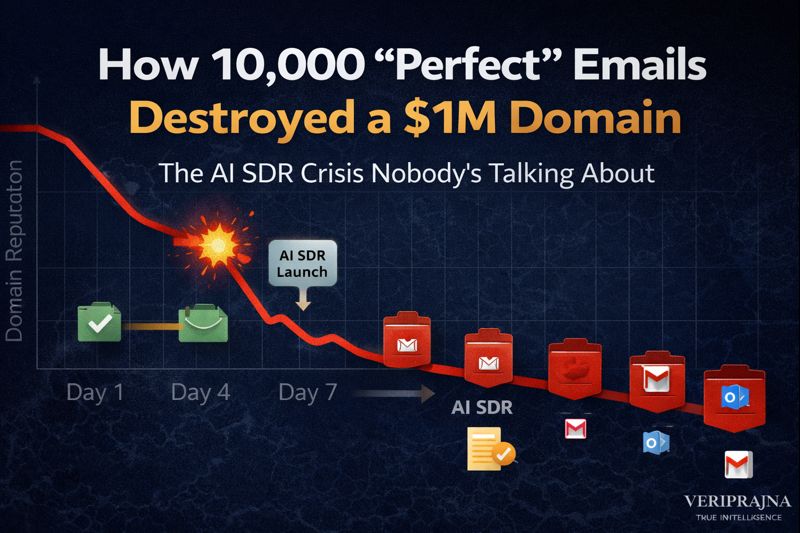
- 🧵 THREAD: How AI SDRs Are Burning $1M+ Domains By Sending 10,000 "Perfect" Emails That Google's AI Flags as Spam in 48 Hours (And How to Build Verifiable Sales Agents Instead)
The AI SDR pitch: $7K/year vs $125K for humans. Process 1,000 contacts/day. <5min response time. - Early results look amazing: 50% higher email response rates than human SDRs.
Then conversion rates collapse. 15% AI vs 25% human.
What happened? 🧵
THE PROBLEM: Hallucinations at scale. - Your AI confidently emails prospects:
• "I saw your expansion into APAC" (didn't happen)
• "Your Salesforce integration" (they use HubSpot)
• "Congrats on Series B" (they're Series A)
Prospects don't delete these. They screenshot them.
They tag your brand as "incompetent." - Most "AI SDR" tools are WRAPPERS.
Pretty dashboard + mega-prompt + GPT-4 = "Sales Agent"
But underneath? Just probabilistic next-token prediction.
The AI doesn't "think."
It simulates the texture of a factual statement by predicting statistically probable words. - THE MATH OF HALLUCINATION:
LLMs use Softmax function → forces probability distribution summing to 1.0 across entire vocabulary.
Critical insight: Standard LLMs have NO internal state for "I don't know." - Asked to describe a company's strategy without data?
→ Can't output NULL
→ Must allocate probability SOMEWHERE
→ Generates "growth," "transformation," "efficiency"
This creates 4 hallucination types in sales: - 1. Fact-Conflicting: Claims they use Tool X when they use Tool Y
2. Input-Conflicting: Quotes $5K when pricing doc says $10K (LEGAL LIABILITY)
3. Context-Conflicting: Proposes Tuesday after they declined Tuesday - 4. Logical: "You raised Series B, so you're replacing CFO" (inference → stated as fact)
THE CASCADE:
Hallucinations → Low engagement → Spam flags → Domain reputation collapse
Google's 2025 spam filters use RETVec (Resilient & Efficient Text Vectorizer): - • Detects statistical signatures of AI-generated text
• If you blast 10K emails with same AI structure (even if words vary), filters recognize the PATTERN
• Your domain gets burned
Once domain reputation craters:
❌ Marketing emails → spam
❌ Sales emails → spam - ❌ Invoices → spam
❌ Password resets → spam
You didn't just lose sales. You lost your email infrastructure.
Cost to rehabilitate a burned domain? Often cheaper to buy a new one.
THE LEGAL EXPOSURE:
Under "apparent authority" doctrine, AI agents can bind companies to contracts. - AI promises "guaranteed 100% uptime or full refund"?
→ Prospect accepts?
→ Company is liable. Regardless of whether AI was "authorized."
In regulated industries (FINRA, HIPAA), hallucinated compliance claims = federal investigation. - VERIPRAJNA'S FIX: Fact-Checked Research Agent Architecture
Not one "AI SDR."
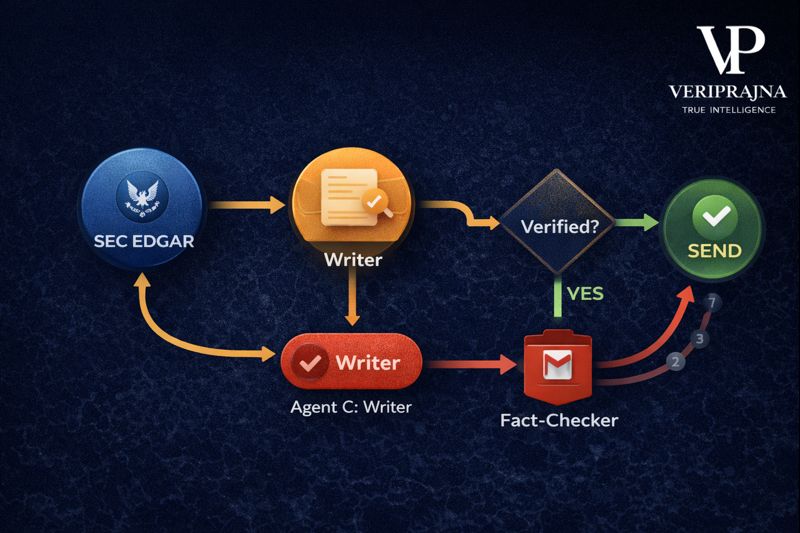
Three specialized agents in a verification loop:
Agent A: RESEARCHER
• Scrapes SEC 10-Ks, APIs, Knowledge Graphs
• Forbidden from creative writing
• Output: JSON with facts + citations - Agent B: FACT-CHECKER
• Adversarial critic
• Compares Writer draft vs Researcher facts
• Logic: "Draft claims '20% growth'.Is this in Research Notes? NO → Reject."
• Uses SelfCheckGPT hallucination detection
• Output: Pass/Fail + specific feedback - Agent C: WRITER
• Synthesizes verified facts into narrative
• Constraint: "Use ONLY provided Research Notes"
THE REFLECTION LOOP: - Research → Draft → Critique → Decision:
• Pass (compliance > 0.95) → Send
• Fail + <3 attempts → Iterate (back to Draft)
• Fail + 3 attempts → Human intervention
It's CYCLIC. Not linear.
The AI "thinks" before speaking. "Reflects" before sending. - WHY LANGGRAPH > CREWAI:
CrewAI: Role-based, implicit state, unpredictable agent interactions
❌ Can't force deterministic paths
❌ "If Fact-Checker fails 2x, escalate to human" = hard to implement
LangGraph: State machine, explicit nodes/edges - ✅ Deterministic: compliance_score < 0.95 AND critique_count < 3 → draft_node (retry)
✅ Provides audit trail compliance teams demand
THE 10-K ADVANTAGE:
We ground research in SEC 10-K filings—Item 1A "Risk Factors." - Public companies MUST disclose material risks. These aren't marketing. They're legal confessions of vulnerability.
Our emails: "I read in your 10-K that 'legacy infrastructure resilience' is Item 1A Risk #4. Our platform addresses this..."
Not hallucination. Cited fact. - This cuts through noise because:
1. It's SPECIFIC (not generic "digital transformation")
2. It's VERIFIABLE (prospect can check their own filing)
3. It's RELEVANT (they literally told SEC this is a top risk)
Level of personalization generic AI wrappers can't match. - THE TRUST PARADOX:
As cost of generating "perfect" text → $0
Value of trust → ∞
When everyone can write flawlessly, writing loses signaling value.
The only remaining signal: ACCURACY
Proof that verification work was done.
THE BOTTOM LINE: - AI SDRs aren't failing because they write poorly.
They're failing because they lie confidently.
Veriprajna's architecture:
→ Scales veracity, not just volume
→ Protects domain reputation (deliverability = revenue) - → Provides legal auditability
→ Converts "black box" liability into "white box" transparency
We're not making AI write "better" than humans.
We're making AI research deeper and verify stricter than humans can afford to do. - The future of B2B sales belongs to systems architected for truth, not just fluency.
Let's discuss Fact-Checked Research Agents for your revenue org. - 📖 Read the full technical whitepaper here: https://veriprajna.com/whitepapers/veracity-imperative-engineering-trust-ai-sales-agents
📧 [email protected]
🌐 https://veriprajna.com
💬 WhatsApp: +919217059957
#AISales #B2BSales #AIAgents