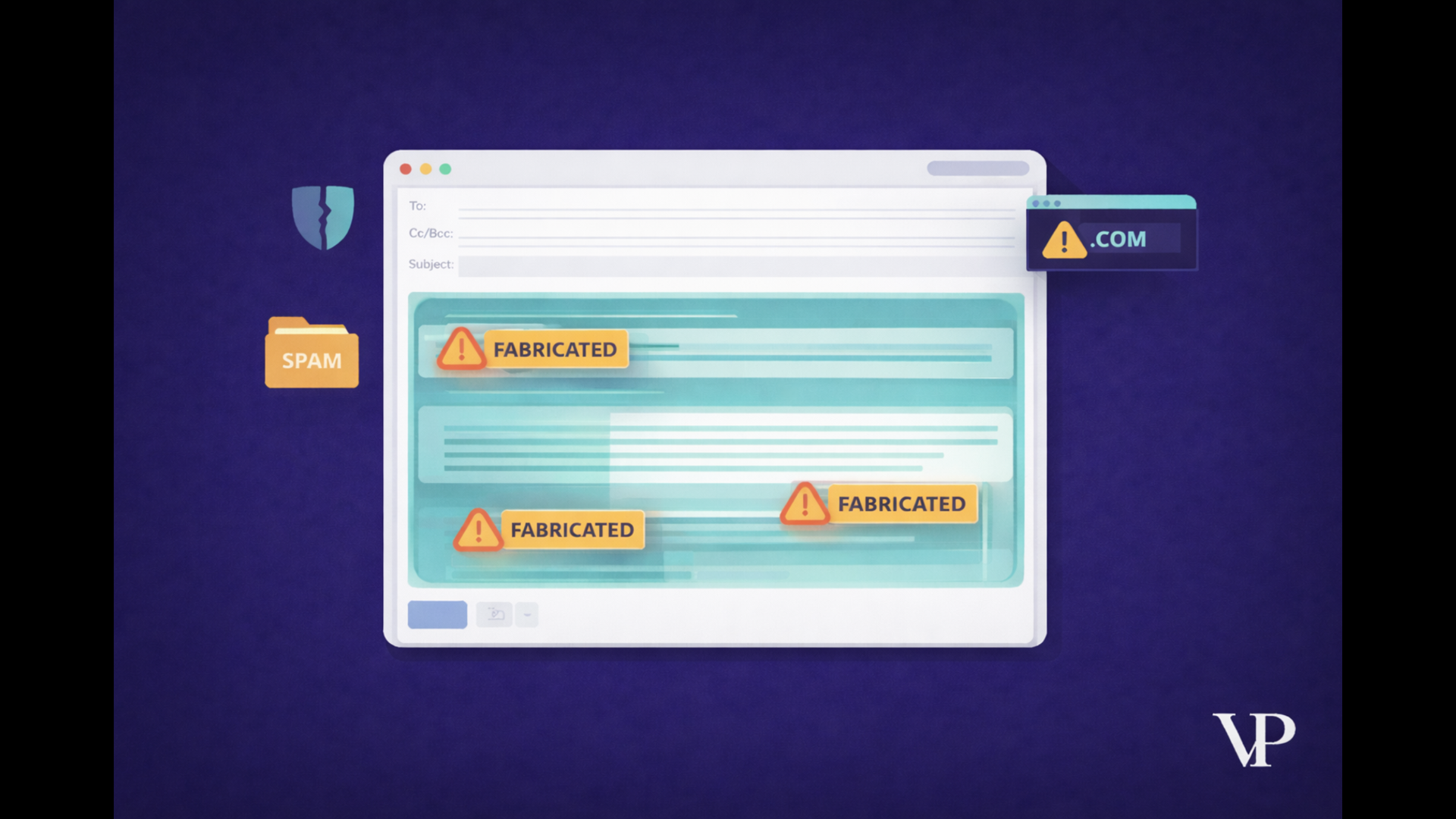
A company I advise recently discovered that their AI sales tool had been telling prospects they were "FedRAMP certified." They're not. They never have been. The AI just decided it sounded convincing.
That single hallucination — one confidently fabricated claim, buried in an otherwise polished email — triggered a compliance review, a legal scramble, and a prospect relationship that went from warm to dead in one reply: "This is either incompetent or dishonest. Either way, we're done."
This is the AI sales agent crisis playing out across B2B right now, and most companies don't even know it's happening. Their AI SDRs are writing grammatically flawless emails stuffed with fabricated facts — invented partnerships, made-up growth numbers, hallucinated product features — and sending them at scale. Every one of those emails is a small fire. At 1,000 emails a day, that's an inferno.
I've spent the past year building systems to solve this problem. What I found changed how I think about AI in sales entirely.
The Economics Are Seductive. The Reality Is Brutal.
I get why everyone's rushing to adopt AI SDRs. The math is irresistible. A human sales development rep costs $75,000 to $125,000 per year, takes 3-6 months to ramp up, and churns at 30-40% annually. An AI SDR costs $7,000 to $45,000 per year and can contact over 1,000 prospects daily — a volume no human can match.
But there's a number that doesn't make it into the vendor pitch decks: AI SDRs convert meetings to qualified opportunities at 15%, compared to 25% for humans. That's a 40% drop in conversion quality. The AI is booking meetings, sure — but it's booking them on false pretenses. When the prospect shows up and realizes the "personalized insight" in the email was fabricated, they don't just decline. They blacklist you.
When everyone can generate perfect prose for free, the only remaining signal of quality is accuracy.
I watched one company burn through three email domains in four months. Their AI was sending thousands of generic, hallucination-laced emails. Gmail's spam filters — which now use machine learning to detect AI-generated sending patterns — flagged the domain. Once your domain reputation is gone, it's not just your sales emails that stop arriving. Your invoices, your password resets, your customer support replies — all of it lands in spam.
Why AI Sales Tools Hallucinate (It's Not a Bug)
When I first started digging into this, I assumed hallucinations were a quality control problem — something you could prompt-engineer away. I was wrong. The issue is mathematical.
Large language models work by predicting the next most probable word in a sequence. They use something called a Softmax function, which forces the model to assign probabilities across its entire vocabulary that sum to exactly 1. The critical implication: the model has no internal state for "I don't know." It must always pick something.
So when you ask it to describe a prospect's financial strategy and it has no data on that company, it doesn't say "I couldn't find this information." It generates tokens that sound like a financial strategy — "margin expansion," "digital transformation," "strategic growth initiatives." It's not retrieving facts. It's simulating the texture of facts.
This gets worse. During training, models are penalized for expressing uncertainty and rewarded for confident predictions. We've essentially trained these systems to be confidently wrong — which is the single most dangerous trait you can give a tool that speaks on behalf of your brand.
In sales outreach, I've seen four distinct ways this breaks:
Fabricated facts: Claiming a prospect uses Salesforce when their job postings mention HubSpot
Contradicted inputs: Quoting a price of $5,000 when the actual pricing doc says $10,000
Invented intent: "I see you're replacing your CFO" based on nothing but a Series B announcement
Broken memory: Proposing a Tuesday meeting after the prospect already declined Tuesday
Each one is a different flavor of the same core problem: the model optimizes for sounding helpful, not for being truthful.
The Retrieval Trap: Why "Adding a Database" Doesn't Fix This
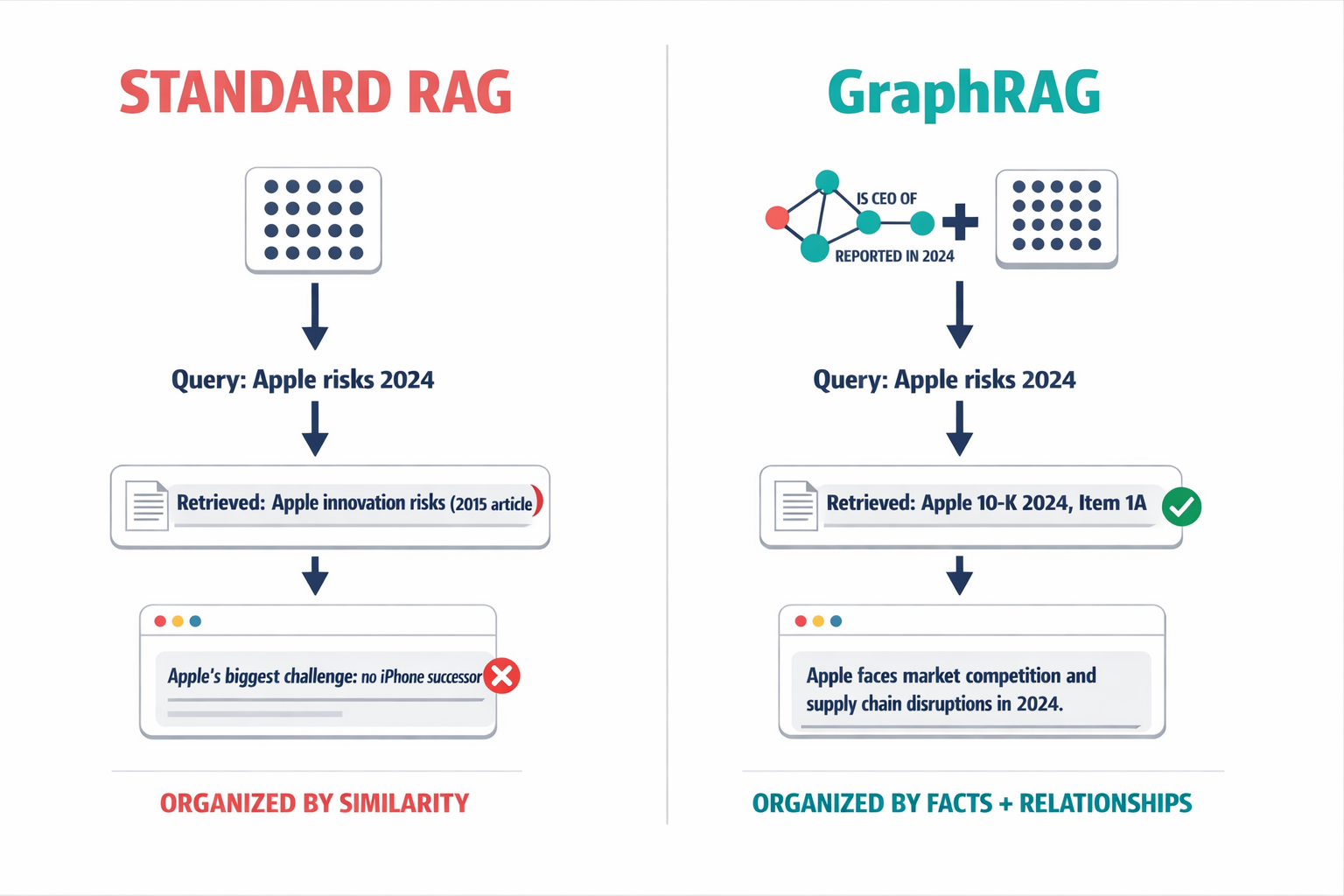
The standard industry response to hallucination is Retrieval-Augmented Generation — RAG. The idea is simple: instead of relying on the AI's training data, you retrieve relevant documents and feed them as context. It's a real improvement. But for high-stakes B2B sales, it's not enough.
We explored this in depth in our interactive analysis of AI sales agent trust, and the failure modes surprised us.
Most RAG systems use vector databases, which store text as mathematical representations and retrieve chunks that are "closest" in meaning to your query. The problem is that mathematical closeness is a terrible proxy for factual relevance in complex business contexts.
Think of it like a library where books are shelved by vibes instead of by subject. You ask for "risks facing Apple in 2024," and the system retrieves a 2015 article about Apple's risk of failing to innovate — because the words "Apple" and "risk" are close in vector space. The AI then confidently tells your prospect that Apple's biggest challenge is the lack of an iPhone successor. In 2024.
Vector databases also can't distinguish between people or corporate entities that share names. "John Smith, CEO of Subsidiary A" and "John Smith, VP at Parent Company B" get mashed together. The AI merges them into one hallucinated person and writes an email referencing a role that doesn't exist.
A database that organizes information by vibes instead of by facts will produce vibes instead of facts.
This is why my team moved to what's called GraphRAG — a hybrid approach that combines knowledge graphs (which enforce strict relationships like "Tim Cook IS CEO OF Apple") with vector databases for broader thematic search. The knowledge graph acts as a skeleton of verified facts. The vector search adds flesh. Neither works well alone.
The Architecture That Actually Works
The fundamental mistake in the current AI SDR market is treating outreach as a single task: take a lead, generate an email, send it. That's like asking one person to research a company, write the pitch, and fact-check their own work simultaneously. Nobody does good work that way.
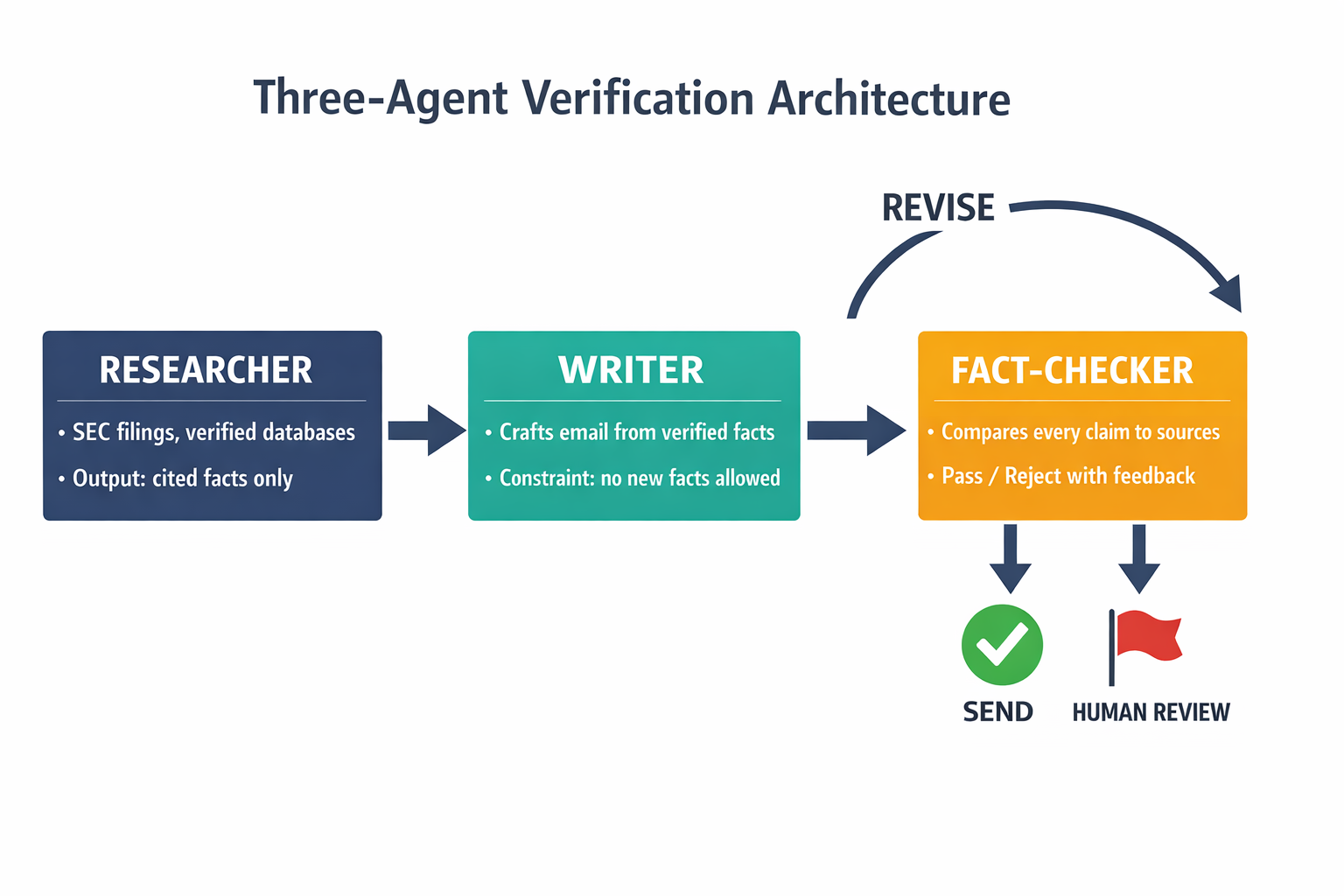
We built a system that separates these concerns into three specialized agents, each with a narrow job and strict constraints.
The first agent is a Researcher. It pulls data from SEC filings, company websites, and verified databases. It's explicitly forbidden from creative writing — its only job is to extract facts and cite them. When it retrieves a risk factor from a company's 10-K filing, it tags it with the exact source: "Microsoft 10-K 2024, Item 1A, Paragraph 4."
The second agent is a Writer. It takes the Researcher's verified facts and crafts a compelling email. But it operates under a hard constraint: it cannot introduce any fact that isn't in the research notes. It's creative with language, not with truth.
The third agent is a Fact-Checker. This is the one that changes everything. It compares every claim in the Writer's draft against the Researcher's source material. "Does the claim 'you grew revenue by 20%' appear in the research notes? No? Rejected." It sends the draft back with specific feedback, and the Writer tries again.
This cycle — write, check, revise — repeats until the email passes or hits a retry limit, at which point it gets flagged for a human to review. No email ever sends without clearing the Fact-Checker.
Fact-checking isn't a politeness. It's a deliverability strategy. Hallucinations cause low engagement. Low engagement triggers spam filters. Spam filters kill your domain.
The moment that reframing clicked for my team — that verification isn't just about ethics, it's about keeping your email infrastructure alive — was when the whole architecture snapped into focus.
Why 10-K Filings Are the Secret Weapon
One decision transformed the quality of our outreach more than any other: constraining the Researcher agent to prioritize SEC 10-K annual reports.
Public companies are legally required to disclose their most significant business risks in "Item 1A: Risk Factors." These aren't marketing spin. They're legal confessions of vulnerability, written under penalty of securities fraud. When a logistics company lists "dependence on legacy software" as a material risk, that's not speculation — it's a sworn statement.
Our Researcher agent pulls these filings via the SEC's EDGAR API, isolates the risk factors and management discussion sections, and filters them against the seller's value proposition. The result is an email that says: "I read in your latest 10-K that legacy infrastructure resilience is a top priority for 2025. Our platform addresses this specifically."
That's not a hallucination. It's a verified fact from the prospect's own legal filings. And it cuts through the noise of AI-generated spam like nothing else I've seen.
Paradoxically, constraining the AI to a narrow set of verified facts makes it more creative, not less. Instead of inventing facts to fill a blank page, it focuses its energy on connecting real facts to a compelling narrative. The constraint is the feature.
What About Companies That Aren't Publicly Traded?
Fair question — and the most common one I get. The 10-K strategy works beautifully for public companies, but the majority of B2B prospects are private.
For private companies, we layer multiple verified sources: LinkedIn company pages, verified press releases, job postings (which reveal technology stacks and strategic priorities), and industry databases. The key principle remains the same — every fact gets a citation, and the Fact-Checker agent validates each one before the email sends. The accuracy bar doesn't drop just because the data sources change.
Does This Slow Down Outreach Too Much?
Yes, it's slower per email. A standard AI wrapper fires off an email in seconds. Our system takes meaningfully longer because it's running multiple research queries, writing a draft, checking it, and sometimes revising it two or three times.
But "emails per hour" is a vanity metric. What matters is qualified meetings per month and domain reputation over time. Sending 100 fact-checked, hyper-relevant emails that get opened and replied to will always outperform sending 10,000 generic emails that get your domain blacklisted. Gmail's AI-powered spam filters are specifically designed to detect and punish the high-volume, low-quality pattern. The math has flipped.
For the full technical methodology behind this architecture — including the orchestration framework comparisons and the reflection loop implementation — see our detailed research.
What This Means If You're Deploying AI Sales Agents Today
If you're running or evaluating an AI SDR tool, there are three things I'd do immediately.
Audit what your AI is actually saying. Pull a random sample of 50 emails it sent last week. Check every factual claim against reality. I've yet to meet a team that did this exercise and wasn't alarmed by what they found.
Check your domain reputation. Tools like Google Postmaster will show you how Gmail views your sending domain. If your AI has been blasting low-quality emails, the damage may already be done — and it affects every email your company sends, not just sales outreach.
Demand citations. Any AI sales tool worth using should be able to show you exactly where each factual claim in an email came from. If it can't, it's guessing. And guessing at scale, with your brand's name attached, is a risk no revenue leader should accept.
In the age of artificial intelligence, the ultimate luxury is truth.
The wrapper era of AI sales — where fluency was the product and accuracy was optional — is ending. Not because of some philosophical commitment to honesty, but because the infrastructure of the internet is actively punishing dishonesty. Spam filters are getting smarter. Prospects are getting savvier. And the companies that figure out how to scale trust, not just volume, are the ones that will still have functioning email domains and intact reputations a year from now.
I'd love to hear how you're thinking about this. If you've deployed AI sales agents and found ways to keep them honest — or discovered the hard way what happens when you don't — that conversation matters.