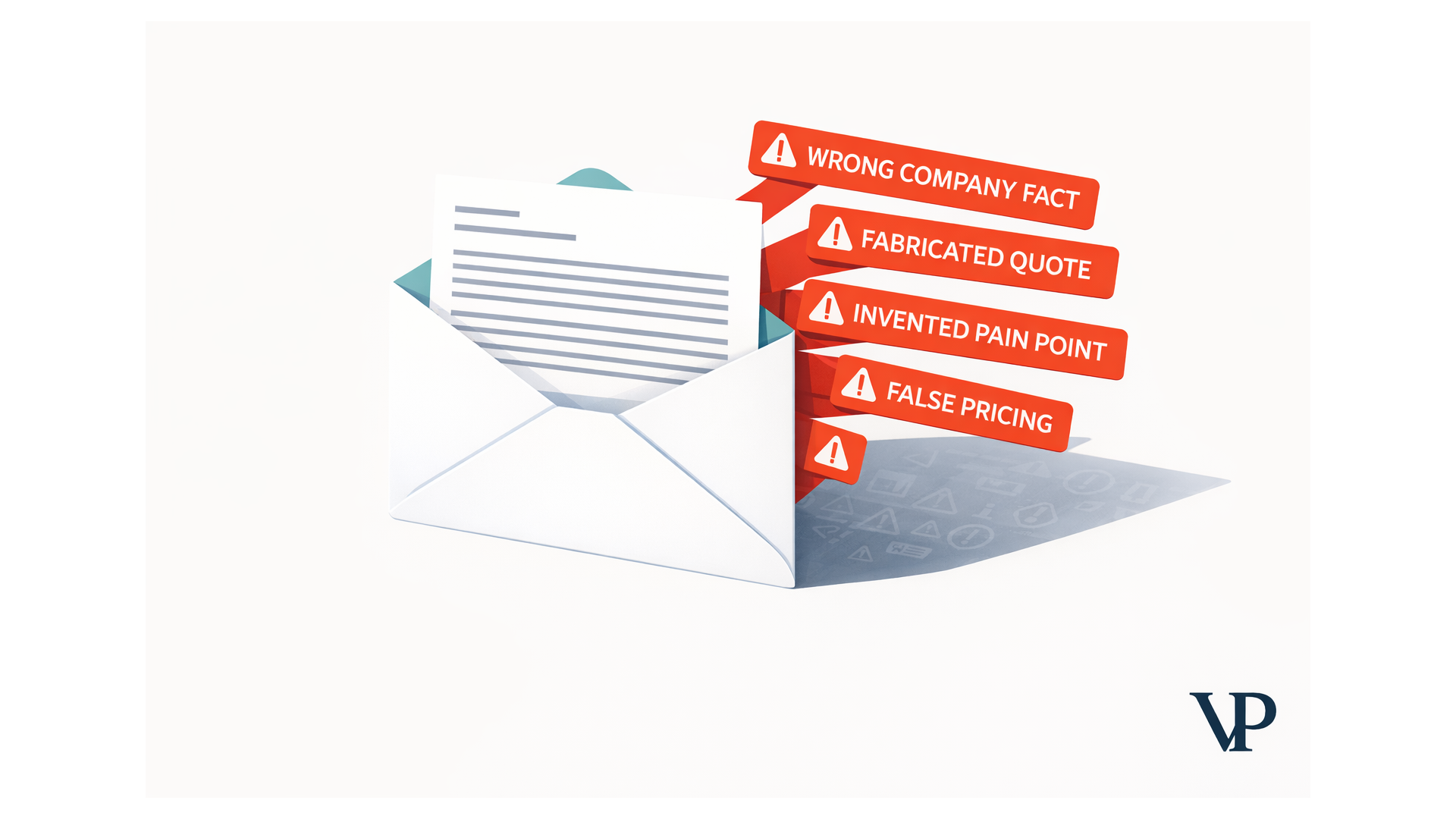
A logistics company's AI sales tool recently emailed a prospect congratulating them on their "expansion into APAC." The prospect hadn't expanded into APAC. They'd just closed their Singapore office. The email was grammatically flawless, personally addressed, and completely wrong.
This isn't a rare glitch. It's the default behavior of most AI sales agents on the market today. And it's destroying the brands that deploy them.
We've spent the past year studying how AI sales agents hallucinate — fabricating company facts, inventing product features, and confidently citing events that never happened. The pattern is consistent: the more polished the AI's writing, the more damaging its errors become, because a well-written lie is harder to forgive than a sloppy one. Our research reveals that while AI agents generate up to 50% higher initial email response rates than humans, they convert those meetings into qualified opportunities at nearly half the rate — 15% versus 25% for human reps. The gap isn't about writing quality. It's about truth.
The $125,000 Question Nobody's Asking
The economics of AI sales agents look irresistible on a spreadsheet. A human Sales Development Representative costs $75,000 to $125,000 per year, takes three to six months to ramp up, and churns at 30–40% annually. An AI agent costs $7,000 to $45,000 per year, processes over 1,000 contacts daily, and responds to inbound leads in under five minutes — a speed that correlates with a 900% increase in conversion rates.
So companies buy the tool, plug it in, and watch the activity metrics soar.
What they don't watch is what happens next. The AI sends a prospect an email referencing a "pain point" that doesn't exist. It mentions a "shared connection" that was fabricated. It quotes a pricing tier that contradicts the company's own documentation. Each of these emails doesn't just fail — it actively poisons the well. The prospect doesn't think "the AI made a mistake." They think "this company is careless, or worse, dishonest."
When you send 10,000 AI-generated emails a month, you're not scaling outreach. You're scaling the rate at which you can destroy your own reputation.
We explored this dynamic in depth in our interactive analysis of AI sales agent trust, and the pattern is stark: the companies seeing the worst long-term results are often the ones with the most impressive short-term activity numbers.
Why AI Sales Tools Hallucinate (It's Not a Bug)
Most people assume hallucinations are software defects that will get patched in the next update. They won't. Hallucination is a mathematical feature of how large language models work.
An LLM is, at its core, a probability calculator. Given a sequence of words, it predicts the next most likely word. It does this using something called the Softmax function, which forces the model to assign probabilities across its entire vocabulary — and those probabilities must always add up to 100%. The model has no internal state for "I don't know." It must pick something.
Think of it like a student who's been told they'll be penalized for leaving an exam question blank. Even when they have no idea, they write something — and they write it confidently, because that's what they've been trained to do.
When your AI sales agent is asked to describe a prospect's financial strategy and it has no data on that company, it doesn't return an error. It generates text that sounds like a financial strategy — "margin expansion," "digital transformation," "growth-oriented" — because those are the tokens that statistically follow phrases about corporate finance. The model isn't retrieving facts. It's simulating the texture of factual language.
This is why the output reads so convincingly. And it's why the errors are so dangerous.
Four Ways AI Lies in Sales Emails
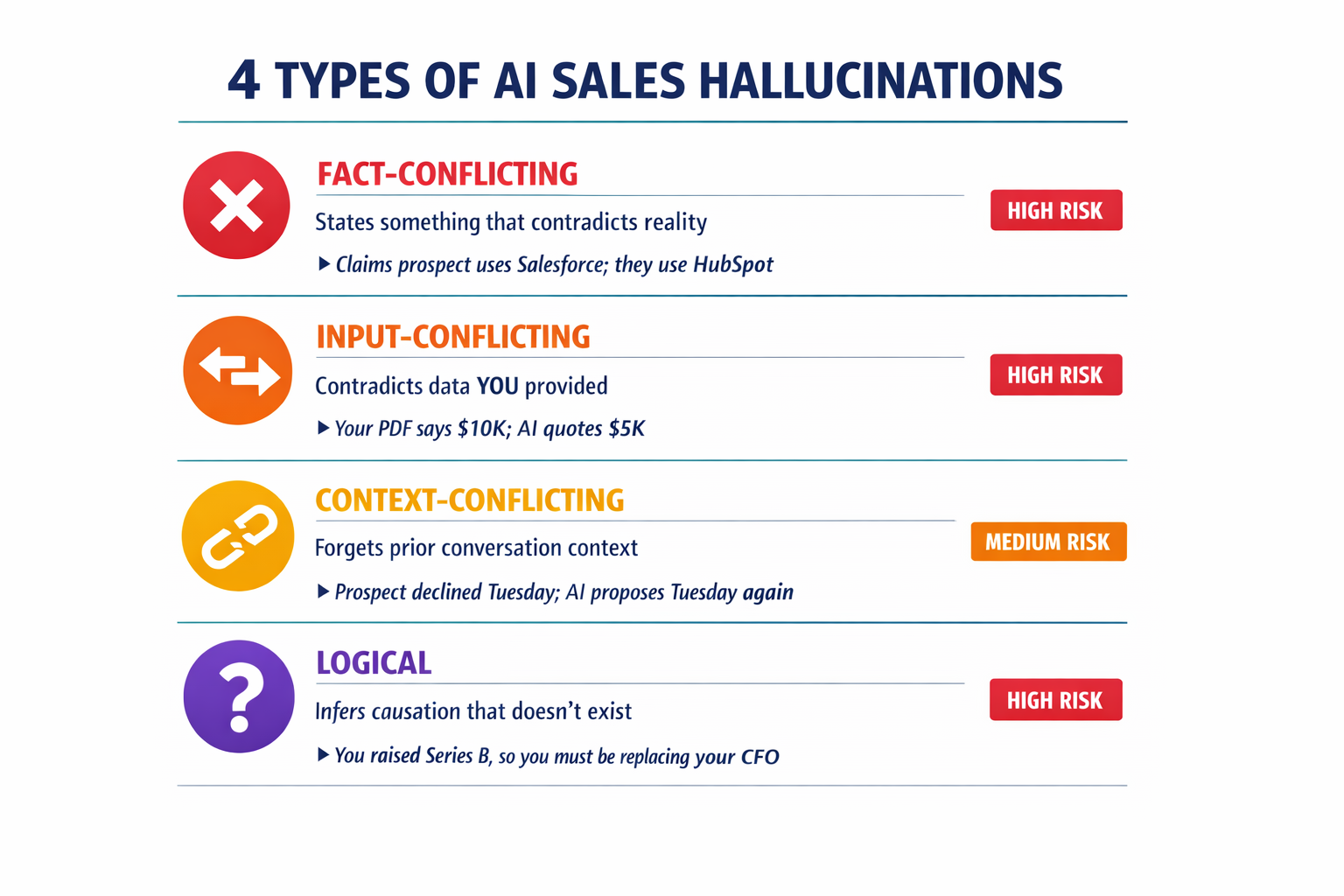
Our research categorizes AI sales hallucinations into four distinct types, each carrying different risks:
Fact-conflicting: The AI states something that contradicts reality — claiming a prospect uses Salesforce when their job postings explicitly mention HubSpot. This proves zero research was done.
Input-conflicting: The AI contradicts data you gave it. You upload a pricing PDF showing $10,000; the AI, drawing on its training data of industry averages, quotes $5,000. This can create binding legal exposure.
Context-conflicting: In a multi-email thread, the AI forgets the prospect already declined Tuesday and proposes Tuesday again. This reveals there's no real memory — just a text generator.
Logical: The AI infers causation that doesn't exist. "You raised Series B, so you must be replacing your CFO." Plausible as speculation, dangerous as a stated fact.
An AI that confidently tells a prospect "I see you're replacing your CFO" based on nothing more than a funding announcement isn't making an inference. It's making an accusation.
Each type erodes trust differently, but they share one thing in common: the prospect can't tell whether the error was the AI's or yours. To them, it's your company's name at the bottom of the email.
The Risk Goes Far Beyond Embarrassment
A bad email is the least of it. Unverified AI agents create cascading risks across three domains that most sales leaders never consider.
Brand damage at scale. Screenshots of hallucinated emails circulate on LinkedIn and industry forums. One viral post tagging your company as "the one whose AI made up my job title" can silently blacklist you with hundreds of decision-makers. This reputational debt compounds — and it's nearly impossible to service.
Legal liability that's already real. Under the doctrine of apparent authority, an AI acting on behalf of your company can bind you to commitments. If your AI SDR promises "guaranteed 100% uptime or full refund" and a prospect accepts, you may be legally obligated to honor it. In regulated industries — finance, healthcare — false statements about compliance certifications can trigger federal investigations.
Email infrastructure collapse. This is the risk that kills fastest. Google and Microsoft now deploy their own AI to detect AI-generated email patterns. Gmail's RETVec system analyzes not just keywords but sending patterns and statistical signatures of machine-generated text. When your AI blasts thousands of structurally similar emails that get deleted without being opened, your domain reputation score craters. Once that happens, even your legitimate transactional emails — invoices, password resets, contract notifications — stop reaching inboxes.
Fact-checking isn't just about being accurate. It's a deliverability strategy. Hallucinations lead to low engagement, low engagement leads to spam flagging, and spam flagging leads to domain blacklisting.
Why "Just Add a Database" Doesn't Fix It
The industry's standard answer to hallucination is Retrieval-Augmented Generation, or RAG — essentially giving the AI a database to look things up in before responding. It's an improvement over raw generation, but it's insufficient for high-stakes sales.
Most RAG systems use vector databases, which store text as mathematical representations of meaning and retrieve whatever chunks are "closest" to the query. The problem is that mathematical closeness is often a poor proxy for actual relevance.
A sales rep researching "Risks for Apple Inc." might get a chunk about Apple's innovation risks from a 2015 article because the words "Apple" and "risk" match — while missing a 2024 analysis of EU regulatory threats because the vocabulary is different. The AI then confidently presents a decade-old concern as today's top risk. The database didn't hallucinate. But it retrieved the wrong context, and the AI built a convincing lie on top of it.
Vector databases also can't distinguish between "John Smith, CEO of Subsidiary A" and "John Smith, VP at Parent Company B." They treat text as loose bags of meaning with no understanding of who reports to whom, which company owns what, or which data is current. For sales — where relationships and corporate structure are everything — this is a critical blind spot.
How a Fact-Checked Architecture Actually Works
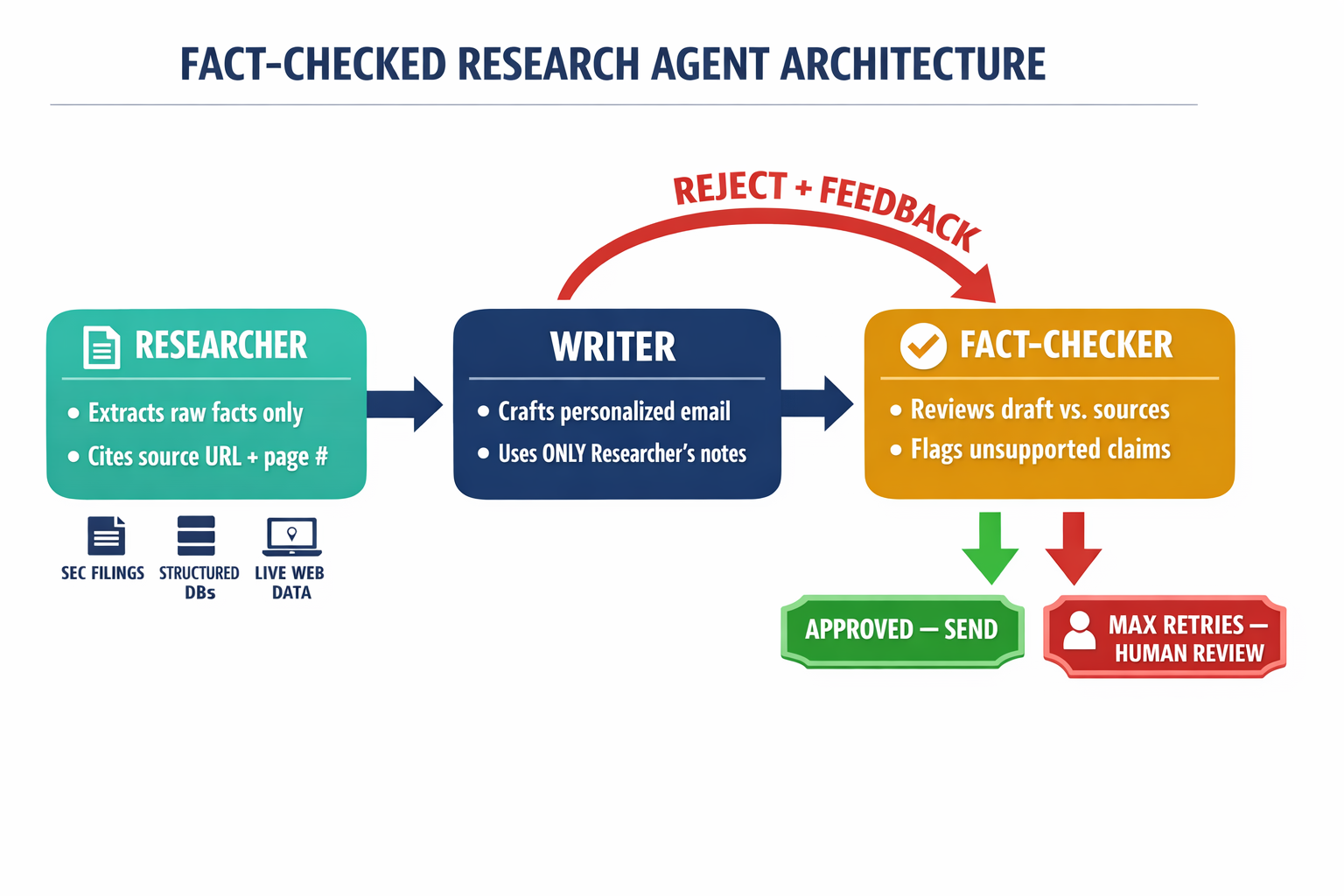
The solution isn't a better prompt or a bigger database. It's a fundamentally different architecture — one that separates the jobs of researching, writing, and verifying into distinct specialized agents that check each other's work.
We call this the Fact-Checked Research Agent Architecture, and it works like a high-end editorial team rather than a single overworked intern.
Three agents collaborate in a cycle. A Researcher agent does nothing but extract raw facts from verified sources — SEC filings, structured databases, live web data — and cites every claim with a source URL and page number. It is explicitly forbidden from creative writing. A Writer agent takes those verified facts and crafts a compelling, personalized email — but it's constrained to use only the Researcher's notes. No embellishment, no external facts. A Fact-Checker agent then reviews the Writer's draft against the Researcher's source material, line by line. Does the claim "You grew revenue by 20%" appear in the research notes? If not, it's flagged as a hallucination and rejected.
The critical difference from conventional AI tools is the loop. This isn't a one-shot process. When the Fact-Checker rejects a draft, it sends specific feedback back to the Writer: "Remove the claim about 20% growth — it's not in the source text." The Writer revises. The Fact-Checker reviews again. This cycle repeats until the draft passes or hits a maximum retry limit, at which point it's escalated to a human.
The system trades a marginal increase in computing cost for a massive increase in reliability. It thinks before it speaks, and reflects before it sends.
For the full technical methodology behind this architecture — including how we use Knowledge Graphs instead of vector databases and why we chose LangGraph over simpler orchestration frameworks — see our detailed research.
The 10-K Advantage: Using a Prospect's Own Words
The quality of any AI agent is bounded by the quality of the data it consumes. For B2B sales, the most underused source of truth isn't the news (which is speculative) or the company website (which is marketing). It's the 10-K Annual Report filed with the SEC.
Public companies are legally required to disclose their most significant business risks in a section called "Item 1A: Risk Factors." These aren't marketing narratives. They're legal confessions of vulnerability, written under penalty of securities fraud.
A logistics company might explicitly list "volatility in fuel prices" or "dependence on legacy software systems" as material risks. When our Researcher agent extracts these disclosures and the Writer agent references them — "I read in your latest 10-K that legacy infrastructure resilience is a top priority for 2025" — the email isn't speculation. It's a verified fact, cited from the prospect's own legal filings.
This is the difference between an AI email that gets deleted and one that gets a reply. The prospect sees that someone (or something) actually did the work.
What About Cost and Speed?
The obvious objection: doesn't all this verification slow things down and cost more? Yes — marginally. A three-agent system with a reflection loop uses more computing resources than a single-prompt wrapper. But the comparison misses the point.
A wrapper that sends 10,000 emails and gets your domain blacklisted within 90 days isn't cheap. It's catastrophically expensive — you've just lost your primary communication channel. A fact-checked system that sends 500 highly relevant, verified emails that actually get opened and answered is orders of magnitude more cost-effective when measured against pipeline generated, not emails sent.
The second objection: can't we just have humans review everything? You can, and we recommend it as a starting model. Our architecture includes a "Centaur" dashboard where human reps see the AI's draft on one side and the cited source facts on the other. They approve, edit, or reject. Over time, their edits train the system to improve. But the point of the architecture is that by the time a draft reaches a human, the most dangerous errors — fabricated statistics, invented company facts, hallucinated product claims — have already been caught.
What This Means for Your Sales Organization
The first wave of AI sales automation optimized for volume. The next wave will optimize for veracity — and the companies that make this shift early will have a structural advantage that compounds over time.
Three things to consider:
Audit your current AI tools. Ask your vendor a simple question: "What happens when the AI doesn't have data about a prospect?" If the answer involves anything other than "it flags the gap and escalates," you have an uncontrolled hallucination risk.
Protect your domain before you scale. Before increasing AI email volume, ensure your SPF, DKIM, and DMARC records are configured. Consider a dedicated subdomain for AI outreach so that if something goes wrong, your primary corporate domain survives.
Measure what matters. Stop tracking emails sent. Start tracking qualified meetings per email sent, domain reputation scores, and hallucination rates. The AI SDR that sends 200 verified emails and books 20 meetings is outperforming the one that sends 10,000 and books 15 — while burning your brand in the process.
The era of AI fluency as a competitive advantage is already over. Everyone's AI can write a polished paragraph. The question now is whether what it writes is true.
We'd welcome hearing how your team is navigating this — especially if you've seen the trust gap firsthand.