The Building That Melted a Jaguar: Why I Stopped Trusting AI to Design Anything

There's a Jaguar in London that got melted by a building.
Not by a fire inside the building. By the building itself. The concave glass façade of 20 Fenchurch Street — affectionately nicknamed the "Walkie-Talkie" — focused sunlight onto the street below like a kid with a magnifying glass. Temperatures on the pavement hit levels that warped the car's bodywork. Tiles cracked. A journalist fried an egg on the sidewalk for a news segment.
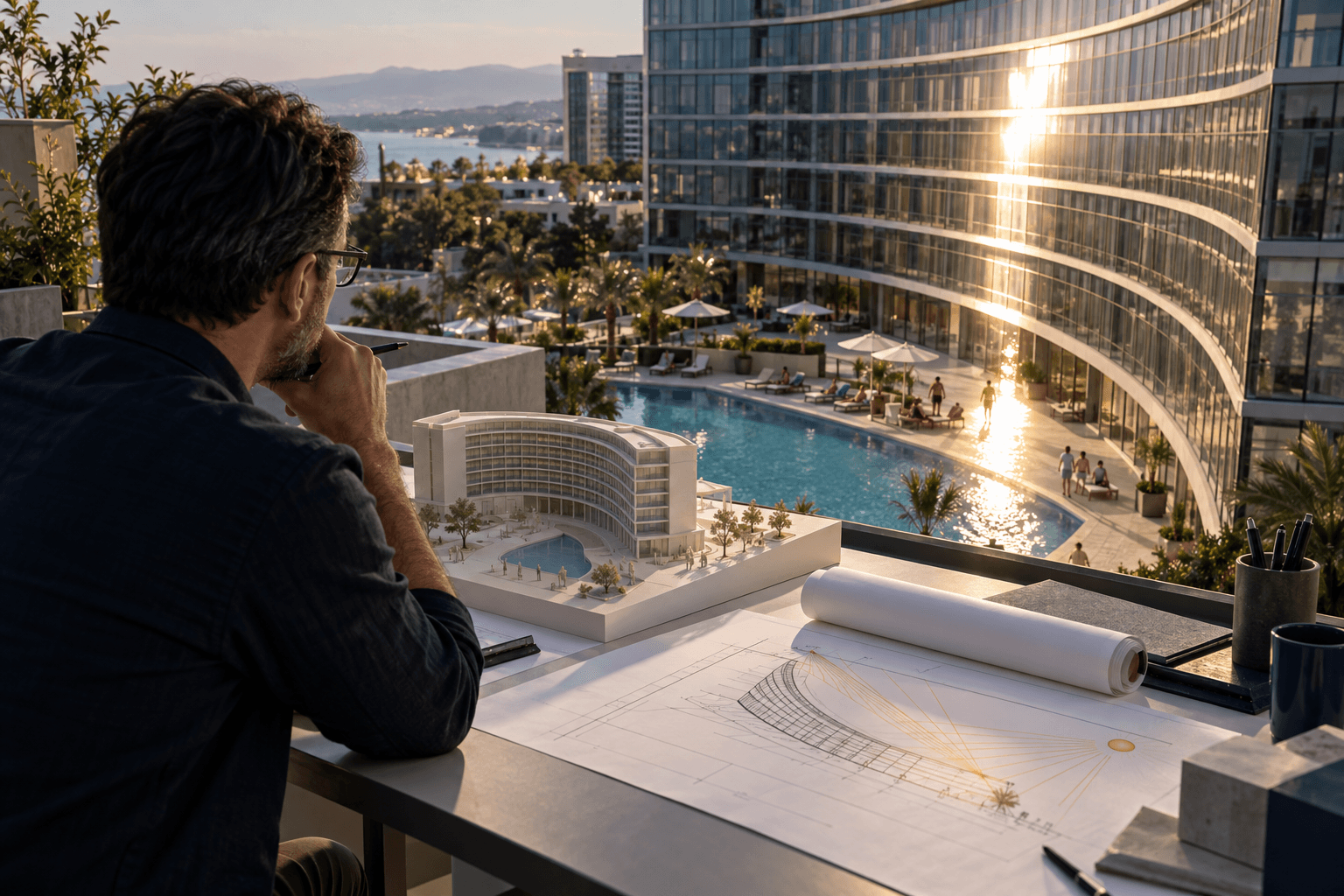
The architect, Rafael Viñoly, had already done this once before. His Vdara Hotel in Las Vegas has a crescent-shaped façade that creates what guests call the "death ray" — a convergence zone by the pool where solar radiation melts plastic lounge chairs and singes hair. The fix? Giant umbrellas. That's it. Umbrellas.
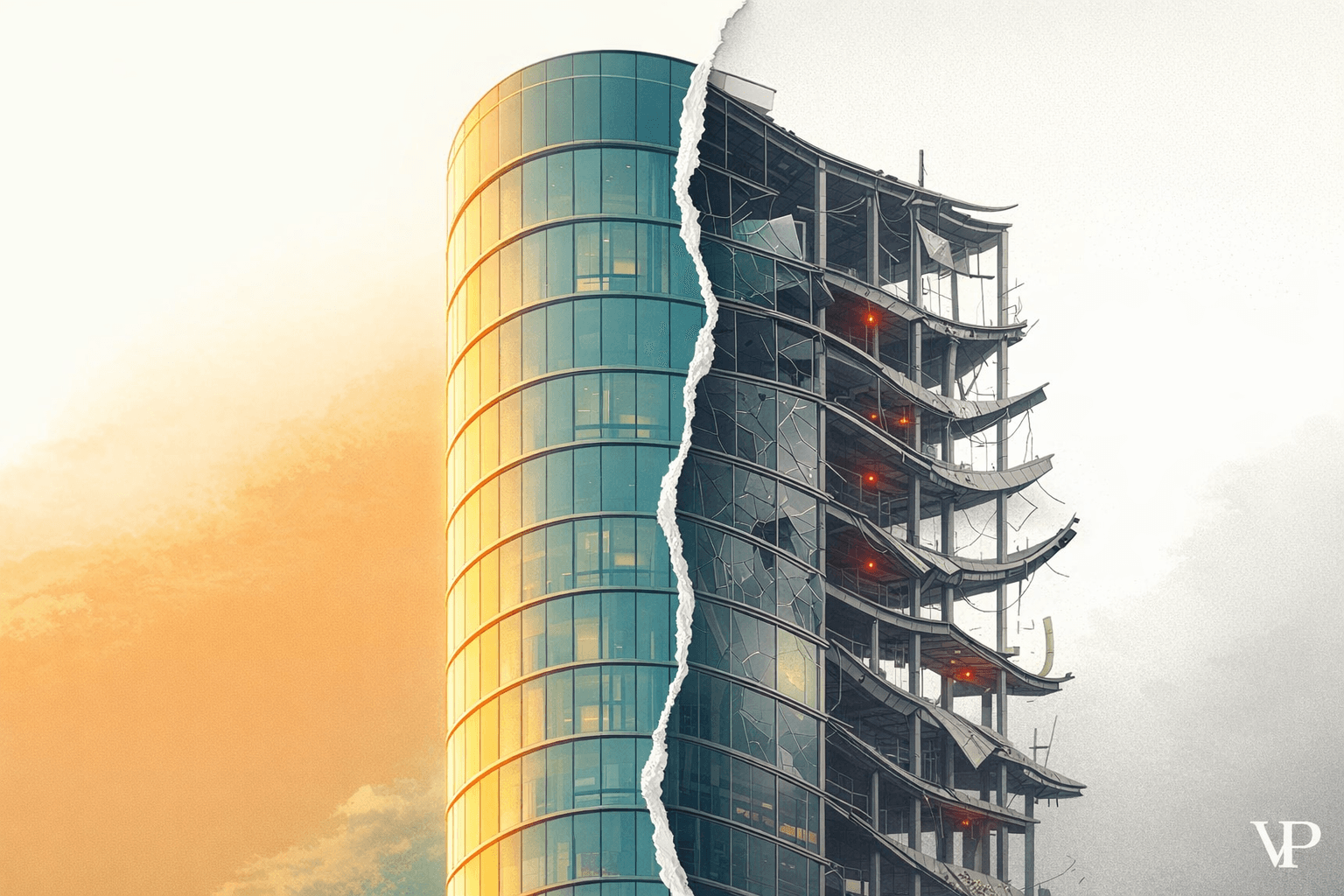
I think about these buildings constantly. Not because they're engineering failures — they are — but because they're a perfect preview of what happens when you let aesthetics run ahead of physics. And right now, with generative AI, we're about to make this mistake at a scale that would make Viñoly blush.
I'm Ashutosh, and my team at Veriprajna builds AI systems for the architecture and construction industry. We've spent the last stretch of our lives arguing — sometimes with each other, often with potential clients, occasionally with investors — that the most dangerous thing in AI right now isn't a model that can't generate a building. It's a model that can.
The Escher Problem
Pull up Midjourney. Type "sustainable high-rise in Miami, photorealistic." You'll get something gorgeous in about ninety seconds. Glass catching golden-hour light. Lush greenery cascading off terraces. The kind of image that makes a developer's pupils dilate.
Now look closer. Really look.
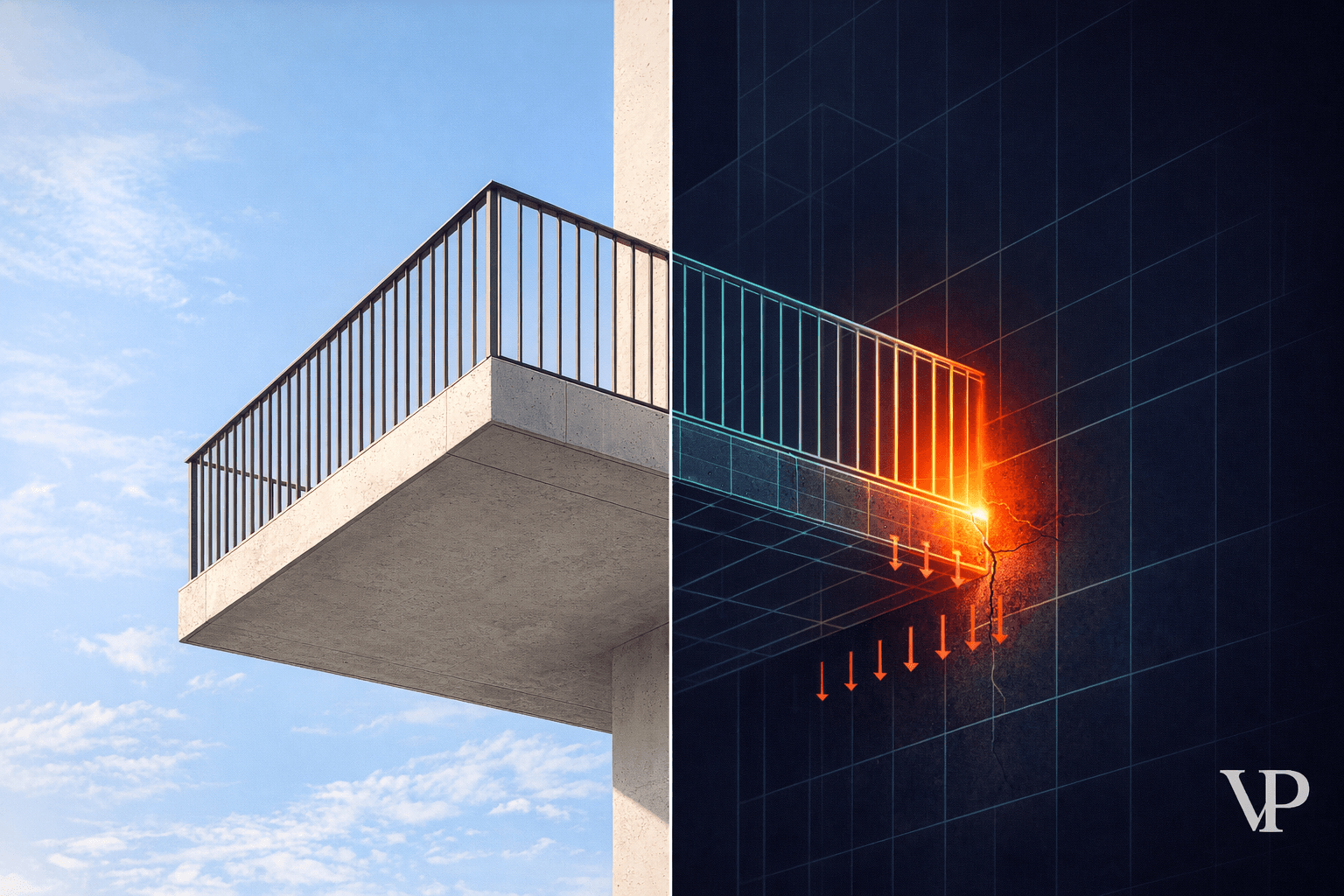
The staircase in the lobby terminates into a solid wall. The load-bearing columns dissolve into the ceiling without transferring force to anything. The windows have no operability mechanisms — they're just rectangles of light painted onto a surface. The cantilever on the east side would require materials that don't exist to avoid collapsing under its own weight.
I started calling these "Escher paintings" after we showed a batch of AI-generated designs to a structural engineer on our team. He laughed for about ten seconds, then got genuinely angry. "This isn't architecture," he said. "This is a hallucination that happens to look like a building."
He was right, and the word "hallucination" is more precise than most people realize. When a diffusion model generates an image, it's working in what's called latent space — a mathematical universe where "window" means "a visual pattern that appears near other visual patterns labeled window." The model has no concept of thermal breaks, glazing ratios, rough opening dimensions, or flashing details. It doesn't know that load must transfer continuously to a foundation. It knows that columns are usually vertical things found in buildings.
A diffusion model doesn't understand architecture. It statistically predicts what architecture looks like.
That distinction — between what something looks like and what something is — sits at the center of everything we're building.
Why Does This Matter If It's "Just" a Concept Image?
This is the objection I hear most often. A venture partner told me this directly over coffee: "Ashutosh, nobody's pouring concrete based on a Midjourney image. It's just for ideation."
I wanted to agree with him. It would have made fundraising easier. But he's wrong, and here's why.
The construction industry operates on something I call the 90/10 rule. Aesthetics — the part that makes a client fall in love — represent maybe 10% of a project's total success metric. The other 90% is manufacturability, structural integrity, supply chain logistics, code compliance, and economic viability. When you show a developer a gorgeous AI rendering in the first meeting, you've set an aesthetic anchor. Everything that follows is an expensive negotiation to get as close to that anchor as reality allows.
And reality is brutal.
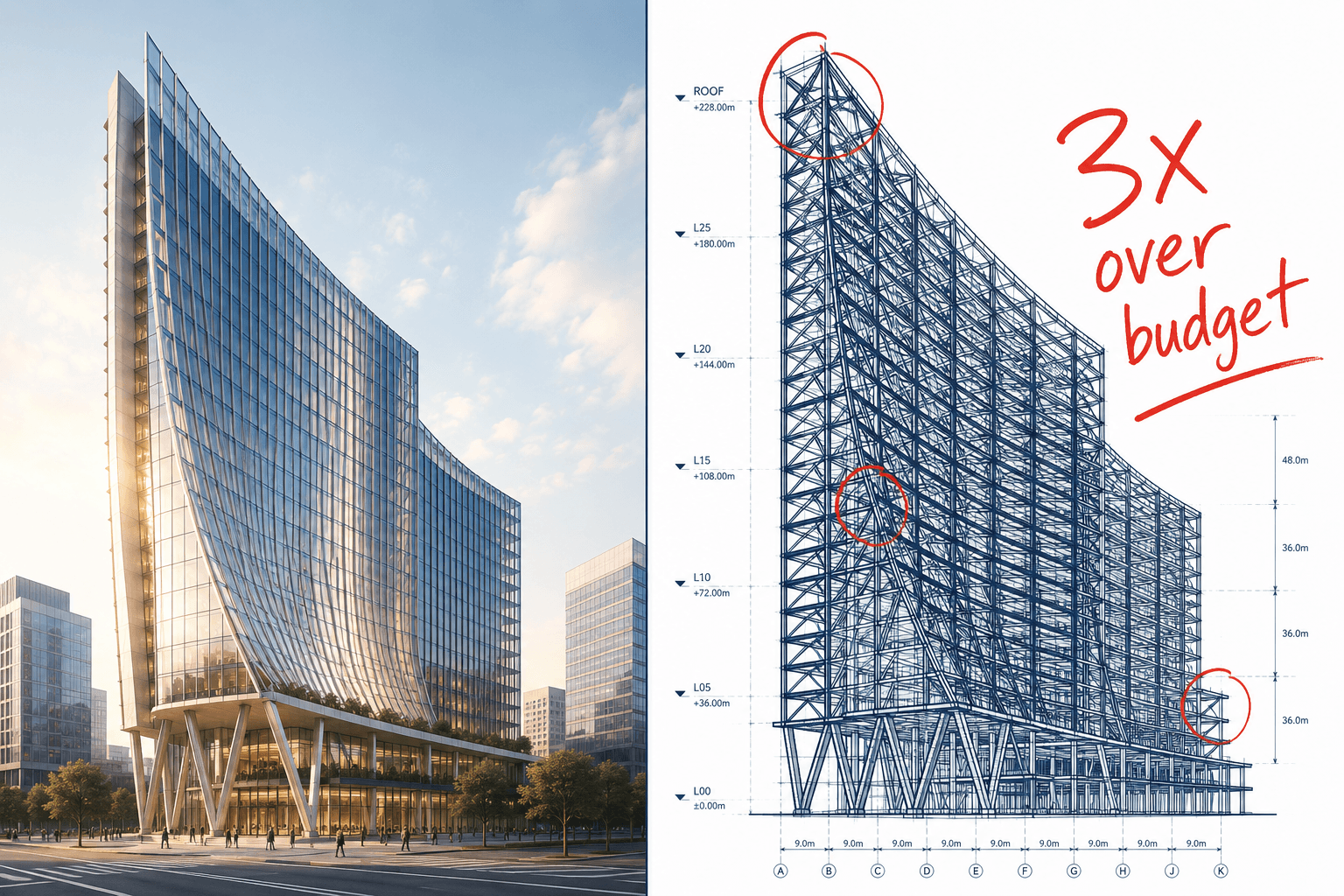
The Sydney Opera House is the canonical example. Jørn Utzon won the competition with a design that was, structurally speaking, a fantasy. The concrete shells were geometrically indeterminate — nobody knew how to build them. The project went forward anyway because the vision was too beautiful to abandon. It took a decade of engineering struggle to find a buildable solution. The budget exploded from $7 million to $102 million — a 1,400% overrun.
That was one building, one architect, one moment of unconstrained ambition. Now imagine every developer in the world getting Midjourney-quality renderings on Day One. Imagine thousands of projects anchored to forms that are fiscally irresponsible before the first shovel hits dirt.
That's not ideation. That's a pipeline of future bankruptcies.
The Pixel That Costs $25 Million
I need to talk about glass, because glass is where the economics of AI-generated architecture get truly absurd.
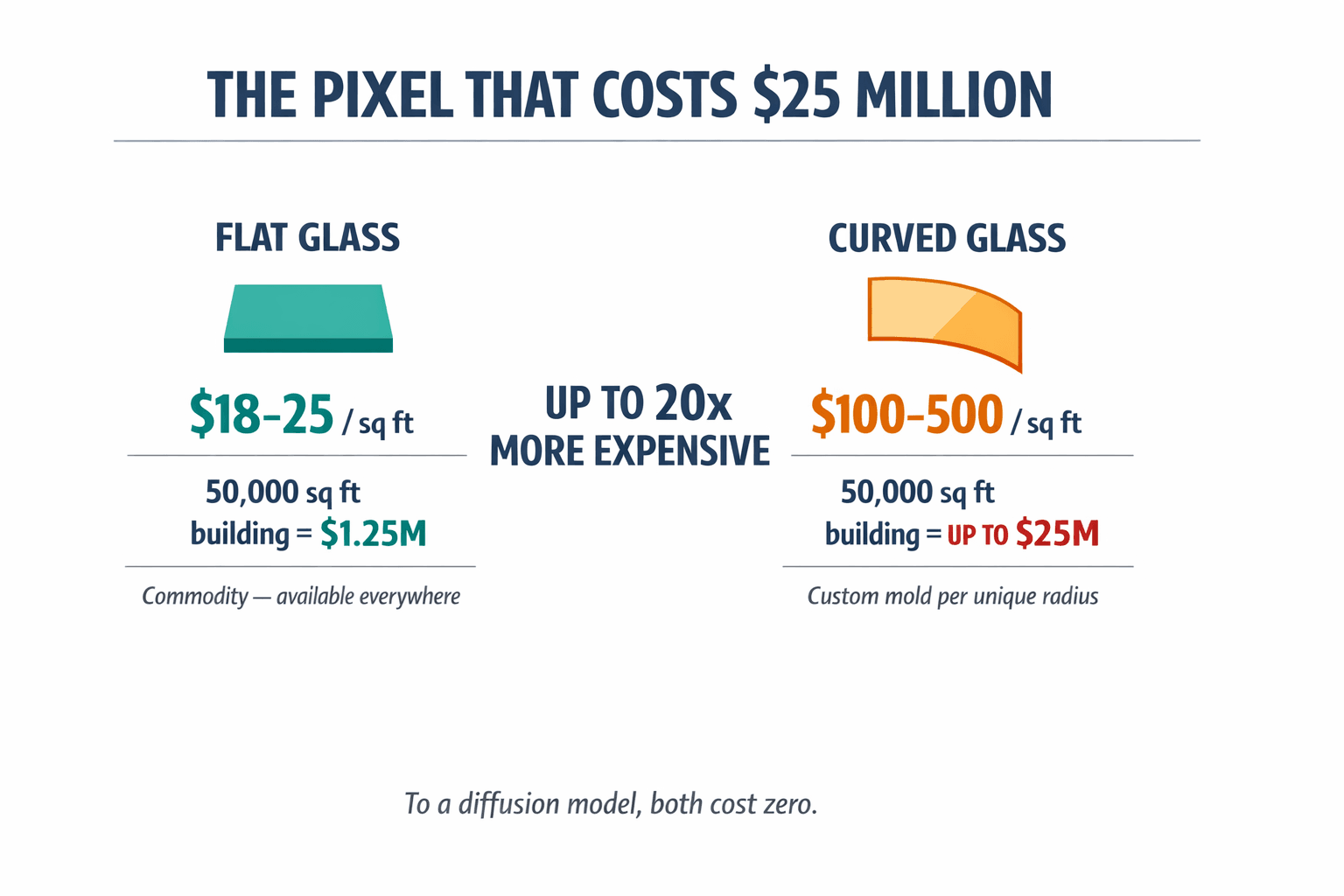
To a diffusion model, a flat pixel and a curved pixel are identical. Generating a sinuous, waving glass façade takes exactly as much computation as generating a flat one. The AI sees no difference.
To a developer, the difference is existential.
Standard flat tempered glass — the commodity product that comes off automated float plants — costs roughly $18 to $25 per square foot in 2025. It's available everywhere. Easy to transport, easy to replace.
Custom curved glass — where each pane is heated over a custom mold, slowly bent into shape with distinct tooling for every unique radius — costs $100 to over $500 per square foot.
Do the math on a building with 50,000 square feet of glazing. Flat glass: $1.25 million. Curved glass: up to $25 million. The AI doesn't know this. The AI doesn't care. The AI thinks curves are free because in pixel-space, they are.
In latent space, a curve costs nothing. In physical space, it costs 20x more. Generative AI lives in latent space. Buildings live in physical space.
This is why I lose sleep. Not because the images are bad — they're beautiful. Because the images are seductive. They make unbuildable things look inevitable.
I wrote about the full economics of this — glass differentials, steel supply chain constraints, fabrication complexity — in the interactive version of our research. The numbers are worse than most people expect.
The Night We Threw Out Our First Approach
I'm going to be honest about something. When we started Veriprajna, we built a wrapper.
I know. I know. We took a foundation model, fine-tuned it on architectural data, built a nice interface, and told ourselves we were doing something different. We weren't. We were doing exactly what every other AI consultancy was doing — repackaging a generalist model and calling it enterprise-grade.
The moment of reckoning came on a Thursday night. We'd generated a structural design for a mid-rise residential project — nothing exotic, just a standard concrete frame. Our system produced it in minutes. It looked plausible. The member sizes seemed reasonable. We were feeling good.
Then our structural engineer ran the numbers manually. The beam on the third floor — the one the AI had confidently sized — would have deflected three times beyond code limits under service loads. Not under some extreme scenario. Under normal use. People walking around, furniture, the weight of the floor above. The building would have sagged visibly.
The AI had picked a beam size that "looked right" based on training data. It had no internal model of deflection limits. It didn't know about L/360 serviceability criteria. It had pattern-matched its way to a plausible-looking answer that would have been a structural failure.
I remember sitting in the office after everyone left, staring at the screen, thinking: We're building a very expensive way to be confidently wrong.
We scrapped the wrapper approach the next week. What we started building instead took us into territory that was harder, slower, and — I'll admit — more frightening. Because it meant we couldn't just ride the wave of foundation models. We had to engineer something from scratch.
What Is Constraint-Based Generative Design?
Here's the core idea, stripped to its essentials.
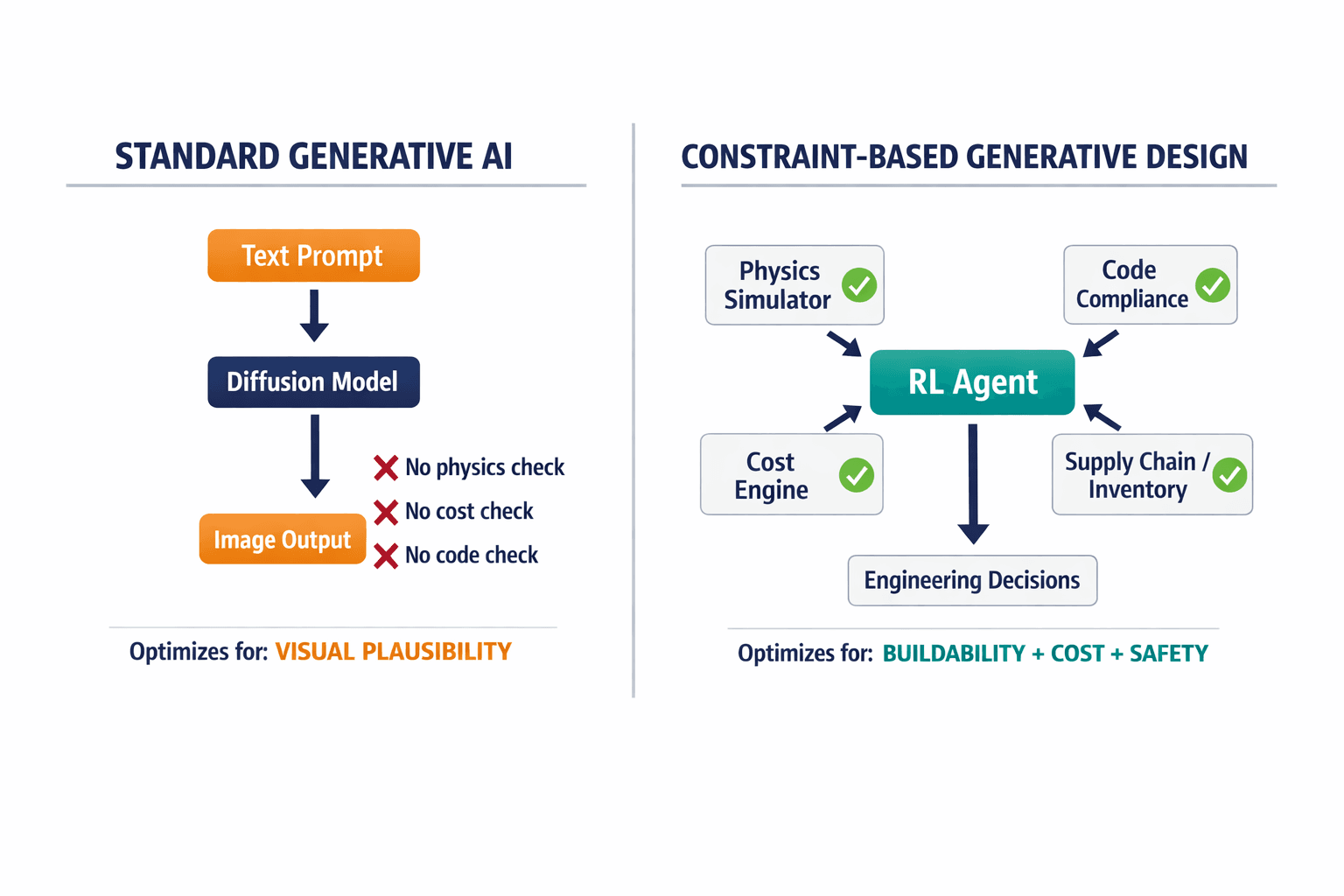
Most generative AI in architecture works like this: text goes in, image comes out. The AI's job is to produce something that looks like what you asked for. There are no rules except visual plausibility.
What we build works differently. Our AI doesn't generate images. It generates engineering decisions. And every decision is bounded by hard constraints — physics, cost, supply chain availability, building codes — that cannot be violated.
We use Deep Reinforcement Learning, which is a fundamentally different paradigm from diffusion models. Instead of denoising random static into a pretty picture, our AI agent learns by doing. It places structural members, assigns beam profiles, adjusts slab thicknesses — and after each action, it gets feedback from a physics simulator, a cost engine, and a code compliance checker.
Think of it like this: a diffusion model is a painter who's seen a million photos of buildings. Our system is an apprentice engineer who's designed a million buildings and gotten yelled at every time one of them fell down, cost too much, or used steel that wasn't in stock.
We don't ask the AI to "design a building." We ask it to "design a building that won't collapse, won't bankrupt the client, and can be built with materials available within 200 miles."
The reward function — the equation that tells the AI what "good" means — is the heart of everything. It balances structural efficiency, material cost, and constructability, while severely penalizing code violations. The AI doesn't get to be creative in a vacuum. It gets to be creative within the constraints of reality.
How Do You Hard-Code a Supply Chain Into an AI?
This was one of the hardest problems we tackled, and it's one that most people in the AI space don't even know exists.
Structural steel procurement has a split personality. There are service centers — local distribution hubs that stock standard beam shapes with lead times measured in days. And there are mill orders — direct purchases from steel mills with minimum tonnage requirements and lead times that can stretch to months. Some beam profiles only get rolled once a quarter.
An unconstrained AI might optimize a structure by selecting a W14x730 beam because it perfectly satisfies a local load condition. Mathematically elegant. Logistically catastrophic. If that beam is a mill-order item with a six-month lead time, the AI just added millions in financing charges to the project.
Our system connects to live inventory databases. The AI's action space is discretized to align with what's actually available — standard AISC W-shapes that service centers stock. When the agent selects a beam, it gets a reward bonus for choosing common stock sections and a penalty for mill-order items. It's also aware of standard stock lengths — 40 feet, 60 feet — and gets penalized for designs that generate excessive waste from off-cuts.
One of my team members described it perfectly during a late design session: "We're not building a designer. We're building a procurement strategist that happens to understand structural mechanics."
That's exactly right.
The Virtual Wind Tunnel
For projects in hurricane-prone regions, we had to solve a different kind of constraint problem. Our AI needs to design buildings that survive Category 5 winds — sustained speeds exceeding 157 mph.
Running a full Computational Fluid Dynamics simulation for every design iteration would take hours per candidate. We need to evaluate millions of candidates. The math doesn't work.
This is where Physics-Informed Neural Networks — PINNs — changed everything for us. Instead of training a neural network purely on data, PINNs embed the governing equations of physics directly into the network's loss function. For wind loading, that means the Navier-Stokes equations. For structural analysis, the equations of equilibrium and stress-strain compatibility.
The result is a neural network that can approximate a complex CFD simulation in milliseconds. Our AI gets "physics intuition" at the speed of neural inference.
What fascinated me was watching what the AI discovered through this process. Over millions of iterations, it independently learned that sharp corners increase drag and base shear. It learned to soften edges, taper building forms, introduce cutouts that reduce vortex shedding. Nobody taught it these tricks. It found them the same way nature finds them — through relentless iteration against an unforgiving fitness function.
Gravity is not a suggestion. Wind is not a texture. In our system, the laws of physics aren't a final check — they're a generative constraint.
A Constraint-Based system with even a basic ray-tracing reward function would have caught the Vdara death ray in the first millisecond of simulation. The AI would have penalized the concave geometry for creating hazardous heat flux and generated a convex or faceted alternative that scattered light safely. No umbrellas required.
For the full technical breakdown of our reward function architecture, the PINN integration, and the system's federated agent design, see our technical deep-dive.
The Argument We Keep Having
People ask me whether this approach kills creativity. I've had this argument with architects, with investors, with my own team.
My answer has evolved. Early on, I'd get defensive — "constraints don't limit creativity, they channel it." That's true but it's a platitude. Here's what I actually believe now, after watching our system run through millions of design iterations:
Unconstrained generation isn't creative. It's random. Creativity that matters — the kind that results in buildings people actually inhabit — emerges from the tension between what you want and what reality allows. The Sydney Opera House became iconic not because of Utzon's original sketch, but because of the decade-long struggle to make it buildable. The spherical solution that finally worked is more elegant than the original fantasy precisely because it was forced into existence by constraints.
Our AI operates in that same space. It doesn't have infinite freedom. It has a vast but bounded design space defined by available materials, physical laws, and budget limits. And within that space, it finds solutions that surprise us — structural configurations that are simultaneously lighter, cheaper, and more resilient than what a human engineer would have proposed.
The other question I get: "Why not just use the AI for concept design and let engineers fix it later?"
Because "fixing it later" is where projects die. Every value engineering cycle costs time and money. Every redesign pushes the schedule. And the further a concept travels before hitting reality, the more painful the collision. We front-load reality into the generation process so there's nothing to fix.
The Fiduciary Machine
There's a framing I keep coming back to. Our AI isn't a designer. It's a fiduciary.
A fiduciary has a legal obligation to act in the client's best interest. When our system evaluates a design candidate, it's not asking "is this beautiful?" It's asking: Can this be built with materials available in this region? Does it comply with local building codes? Will it survive the environmental loads specific to this site? And can the developer afford it?
The cost engine estimates Total Cost of Ownership for every candidate — not just material costs, but fabrication complexity, connection labor hours, and long-term energy performance. A standard bolted shear connection gets rewarded. A complex moment connection requiring full-penetration field welding gets penalized. Steel beams that penetrate the thermal envelope get dinged for the decades of energy waste they'll cause.
Over millions of training episodes, the agent converges on something remarkable: a design that isn't just structurally valid, but optimally balanced across safety, cost, and availability. No human engineer could manually iterate through that many alternatives. The combinatorial space is too vast. But an AI agent with the right reward function and the right constraints? It lives in that space.
The Future Isn't Better Prompts
I'll end with something that might sound harsh, but I believe it completely.
The construction industry doesn't have an imagination problem. It has a certainty problem. Developers don't need more beautiful renderings. They need confidence that what they're looking at can actually be built, on budget, on schedule, with materials that exist.
The current wave of generative AI — Midjourney, Stable Diffusion, DALL-E — offers imagination without certainty. It offers the illusion of design without the substance of engineering. And the gap between those two things is measured in melted Jaguars, singed poolside guests, and billion-dollar budget overruns.
We're building something different. Not a tool that dreams buildings, but a system that engineers them. Physics hard-coded because gravity doesn't negotiate. Inventory hard-coded because supply chains don't bend to aesthetics. Cost hard-coded because no developer ever went bankrupt from a building that was too boring.
Don't generate art. Generate assets.
The future of architecture isn't in better prompts. It's in better physics.