The Render Was Beautiful. The Building Couldn't Be Built.

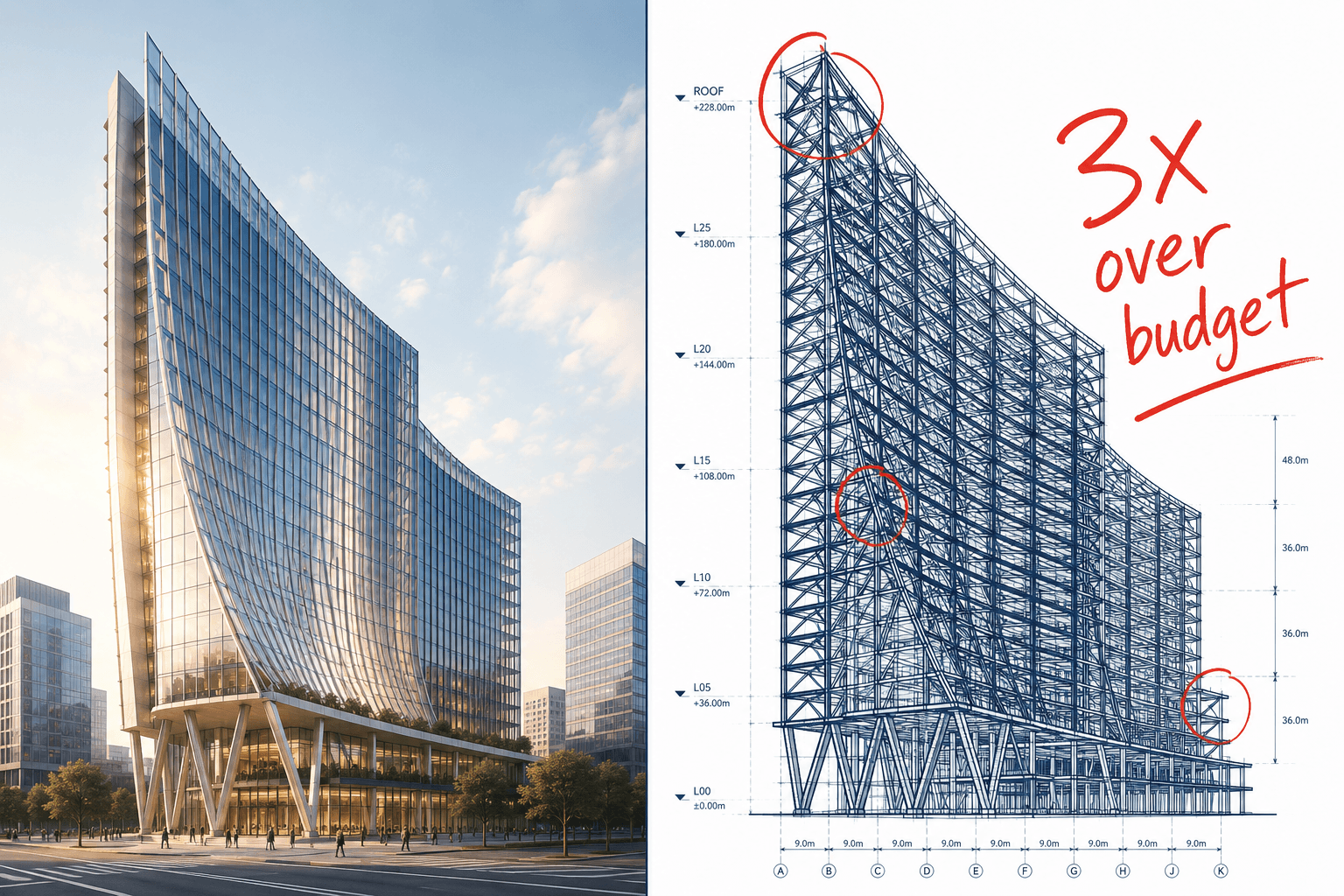
The first time I really understood the problem, I was looking at a render of a glass facade that curved like a wave, and a one-line note from the contractor underneath it: 3x over budget.
The architect had generated the concept in an afternoon. It was genuinely beautiful — the kind of image that wins the commission. And it was, in the most expensive possible way, a lie. The double-curved glass it called for runs somewhere between $100 and $500 a square foot. Flat tempered glass that does the same job runs $18 to $25. Nobody in the room had known that when they fell in love with the picture. They found out sixty days later, when a general contractor priced the dream and a developer started to panic.
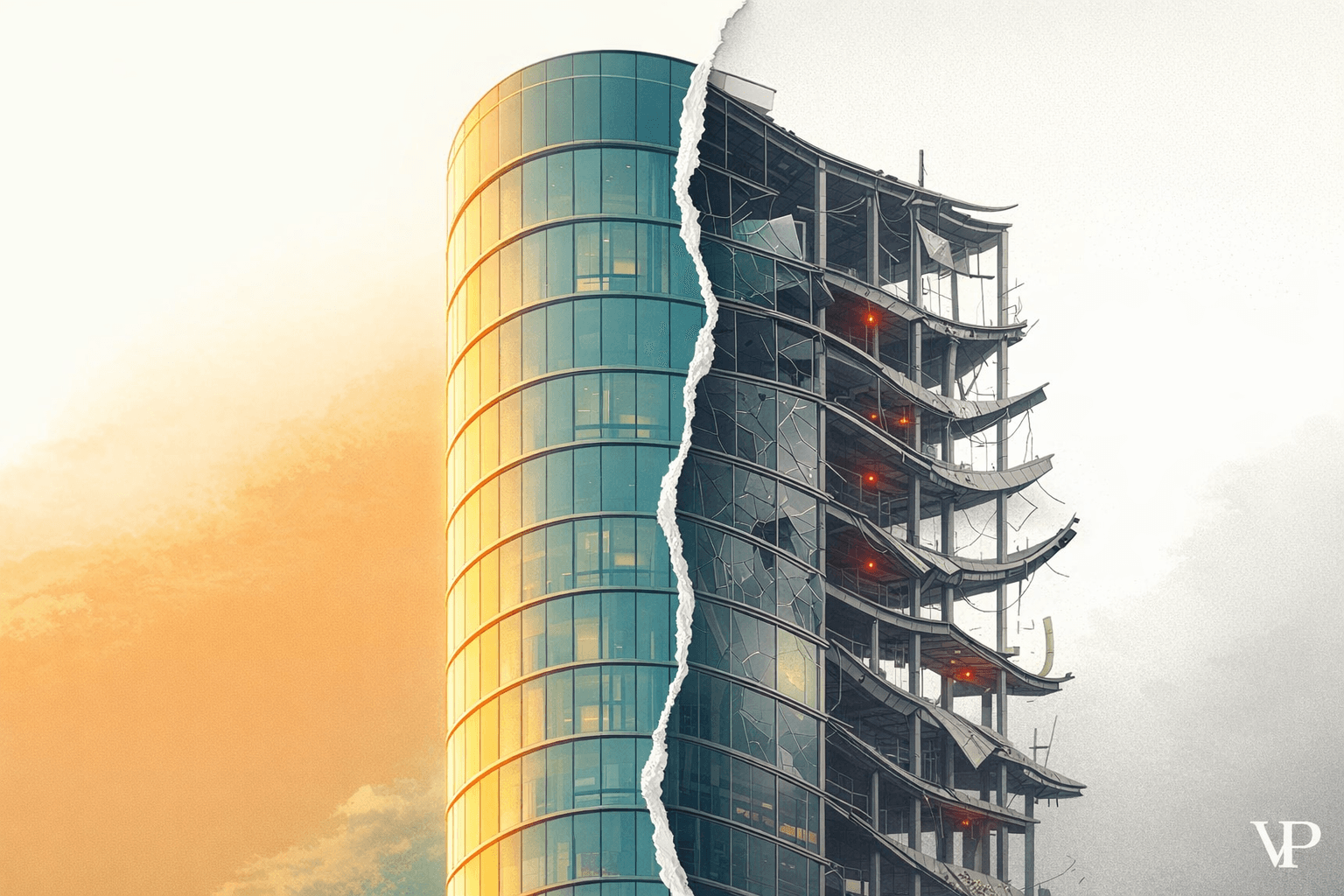
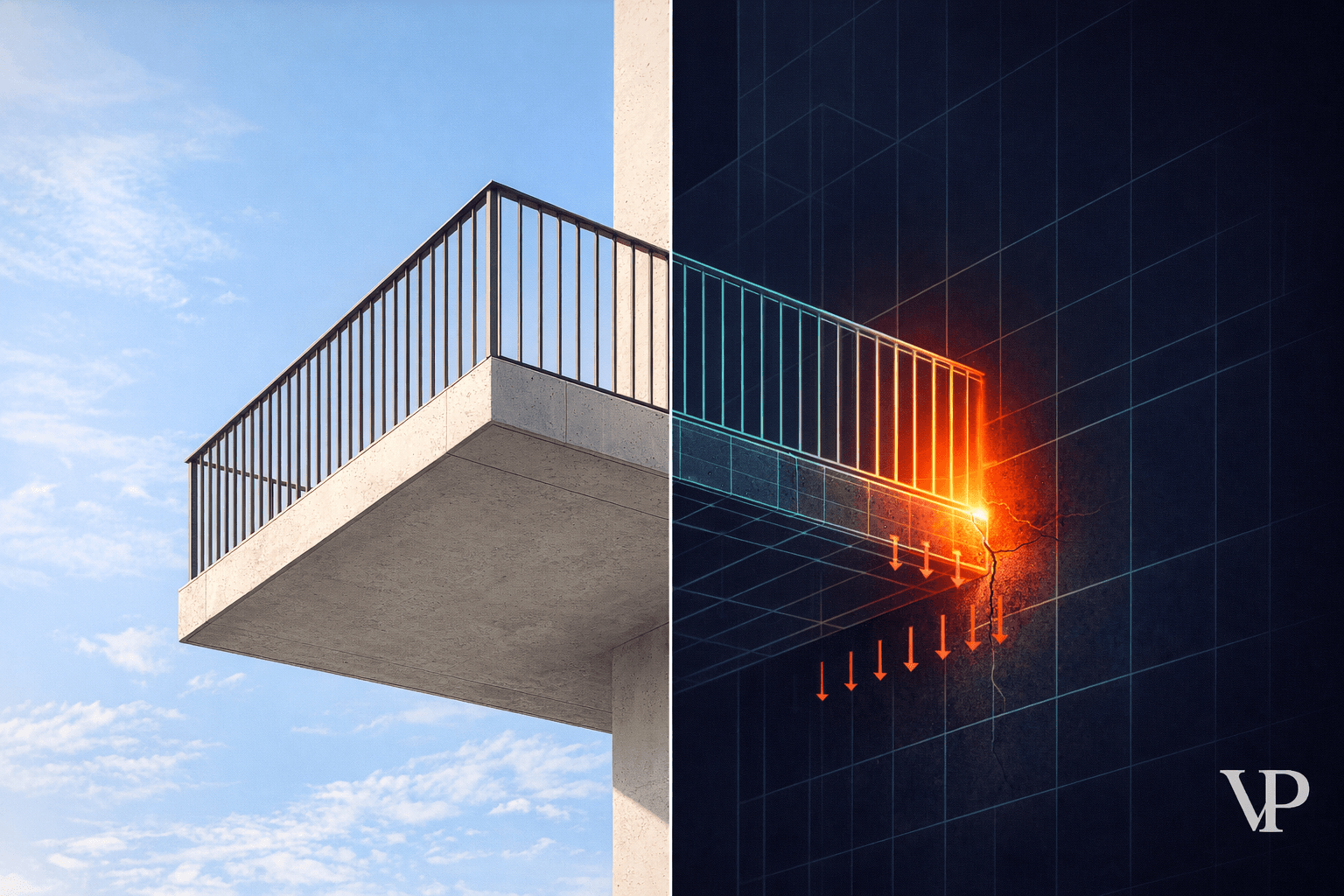
That gap — between the render and the load path, between what generative AI can draw and what a structural engineer can actually stamp — is the most expensive problem in the building industry that almost nobody is building software for. Generative AI in architecture has gotten extraordinary at producing pixels. It has learned nothing about gravity. The tools that generate these forms have no physics engine inside them. They produce images, not structures, and the difference is where projects go to die.
Trimble puts the annual cost of construction rework driven by poor design at $177 billion. The number that haunts me more is the breakdown behind it: roughly 80% of a project's cost deviation traces back to design changes, and only about 17% to what actually happens on the construction site. We have spent a decade pouring software into the 17% — site logistics, equipment telematics, drone progress scans — and left the 80% to a manual handoff between two teams that don't share a model.
The tools generating these buildings produce pixels, not load paths. That single gap is where eight out of ten cost overruns are born.
I want to tell you what we got wrong trying to fix it, because the failure is the part that taught us anything.
The Death Ray Nobody Modeled
Before the failure, the cautionary tale — because it's the cleanest illustration I know of what it costs when the shape gets chosen weeks before anyone checks the physics.
Rafael Viñoly's Vdara Hotel in Las Vegas has a crescent-shaped, south-facing glass facade. The concave geometry did exactly what a concave mirror does: it focused sunlight onto the pool deck below. Temperatures climbed high enough to melt plastic lounge chairs and singe guests' hair. Staff started calling the focal zone the "death ray." The fix was film, fins, and large umbrellas — ugly, after-the-fact apologies bolted onto a finished building.
The detail that should stop every architect cold: the same architect did it again. At 20 Fenchurch Street in London — the "Walkie-Talkie" — a concave facade focused sunlight hot enough to damage a parked Jaguar's bodywork on the street below. Two buildings, the same physics, the same architect, the same blind spot in the design process.
The physics were not subtle. A concave mirror focuses light; a first-year ray-tracing analysis catches it in milliseconds. The problem was never that the math was hard. The problem was that the math lived in a different building, on a different team's computer, weeks downstream of the moment the shape was chosen. And now generative tools let anyone produce complex curved geometry in seconds. The number of ways to accidentally build a solar concentrator, a wind tunnel, or an acoustic focus has gone up. The number of physics checks happening while the shape is still soft has not.
The Thing We Built First, That Didn't Work
When my team started on this, we did the obvious thing, and I want to be honest that I was the one who pushed for it. The dream was instant physics feedback — let the architect drag a facade and watch the structural stresses update live, no waiting. The textbook tool for that is a physics-informed neural network: you bake the governing equations of the structure straight into the model, and in theory it gives you the physics for free.
We spent the better part of a month on it. It was seductive on paper and treacherous in practice. The honest literature on physics-informed neural networks is brutal once you read past the press: they embed idealized equations that quietly omit boundary and multiscale effects, and the errors propagate multiplicatively — which means the model hands you a plausible, confident, wrong answer. Beam bending is a fourth-order differential equation, and those wreck the gradient stability the whole method depends on. Worst of all, change the structural configuration and you have to retrain. For a tool whose entire promise was "explore freely," a model that needs a full reanalysis every time you move a column is not a tool. It's a trap with a nice demo.
The moment it died for me was watching it return a clean, beautiful displacement plot for a frame I already knew was under-designed. It didn't flag uncertainty. It didn't hesitate. It was wrong with total confidence, which is the single most dangerous thing a structural tool can be. A structural analysis that is confidently wrong is more dangerous than one that is honestly slow. I'd been so sure the physics-informed route was the elegant answer that I'd skipped asking whether elegant was the same as safe. It wasn't.
That failure is what bought us the actual approach.
What Actually Worked: Graph Neural Networks, Trained on the Firm's Own Buildings
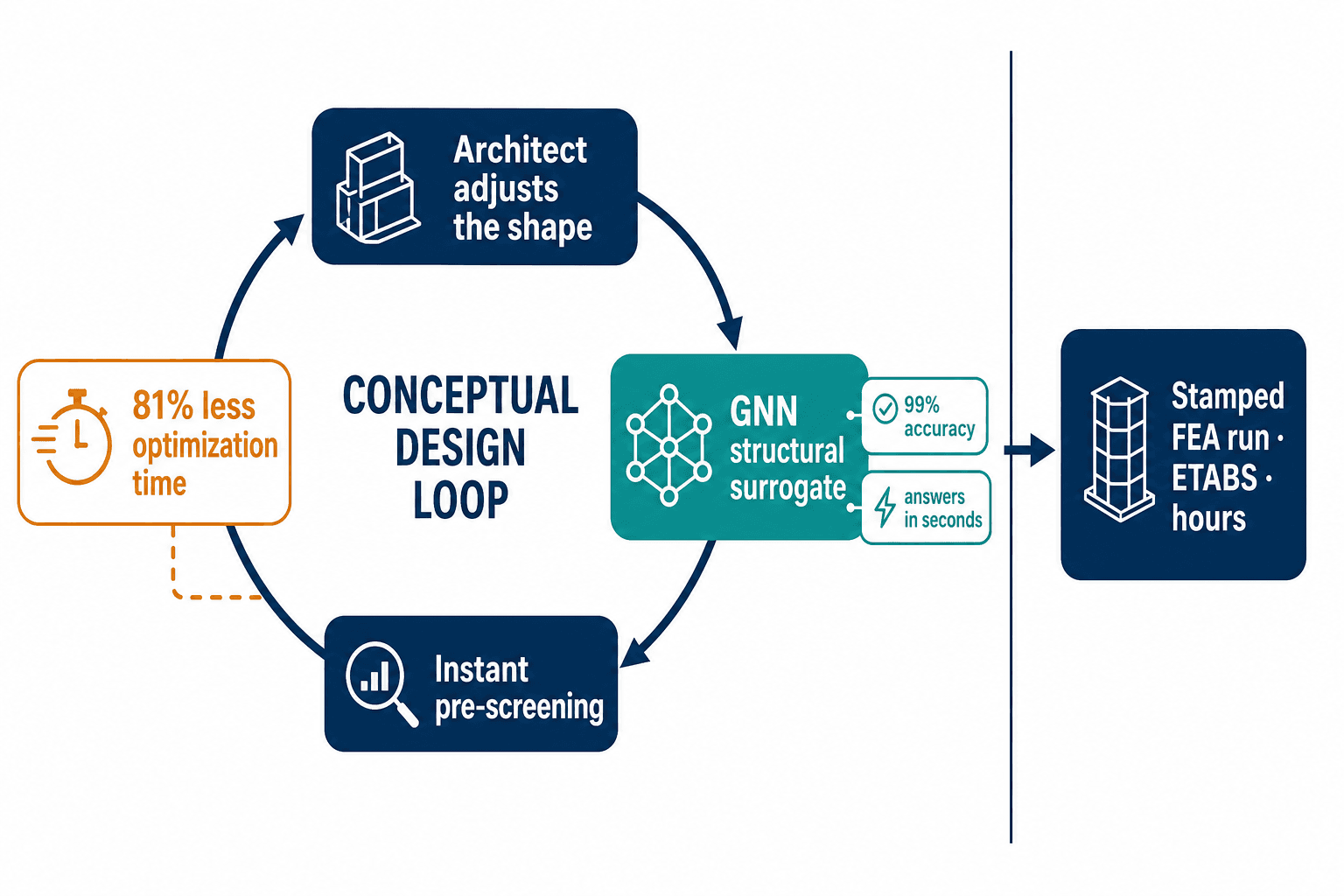
The turn came when we stopped trying to make the AI re-derive physics from equations and started letting it learn physics from a firm's own analysis history. Structures are graphs — nodes and members, joints and loads. Graph neural networks are built for exactly that shape, and the research has gotten genuinely good: a framework called StructGNN predicts displacements, moments, and shear forces at better than 99% accuracy, and holds 96% accuracy even on taller structures it had never seen. A separate line of work using a GNN as a structural surrogate inside the optimization loop cut optimization time by 81% and trimmed embodied carbon by nearly 6%.
The unlock isn't the accuracy number. It's where a model that fast can sit. A full finite-element run in ETABS takes hours; during a value-engineering scramble, ten member-resizing iterations is two weeks of senior-engineer time. A surrogate that answers in seconds can live inside the conceptual design loop — screening a curved facade for solar focus, a long span for deflection, a transfer beam for a section that doesn't exist at any service center — while the shape is still cheap to change. Not to replace the stamped FEA run. To stop the architect from spending three weeks falling in love with something the FEA run will later condemn.
This is the heart of what we build at Veriprajna for AEC firms: physics-informed pre-screening during conceptual design, structural optimization against the steel you can actually buy, and BIM-to-analysis pipelines that stop bleeding engineer-hours into manual translation. Not a chatbot bolted onto Revit. A model trained on the firm's own typologies, so it knows what their buildings tend to do.
Why Is the Cheapest Steel Member Often the Most Expensive?
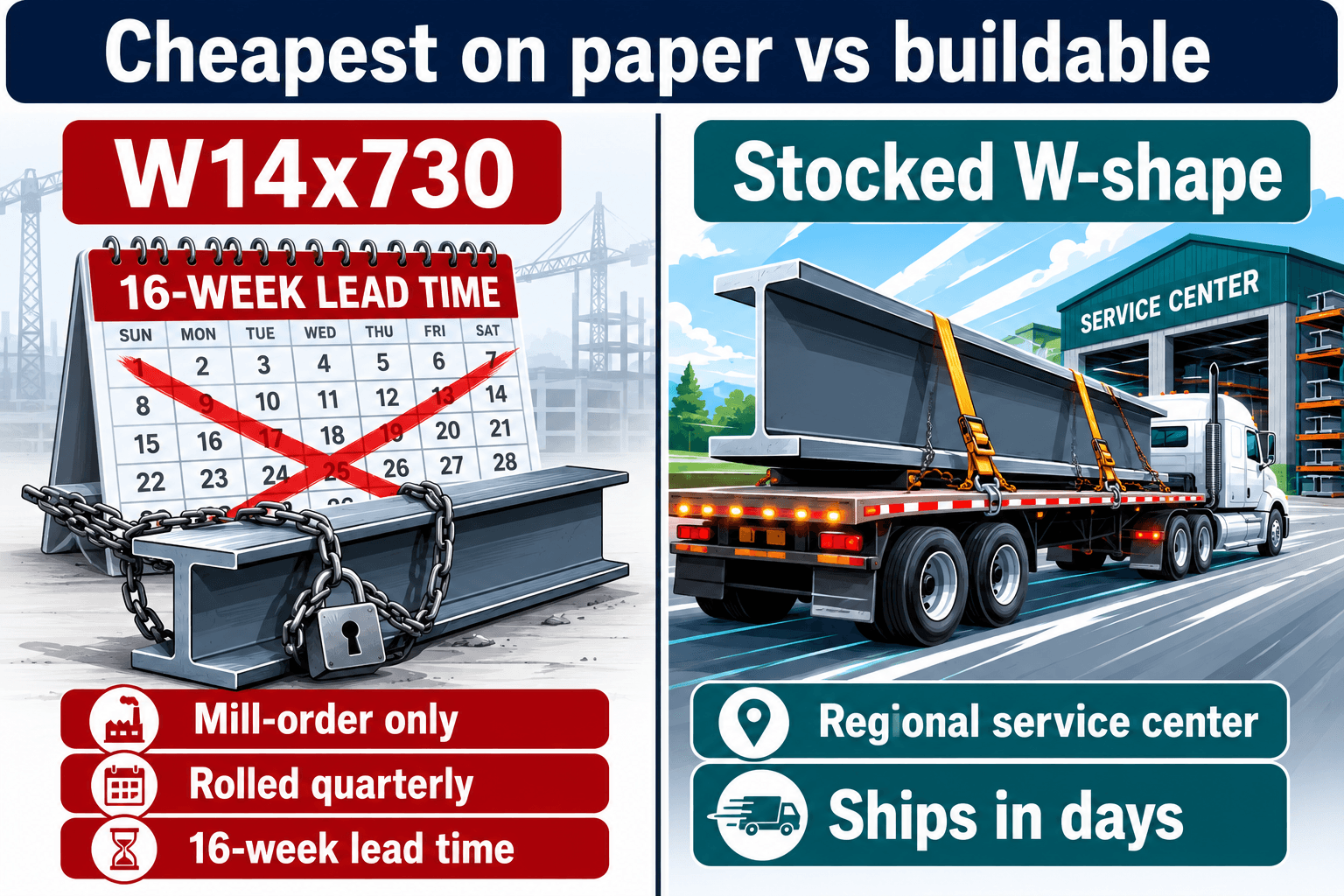
I didn't appreciate this until I sat with a structural team during procurement: the cheapest member on paper is frequently the most expensive member in reality, and no optimization tool I'd seen knew the difference.
A solver will happily spec a W14x730 because it's structurally efficient. But that's a mill-order-only section — you can't pull it from a service center, the mill rolls it on a quarterly cadence, and you've just put a 16-week lead time on your critical path. Meanwhile a slightly heavier W-shape that every regional service center stocks ships in days. The "optimal" design, by weight, blew the schedule. The "suboptimal" one built on time and under budget.
And here's the part that makes this hard to productize: there is no real-time steel inventory API anywhere in this industry. AISC maintains a shapes-availability database, but actual stock still moves between fabricators and service centers by phone, by spreadsheet, by EDI. Mill minimums, stock-length waste, who has what this week — that knowledge lives in relationships, not endpoints. Any AI that optimizes structure against procurement reality has to be built to ingest that messy, human, firm-specific data, because no clean feed is coming to save you. That's exactly the kind of problem off-the-shelf software refuses to touch and custom work exists for.
This matters more every quarter. Steel rose 11.9% across the ENR 20-city average in 2025, the tariffs on steel and aluminum jumped from 25% to 50% mid-year, and an early-stage cost estimate built on last quarter's prices is fiction. Optimizing for tonnage while ignoring availability and volatility is optimizing the wrong variable.
The Translation Tax Between Revit and ETABS
There's a quieter cost I'd underestimated, and it's pure waste. Your architect works in Revit. Your structural team analyzes in ETABS. Getting the model from one to the other should be a button. It is, instead, a tax your firm pays hundreds of times a year.
IFC export from Revit routinely drops the analytical model: connection types vanish, analytical offsets reset, load assignments disappear. The format itself is fragmented — IFC2x3 versus IFC4 alignment issues are real, and even the vendor-blessed exchange add-ins are, by the industry's own admission, poor out of the box. So an engineer spends two to four hours cleaning up the translation before analysis even starts. Multiply by fifteen-plus iterations a project, across thirty-plus projects a year, and you're burning thousands of senior-engineer hours on data janitorial work. Not engineering. Not design. Translation.
Your most expensive engineers are spending thousands of hours a year not analyzing buildings, but repairing the file that was supposed to describe them.
This is unglamorous and it is enormous, and it's the part of the build that pays for itself fastest. A custom pipeline wired through the Revit API and the analysis tool's API — not a generic IFC round-trip — preserves what IFC drops. It's the least exciting slide in any pitch and the line item a managing principal circles first.
The Stamp Doesn't Move
People always ask me some version of: doesn't AI just let firms skip the engineer? And the answer, legally, is the opposite of what they expect.
When a structural engineer signs and stamps a drawing set, they assume personal, professional liability for it. AI changes nothing about that. There is no regulation anywhere that distinguishes an AI-generated member from one a junior engineer drafted — the engineer of record owns both, completely. An AI-generated design still has to satisfy every provision of the building code, and with ASCE 7-22 now folded into IBC 2024 (new response spectra, new snow maps, reworked anchorage equations), there's more code to satisfy, not less.
I've come to think this is a feature, not an obstacle, and it shapes everything we build. The engineer must be able to interrogate the AI's output — see the load path, check it against the code, validate it the way they'd validate an intern's work — because they're the one whose license is on the line. A tool that produces a confident black-box answer is useless to a professional who is legally required to defend it. Which is the final reason that month on physics-informed networks was so clarifying: it was teaching me to build the wrong thing — opaque confidence — for a buyer who needs the exact opposite.
So Why Hasn't Autodesk Just Done This?
It's the fair question, because the giants are clearly moving. Autodesk Forma is rolling out "Neural CAD for Buildings," billed as the first AEC-specific foundation model. Nemetschek has made agentic AI a group-wide priority. Gartner expects 40% of enterprise applications to embed AI agents by the end of 2026. The field is unmistakably in motion.
I've sat through enough technology-evaluation meetings to know where each tool actually stops. Forma is brilliant at massing and site planning and stops well above structural member sizing — it has no idea what your steel costs. Altair's SimSolid and PhysicsAI do meshless simulation fast, but they're priced for enterprise, aimed at mechanical and automotive, and aren't BIM-native or procurement-aware. TestFit and Hypar are site- and space-planning tools with no structural verification at all. The closest, Stru.ai, is an automation wrapper around existing FEA — it speeds up driving ETABS; it doesn't replace the hours-long run with instant feedback, and it isn't generative.
No commercial tool closes the loop between generative design and structural verification, against the steel you can actually buy, trained on your buildings. That loop is the whole game.
That's not a knock on any of them — they're good at what they do. It's that the seam between generative design and structural reality is precisely the place a horizontal platform won't go, because closing it requires a firm's own analysis history, its own typologies, and its own messy procurement relationships. It's custom by nature. And the adoption numbers say the window is wide open: only 27% of AEC professionals report using AI in operations, and just 8% of architecture firms have implemented an AI solution, even as architect adoption jumped from 41% to 59% in a single year. The firms moving now aren't late. They're early, in an industry that's barely started.
Is Value Engineering Actually Inevitable?
For seventy years, roughly 85% of construction projects have run over budget, by an average of 28%, and fewer than one in ten megaprojects finishes on time and on budget. The industry has filed value engineering under inevitable — the 60-to-90-day ritual where the contractor prices the dream, the developer panics, and the engineer re-runs the model ten times while everyone loses a month.
It is not inevitable. It's the symptom of a design process that checks structural viability, material availability, and fabrication complexity after the shape is locked instead of while it's still soft. Move those checks upstream — into the conceptual loop, at the speed of a graph neural network, trained on the firm's own work and wired to the steel it can actually get — and the value-engineering crisis doesn't get managed. It stops being born. If you run an AEC firm and want to see how that pipeline is put together, we've laid out the full approach here.
The render that started this — the beautiful glass wave with 3x over budget scrawled underneath — didn't have to die in a contractor's spreadsheet sixty days too late. The physics that killed it were knowable on day one. The only question worth asking now is why we keep finding out last.