
Half Your Customers Punish AI Brand Content. We Built a Way to Use It Anyway.

A chief marketing officer slid a deck across the table to me last year. It was a statement of work from her agency, and one line item read "AI-augmented production." The number next to it was the same number agencies have always charged for production — full traditional rate. That same week, her team had run a consumer panel on the work that line item produced. The results came back hostile. People found the ads, in their own words, annoying and a little soulless. She wasn't angry about the AI. She was angry that she was paying premium prices to manufacture content her customers were quietly rejecting, and nobody in the chain had told her.
That meeting is why we built what we built. The core problem with AI brand content in 2026 isn't whether the technology is good enough — it is, and getting better monthly. The problem is that you can use AI aggressively to make content faster and cheaper, and a meaningful slice of your customers will punish you the moment they sense it. So the goal we settled on, and the thing we now build for brand teams, is almost paradoxical: use AI ruthlessly in the process, and keep it invisible in the output. Hybrid production pipelines, brand-fidelity scoring, and a governance layer that survives a regulator's questions.
Let me walk through how I got there, including the version we shipped that broke.
What Executives Believe vs. What Consumers Actually Do
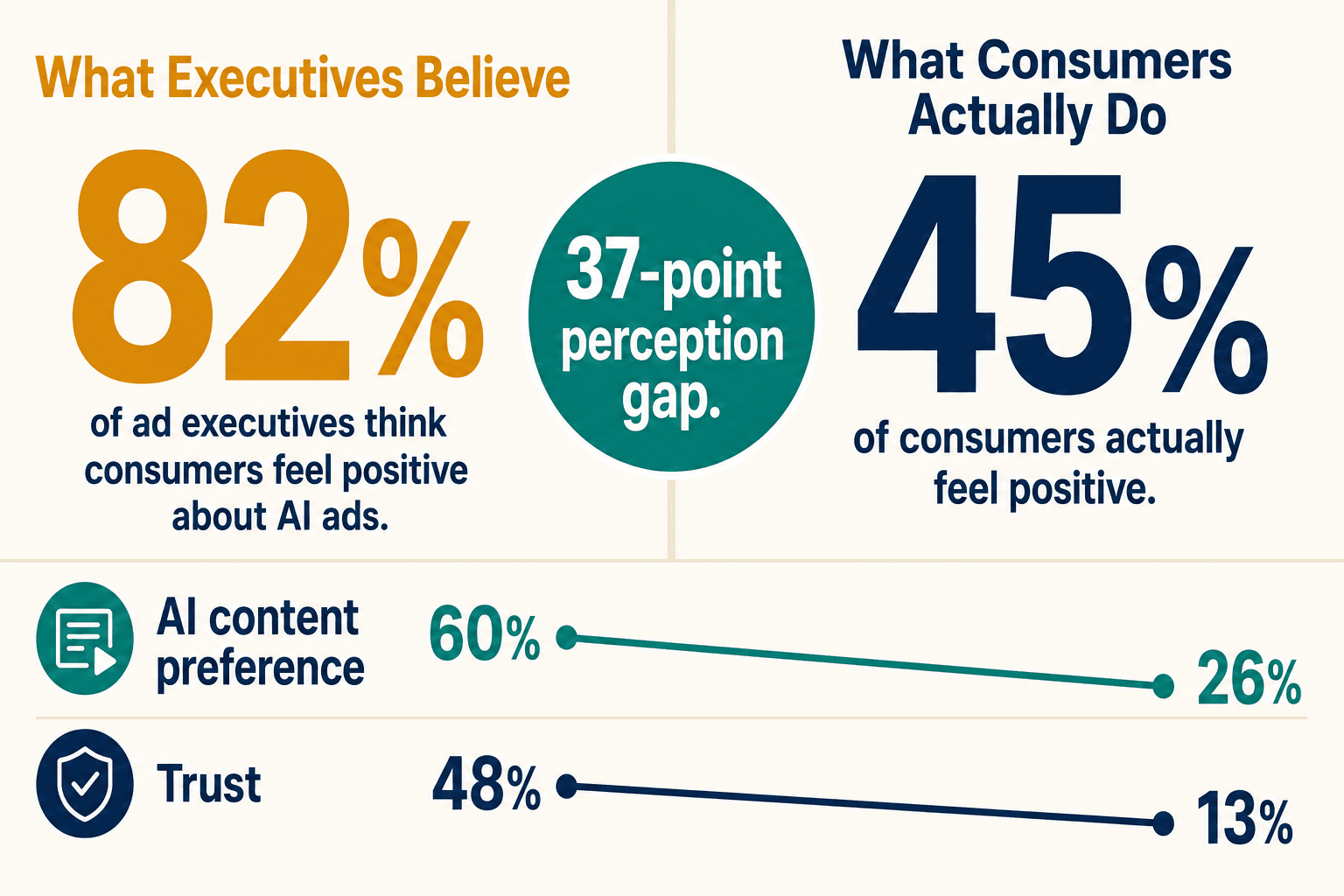
Start with the gap that should frighten any marketing leader. The IAB found in 2026 that 82% of ad executives think Gen Z and millennial consumers feel positive about AI in advertising. Only 45% of those consumers actually do. That's a 37-point perception gap, and it's the distance between the strategy deck and the customer.
It gets worse the longer you look. Consumer preference for AI content has fallen from 60% in 2023 to 26% in 2026. Gartner's March 2026 survey of more than 1,500 U.S. consumers found that half now prefer brands that avoid generative AI in consumer-facing content. And one-third of consumers, per Adobe's 2026 Digital Trends report, will stop interacting with a brand entirely once they discover its content was AI-generated.
Half your customers don't dislike AI content. They dislike being able to tell.
The most useful number I've ever shown a skeptical CMO comes from Smartly.io: consumer trust drops from 48% to 13% when an ad is made entirely by AI versus co-created with humans. That's a 73% trust collapse from a single production decision. No content-cost saving in any spreadsheet I've seen offsets a 73% drop in trust. The arithmetic only works if the AI is invisible.
What makes this genuinely hard rather than just a branding slogan is that the resistance isn't only opinion — it's physiological. NielsenIQ's neuroscience work measured weaker memory activation in the brain for AI ads, even the polished ones. Consumers rated them more annoying, more boring, more confusing than traditional ads. The brain is doing the detecting before the conscious mind forms an opinion.
The Coca-Cola Moment Every CMO Is Trying Not to Have
Every marketing leader I talk to is privately terrified of one specific event, even if they don't name it. Coca-Cola generated something like 70,000 clips for a holiday spot in 2025 and got a backlash that reframed the whole effort from "innovative" to "cheap" and "dystopian." Toys "R" Us put an AI-generated child actor in a Sora-made film and triggered something close to primal rejection. McDonald's pulled a holiday ad after viewer outcry. These are not small brands experimenting at the edges. These are the most sophisticated marketing organizations on earth, and the content still landed wrong.
The one that should keep agency-side leaders up at night is different, because it wasn't about taste. In June 2025, the Brazilian agency DM9 — part of the Omnicom network — won the Creative Data Grand Prix at Cannes Lions. Investigators later found the case film used AI-generated footage to simulate campaign results, including modified CNN Brasil coverage created without permission. The chief creative officer resigned. Twelve awards were revoked. Cannes introduced mandatory AI disclosure and detection tools for every future entry.
That wasn't a rogue freelancer cutting a corner. It was a major network agency fabricating evidence for the industry's highest honor, under the ordinary pressure to show AI-driven results. And it points straight at a question most brands haven't asked their agencies out loud:
If your agency is using AI in ways you never approved, who owns the reputational risk when it surfaces? You do.
I think back to that SOW deck constantly. The brand was paying traditional rates, the agency was pocketing the AI efficiency, and the disclosure obligation — legal and reputational — sat entirely with the brand. The asymmetry is the business model. Part of what we do now is simply audit what agencies are actually using, and whether it's disclosed, before it becomes the brand's problem in public.
Why Did Our First Brand-Fidelity Scorer Fail?
Here's the part I'm less proud of, and the part that actually taught us the thing worth selling.
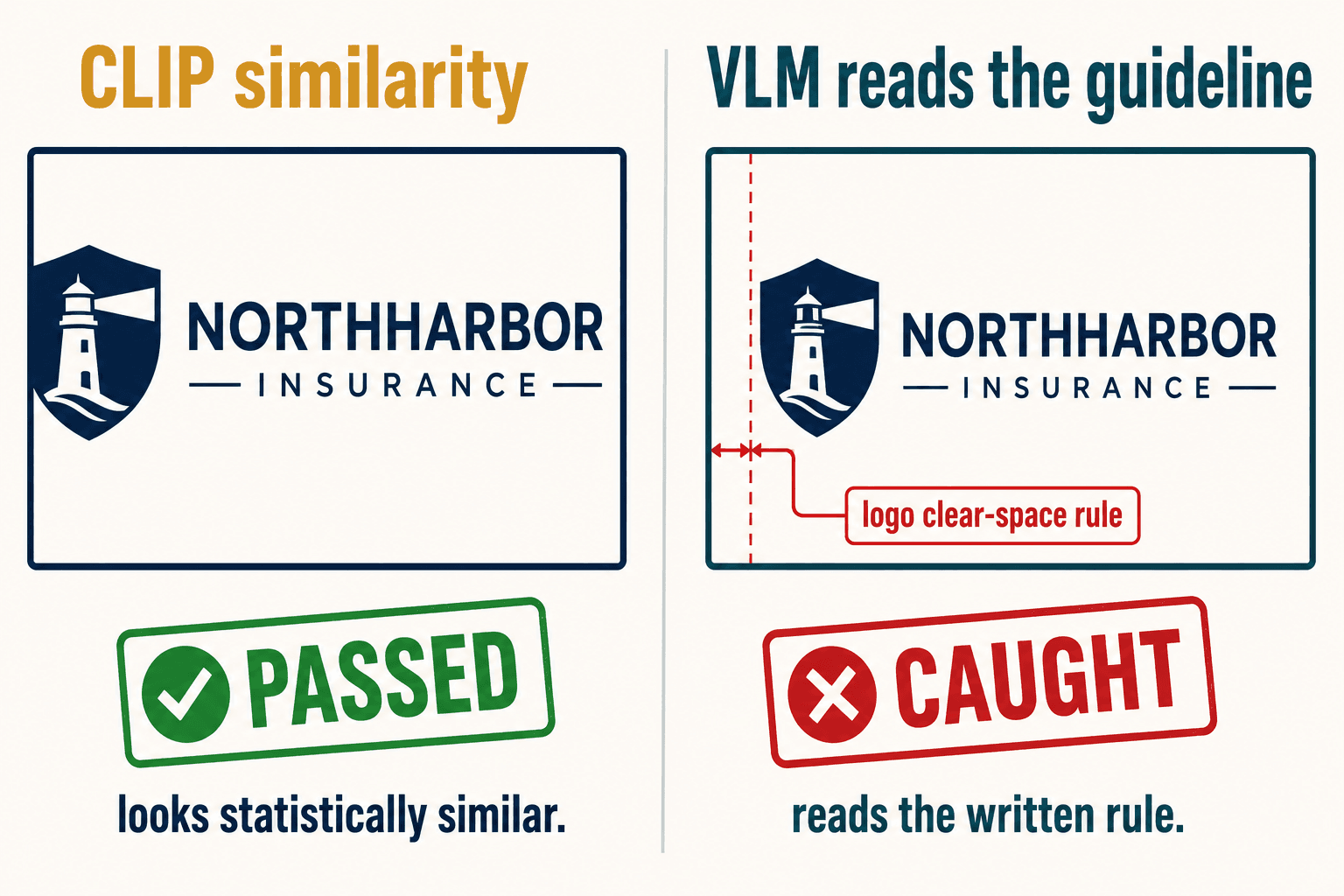
When we set out to measure whether AI-generated content stayed on brand, I backed the obvious approach. You take the brand's reference images, you embed them, you embed the new asset, and you score similarity — CLIP scores, the standard image-text matching technique most vendors quietly use. We built it, it produced a clean number between zero and one, and it demoed beautifully. I was convinced.
Then we ran it on a pilot brand's real output. The scorer happily passed an image that violated the brand's logo clear-space rule — the minimum empty margin that has to surround the mark — because the image looked statistically similar to the reference set. Meanwhile it flagged a perfectly compliant asset as off-brand because the color grade was unusual. I remember staring at the report thinking the number was confident and wrong at the same time.
That was the failure that paid for everything after it. CLIP-style similarity measures "does this look like that." It has no idea what your brand guideline actually says. "Looks on-brand" and "obeys the logo clear-space rule" are two completely different questions, and a similarity score can't tell them apart.
So we rebuilt it on vision-language models — systems that can read an image and read your written brand guideline and check one against the other. Not "is this similar to past work," but "does the logo have its required clear space, is the typeface from the approved family, does the tone match the documented brand voice." It's slower and more annoying to build than a similarity score. It's also the only version that a creative director will trust enough to let into the approval workflow.
A brand-fidelity score that can't cite the rule it's enforcing is just a vibe with a decimal point.
The Real Variable Isn't AI vs. Human. It's Finishing Labor.
The night that reframed the whole project for me, I was reading back through NielsenIQ's panel data. Buried in it was a detail I'd skimmed past the first time: the only ad in the study that consumers couldn't immediately identify as AI was one a professional had created through considerable iterative editing. Not generated and shipped — generated, then worked over by a human for a long time.
That stopped me. The entire public conversation is framed as "AI or human," as if those are the two boxes. But the data was telling me the predictive variable isn't the origin of the pixels. It's the finishing labor — the human iteration that sands off the uncanny edges machines still leave. AI can carry almost all of the work invisibly. It's the final human pass — the part no spreadsheet bothers to price — that determines whether your customer's brain flags the result.
That's the design principle the whole pipeline now rests on. Use AI hard where it doesn't touch the customer's perception — ideation, variant generation, rough cuts, localization, asset volume. Reserve human craft for the finishing pass on anything that ships. "Human where it matters, AI where it helps," tuned to each brand rather than sold as a template.
And the efficiency is real when you architect it this way. AI-augmented production runs closer to $100 per asset against $500 to $2,000 traditional, with labor reductions around 75% per asset. Localization is where it's almost embarrassing: traditional localization runs $50 to $200 per minute, and AI localization delivers human-quality output at roughly half the cost when a human reviews it — which matters when the average company is entering 1.5 new markets a year and poor localization quietly bleeds about 20% of potential revenue. The savings are genuine. They just have to be banked in the parts of the process the customer never sees.
The tooling to do this exists, and we're deliberately vendor-neutral about it. Adobe's GenStudio encodes brand rules into Firefly generation through what it calls StyleIDs, and it's excellent inside the Creative Cloud world — but it locks you to Firefly for generation, and its video trails the leaders by a year or more. Typeface, founded by a former Adobe CTO and used by the likes of PepsiCo, Disney and Estée Lauder, has a genuinely strong governance layer — but only over content produced through Typeface itself. Bria trains custom brand models on up to 5,000 of your own images, which is powerful for image work and useless for video. Runway's Gen-4.5 produces the best AI video available, with real physics simulation — and zero brand governance; you get raw output. Kling 3.0 does multi-shot consistency at about 40% of Runway's cost. None of them solves the whole problem, and I've watched more than one brand-content initiative stall in exactly those gaps — a team that bought Typeface for governance, then discovered their video pipeline lived entirely outside it. The gaps between tools are where the work actually is.
Compliance Lives in Your Metadata, Not Your Creative Review
The mistake I see brands make on the legal side is treating AI disclosure as a creative-review checkbox. It isn't. It's a data-architecture problem, and the deadline already passed for the rule with the biggest teeth.
The EU AI Act's Article 50, in force as of August 2026, requires AI-generated content to be marked in a machine-readable format and detectable as artificially generated. Read that twice. Machine-readable. That obligation doesn't live in your creative director's eye or your approval meeting — it lives in your digital asset management system and your CMS, in whether each asset record actually carries the AI-provenance metadata. I've opened too many DAM records with an empty "AI-generated: yes/no" field to believe this is handled. The penalties aren't theoretical either: up to €15 million or 3% of global turnover for transparency violations.
And it's not one rule, it's a fragmenting patchwork. The FTC's updated endorsement guides require clear and conspicuous disclosure of synthetic AI testimonials. New York's SB-8420A, effective June 2026, mandates conspicuous disclosure of AI-generated synthetic performers in commercial ads. California's AB 853 phases in its own requirements. Each jurisdiction, each timeline, each definition slightly different. A premium brand selling across all of them needs one governance framework that satisfies the strictest, not four creative reviews that each guess.
Your AI disclosure obligation doesn't live in the approval meeting. It lives in your asset metadata — and most brands' metadata is empty.
This is the least glamorous capability we build and the one that, in my experience, actually gets the deal signed, because it's the part that turns into a fine.
But governance isn't only insurance. The brands I've seen build mature AI governance early don't just avoid the fine — they ship faster, because their teams stop re-litigating what's allowed on every project. The research bears it out: organizations with mature AI governance innovate roughly 2.5x faster and carry about 40% lower compliance risk. The framework that keeps you out of court is the same one that lets you move.
Can't You Just Buy a Platform for All This?
People ask me a version of the same question often: can't we just buy a platform for all this? And I have to be honest about where bought software stops.
The big systems integrators will happily architect an AI content strategy for you — the engagements run $500,000 to $5 million and up, and they deliver slide decks and frameworks, not working pipelines. They tend to subcontract the actual build to firms like us anyway. In-house teams give you full control and direct access to brand knowledge, but AI-native creative producers are brutally hard to hire right now, and building governance from scratch takes most teams six to twelve months. Service shops like Superside give you AI-augmented human craft at scale, but you're buying labor, not a system you own and keep.
There's a harder limit I've learned to name in the first meeting. No external party — not the platforms, not the integrators, not us — can solve your organizational buy-in problem. I once sat across from a creative director who told me, without hesitation, that he would not put his name on AI work. He wasn't wrong to feel that way, and no governance architecture overrides it. If the people who make your brand fundamentally reject the workflow, the best technology in the world sits unused. Change management inside your own building is yours to own. I'd rather say that early than pretend a tool fixes it.
What we can own is the architecture: the cross-jurisdictional governance framework, the vendor-neutral mix of tools matched to your actual needs instead of one platform's roadmap, the VLM-based brand-fidelity scoring that reads your real guidelines, the agency-audit capability, the hybrid pipeline tuned to where your customers will and won't tolerate machine work, and the cultural-adaptation review for localization. That's the system we build for brand content teams, and we build it to integrate with the platforms and agencies you already use, not to replace them.
The brands that win the next few years won't be the ones who used the most AI or the least. They'll be the ones who understood that their customers are running a detector in their own heads, all the time, and built a production system that respects it — aggressive where the machine helps, invisible where it would betray them. The CMO with that hostile consumer panel didn't have a technology problem. She had a system that let efficiency leak into the one place her customers were watching. Close that leak, and AI stops being a reputational liability and goes back to being what it should have been all along: a faster way to make work people actually trust.