Your AI Gym Coach Is Three Seconds Too Slow to Save Your Spine

I watched a guy nearly wreck his lower back because an app told him the wrong thing at the wrong time.
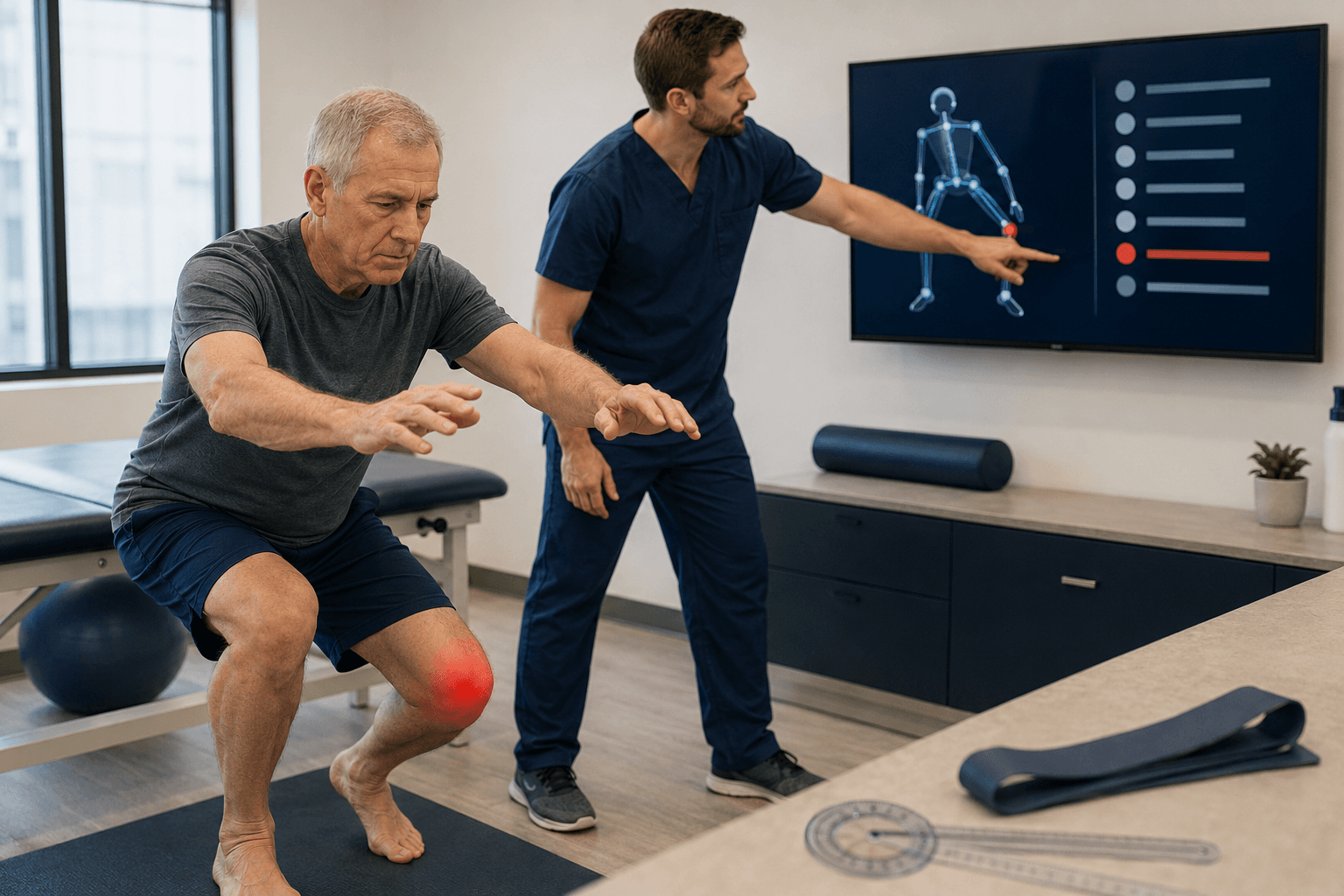
He was in a commercial gym in Bangalore, phone propped against a dumbbell, running one of those AI coaching apps that promises to "watch your form in real-time." He was squatting — not heavy, maybe 80 kilos — and somewhere around the fourth rep, his lumbar spine started rounding. The classic butt wink. Shear forces climbing on his L4-L5 vertebrae, disc compression shifting from safe to dangerous.
The app buzzed and said, "Keep your chest up."
But it said it on his fifth rep. The one where his form was actually fine. The correction was for rep four — three seconds ago, an eternity in biomechanics — and now it was confusing him into overcorrecting a rep that didn't need correcting. He adjusted mid-lift, lost his brace, and I watched his back round worse than before.
That moment crystallized something I'd been suspecting for months at Veriprajna: the entire architecture most fitness AI companies are building on is not just slow — it's biomechanically dangerous. The latency gap between when a cloud-based AI "sees" a problem and when its feedback reaches the user isn't a minor UX inconvenience. It's a liability. And in the context of loaded spinal movement, it's the difference between a correction and a injury.
The 200-Millisecond Budget Nobody Talks About
Here's a number that should be tattooed on the forehead of every fitness tech founder: 200 milliseconds.
That's roughly the total time a human has to perceive a visual stimulus and initiate a motor correction. For elite athletes, it's closer to 150ms. For the average gym-goer, maybe 250ms. Auditory and haptic cues are faster — 25 to 100 milliseconds.
This isn't my opinion. It's physiology. And it creates what I call a "latency budget" for any system that wants to coach human movement in real time. If the total system latency — from camera capturing a frame to the user feeling a haptic buzz — exceeds 200ms, the feedback arrives too late to influence the current phase of movement. It becomes decoration. Or worse, interference.
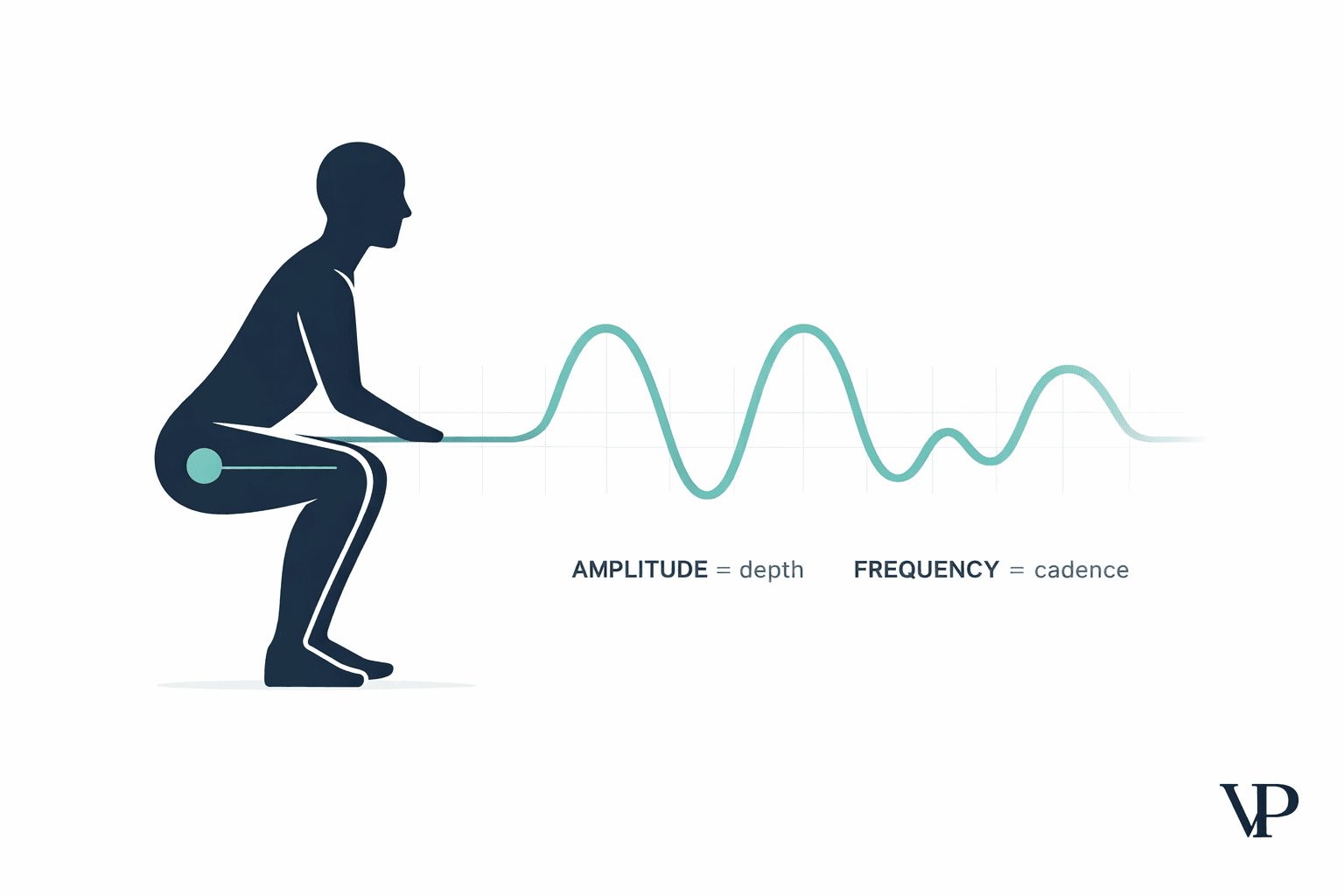
Now consider the kinematics of a back squat. The descent takes 1.5 to 2 seconds. The transition at the bottom — the "bounce," where your spine is most vulnerable — is often less than 200 milliseconds. If your lumbar spine starts flexing at the midpoint of the descent, the shear forces spike immediately. A coaching cue needs to arrive before you hit maximum depth and load.
A warning that arrives three seconds after your spine rounds isn't coaching. It's a post-mortem.
Most people building AI fitness products don't think about this. They think about the model. They think about the prompt. They think about the UI. They don't think about the physics of feedback timing and what happens when you desynchronize correction from error in a continuous set of reps.
Why Does Cloud AI Fail for Real-Time Fitness?
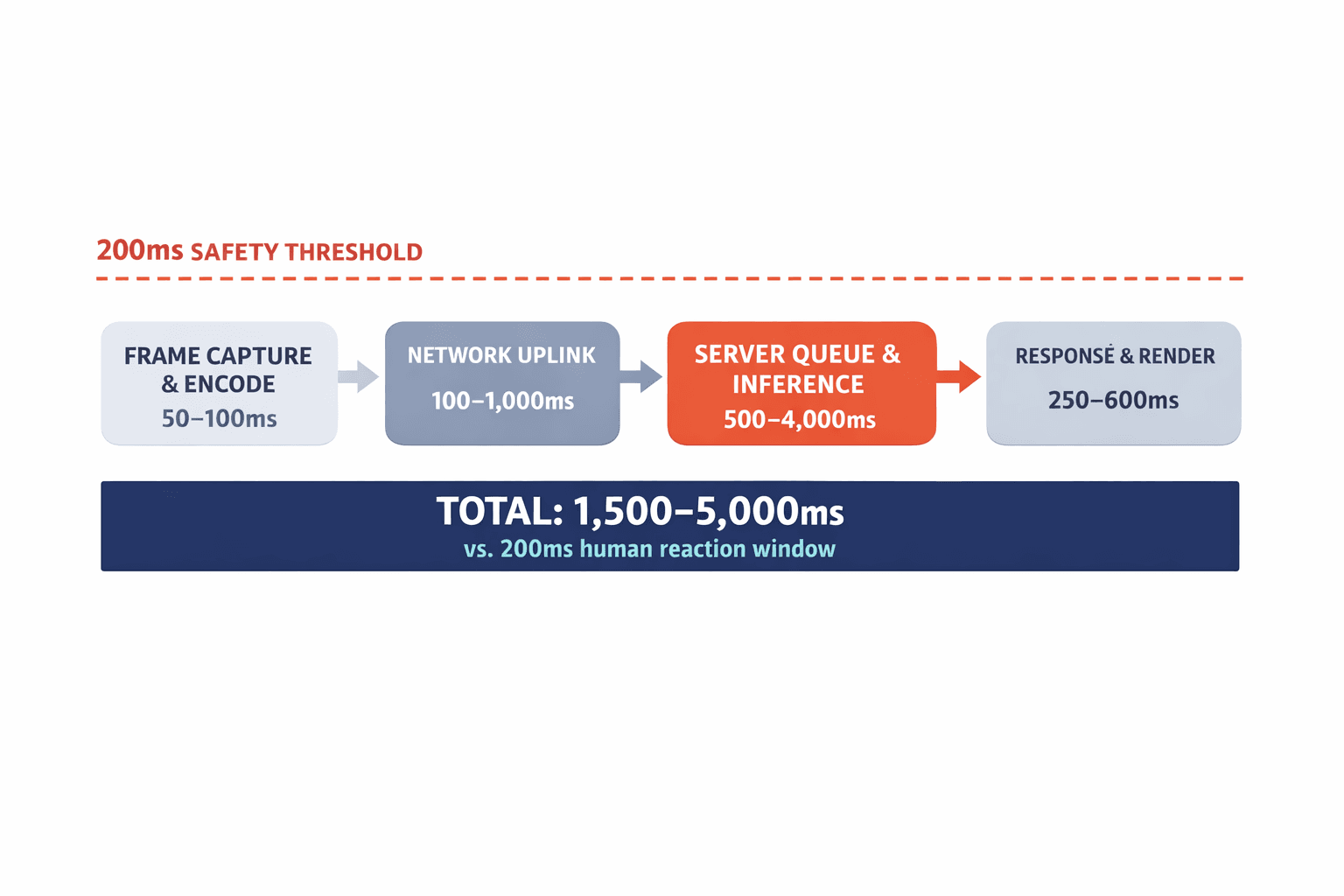
I need to be specific here, because "cloud is slow" is a vague complaint. Let me walk you through what actually happens when a fitness app sends a video frame to GPT-4o Vision or AWS Rekognition for form analysis.
Frame capture and encoding: 50 to 100 milliseconds. Your phone grabs a 1080p frame, compresses it to JPEG, often Base64-encodes it for API transmission. You can't aggressively downsample because you need resolution to detect subtle keypoints like ankle inversion.
Network transmission (uplink): 100 to 1,000 milliseconds. This is where things get ugly. Gyms are RF nightmares — basements, metal-framed buildings that act like Faraday cages, congested public Wi-Fi. Uploading a 2MB image on a fluctuating LTE connection can take anywhere from 200ms to over a second.
Server queue and inference: 500 to 4,000 milliseconds. The request hits OpenAI or Google's servers, enters a queue. GPT-4o's audio latency benchmarks around 320ms, but vision analysis is significantly slower — often 2 to 4 seconds depending on server load.
Response transmission and rendering: Another 250 to 600 milliseconds for token generation, downlink, JSON parsing, text-to-speech.
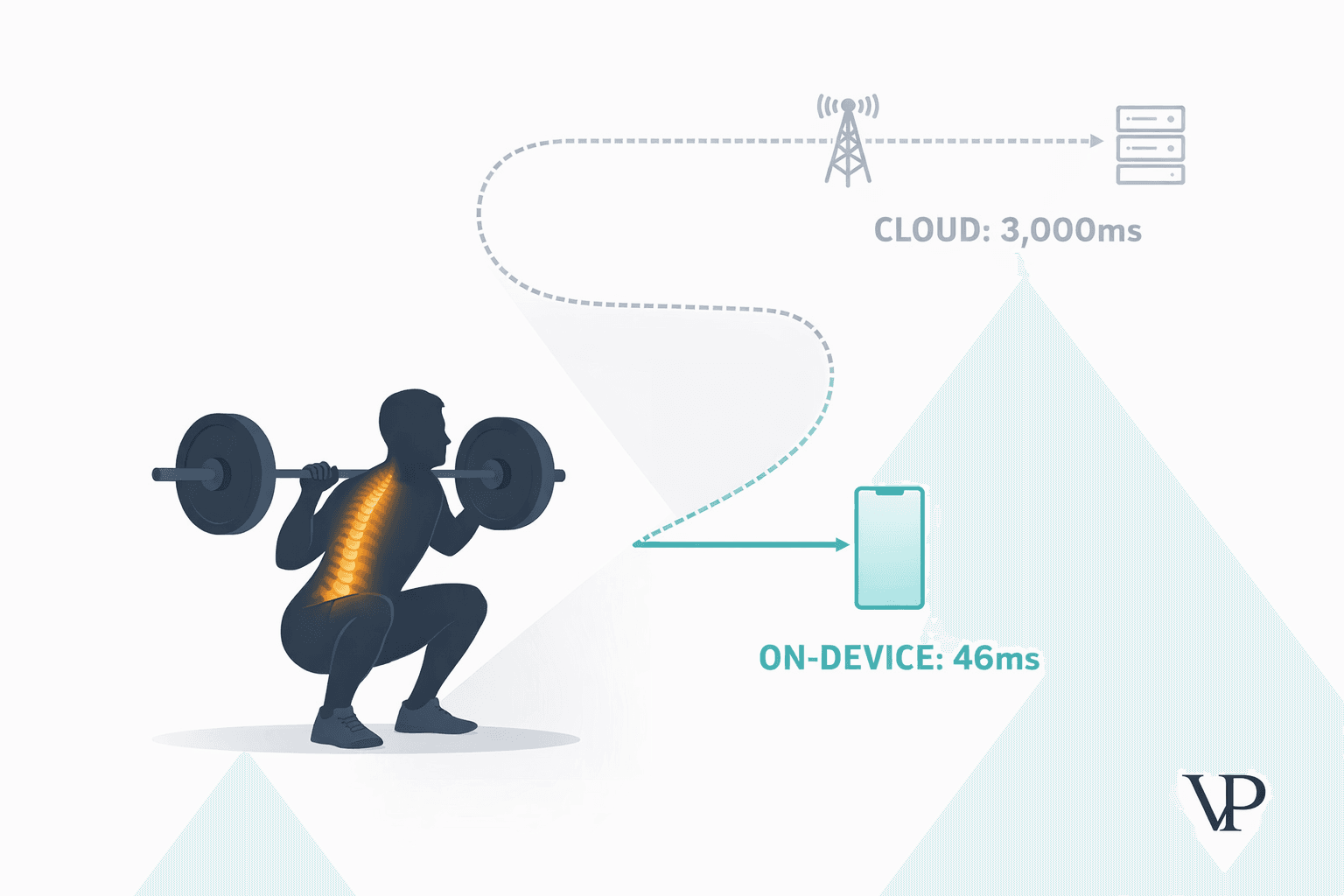
Add it all up. Best case with fiber Wi-Fi: about 1.5 seconds. Typical gym scenario: 3 to 5 seconds.
I remember the night my team and I sat down and actually measured this end-to-end. We'd been assuming the cloud path was "fast enough" because the marketing materials said "real-time." We set up a test rig — phone on a tripod, a team member doing controlled squats, timestamps at every stage of the pipeline. When we saw the numbers come back, there was this long silence. Someone said, "So we're basically building a dashcam, not a spotter." That was the moment we scrapped six weeks of work and started over.
The Negative Transfer Problem
The latency gap doesn't just make feedback late. It makes feedback harmful.
In motor learning research, there's a well-studied phenomenon called negative transfer. It happens when feedback arrives desynchronized from the action it refers to. In a continuous set of exercises, a 3-second delay means the correction for Rep 1 arrives while you're performing Rep 2.
Your brain doesn't know the feedback is stale. It associates the cue with whatever you're doing right now. If the AI says "Keep your chest up" during a rep where your chest is already up, you subconsciously link the correction to your current (correct) behavior. You overcorrect on Rep 3. Your form degrades. The AI, if it's still watching, now sees a new error — one it caused.
I wrote about this feedback loop problem in depth in the interactive version of our research. The motor learning literature is clear: concurrent feedback that isn't perfectly timed doesn't just fail to help — it actively interferes with the brain's intrinsic error detection mechanisms.
And there's a cognitive load dimension too. During a heavy lift, an athlete is managing balance, intra-abdominal pressure, leverage, breathing. Late feedback acts as a neurocognitive distractor. Research on the "11+" injury prevention program shows that anything that delays sensory processing reduces the time available for motor coordination corrections. The AI is effectively stealing processing power from the athlete's brain, increasing injury risk rather than reducing it.
An AI spotter that lags doesn't protect the user. It competes with them for attention at the worst possible moment.
What Happens When You Move Intelligence to the Phone?
This is where the story changes.
Modern smartphones ship with dedicated Neural Processing Units — the Apple Neural Engine, Qualcomm's Hexagon DSP. These chips are specifically designed for the matrix multiplication operations that power neural networks. They're sitting in your pocket right now, mostly idle, capable of running sophisticated computer vision models at 30+ frames per second while barely touching the battery.
We evaluated three open-source pose estimation models: BlazePose (Google's MediaPipe), MoveNet (TensorFlow Lite), and YOLOv11-Pose. Each has tradeoffs, but for a dedicated personal trainer app where accuracy matters more than multi-person tracking, BlazePose won decisively.
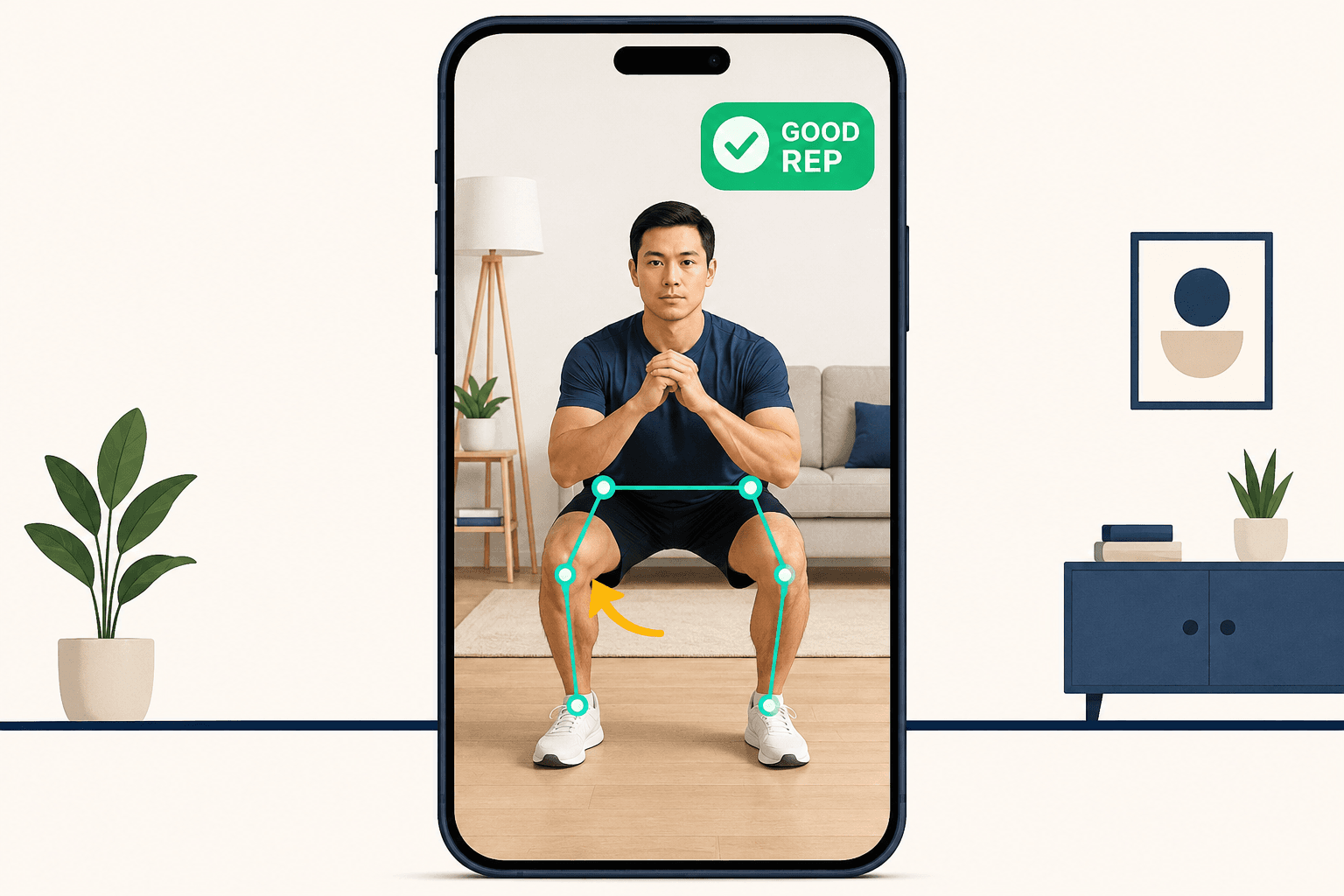
Why? Two reasons. First, it detects 33 keypoints — significantly more than the standard 17-point topology. That includes detailed hand and foot landmarks, which matter enormously for analyzing grip width in a bench press or foot stability in a squat. Second, it infers 3D coordinates. That Z-axis estimation means it can detect rotational movement — like a knee caving inward during a lunge — that a 2D model would miss entirely.
The latency math on-device looks nothing like the cloud:
Camera capture: 30ms. Inference on NPU: 15ms. Angle calculation logic: under 1ms. Feedback trigger: under 1ms.
Total: roughly 46 milliseconds. Well under the 200ms threshold for human reaction time. The AI can detect and respond to a form breakdown faster than the user's own nervous system can register the error.
There was a moment — I think it was a Tuesday evening, the office was mostly empty — when we first got the on-device pipeline running end-to-end. One of my engineers was doing bodyweight squats in front of his laptop camera, and the skeleton overlay was tracking him with this eerie precision. No lag. No jitter. The haptic buzz hit his phone at the exact instant his knee started drifting inward. He stopped, looked at me, and said, "It feels like it's inside the movement." That's when I knew we had something.
How Do You Stop the Skeleton From Vibrating?
Raw neural network output is noisy. Keypoints jitter frame-to-frame because of pixel quantization and fluctuating model confidence. If you calculate knee angle from raw data, the number bounces around — 90°, 85°, 92° — even when the user is standing still. This makes the experience feel broken.
The obvious fix is smoothing. Average the last 10 frames, and the jitter disappears. But you've just introduced 333 milliseconds of lag at 30 FPS. You've reintroduced the latency you spent months eliminating.
We use the 1€ Filter — a first-order low-pass filter with an adaptive cutoff frequency. It's the industry standard for real-time human-computer interaction, used in VR gaming and precision cursor tracking. The elegance is in its adaptivity: when the user is holding a plank (low velocity), the filter aggressively smooths, making the skeleton look rock-solid. When the user drops into a squat (high velocity), the filter backs off, prioritizing responsiveness over smoothness.
People sometimes ask me why we don't use Kalman filters. Kalman filters are beautiful for predicting ballistic trajectories — missiles, satellites. But human movement is erratic and non-linear. Tuning a Kalman filter for general fitness across thousands of body types and movement patterns is a nightmare. The 1€ Filter is lightweight, easy to tune with just two parameters, and handles the unpredictability of human motion gracefully. For the full technical breakdown of our signal processing approach, see our research paper.
The $36-Per-Hour Gym Buddy
Beyond physics, there's a brutal economic argument against cloud-based fitness AI that most founders discover too late.
GPT-4o Vision input costs roughly $0.001 per image. For safety-grade form analysis, you need a minimum of 10 frames per second. That's 600 frames per minute. $0.60 per minute. $36 per hour.
No consumer will pay $36 per hour for an automated gym buddy. So developers do the only thing they can: they throttle the frame rate to once every 5 or 10 seconds. Which means the product is now checking your form twice during a set of squats. That's not a spotter. That's a suggestion box.
We had an investor meeting — this was early on — where someone looked at our edge-first architecture and said, "Why not just use GPT-4o? It can see video now." I pulled up the cost math on a napkin. 50,000 monthly active users, each doing 10 sessions a month, continuous analysis. Over $250,000 per month in API fees alone. The room got quiet.
With edge AI, the cost to analyze one million squats is the same as the cost to analyze one: zero. The user's phone is the server.
The edge model flips the economics entirely. Once the app is downloaded, compute happens on the user's $1,000 iPhone. No API calls, no bandwidth costs, no server scaling. If the app goes viral overnight and gains 100,000 users, the infrastructure bill doesn't change. The architecture is infinitely scalable because there's nothing to scale.
What About Battery Drain?
This is the first objection every engineer raises, and it's legitimate. Running a neural network 30 times per second sounds like a recipe for a phone that's dead in 20 minutes and hot enough to fry an egg.
But the data tells a counterintuitive story. Smartphone energy drain is dominated by two things: the screen and the cellular radio. Continuous video streaming to the cloud keeps the radio in a high-power state, which is a massive battery killer. Local NPU inference, by contrast, is specifically designed for low-power operation — orders of magnitude more efficient per operation than the general-purpose CPU.
We layer three mitigation strategies on top: adaptive frame rate (throttling to 1 FPS during rest periods), int8 quantization (shrinking the model's weights from 32-bit to 8-bit, cutting size by 4x with negligible accuracy loss), and hysteresis cooling (monitoring the device's thermal state and proactively switching to a lighter model before the OS forces a hard throttle). In our testing, hour-long sessions run comfortably without overheating or significant battery impact.
The Privacy Argument Nobody's Making Loudly Enough
There's a dimension to this that goes beyond performance and cost, and it's the one that keeps me up at night.
Cloud-based fitness AI means streaming video of your body to a remote server. Biometric data — body geometry, gait patterns, movement signatures — is heavily regulated under BIPA in Illinois, GDPR in Europe, CCPA in California. The legal exposure for companies collecting this data without airtight consent and retention policies is enormous. BIPA alone has generated massive class-action settlements.
With edge processing, the video frames live in the device's RAM and are discarded immediately. They're never written to disk. Never transmitted. The user retains possession of their data at all times.
An app that works in airplane mode is making a promise about privacy that no terms-of-service page can match.
I've found that when we tell users "your video never leaves your phone," the trust shift is palpable. It's not a legal argument to them. It's a gut feeling. They relax. They actually use the app in their bedroom or their garage — places where they'd never point a camera connected to a cloud server.
So Where Does the Cloud Belong?
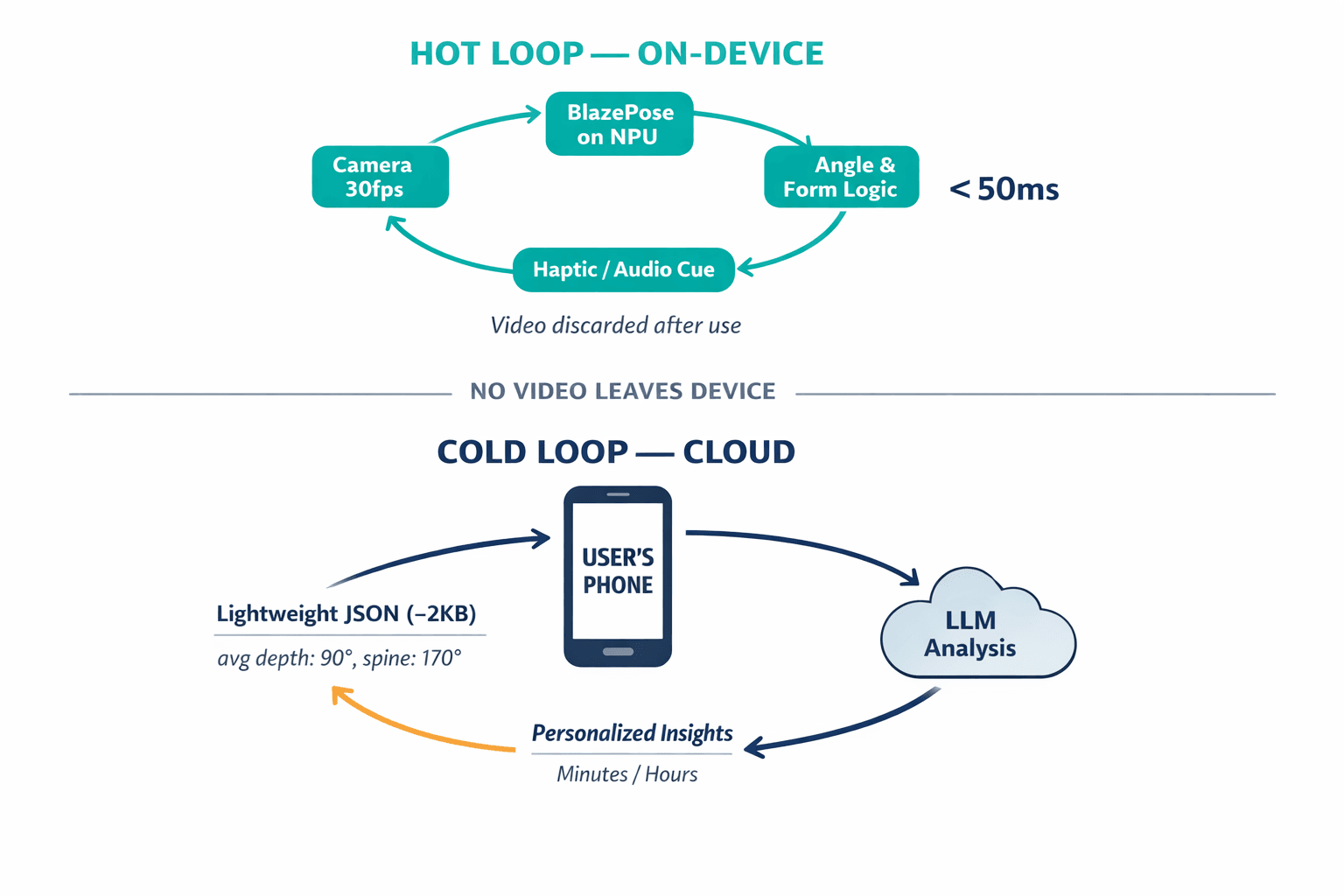
I'm not anti-cloud. I'm anti-cloud-for-the-wrong-job.
We build what I think of as a hybrid architecture with two loops. The hot loop runs on-device: BlazePose on the NPU, sub-50ms latency, handling safety, spotting, rep counting. It processes high-frequency video and discards it after use. The feedback is immediate — a haptic buzz, a short audio cue like "Knees out."
The cold loop runs in the cloud, but it never touches video. It receives lightweight JSON metadata — "Set 1: average depth 90°, spine angle 170°, form breakdown at rep 4." An LLM processes this over minutes or hours, generating personalized insights: "Your form consistently degrades in set 4. Let's reduce volume next week and build endurance."
This gives you the conversational intelligence of a GPT — "How was my workout?" — without sacrificing the speed of the edge spotter. The data that travels to the cloud is a few kilobytes of numbers, not gigabytes of video. The privacy surface area shrinks to almost nothing.
People ask me whether this hybrid approach means we're just delaying the inevitable move to full cloud once models get faster. I don't think so. The physics of network transmission doesn't change. Light through fiber has a speed limit. Cell towers have congestion. Gyms will always be RF-hostile environments. And the fundamental insight — that the user's phone already has the compute power to do this job — only gets more true with every hardware generation. The NPUs in next year's phones will be twice as fast as this year's. The gap widens in our favor.
The Architecture Is the Product
I've spent the last year arguing a position that some people in the AI fitness space find uncomfortable: your choice of architecture is not a technical implementation detail. It is the product.
If your architecture introduces a 3-second delay, you haven't built a spotter. You've built a commentator. If your architecture requires streaming video to a server, you haven't built a privacy-respecting product. You've built a surveillance tool with a fitness skin. If your architecture costs $36 per hour per user, you haven't built a business. You've built a demo.
The industry got seduced by the capabilities of large multimodal models — and those capabilities are genuinely impressive for the right use cases. Long-form video analysis, conversational coaching, personalized programming. But the right use case for a 3-second inference pipeline is never real-time injury prevention during loaded spinal movement.
800 milliseconds is an eternity in biomechanics. If your AI can't respond faster than the human nervous system, it's not a coach — it's an audience.
The phone in your pocket has a chip designed to run neural networks at the speed of thought. The camera is already pointed at the user. The haptic motor is already there. Everything you need to build a system that truly sees an athlete — not one that watches a delayed video of them — is sitting in the user's hand.
The question every fitness tech company needs to answer honestly: is your app watching a video, or is it spotting the user? Because the athlete's spine doesn't care about your marketing copy. It only cares about milliseconds.