Before Procurement AI Excludes a Supplier, Inspect Its Assumptions

A procurement team needs a reason to exclude a supplier that it can defend in terms of the purchase. A score below the shortlist threshold identifies an outcome. It does not yet explain whether the supplier falls short on performance, whether the evidence is thin, or whether the formula rewards a long trading history in ways the team intended.
Disclosure: This article was drafted using generative AI.
I built MeritLens around that distinction. My position is that an exclusion sensitive to history and revenue assumptions deserves an inspectable explanation before a simulated autonomous award proceeds. Changing those assumptions should expose a decision for review while preserving the original decision and its evidence. The explanation must also leave room for a buyer to conclude that a risk concern is justified.
Better delivery can coexist with exclusion
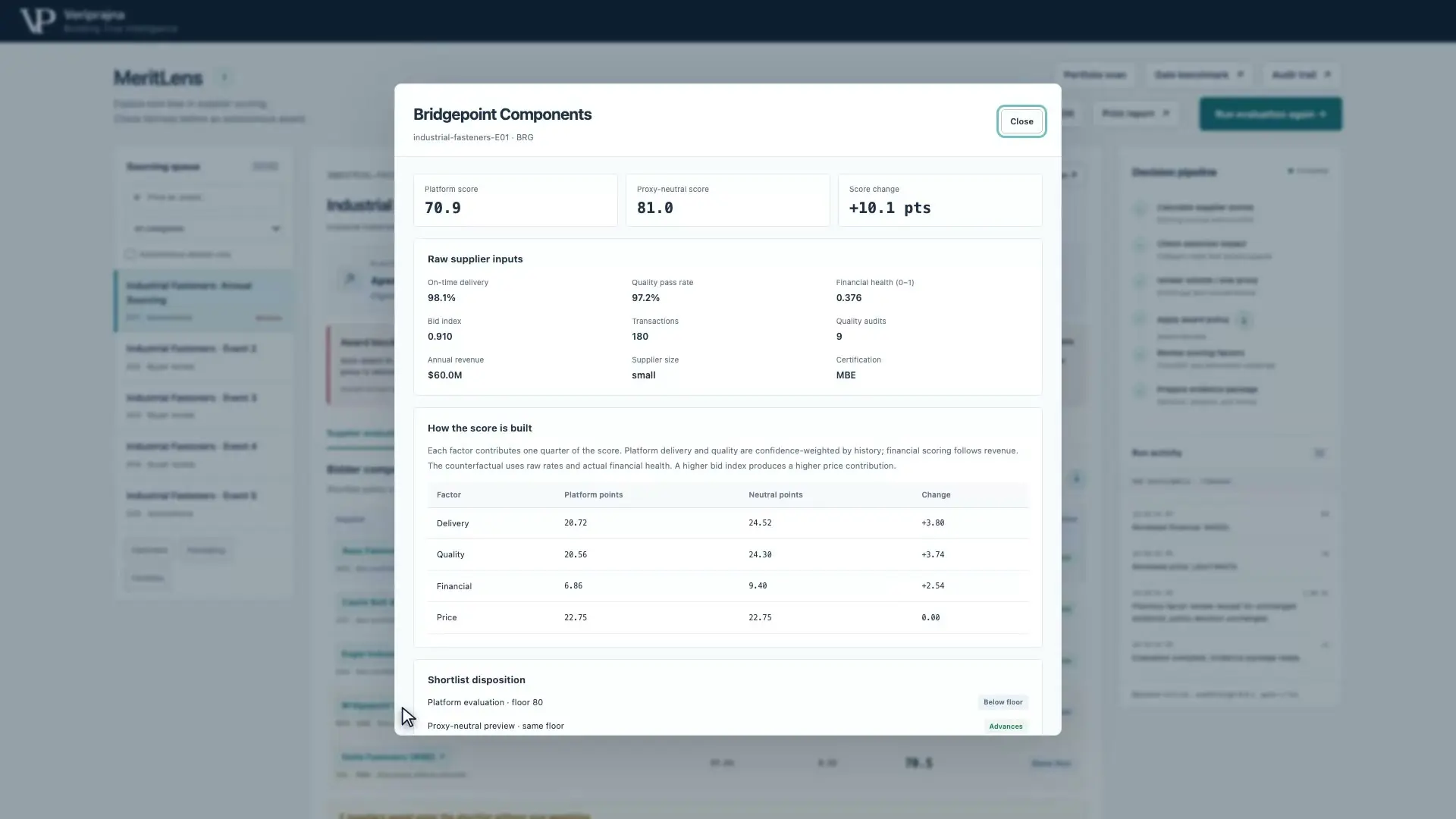
Consider the synthetic Industrial Fasteners sourcing example in our demo. Bridgepoint Components has a 98.1% on-time delivery rate; Apex Fastener Industries has 97.2%. Bridgepoint also has a slightly higher quality-pass rate. Yet the simulated platform scores Bridgepoint at 70.9 and Apex at 91.9. The shortlist floor is 80, so Bridgepoint is excluded.
The formula assigns equal weight to delivery, quality, financial and price factors. Delivery and quality are adjusted for the amount of supporting history: transaction and audit counts determine how far the measured rate moves away from an 80% prior. The financial factor uses revenue. These are consequential choices even though supplier diversity labels and size labels are absent from the scoring formulas. The wider assessment uses diversity labels to compare groups and apply its policy.
Bridgepoint has 180 transactions and nine audits, compared with Apex's 4,200 transactions and 140 audits. Its stronger raw rates consequently receive less credit in the original score. Revenue introduces another difference between the small supplier and the larger one. The exclusion reflects a mix of measured performance, evidence volume and the chosen financial proxy.
That is the useful starting point for a review. The better delivery rate does not settle the purchase. It does make “the supplier scored too low” an incomplete explanation.
An alternative formula makes the disagreement concrete
MeritLens's proxy-neutral preview gives every supplier full credit for its raw delivery and quality rates, uses financial health directly instead of revenue, and keeps price and factor weights unchanged. It is an explicit alternative calculation, so a buyer can see exactly what has been relaxed and what remains.
Under that alternative, Bridgepoint scores 81.0 and enters the preview shortlist. Apex scores 88.0 and remains the leader. The original 21.0-point gap becomes a 7.0-point gap. About two-thirds of the original gap is attributed to the configured history and revenue assumptions. That attribution depends on the alternative formula; it is not causal proof of real-world discrimination.
I use the alternative to locate the disagreement. A buyer who accepts the raw rates but disputes revenue as a financial measure has a different objection from a buyer who doubts whether nine audits provide enough quality evidence. Combining both concerns into one total hides which assumption needs a defense.
The preview also preserves an inconvenient fact for a simplistic fairness story: Bridgepoint's financial health is lower. Removing revenue from that factor does not erase the financial difference, and stronger delivery does not make Bridgepoint better on every legitimate criterion. A useful explanation should keep that remaining disadvantage visible.
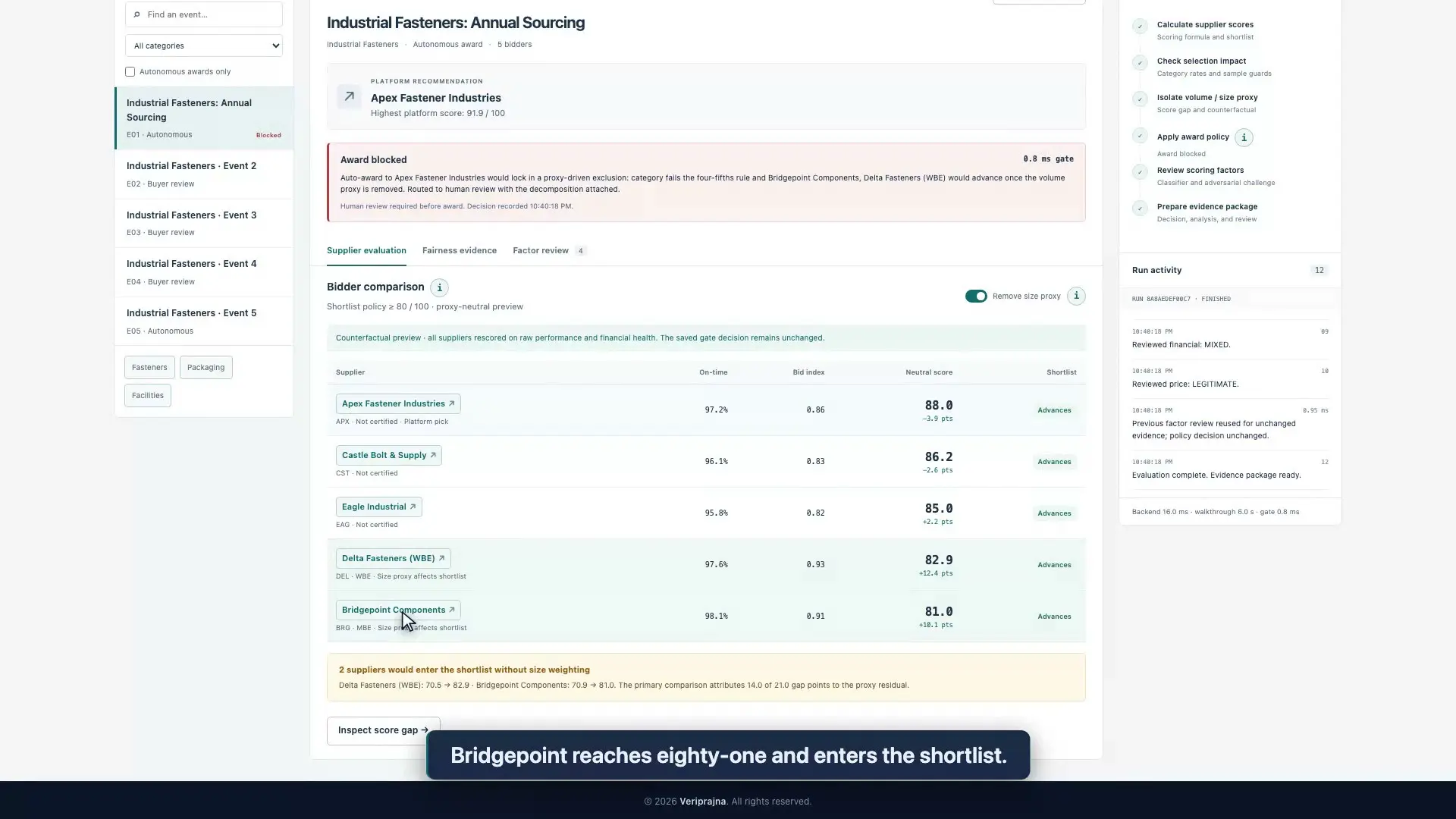
The original recommendation and saved BLOCK decision stay unchanged. The preview does not award a contract, replace the original scorer or rescore the recorded category assessment. All suppliers and awards here are synthetic or simulated, and the demo has no live procurement-platform connection. The MeritLens explainer shows the calculation and decision boundary in more detail.
Removing a penalty has a cost
The hard question is whether limited history should reduce eligibility. A raw rate based on few observations gives less information than the same rate supported by many observations. A buyer can reasonably care about that uncertainty. Giving full credit to every raw rate, as the preview does, removes a history penalty but also removes the formula's adjustment for evidence volume.
I do not treat the preview as a replacement procurement policy. It is useful because it exposes how much the eligibility decision depends on that adjustment. If a team adopts the alternative without another way to assess thin evidence, it accepts an unresolved risk. If it keeps the original formula unchanged, it accepts that suppliers with stronger observed performance can remain excluded because they have less history.
For a hypothetical purchase where failure would be costly, retaining a conservative eligibility rule may be defensible. The justification should explain what uncertainty the rule addresses and why the required history is relevant to that purchase. For a hypothetical purchase where the team can investigate missing evidence before commitment, routing a sensitive exclusion to review may be preferable. That route costs attention and time, but it allows the team to distinguish an unresolved evidence concern from a performance shortfall.
Those are buyer choices, not additional features demonstrated by MeritLens. The demo shows the score comparison and the hold. It does not establish which procurement risks a real organization should accept or show a completed human assessment.
My design preference is to preserve the disagreement at the point where it matters. A review should be able to conclude that the exclusion is warranted. It should also be able to identify an assumption that needs revision without silently granting the challenger an award. Shortlist eligibility is one decision; selecting the supplier is another.
A policy outcome needs its reason attached
In the fasteners example, the hold has a specific basis. The configured category diagnostic flags a selection disparity, the original top scorer has the non-diverse fixture label, and diverse challengers excluded by the original score reach the shortlist floor under the alternative. Together, those conditions produce BLOCK and require human review of the simulated award. A changed individual score alone is insufficient to trigger that rule.
The opposite boundary matters too. In the separate synthetic Packaging Materials example, the category diagnostic returns PASS and the gate returns ALLOW, even though one supplier becomes eligible in the proxy-neutral preview. Some individual supplier-class cells are too small to assess under the configured guard. ALLOW describes the result of this policy; it does not establish that every class was assessed or every exclusion is insensitive to proxies. These diagnostics are configured demo rules, not procurement-law determinations.
That boundary gives a buyer a practical evaluation criterion: inspect the reason behind the outcome alongside the cases that the rule leaves outside its scope. A green label can be correct under a narrow policy while leaving a question that matters to the purchase unresolved. Expanding the rule to hold every sensitive exclusion would cover more cases, but it would also send more decisions to human review. The team needs to choose that workload deliberately.
The same division of authority applies to AI explanations. MeritLens saves the deterministic gate decision and audit record before its advisory factor review. Completed model explanations can be reused for unchanged inputs, and the core decision works without a model call. Advisory prose can explain or challenge the factor interpretation; it cannot rewrite the numerical evidence or saved result. Persuasive wording therefore has a defined role without becoming permission to proceed.
And if you would rather see it than read me describe it, here is the whole thing running end to end.
When assessing a procurement AI system, I want the buyer to be able to reconstruct an exclusion: the original score, the evidence supporting its factors, the assumptions that change eligibility, the disadvantages that remain, and the precise rule governing the next step. An alternative score earns its place when it makes that judgment more specific. The final responsibility is to defend the purchase decision, including the uncertainty the team has chosen to accept.