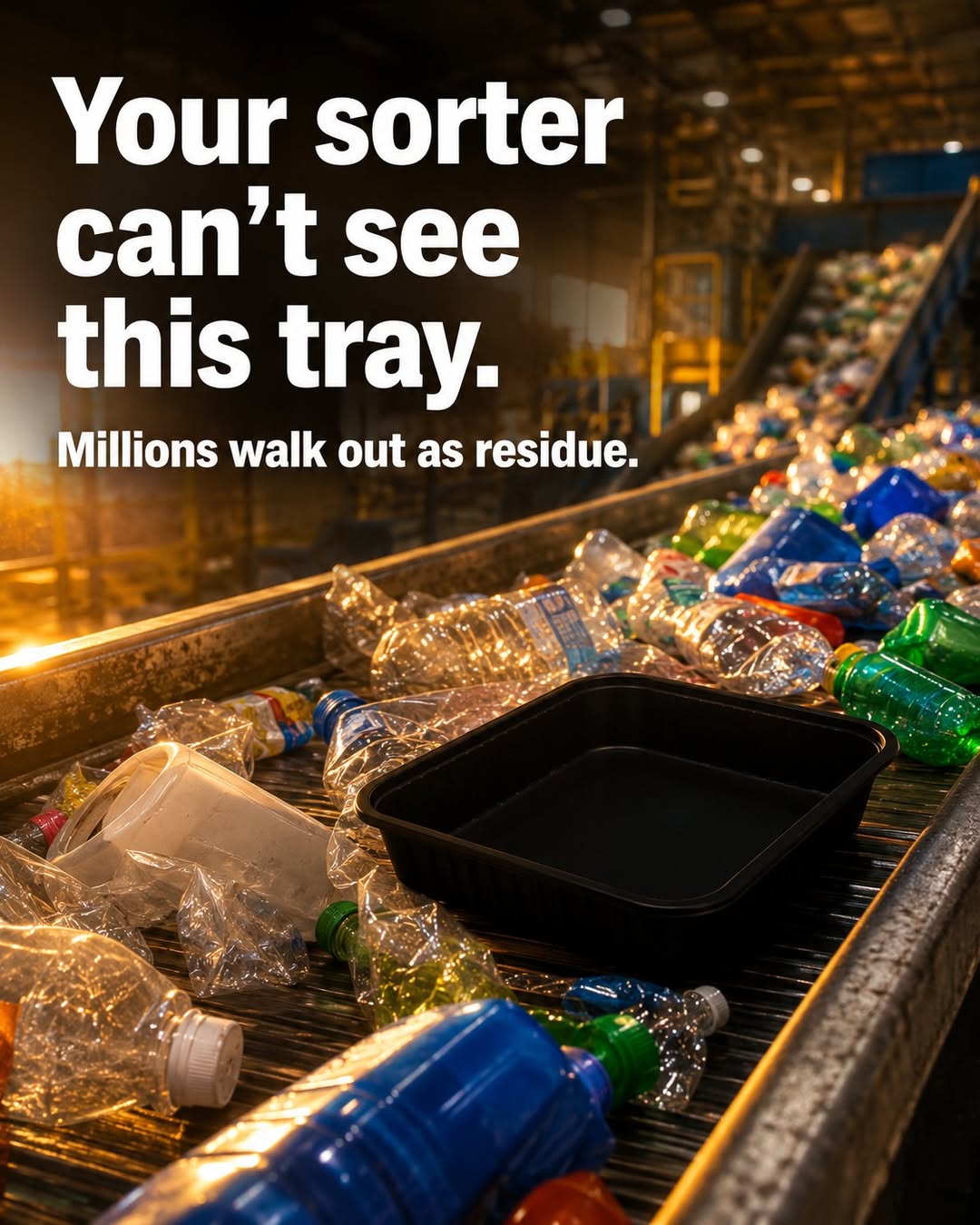
A black plastic tray sitting on a black conveyor belt is invisible to your optical sorter. Not hard to classify. Invisible.
Here is the physics the demo skips. Standard sorters (TOMRA Autosort, Machinex, Pellenc) read polymers using near-infrared light. Carbon black pigment absorbs all of that light before it reaches the plastic. The sensor gets zero signal back, the ejector stays silent, and the tray drops to residue, then landfill.
This is not a software problem. No amount of AI training fixes a sensor that receives nothing.
For a mid-size facility, that blind spot is roughly 5% of the stream. A 50,000 ton-per-year plant loses about 2,500 tons of recoverable black plastic a year. At recycled PP near 1,100 euros a ton plus the avoided landfill gate fee, that is roughly 2.2 to 2.7 million euros walking out as residue.
The fix lives in a different part of the spectrum. Mid-wave infrared (2.7 to 5.3 microns) reads the polymer's own strong vibrations, and carbon black turns transparent enough at those wavelengths to leave a clean signature. A black PP tray that was a void in NIR becomes a sharp, readable spectrum.
One number our team keeps front and center: peer-reviewed accuracy on real, dirty waste is 83.4%, not the near-99% on the lab slides. The gap between the brochure and the belt is the whole job.
If you run a sort line: what is your black plastic share, and where does it go today, residue or a side belt nobody quite trusts?
#PlasticRecycling #MaterialsRecovery