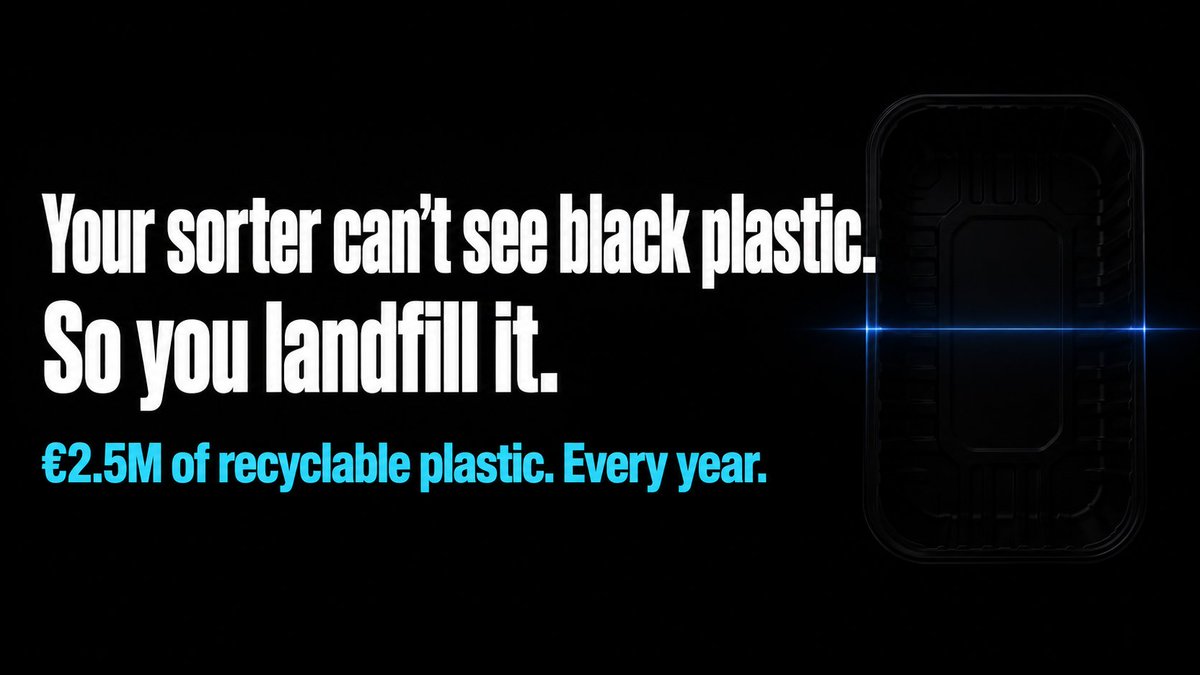
- Carbon black pigment absorbs every wavelength your optical sorter reads. A black PP tray on a black belt returns zero signal. The ejector never fires. It drops to residue, then landfill. This isn't a firmware bug. It's spectroscopy. 🧵
- Black plastic is 3-15% of the waste stream. A 50,000 t/yr MRF at 5% loses 2,500 tons of recoverable PP and ABS a year. At ~€1,100/ton rPP plus avoided landfill, that's €2.2-2.7M walking to the dump annually.
- TOMRA Autosort, Machinex MACH Hyspec, Pellenc Mistral+ all read Near-Infrared (0.9-1.7 µm). Carbon black absorbs it before the light reaches the polymer's C-H bonds. No AI training fixes a zero-signal input. And the next firmware update can lock out any third-party fix.
- The fix is a different part of the spectrum. Mid-Wave Infrared (2.7-5.3 µm): by 3.0 µm carbon black turns transparent. A tray that was a void in NIR shows a sharp C-H peak at 3.4 µm. The Specim FX50 reads 154 bands of actual chemistry at belt speed.
- The honest number: a peer-reviewed Jan 2026 study (Resources, Conservation & Recycling) hit 83.4% balanced accuracy on real waste with MWIR + a 1D-CNN. Not the "near 99%" on spec sheets. Dirty streams are harder than lab samples. We design for 83%, not the brochure.
- "Won't NIR-detectable black pigment just solve this?" Eventually. But it costs 3-6x Carbon Black 7, needs food-contact requalification, and under 10% of FMCG black is detectable in 2026. Automotive and electronics aren't switching. Legacy black waste persists 15-20 years.
- Meanwhile the platform vendors won't fix it in your line. TOMRA's black-capable machine is a bundled €450-650K box that won't license software or retrofit non-TOMRA hardware. Steinert's BlackEye is a 1 t/h finishing line for clean flake. Machinex is SWIR-only: same blind spot.
- So we don't rip out your sorter. We add a sensing station on the black-heavy reject side-belt: RGB camera for object boundaries, FX50 for 154-band classification, a 1D-CNN running under 5ms, result fired straight to your PLC over OPC-UA or EtherCAT.
- Most MRFs upgrading never run the latency math. At 3 m/s with 50ms detection-to-firing, your ejector throws a 200mm burst at a 70mm object. It grabs 2-3 neighbors and purity drops 4-6%. Often the fix is TensorRT tuning to 15ms, not a $40K FPGA. We tell you that.
- The question every plant director asks second: what happens when the camera dies? The FX50's Stirling cooler runs ~10,000 hrs, service every 14-18 months, 12-16 week lead time. We build a hot-swap bracket, a rotating spare, and an RGB fallback so the line never stops.
- MRF operators: is your black plastic a residue line you've written off, or recoverable tonnage? And if you're quoting a new line in 2026, did anyone run your belt-speed-vs-ejector-pitch latency math first, or just sell you a box? #MRF #recycling
- Full vendor map, the MWIR physics, and the retrofit architecture here: https://veriprajna.com/solutions/materials-recovery-ai