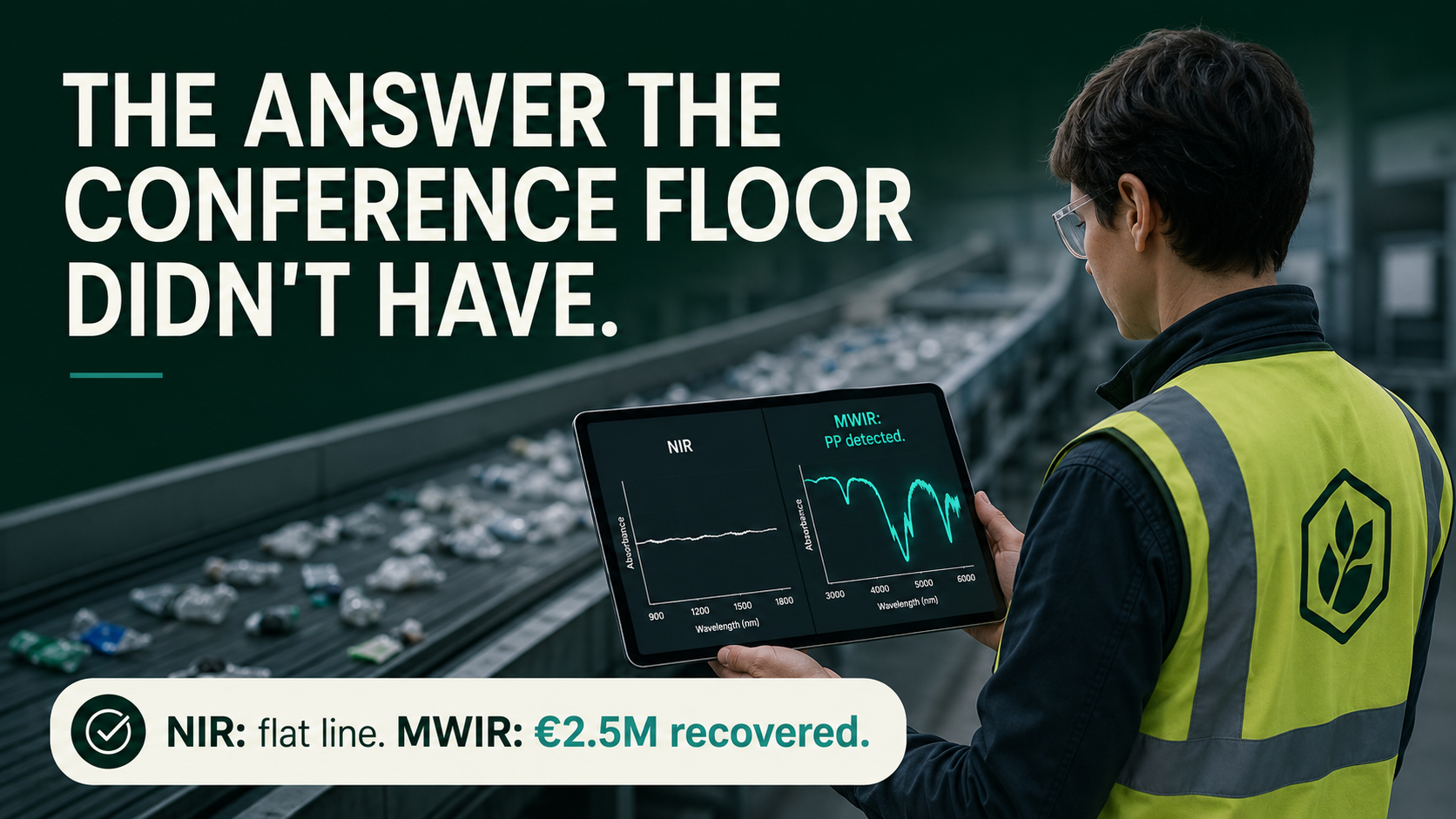
I met an MRF plant director at a waste management trade show a while back who told me he had stopped attending the AI sorting track. Not because he did not care. Because every vendor on the floor had the same pitch and none of them could answer the question he had come to ask: can I recover black plastic without scrapping the line I commissioned four years ago?
That question has an engineering answer. The answer is yes, with a €150K-250K MWIR retrofit alongside the existing sorter, recovering the 3-15% of the waste stream that every NIR and SWIR camera in the industry sends straight to residue. For a 50,000-tonne-per-year facility at 5% black plastic share, that is 2,500 tonnes per year at €1,100 per tonne for recovered rPP. Before avoided landfill fees, the annual P&L impact is roughly €2.5 million. The question he was asking was worth €2.5 million, and the conference floor could not answer it because the vendors each owned a piece of the problem but none of them would map the piece they did not own.
That director's situation is what I built the materials recovery AI work around.
The Physics Conversation Most Buyers Never Have
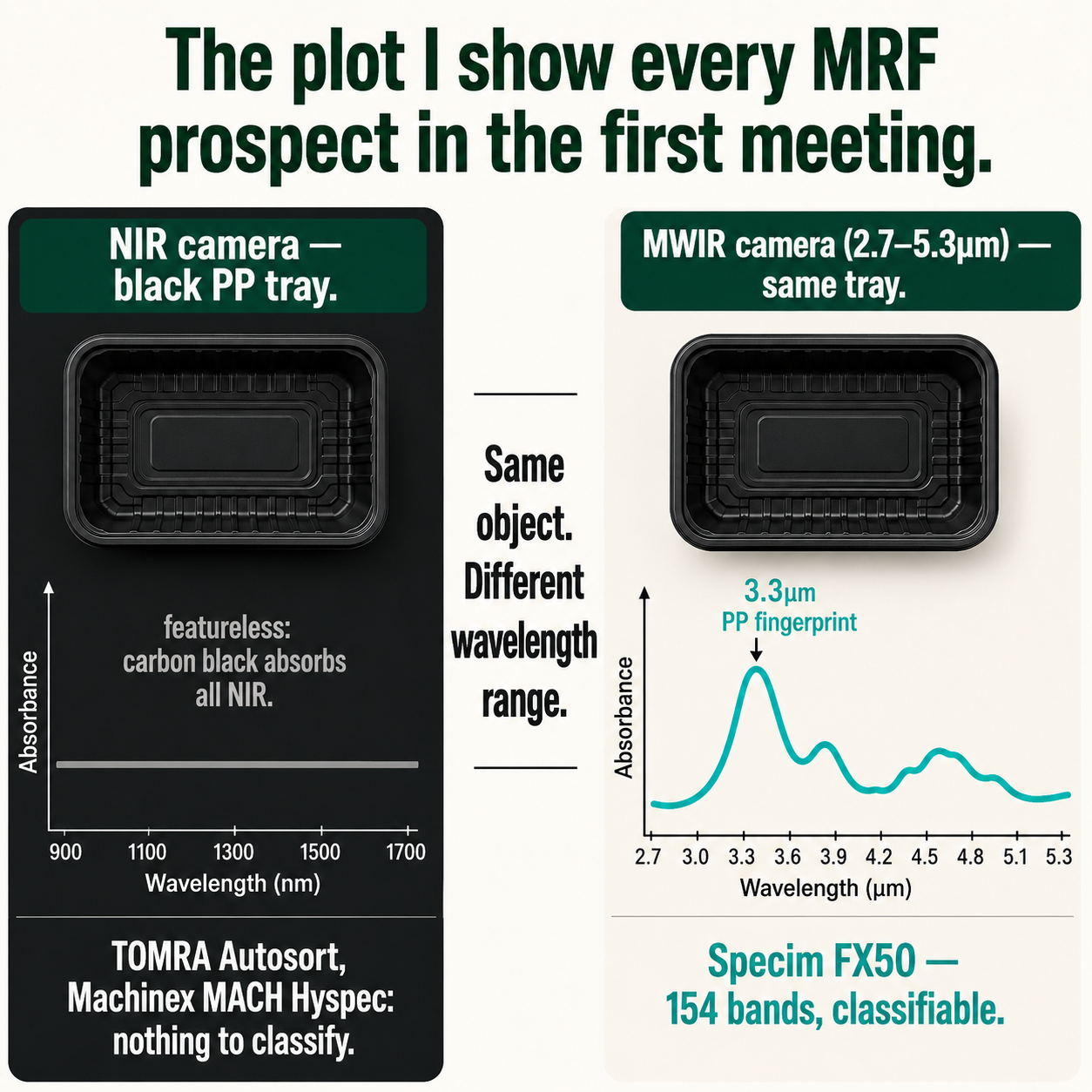
My standard opening with an MRF prospect is to pull up a SWIR reflectance spectrum for black PP next to a clean natural PP scan. The clean PP shows a clear absorption fingerprint around 1,700 nm. The black PP is a flat line. Carbon black absorbs NIR and SWIR so completely that the camera has nothing to classify. This is not a software problem. There is no classification model that recovers information the sensor never captured.
I have shown that plot to plant directors who have been in MRF operations for twenty years and watched them pause. The TOMRA sales rep who sold them the AUTOSORT never had this conversation. Why would they? The AUTOSORT is excellent at what it does. The rep's job was not to explain the physics of what it cannot do.
Moving the sensor range into mid-wave infrared (MWIR, 2.7-5.3 µm) is what changes the physics. At those wavelengths, the carbon black coating becomes transparent enough that the polymer beneath resumes its absorption fingerprint. The Specim FX50 — 154 spectral bands across 2.7-5.3 µm — is the only commercial push-broom hyperspectral camera operating in that range. TOMRA uses the same sensor physics in the Autosort Black. Steinert uses it in the UniSort BlackEye. Neither of them sells the sensor independently. That is by design.
When the vendor's competitive moat is the ecosystem, the sensor physics never makes it into the product brochure.
What I Found When I Actually Read the Accuracy Papers
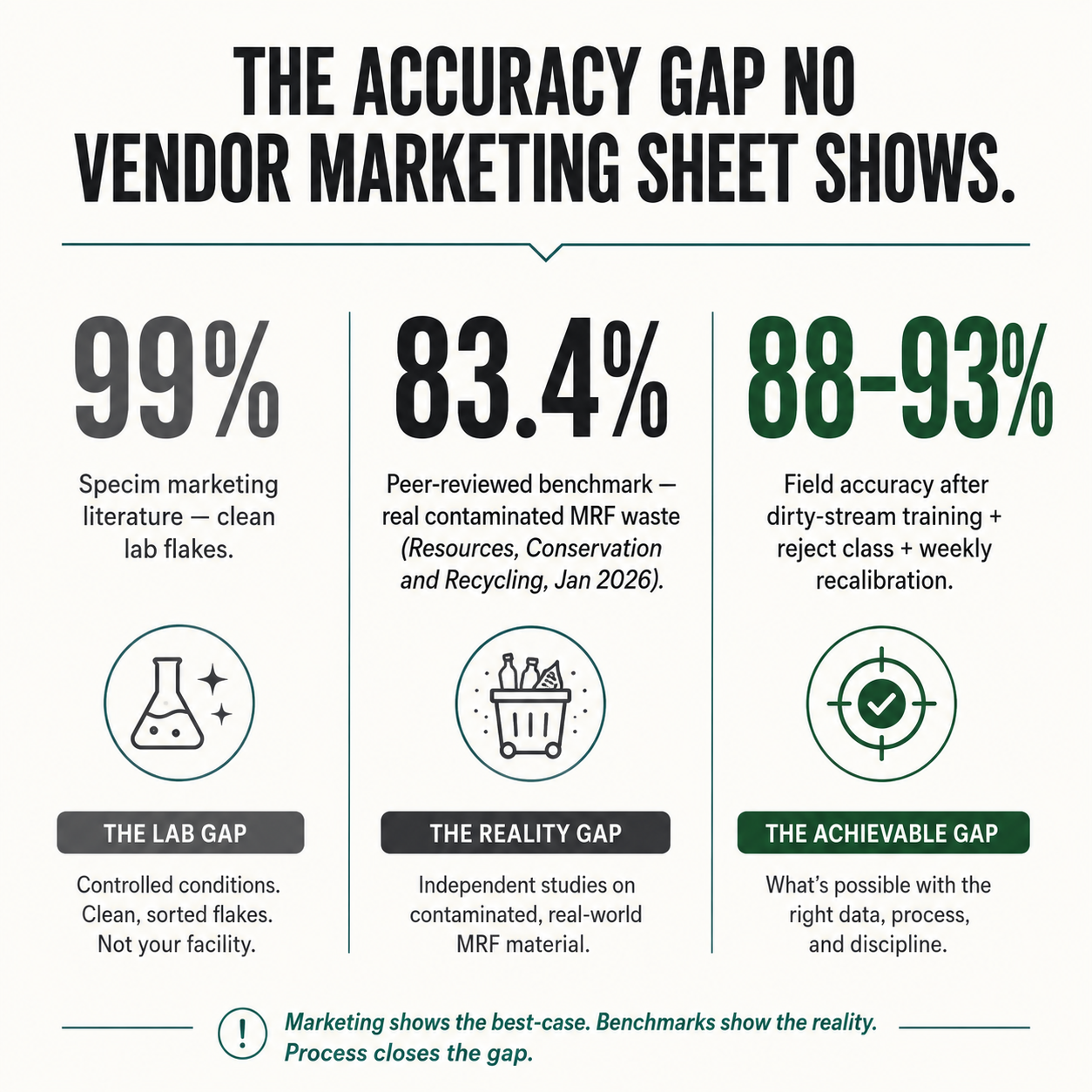
Before the first MWIR project, my team went looking for peer-reviewed accuracy data on real-world contaminated plastic streams rather than lab flakes. The Specim marketing materials cite near 99% accuracy. The peer-reviewed benchmark published in Resources, Conservation and Recycling in January 2026 — testing MWIR plus CNN on actual MRF waste — reported 83.4% balanced accuracy.
The gap is real and it is not a vendor failing. It is the difference between clean single-layer flakes under controlled illumination and the wet, contaminated, multi-layer-laminate, partially-crushed objects that come off a real sort line. PP/EVOH/PE laminates produce composite spectra that do not match single-polymer training classes. Moisture scatters MWIR in ways that shift the absorption peaks. A model trained on clean data will fail on dirty streams in predictable ways.
My response was to treat the 83.4% as the baseline I needed to beat, not the ceiling I should advertise. The architecture I run now trains the 1D-CNN on dirty, contaminated samples from the client's actual waste stream before commissioning. A reject class routes objects below 85% confidence to a manual QC station rather than contaminating a sorted bale. Weekly recalibration loops feed operator-verified corrections back into the model. Field accuracy stabilizes in the 88-93% range within two to three months. High enough to produce APR Grade A rPP bales (97% PP content, 0.5% PVC cap) with downstream bale QA in place.
The number I use in commercial conversations is 88-93%, not 99%. That choice loses some initial pitches to vendors who quote the higher figure. It has not lost a commissioned project yet.
83.4% balanced accuracy on real waste. 99% on clean lab flakes. The gap is the entire business case for training on your stream rather than the vendor's.
The Latency Math Nobody Ran
The second project I took in this space came from a facility running TOMRA and Machinex primary sorters, then a side-belt MWIR retrofit from a smaller integrator, with chronically disappointing purity on the black fraction. The client had gone through months of trying to improve classification accuracy before calling us.
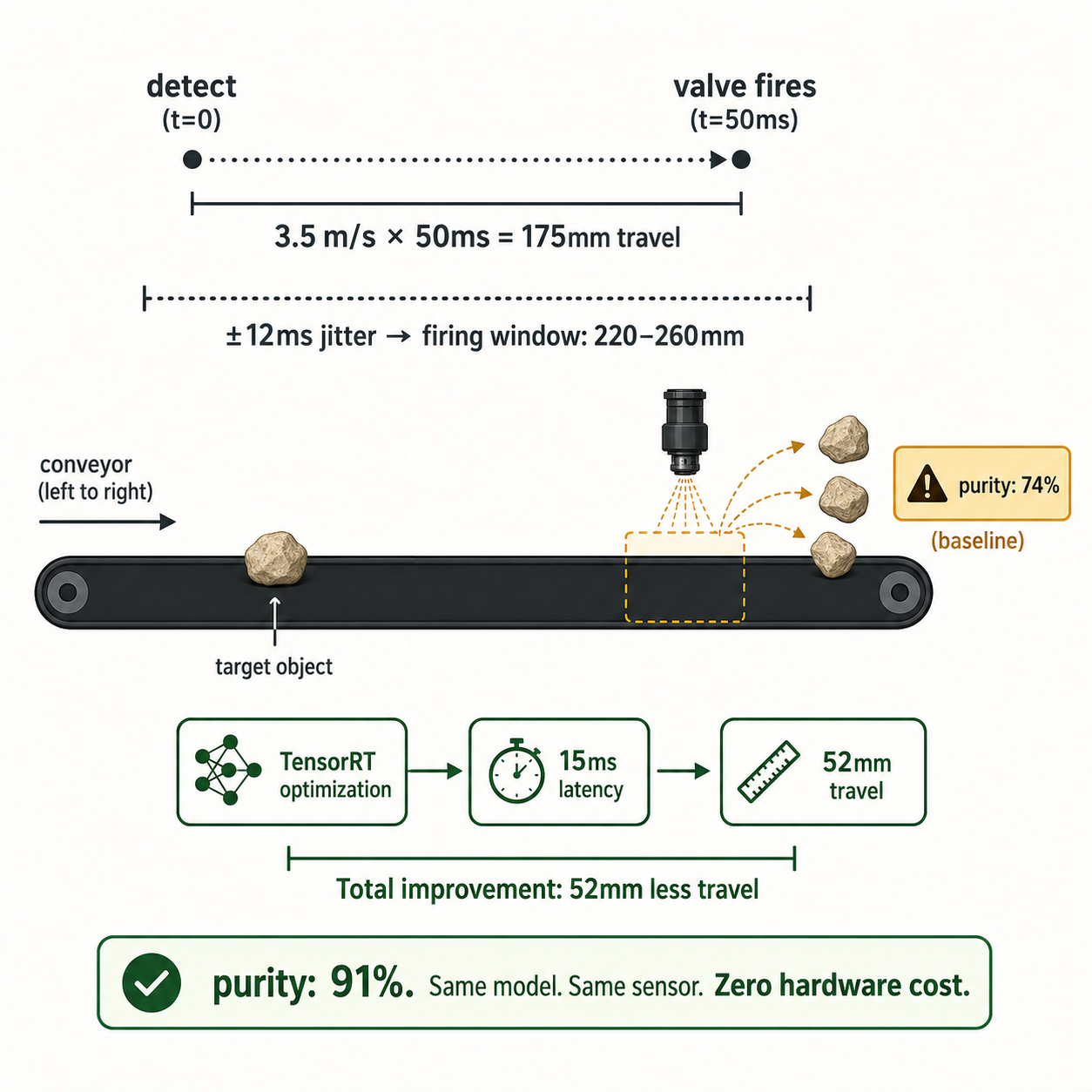
Within a day of looking at the system, I understood what was wrong. The detection-to-firing latency was 50 ms on an unoptimized edge GPU. The belt was running at 3.5 m/s. That gives 175 mm of travel between detection and valve activation — and with ±12 ms jitter, the firing window stretched to 220-260 mm. The ejector nozzle pitch was 12.5 mm. The air burst was catching the target plus two or three adjacent objects on every activation. The classification model was not the problem. The purity problem was a basic physics calculation that had never been run.
The fix was a TensorRT optimization pass on the inference pipeline — kernel fusion, half-precision, batch size 1. Latency dropped to 15 ms. At 3.5 m/s that is a 52.5 mm travel distance, well within the ejector pitch with standard tracking compensation. The client's purity went from 74% to 91% on the black PP stream without any change to the classification model, the sensor, or the hardware.
I tell this story in every scoping conversation now, because it changed how I think about what MRFs are actually buying when they commission AI sorting equipment. They are buying a complete latency budget. The sensor, the model, the compute, and the ejector manifold are four parts of one timing system. Optimizing one without understanding the others produces exactly the situation that client was in.
FPGA dataflow architectures — Xilinx Kria SoM running Vitis AI or FINN — reach 2 ms deterministic latency, which matters when belt speeds push above 4-5 m/s and even an optimized GPU produces an unacceptable ejection window. The engineering cost is real: 4-6 months, a thin talent pool in FPGA and HLS toolchains, hardware around $25-40K. My consistent finding is that most facilities do not need FPGA. They need someone to run the belt speed × detection latency multiplication and then optimize the software pipeline. The €180K FPGA engagement is the right answer for a small subset of facilities. It is easy to oversell because it sounds more technically sophisticated than fixing a TensorRT configuration.
The WEEE Call I Was Not Expecting
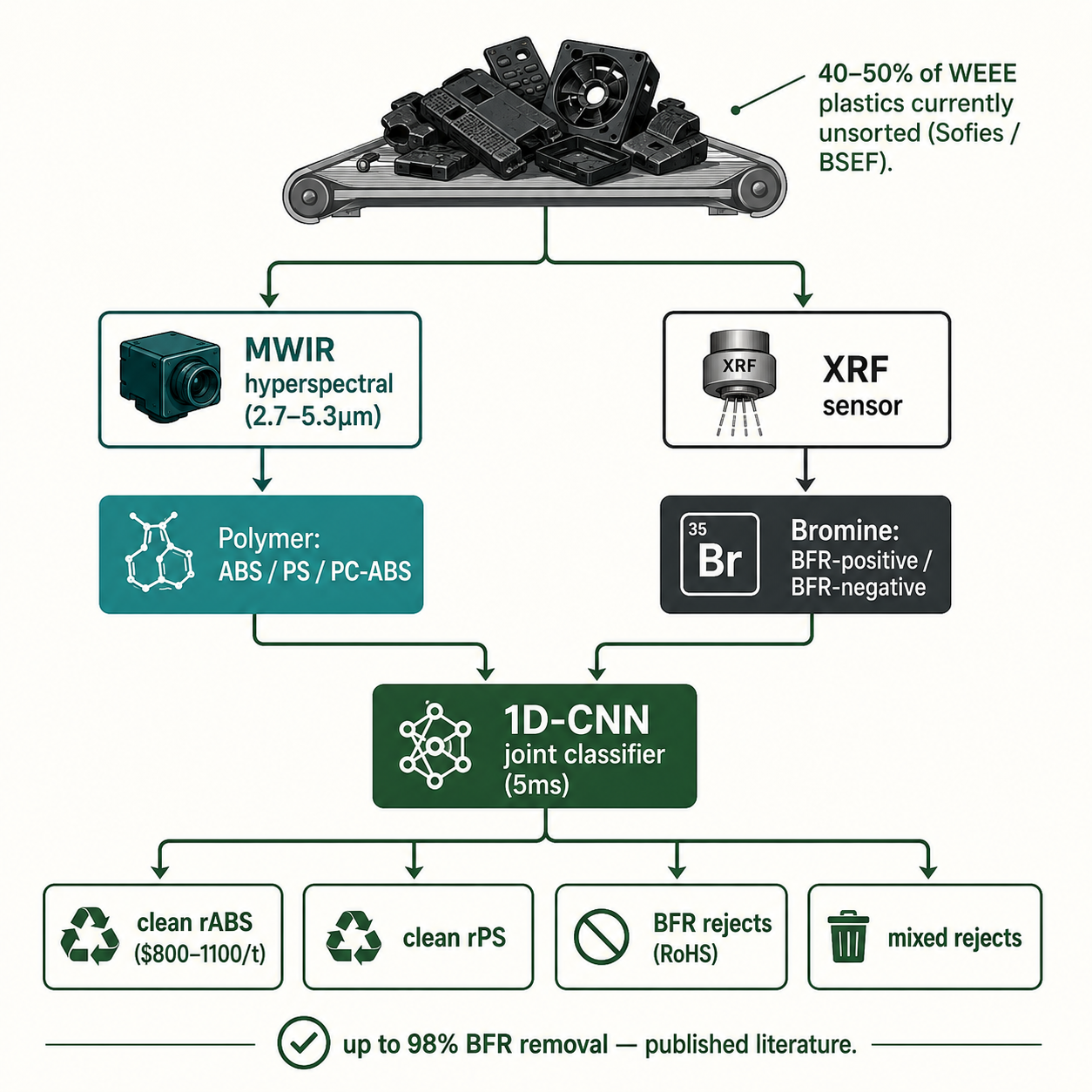
I had not planned to work in WEEE when a referral landed from a European electronics recycler. Mixed black plastics from end-of-life electronics: a stream of ABS, PS, PC/ABS blends, and ABS with brominated flame retardants. RoHS prohibits BFR-containing material from going back into recycled feedstock for new equipment. The standard optical sorter could not separate ABS-clean from ABS-FR. Neither could MWIR alone.
Research from Sofies and BSEF estimates 40-50% of captured WEEE plastics are not properly separated from BFR-containing material today. The legal exposure is real. The per-tonne economics are also substantially better than bulk rPP recovery: rABS at $800-1,100 per tonne FOB versus rPP at €1,100-1,200. The margin per tonne was there. The architecture was not.
MWIR gives you polymer type. X-ray fluorescence gives you bromine concentration. Neither alone gives you the classification you need: clean ABS, clean PS, BFR-positive, mixed reject. The sensor fusion approach — fusing MWIR spectra with XRF readings into a single 1D-CNN classification head trained on the joint feature space — runs at 5 ms on an optimized edge GPU, well within the latency budget for WEEE belt speeds. Combined NIR plus X-ray approaches in published literature remove up to 98% of BFR-containing plastics from mixed streams. I had not scoped this niche before that referral. I have quoted several WEEE projects since.
The Regulatory Timeline That Moved the Conversation
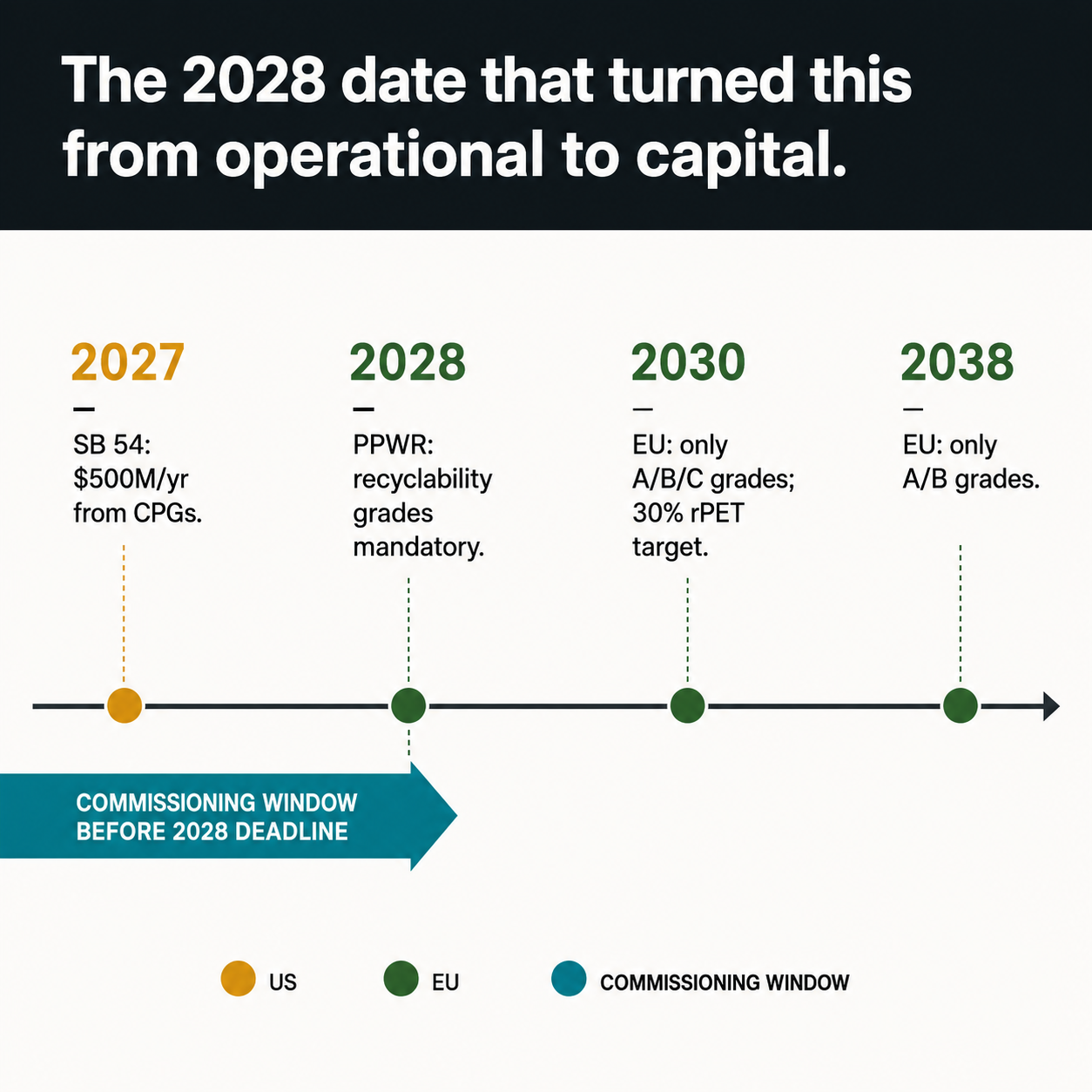
Until early 2025, most MRF directors I talked to treated black plastic recovery as a capital discretionary. The regulatory pressure was always "coming." The PPWR delegated act for recyclability grade thresholds now has a hard date: January 1, 2028. From 2030, only A, B, and C-grade packaging may be marketed in the EU; from 2038, only A and B. Carbon-black-pigmented packaging without a corresponding MWIR-capable recovery infrastructure demonstrating material cyclability will struggle to achieve Grade C.
California SB 54 is moving simultaneously. The extended producer responsibility framework establishes approximately $500 million per year in fees from CPGs and up to $150 million per year from resin manufacturers starting 2027. Mandatory recycled content targets — 30% rPET in beverage bottles, 35% in other plastic packaging by 2030 — are driving demand for high-purity rPP and rABS bales beyond current supply.
The conversation shifted when I started opening with the 2028 delegated act date rather than the P&L case. Plant directors who had been treating this as an operational improvement started treating it as a capital planning question with a deadline. The P&L case is what closes it. The regulatory date is what creates urgency to plan now rather than at the next budget cycle.
The Maintenance Question I Now Ask Before the Project Starts
One thing I learned to ask before scoping an MWIR retrofit: does the facility have a Stirling cooler contingency plan?
The Specim FX50 cools its detector to approximately 77 K via an integrated Stirling cryocooler. Specim's datasheet rates the cooler at 10,000 hours. In real MRF conditions — dust ingress, belt vibration, temperature cycling — my experience is that failures arrive closer to 7,000-8,000 hours. At 16 hours of daily operation, that is a cooler service interval of 14-18 months. Replacement cooler lead time from Specim is 12-16 weeks. A facility without a hot-swap mounting bracket and a spare in rotation is looking at a three-month line outage on a predictable schedule.
No bundled OEM product addresses this in its standard configuration. I learned to ask about it after the first time a client called me to say the MWIR camera had failed and they did not have a spare and Specim's lead time was 14 weeks. The answer now is part of every commissioning package: hot-swap bracket, rotational spare scheduled to refurb at 6,500 hours, and a degraded-mode RGB-only classification path that keeps the line running at reduced accuracy while the MWIR camera is offline. The second conversation the OEM never has.
The full architecture documentation for the MWIR retrofit — belt-speed latency calculator, dirty-stream training protocols, Stirling cooler contingency specs, PPWR grade exposure assessment — is at veriprajna.com/solutions/materials-recovery-ai.
The MRF director who stopped going to conferences was asking the right question. What I keep wondering is how many operations leads have the same question and have simply stopped expecting the conference floor to answer it. If you are one of them, I'd like to hear where your stream sits and what the economics say.