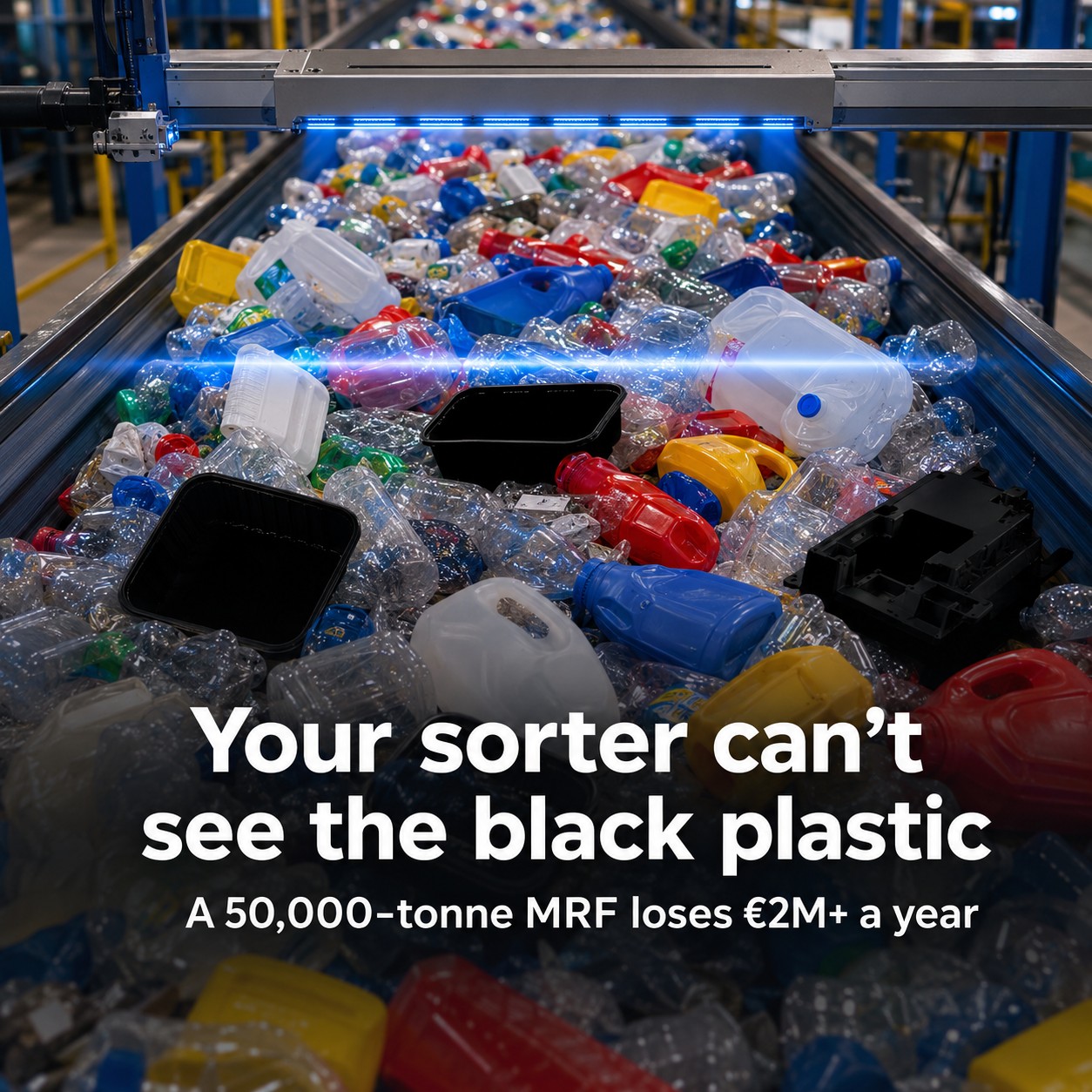
Carbon black absorbs every near-infrared wavelength your optical sorter reads. The detector gets back a void, and no amount of AI training fixes a zero-signal input.
Here's the part most "AI for recycling" pitches skip: a black PP tray on a black conveyor belt is invisible to a standard NIR sorter. TOMRA Autosort, Machinex MACH Hyspec, Pellenc Mistral+ all read C-H and O-H bond vibrations in the 0.9-1.7 micron range. Carbon black eats those photons before they reach the detector. The pneumatic ejector stays silent. The material drops to residue, then to landfill.
For a mid-size MRF that's 3-15% of the stream walking out the door. A 50,000 t/yr facility at 5% black plastic loses roughly €2-2.5M a year in recoverable rPP, plus the gate fees to bury it.
The fix isn't smarter software. It's a different part of the spectrum. Mid-wave infrared (2.7-5.3 micron) reads the fundamental polymer vibrations carbon black can't hide. A peer-reviewed January 2026 study put MWIR plus a 1D-CNN at 83.4% balanced accuracy on real, dirty waste, not the lab-clean "99%" you see in sensor brochures. We quote the honest number on purpose.
What we build is the retrofit nobody sells you: an MWIR sensing station on your residue side-belt, a 1D-CNN classifying polymers (PP, PE, PS, even WEEE flame-retardant ABS housings) in under 5ms on edge hardware, wired into your existing PLC over OPC-UA or EtherCAT. Vendor-neutral. No €600K bundled machine.
And we answer the question every MWIR rep dodges: the Stirling-cooled sensor runs about 10,000 hours, so we ship a 30-minute hot-swap bracket and an RGB backup mode that keeps the line running while a replacement cooler sits on a 12-16 week lead time.
Save this for your next vendor evaluation meeting. The one question to ask any sorter rep: "show me per-polymer accuracy on contaminated real-world input, not clean flake." What answer did you get last time you asked?
#PlasticRecycling #MaterialsRecovery #WEEErecycling #EdgeAI #WasteManagement