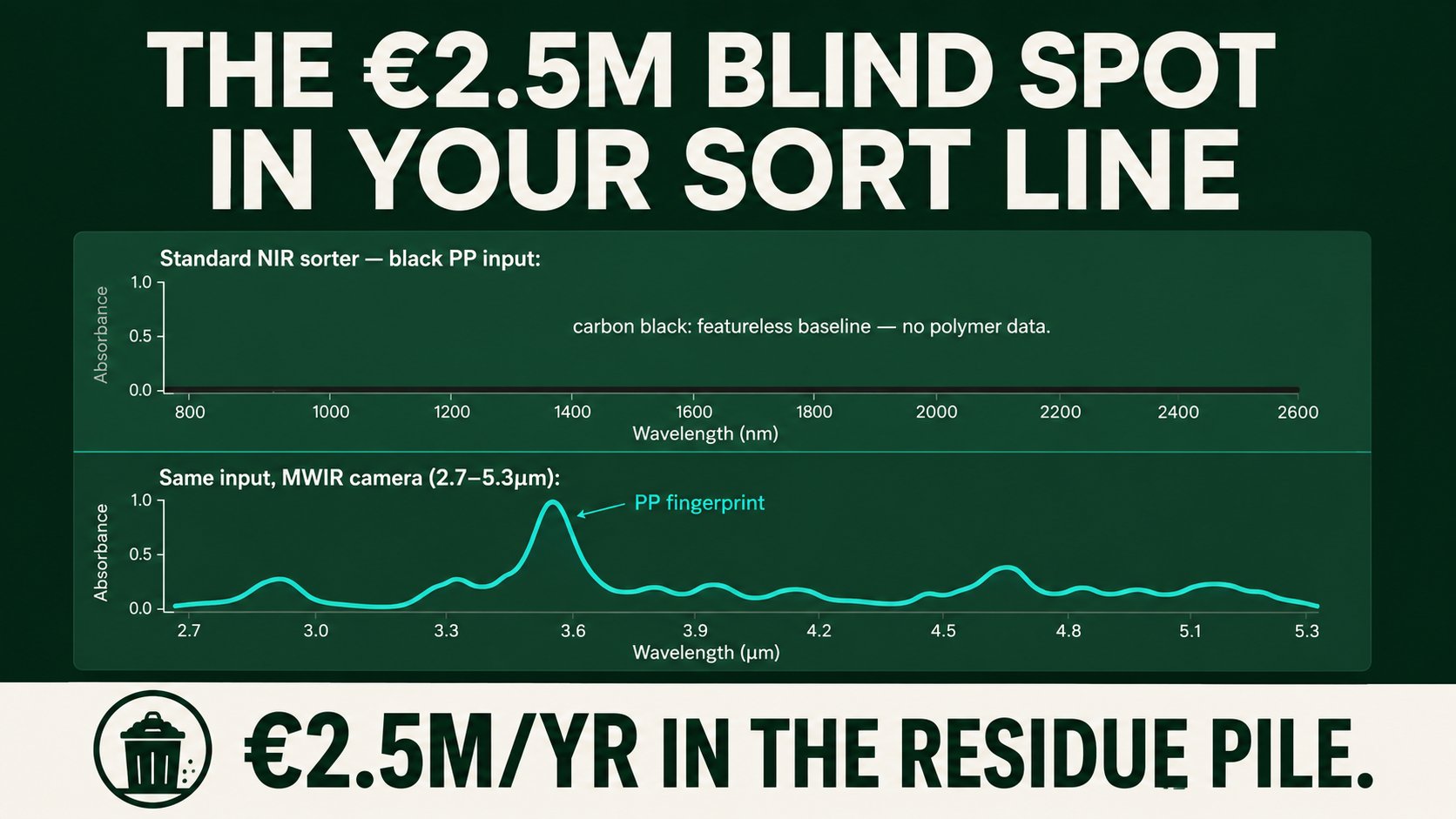
Carbon black pigment absorbs near-infrared light completely. That is a physics fact, not a firmware limitation, and it means every optical sorter relying on NIR or standard SWIR — TOMRA Autosort, Machinex MACH Hyspec, Recycleye QuantiSort, Greyparrot Analyzer — sends every black PP tray, black PE container, and black ABS housing straight to residue. For a 50,000-tonne-per-year MRF processing a typical 5% black plastic share, that is 2,500 tonnes per year at €1,100 per tonne for recovered rPP, plus €70-100 per tonne in avoided landfill fees. The annual P&L impact is approximately €2.2-2.7 million sitting in the residue pile.
The market has two responses. The first: buy a bundled black-plastic-capable line. TOMRA Autosort Black or Steinert UniSort BlackEye, installed at €450K-650K, closed-ecosystem, non-retrofittable. The second: build a vendor-neutral MWIR retrofit alongside the existing sorter. A Specim FX50 hyperspectral camera running at 2.7-5.3 µm, a custom 1D-CNN classification model trained on dirty real-world streams, edge compute sized to the belt speed of the facility. That retrofit path costs €150K-250K installed and recovers the five major black polymers to APR Grade A bale specification.
We have built and documented both architectures in detail. The full technical spec lives at veriprajna.com/solutions/materials-recovery-ai. What follows is the engineering and business case behind the build decisions.
Why Your Existing Line Cannot Be Patched
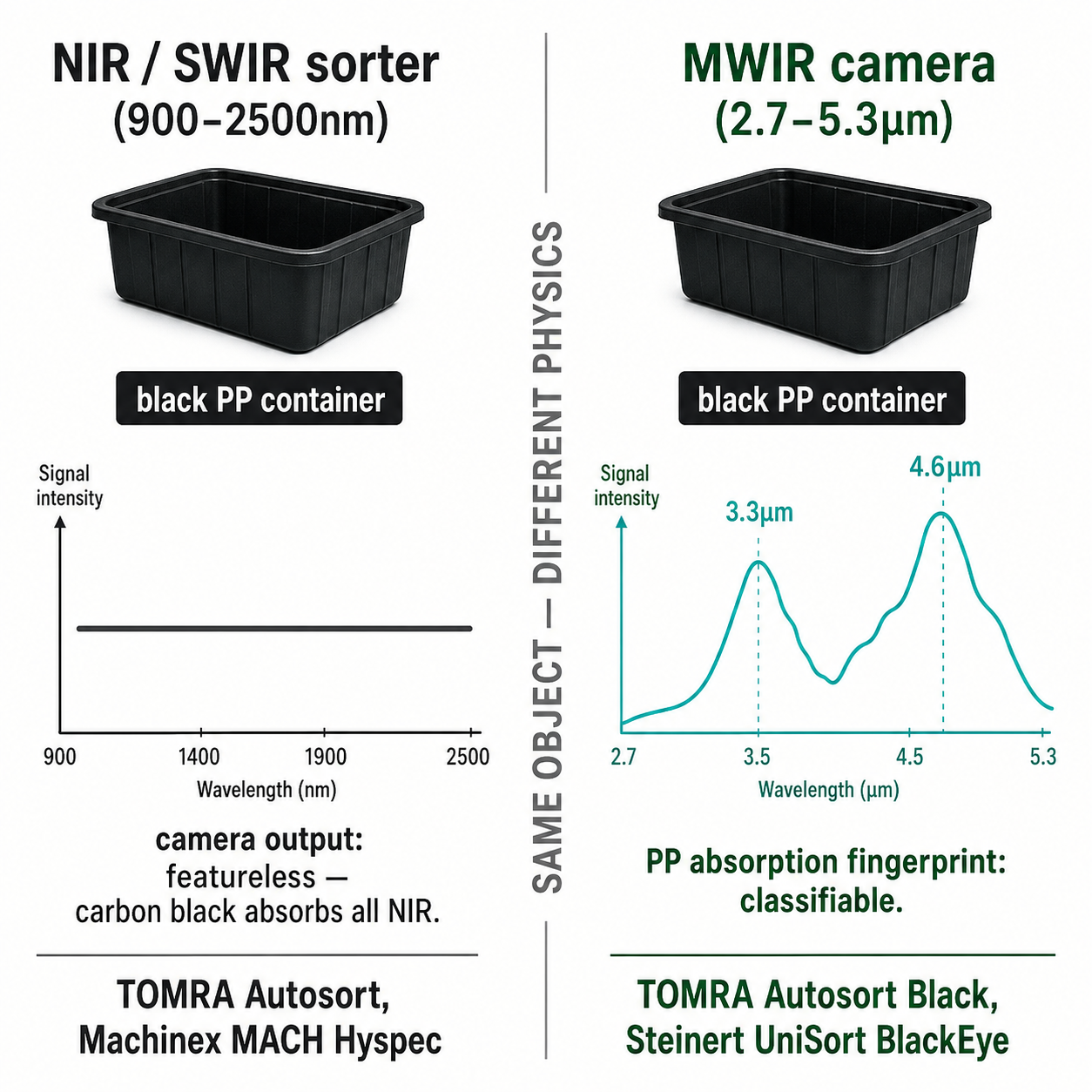
The NIR spectrum (roughly 900-1,700 nm) is the workhorse of every modern optical sorter. Carbon black absorbs across that entire range so aggressively that the camera sees a featureless baseline absorber regardless of which polymer is underneath. Black PP looks identical to black PS looks identical to black ABS at wavelengths below 2.5 µm. This is not a classification error. The sensor does not have the information to classify. TOMRA acknowledged this publicly by launching the Autosort Black as a separate product line rather than as a firmware update to the standard Autosort. Machinex MACH Hyspec runs SWIR up to about 2.5 µm — not far enough into the mid-wave infrared to penetrate carbon black.
Moving into mid-wave infrared (MWIR, 2.7-5.3 µm) is what changes the physics. At those wavelengths, polymers resume their characteristic absorption fingerprints. The Specim FX50 — the only commercially available push-broom hyperspectral camera operating across this full MWIR range, with 154 spectral bands — distinguishes black PP from black PS from black ABS at production line speeds. This sensor underlies both the TOMRA Autosort Black and the Steinert UniSort BlackEye, though neither vendor sells the sensor independently or licenses their classification software to third-party hardware.
The carbon black problem is not something a service visit fixes. The sensor needs to change.
The €650K Bundle vs the €200K Retrofit
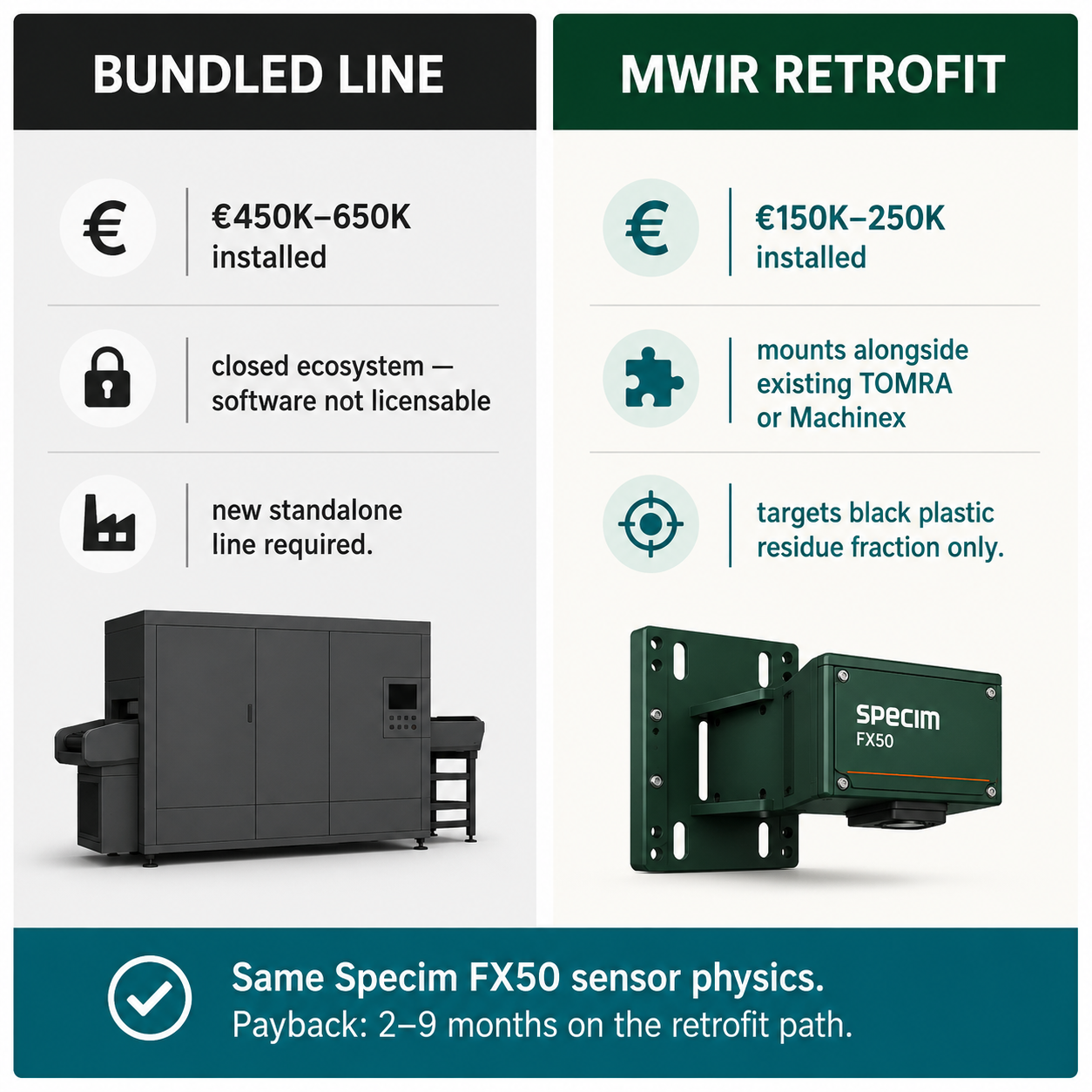
For greenfield construction, the bundled approach is defensible. But most MRFs facing the black plastic problem are running sorters they purchased four to eight years ago, amortizing over 10-12 year cycles. A plant director who bought an AUTOSORT in 2022 is not going to spend €650K on a parallel line that handles 5% of throughput. The math does not close.
The retrofit path works differently. The MWIR module mounts on a side-belt or secondary conveyor targeting the residue fraction the primary sorter rejects. Specim FX50 plus edge compute plus PLC integration plus commissioning lands between €150K-250K depending on installation complexity. Applied to the black plastic fraction of a 50,000-tonne facility, payback is 2-4 months under optimistic recovery rates and 6-9 months under realistic 60-70% classification accuracy on a dirty, multi-contaminant stream.
That realistic range matters. The peer-reviewed benchmark published in Resources, Conservation and Recycling in January 2026 — testing MWIR plus CNN classification on actual contaminated MRF waste, not clean laboratory flakes — reported 83.4% balanced accuracy across polymer classes. Specim marketing materials cite figures near 99%. The gap comes from moisture, adhesive labels, multi-layer laminates (PP/EVOH/PE laminates produce composite spectra that do not match single-polymer training classes), and partial object occlusion. A facility that budgets for the 99% figure and plans the downstream commodity chain around it will be disappointed.
The architecture we deploy closes that gap three ways: the 1D-CNN trains on dirty, contaminated samples collected from the client's actual waste stream; a reject class routes objects below 85% confidence to a manual QC station rather than into a sorted bale; and weekly recalibration loops feed operator-verified corrections back into the model. Field accuracy stabilizes in the 88-93% range after the first two to three months of operation. High enough to produce APR Grade A rPP bales (97% PP content, 0.5% PVC cap), provided downstream bale QA is in place.
What the Vendor Landscape Actually Shows
The buyers who call us most often come from one of two situations: they have gotten quotes from several vendors and cannot evaluate them independently, or they bought one platform and are now asking why it does not solve a problem they did not realize they had when they signed. Eight vendors are active in this space — TOMRA, Steinert, Pellenc ST, Machinex, AMP Robotics, Greyparrot, Recycleye, ZenRobotics — and each has a real product with a gap that commercial literature does not surface clearly.
Steinert's UniSort BlackEye is the world's first commercial system achieving pure-grade black PE/PP separation. It works. Its throughput ceiling is approximately 1 tonne per hour on the 10-40mm flake fraction. Designed as a finishing sorter for clean streams, it is not a primary sort line on inbound mixed plastics. Most plant directors discover this late in the sales cycle.
Pellenc ST's Mistral+ CONNECT "Profile Detection" identifies black plastic contamination in a paper or PET stream. Detecting a black object in a stream is different from classifying which polymer it is. Pellenc's black capability is contaminant-detection grade, not species-separation grade. It tells you a black thing is there; it cannot tell you whether that black thing is PP, PS, or ABS-FR.
AMP Robotics' Cortex system picks 80-140 objects per minute per robot on a pay-per-ton commercial model that is genuinely innovative. The cameras are RGB. RGB cameras are as blind to carbon black as NIR cameras, for the same physical reason. AMP's strength is residual mining and finish-sort on container streams, not black polymer separation.
A plant director who bought an AUTOSORT in 2022 is not buying a €650K black-plastic line that handles 5% of throughput. The retrofit math has to close on its own.
The platform vendors are also tied to their ecosystems. TOMRA will not license Autosort Black software to non-TOMRA hardware. Machinex Services will not optimize your TOMRA installation. The independent integrator who has worked with all of them, who can look at your existing line and say "your AUTOSORT handles 92% of your stream well, here is a €180K MWIR module for the 5% it rejects" — that firm did not previously exist in a credible form.
The Belt Speed Problem That Arrives Later
Black plastic recovery gets most of the attention. The belt speed problem surfaces after a facility pushes throughput and purity starts dropping without an obvious cause.
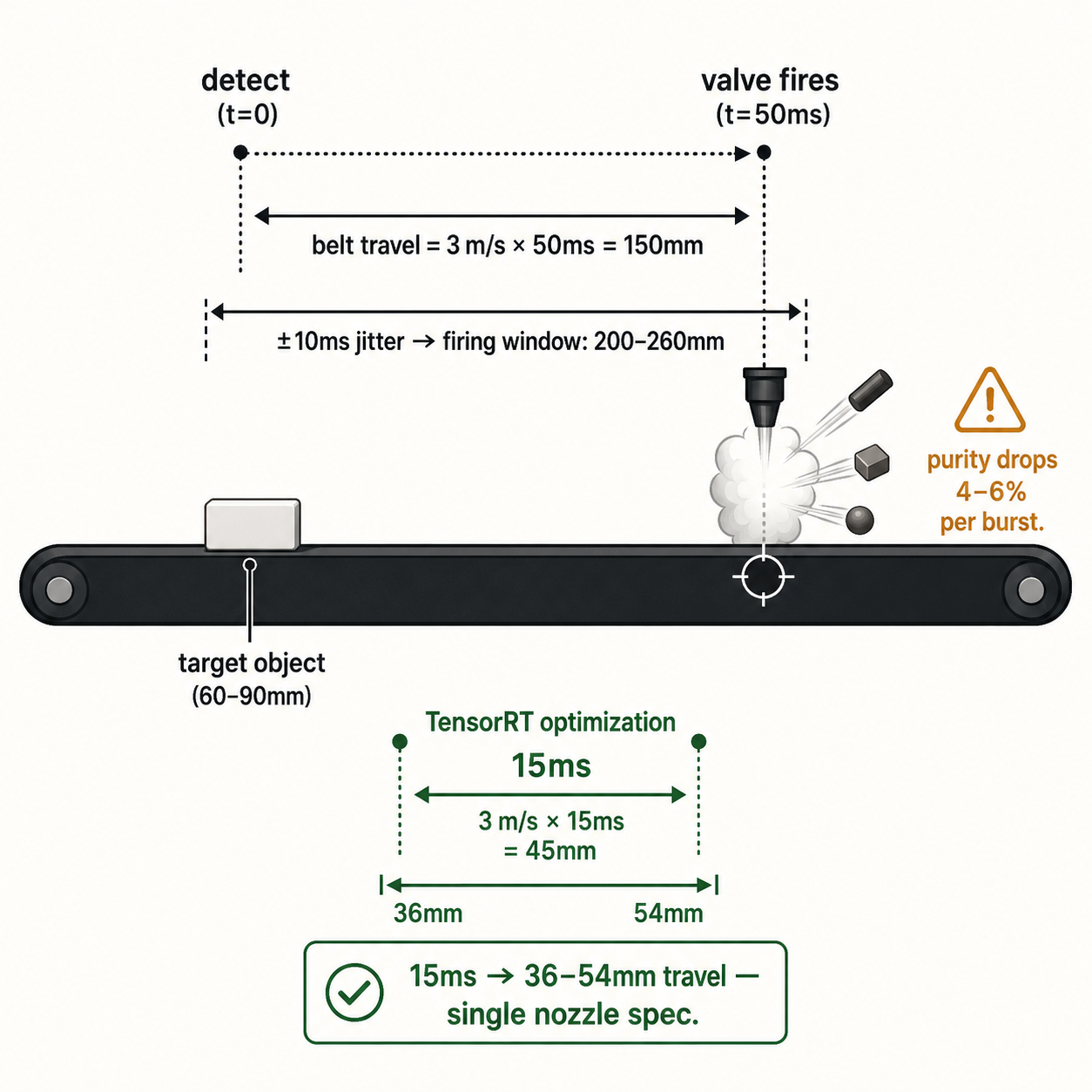
Air-jet ejection is a physical sequence: detect the object, route the inference decision to the PLC, fire the valve, time the air burst to intercept the object at the ejector manifold. Multiply belt speed in meters per second by detection-to-firing latency in seconds and you get the distance the object travels before the valve fires. Add jitter (the variance around the mean latency) and you get the firing window. When that window is wider than the ejector nozzle pitch, the air burst takes the target plus one or two adjacent objects. Purity drops 4-6% per additional item captured in the burst.
The math for a concrete case: a 1.2-metre-wide belt at 3 m/s, ejector pitch of 12.5 mm, edge GPU pipeline running at 50 ms latency with ±10 ms jitter. The object travels 150 mm by valve activation; the jitter window extends this to 200-260 mm. Average object size is 60-90 mm. The sorter appears to be running correctly. The purity is eroding on every belt-speed overshoot.
The fix is often not hardware. TensorRT kernel fusion and half-precision inference on a NVIDIA Jetson Orin drops latency from 50 ms to 12-18 ms. At 3 m/s, that brings ejection window error to 36-54 mm — workable for 12.5 mm pitch with single-nozzle activation. That optimization costs nothing in capital. It is a software engagement.
FPGA dataflow architectures — Xilinx Kria SoM running Vitis AI or FINN — hit 2 ms deterministic latency with near-zero jitter. At belt speeds above 4-5 m/s with tight ejector pitch, where even an optimized edge GPU produces unacceptable ejection windows, FPGA is the correct architecture. The engineering time is 4-6 months, the hardware is $25-40K, and it is warranted only when the facility's belt speed and ejector pitch push outside the GPU operating envelope. We run that calculation before recommending the architecture. Often the answer is: optimize the GPU pipeline first.
WEEE: Higher Margin, Less Competition
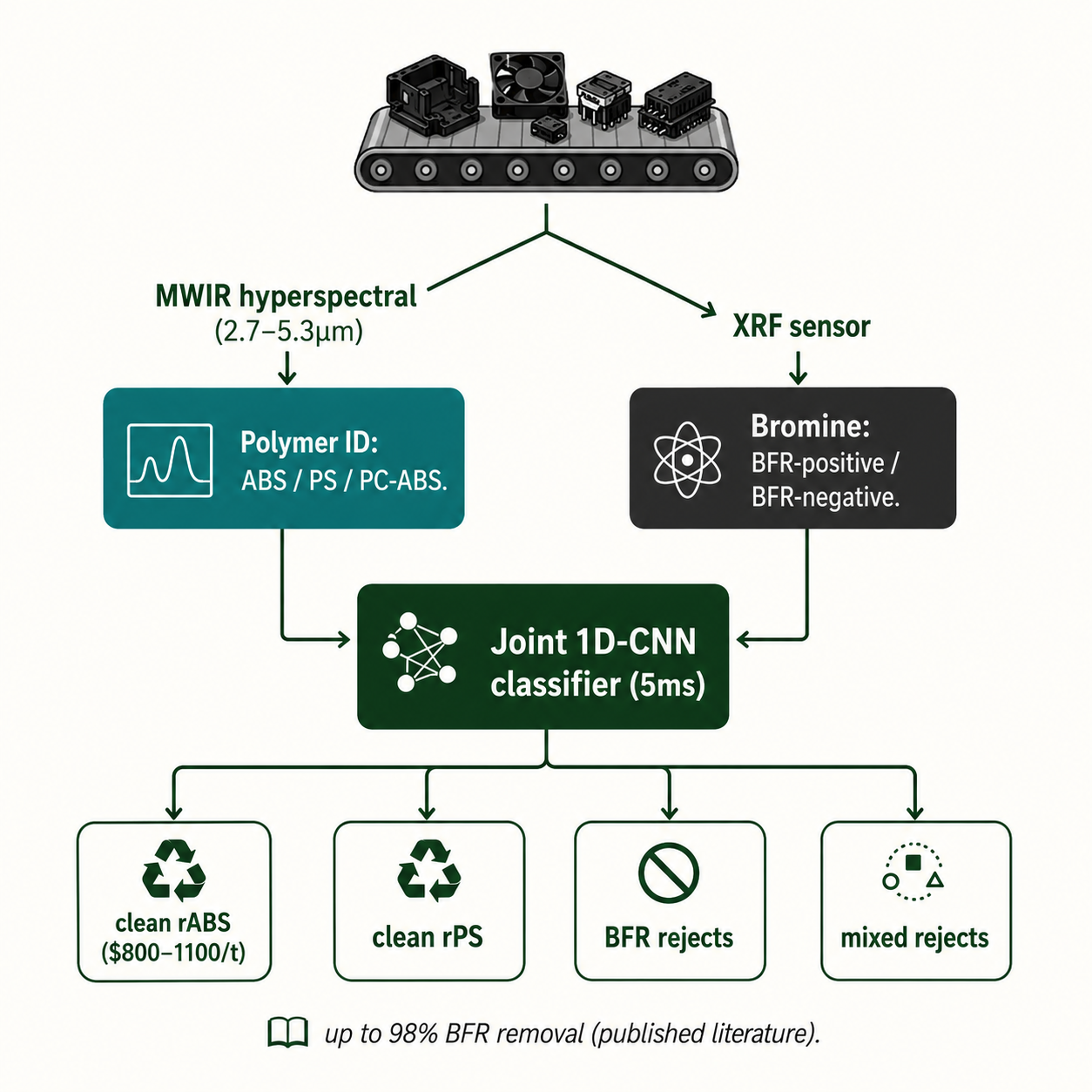
Electronic waste recyclers face a variant of the black plastic problem with higher stakes and higher per-tonne margins. Mixed black plastics from end-of-life electronics include ABS with brominated flame retardants — RoHS-prohibited material that cannot be fed back into recycled feedstock for new equipment. Research from Sofies and BSEF estimates 40-50% of captured WEEE plastics are not properly separated from BFR-containing material today.
MWIR identifies polymer type: ABS, PS, PC/ABS. X-ray fluorescence identifies bromine concentration. Neither sensor alone produces the classification a WEEE recycler needs. Fusing MWIR spectra with XRF readings into a single 1D-CNN classification head trained on the joint feature space produces four output bins: clean rABS, clean rPS, BFR-positive rejects, and mixed rejects. Combined NIR plus X-ray approaches in published literature remove up to 98% of BFR-containing plastics from mixed WEEE streams. The latency budget for this sensor fusion pipeline is 5 ms — achievable on an optimized edge GPU for the belt speeds typical in WEEE processing.
Recovered rABS prices run $800-1,100 per tonne FOB. Clean rPS at similar levels. These margins are substantially higher than bulk rPP recovery, and the platform vendors are not competing hard for this niche.
The Regulatory Pressure Is Not Hypothetical
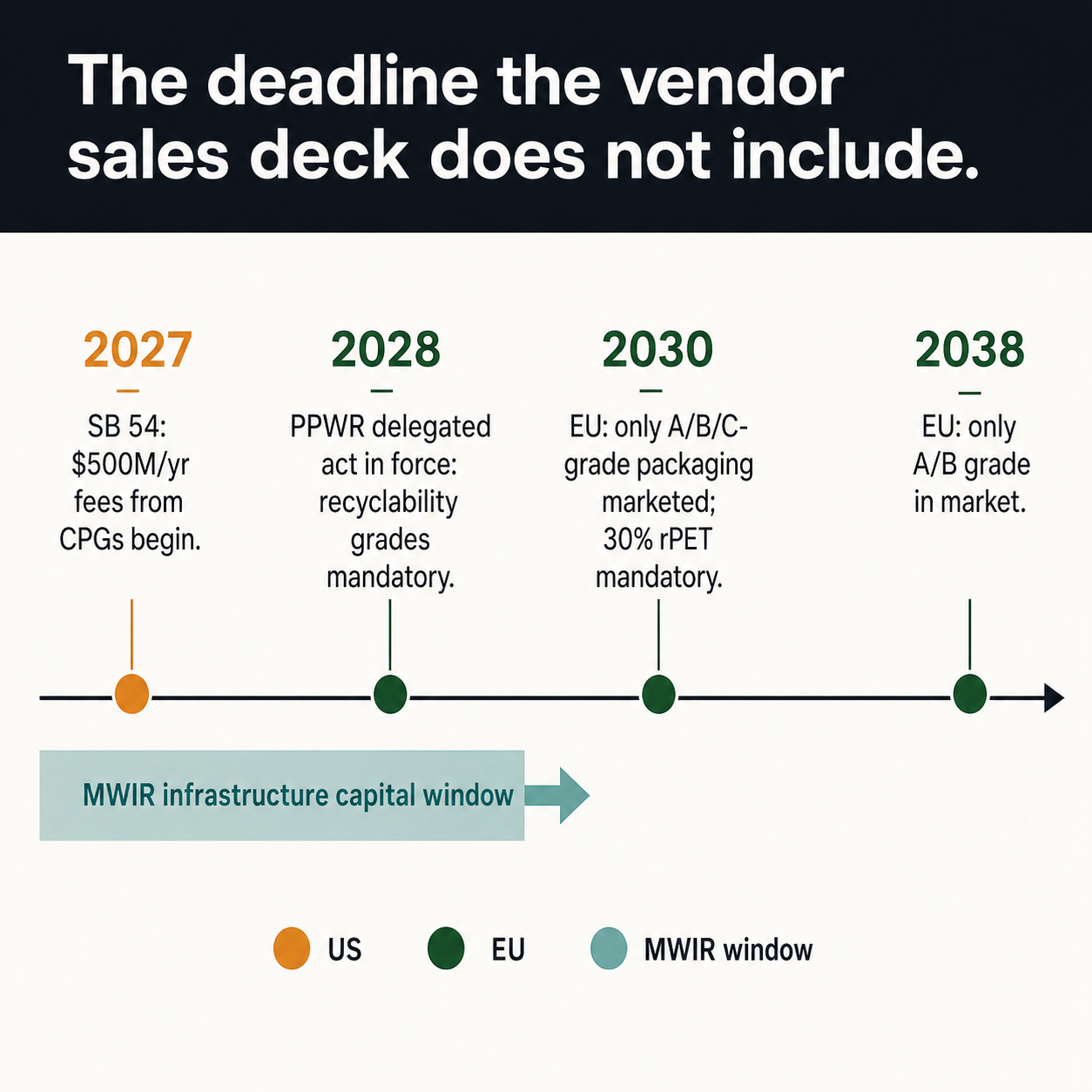
Two regulatory developments are converting black plastic recovery from capital-discretionary to compliance-relevant for operators in the EU and the US.
The European Union's Packaging and Packaging Waste Regulation mandates recyclability grade thresholds through a delegated act with implementation due January 1, 2028. From 2030, only A, B, and C-grade packaging may be marketed in the EU; from 2038, only A and B. Carbon-black-pigmented packaging without a corresponding MWIR-capable recovery infrastructure demonstrating material cyclability will have difficulty achieving Grade C under the technical criteria. Brands selling that packaging and MRFs handling it will face pressure from both ends of the supply chain simultaneously.
In California, SB 54 establishes an extended producer responsibility framework with approximately $500 million per year in fees from CPGs and up to $150 million per year from resin manufacturers starting 2027. MRFs demonstrating high-value polymer recovery from streams that previously went to landfill are positioned to negotiate stronger terms under EPR-funded collection agreements.
The 2030 mandatory recycled content targets — 30% rPET in beverage bottles, 35% in other plastic packaging — will drive demand for high-purity rPP and rABS bales beyond current supply. A facility that commissions MWIR infrastructure before the 2028 PPWR delegated act deadline has a material supply position that post-2028 entrants, commissioning in a constrained capital market, will not have.
What About NIR-Detectable Pigments?
The brand-side response to the carbon black problem has been underway since approximately 2018. UPM launched Circular Renewable Black — a bio-based, NIR-detectable, carbon-negative pigment — in December 2025. Cabot's NIR-reflective alternatives to standard Carbon Black 7 have achieved FDA food-contact clearance. Ampacet has tested NIR-sortable masterbatches in collaboration with Pellenc ST hardware.
Adoption is the issue. Standard carbon black pigment costs approximately €0.20/kg. NIR-detectable alternatives run €0.60-1.20/kg before food-contact requalification testing. Best industry estimates put NIR-detectable black at under 10% of FMCG black packaging in 2026. Automotive interior plastics, electronics housings, and cost-sensitive private-label packaging are not converting on a timeline that changes the near-term residue calculus. The existing black polymer waste stream entering MRFs today will persist for 15-20 years regardless of specification changes, because the stock of long-lived products using legacy pigments does not disappear when a packaging spec updates.
The right framing for a plant director evaluating MWIR infrastructure: the investment hedges both directions. If pigment substitution accelerates faster than forecast, the MWIR line keeps recovering the long tail. If it stalls — as it has for eight years already — the facility is positioned ahead of the problem rather than behind it.
The Maintenance Question Every Vendor Sidesteps
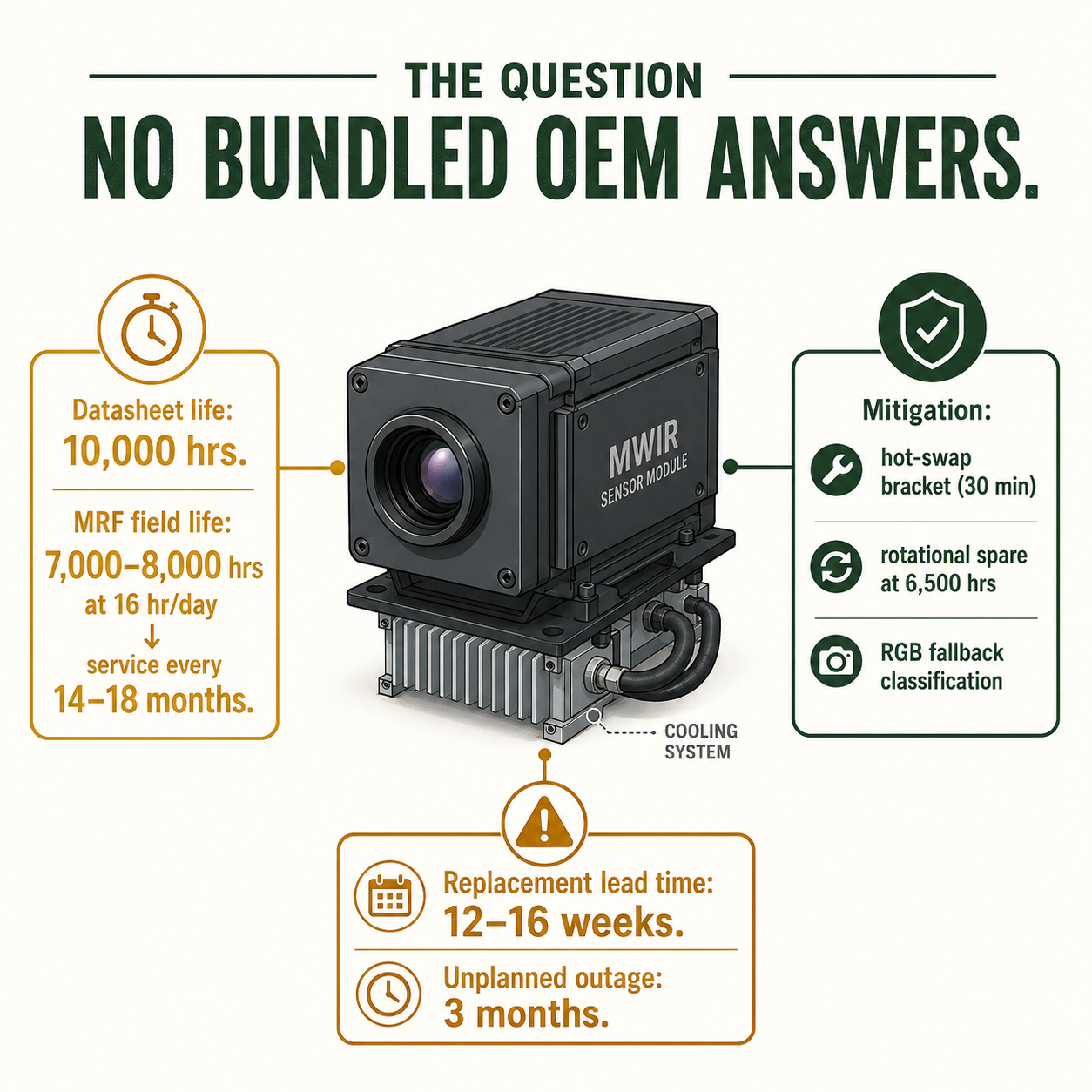
Before commissioning MWIR, one operational question deserves an answer the sales deck rarely provides: what happens when the camera needs service?
The Specim FX50 cools its InSb detector to approximately 77 K via an integrated Stirling cryocooler. Specim's datasheet rates the cooler at 10,000 hours. Real MRF operating conditions — dust ingress, vibration loading from belt systems, temperature cycling — reduce field life to 7,000-8,000 hours. At 16 hours of daily operation, that is a cooler service interval of 14-18 months. Factory replacement lead time from Specim is 12-16 weeks. A facility without a spare camera in stock and a hot-swap mounting bracket is facing a three-month line outage on a predictable schedule.
The contingency architecture we build in: a hot-swap bracket so the camera exchanges in 30 minutes, a rotational maintenance schedule that sends the cooler to refurbishment at 6,500 hours and makes the refurbished unit the on-site spare, and a degraded-mode classification path using RGB segmentation alone — lower accuracy, but the sort line continues running while the MWIR camera is offline. No bundled OEM system addresses Stirling cooler contingency publicly. It surfaces in the second sales meeting when the plant director asks, and the vendor does not have a clean answer.
The full architecture documentation for our MWIR retrofit, including belt-speed latency calculator, WEEE sensor fusion specs, and PPWR grade exposure assessment, is at veriprajna.com/solutions/materials-recovery-ai.
The questions MRF operators are navigating right now — whether to retrofit or replace, how to run the FPGA-vs-GPU decision honestly, what the PPWR deadline means for capital planning — have engineering answers that do not require buying a vendor's ecosystem to access. If you're working through any of those and finding the standard sales conversations circular, we'd like to hear what your stream looks like and what the economics actually say.