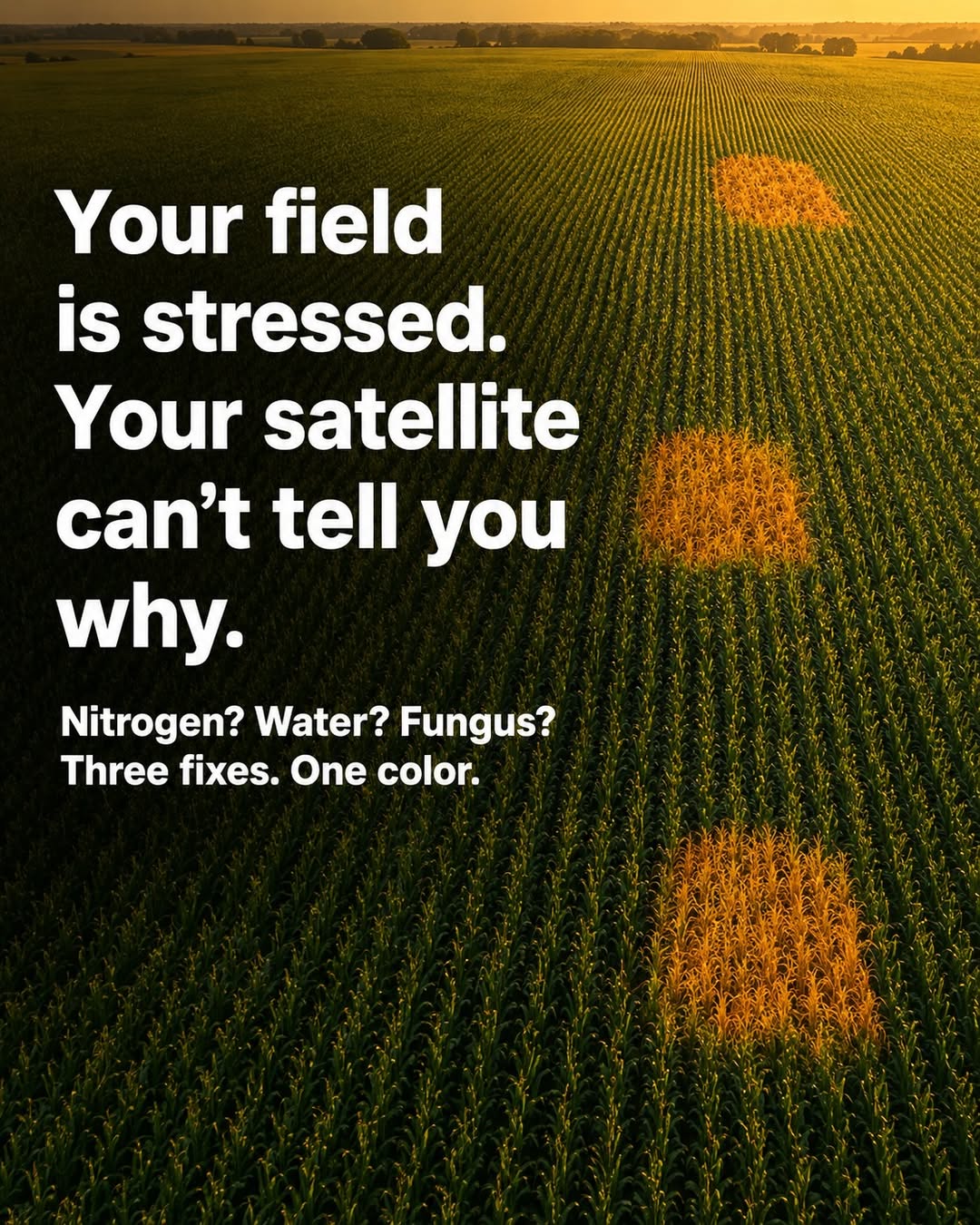
Your satellite says a corn field is stressed. It can't tell you if that's nitrogen, water, or a fungus quietly eating your yield.
That gap is expensive. NDVI compresses the whole red and near-infrared spectrum into two numbers, so every problem comes back as the same amber "stress" alert. The three most common causes need opposite responses:
→ Nitrogen deficiency shows up in the visible and red-edge bands. The fix is variable-rate urea.
→ Water stress shows up in the SWIR bands around 1400-1900nm. The fix is targeted irrigation, not fertilizer.
→ Early tar spot triggers a xanthophyll response at 531nm before any visible spots appear. The fix is a fungicide, and only before the R3 growth stage.
Guess wrong and you pay twice. Nitrogen on a water-stressed field wastes $15-25 an acre. Missing the tar spot window cost Illinois growers up to $29.75 an acre in 2024 — part of the 963 million bushels of US corn lost to disease that year.
Hyperspectral sensors resolve 135 to 270+ narrow bands instead of 8. A model trained on a crop's spectral signatures reads the full curve at every pixel and catches the change 7-14 days before damage is visible.
The data was never the hard part — Pixxel and Planet already sell it. The hard part is the analytics layer that turns a spectral curve into a prescription your spray rig can execute.
For the agronomists here: when your monitoring platform flags a field as "stressed," how often can it tell you why?
#PrecisionAgriculture #RemoteSensing