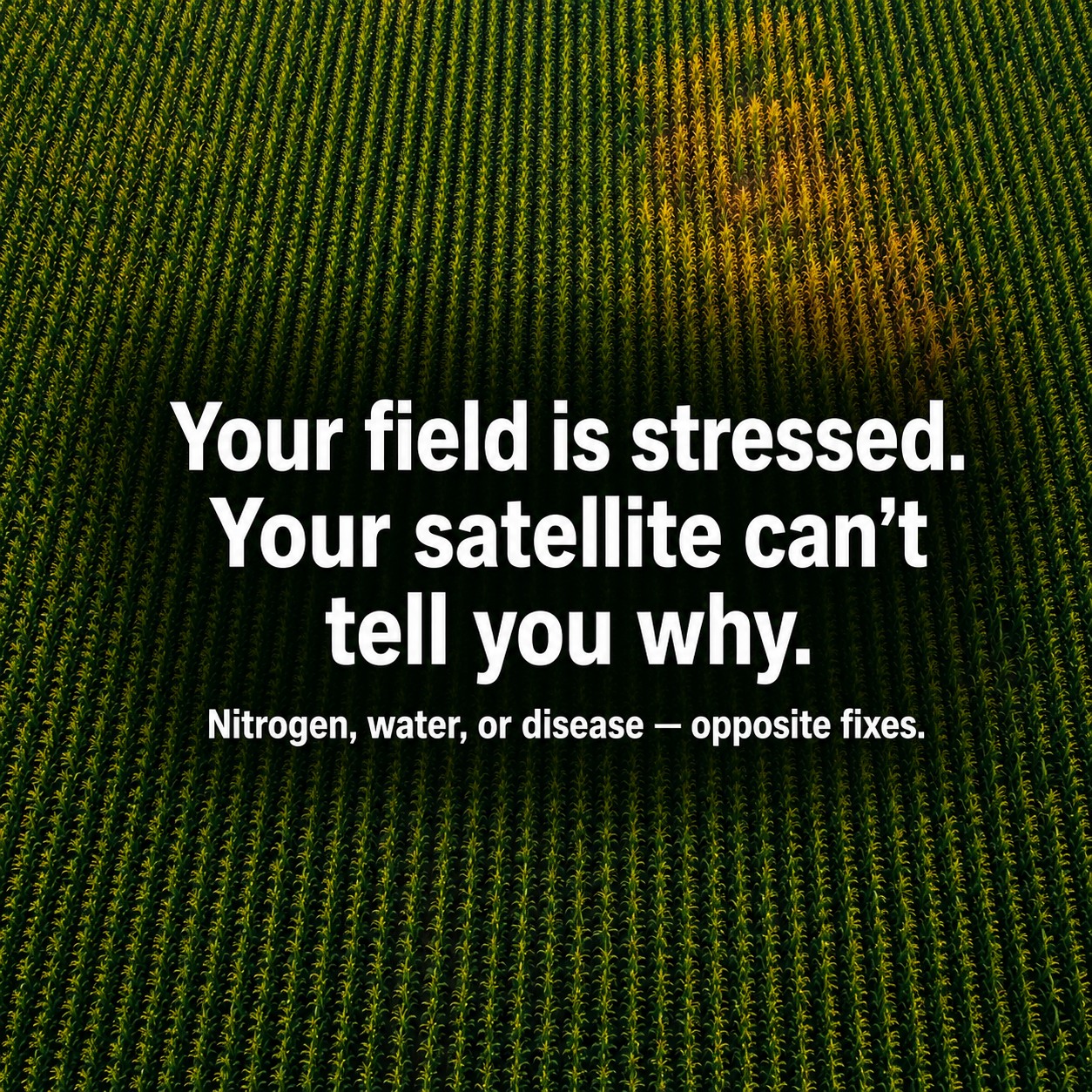
Your satellite says the field is stressed. It can't tell you if it's nitrogen, water, or fungus.
NDVI compresses the entire red and near-infrared spectrum into two broadband numbers. Planet gives you 8 bands, Sentinel-2 gives you 13 — enough to flag "something's wrong in the northeast quarter," not enough to say what.
And the three usual culprits demand opposite responses:
Nitrogen deficiency shows as a chlorophyll drop near 670–680nm, with the red edge shifting a few nanometers. Fix: variable-rate urea.
Water stress barely touches the visible bands — it hides in the SWIR around 1400–1900nm, where water absorption flattens. Fix: targeted irrigation, not fertilizer.
Early tar spot trips a xanthophyll response at 531nm before a single lesion is visible. Fix: fungicide — but only before the R3 growth stage, after which the ROI collapses to near zero (Iowa State pathology data).
NDVI calls all three "stress." Pour nitrogen onto a water-stressed block and you've burned $15–25/acre. Miss the tar spot window and Illinois growers lost up to $29.75/acre in 2024 — the year US corn shed 963 million bushels to disease.
Hyperspectral sensors resolve 135–270+ narrow bands. A 3D-CNN reads the full reflectance curve at every pixel and extracts the diagnostic features broadband indices average away — catching the biochemical shift 7–14 days before the human eye or an RGB camera can.
The data already exists — Pixxel, Planet Tanager-1, drone HSI. What's usually missing is the analytics layer between raw spectra and a variable-rate prescription map. That's the part we build — on proven infrastructure, not a proprietary platform you'd have to bet on after watching 28 vertical-farming startups fold in a single down year for agtech.
Save this for your next vendor evaluation: the question isn't whether to use spectral data, it's who builds the layer that turns it into a decision.
#PrecisionAgriculture #HyperspectralImaging #AgTech #CropProtection #RemoteSensing