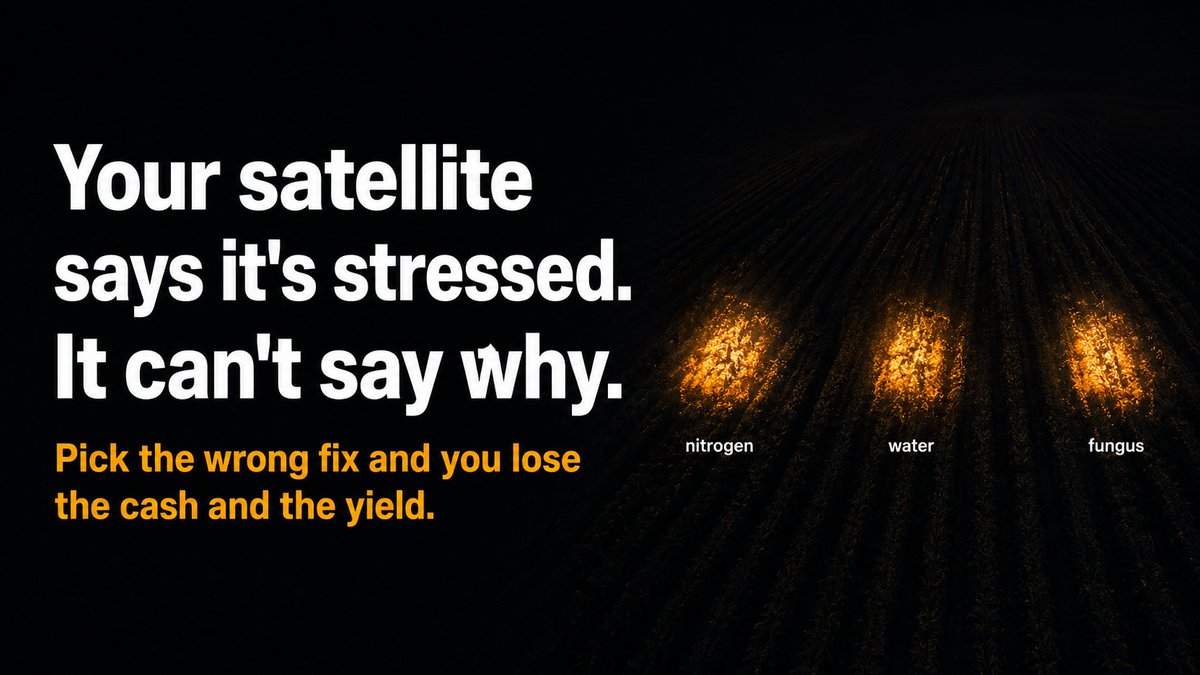
- Your satellite says a corn field is stressed. It can't say why. Nitrogen deficiency, water stress, and early tar spot all light up NDVI amber — but each needs the opposite fix. Apply the wrong one and you've burned cash and the yield anyway. 🧵
- NDVI compresses the whole red+NIR spectrum into two broadband values. PlanetScope gives 8 bands, Sentinel-2 gives 13. That's great for "which field needs attention." It's useless for "what is actually wrong with this one."
- The diagnosis lives in narrow bands NDVI averages away:
- N deficiency: chlorophyll drop at 670-680nm, red-edge shifts 3-5nm
- Water stress: SWIR water absorption (1400-1900nm) flattens
- Early tar spot: xanthophyll response at 531nm
Three signatures. One broadband alert. - Timing is the other half. RGB/NDVI catch damage 10-15 days AFTER onset — by then yield loss is locked in. Hyperspectral models read the biochemical change 7-14 days BEFORE symptoms appear. Net: a 17-29 day earlier intervention window.
- The stakes aren't small. US corn lost 963M bushels to disease in 2024 — 6% of yield. Tar spot alone: 280M bushels, up to $29.75/acre in Illinois. And fungicide after the R3 growth stage? ROI near zero (Iowa State). The window is everything.
- So why doesn't anyone just sell this? Pixxel and Planet sell spectral DATA. Headwall and Specim sell $50K-150K sensors. FieldView executes prescriptions. Nobody builds the analytics layer between raw reflectance and an actual VRT spray map. That's the gap.
- Accenture even bought a European precision-ag analytics firm in Feb 2025 — and still ships platform implementations and ESG strategy, not spectral pipelines. Neither they nor Deloitte will write a 3D-CNN or collect field-verified ground truth. That's builder work.
- That's what we build: custom 3D-CNN/transformer models on your crop's signatures, disease libraries from field-verified labels, HSI-to-VRT maps that respect real boom width and nozzle spacing. The payoff isn't the model — it's not dumping $15-25/acre of nitrogen on thirsty corn.
- The economics are obvious where the crop is expensive. Napa Cabernet at $10K-30K/acre makes $50-100/acre monitoring trivial. One California vineyard cut fungicide use 22% with hyperspectral + AI, no quality loss. Early detection prevents 15-40% yield loss at 150%+ ROI.
- Honest question for agronomists and ag-data teams: when your monitoring flags "stress," how often can you actually diagnose the cause before you spray — and what does a wrong call cost you per acre? #PrecisionAg
- We wrote up the full multispectral-ceiling problem, the vendor landscape, and how we build the spectral-to-prescription pipeline: https://veriprajna.com/solutions/hyperspectral-agriculture-ai