On Equora's fixed synthetic tenant-screening fixture, ScreenScore v3 produced a 0.6940 Black applicant disparate-impact ratio, below the demo's configured 0.80 four-fifths policy gate. That red score does not tell a team what to change, how much utility a change costs, or why one alternative should be selected over another.
That missing step is the operational challenge in housing AI compliance. An audit can identify disparity. A decision record needs more: a reproducible search for a lower-disparity alternative, an inspectable tradeoff, and a release rule that does not depend on generated prose. We built Equora to make that sequence concrete. The walkthrough is at https://veriprajna.com/demos/housing-ai-compliance.
The red score cannot choose the next model
Equora starts with a fixed synthetic tenant-screening applicant pool of 9,000 records. It evaluates ScreenScore v3 (credit-leaning baseline) and keeps race and voucher status as audit fields, not model features.
On that fixture, the baseline AUC is 0.7823. The audit reports disparate-impact ratio (DIR) and compares group outcomes against its configured four-fifths policy gate. That gate is a demo policy choice, not a legal conclusion, and the synthetic result is not a claim about any landlord, vendor, or real applicant population.
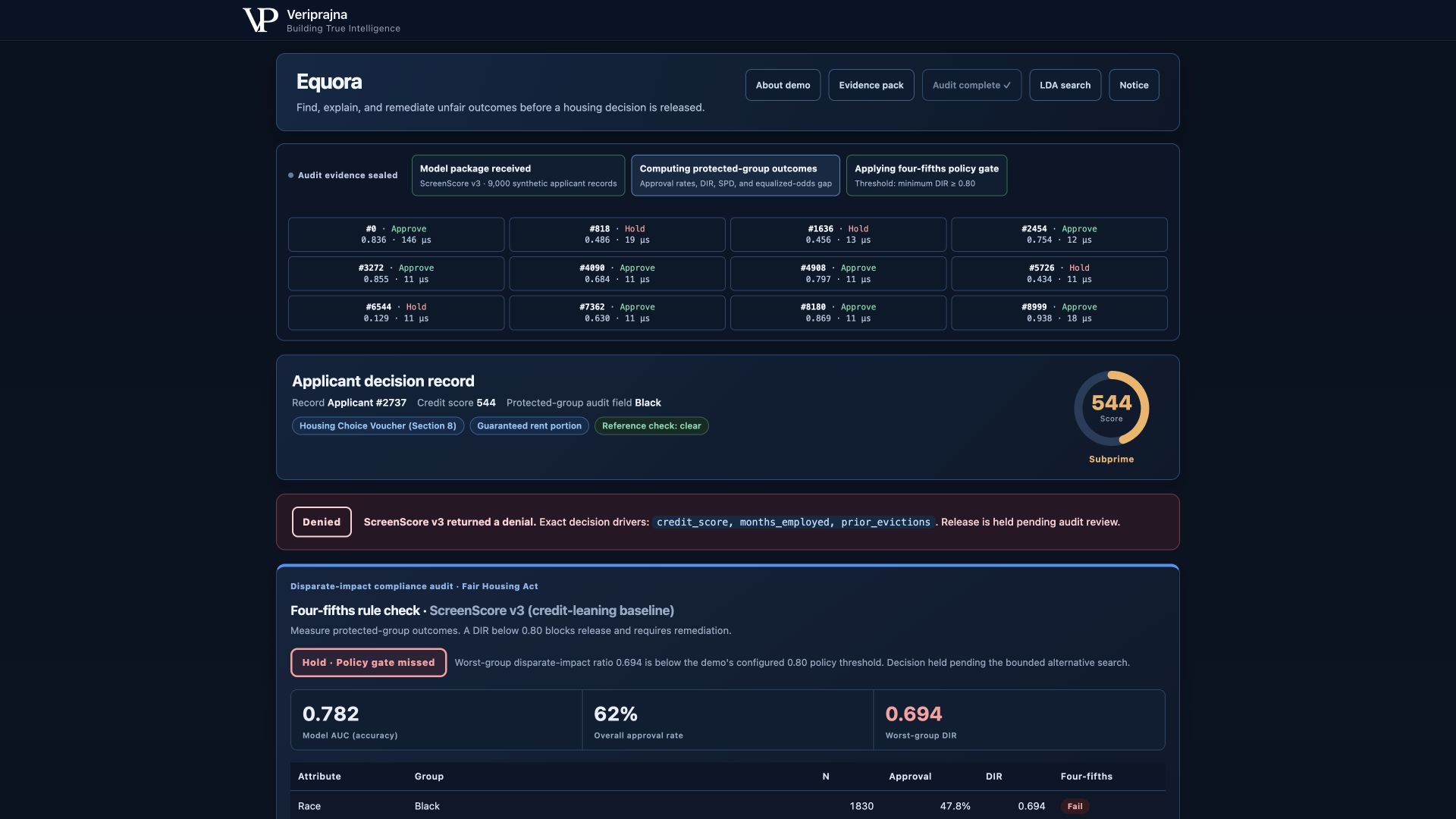
The completed Equora audit shows the synthetic baseline and its 0.694 worst-group DIR. The four-fifths threshold shown in the interface is the demo's configured policy gate, not a housing-law judgment.
The number identifies a problem inside the fixture. It does not identify a permissible intervention, compare alternatives at a consistent approval level, or show the performance cost of a change. Stopping at the dashboard would leave counsel and model-risk teams with an alert but no reproducible path from finding to action.
Make the candidate set explicit
The core Equora mechanism is a bounded Least Discriminatory Alternative (LDA) search. It evaluates 480 facially neutral configurations at equal selectivity. The grid varies optional feature inclusion, credit-score caps, whether guaranteed voucher income is credited, and regularization strength. Debt-to-income ratio, months employed, and reported income remain included.
Those boundaries matter. A search is reviewable only when another team can see which changes were allowed, which were excluded, and how every candidate was tested. Equora retrains each candidate, measures accuracy and minimum DIR, and places the result on an accuracy/fairness Pareto frontier. Of the 480 configurations, 240 clear the demo's configured 0.80 gate within its 0.03 AUC budget.
The compliance artifact is the replayable search record, not the color of the scorecard.
The selected candidate caps credit-score influence at 640, credits guaranteed income, and uses L2 regularization of 10.0. On the same fixed synthetic fixture, minimum DIR moves from 0.694 to 0.875. AUC moves from 0.7823 to 0.7788, a measured loss of 0.0036 that the interface displays as 0.36%.
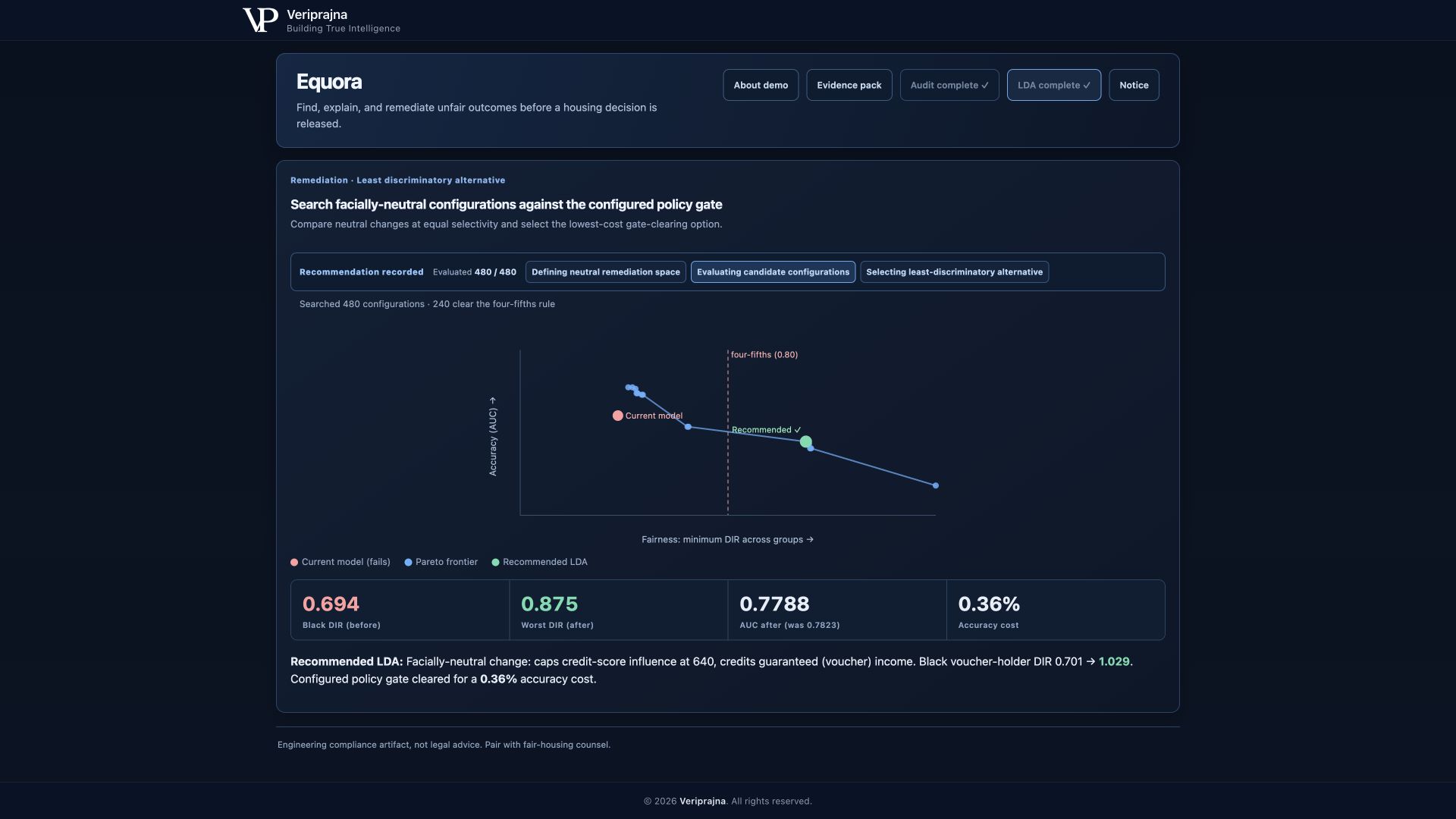
The bounded search makes the measured tradeoff visible: 0.694 to 0.875 minimum DIR while AUC moves from 0.7823 to 0.7788 on the fixed synthetic fixture.
The recommendation is deliberately narrow. It is the lowest-measured-AUC-cost candidate that qualifies inside this 480-configuration grid. It is not a universal optimum, a finding that the model is fair, or a legal certification. A different search space, policy threshold, dataset, or budget could produce a different result.
The durable control sits outside generated language
Metrics, policy thresholds, candidate evaluation, and selection are deterministic in Equora. A language model, when enabled, is limited to drafting text. It does not compute DIR, choose the threshold, or select the alternative.
That separation becomes important when a model decision has to be explained. For a denied synthetic record, Equora calculates exact linear-model feature attribution and constrains the draft notice to the three strongest negative contributors. A feature-grounding critic checks whether the cited reasons match those contributors. A generic reason code that names no specific feature fails the check and routes to human review.
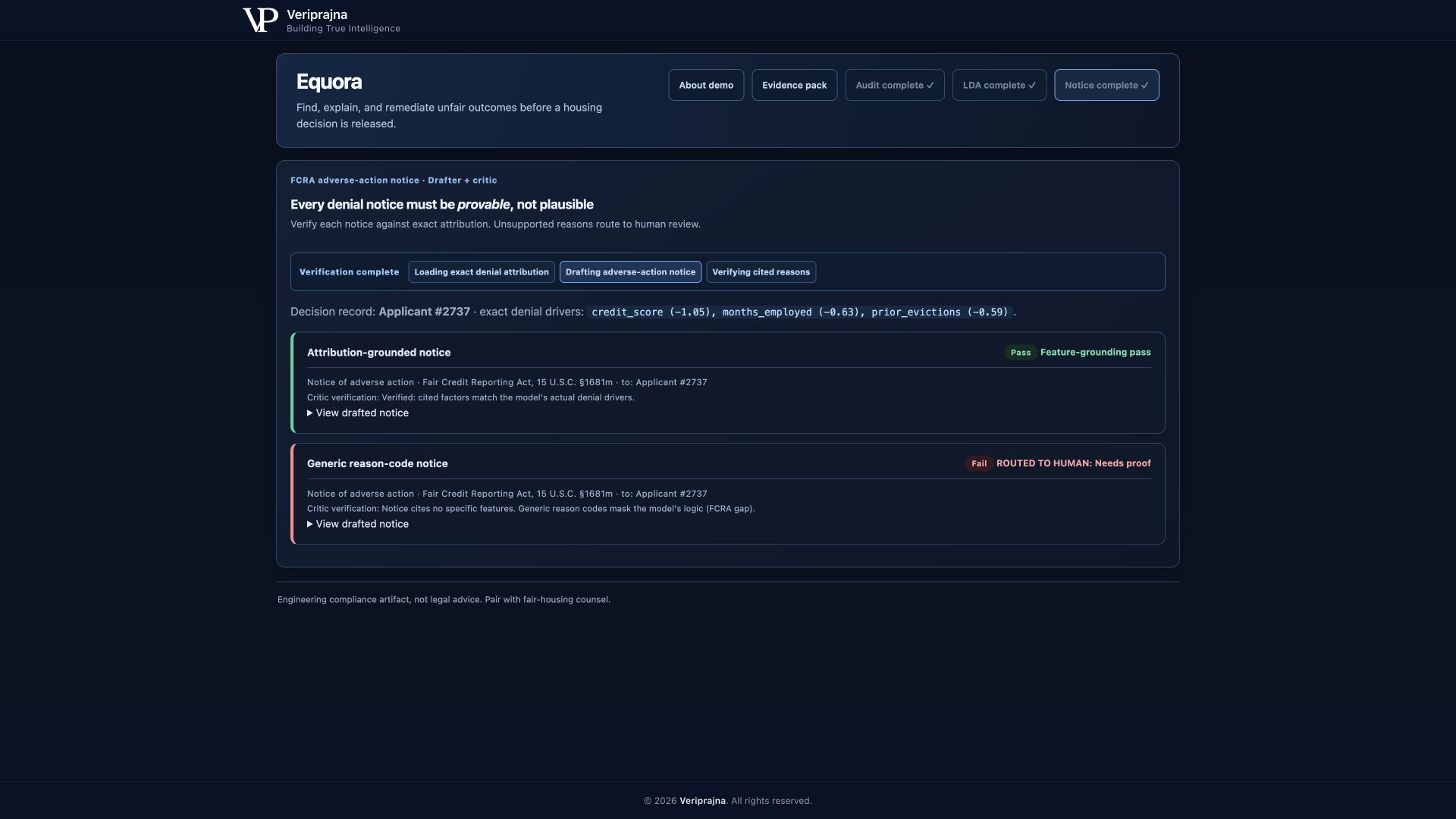
The notice screen separates a reason grounded in exact model attribution from a generic reason code that is held for human review.
This check is precise, but its scope is limited. Passing it shows that cited reasons match the model's top-three negative feature contributions. It does not establish that every FCRA notice element is complete or that counsel would deem the notice legally sufficient.
Evidence before confidence
The full record should let a reviewer reconstruct what happened: the synthetic input, the baseline disparity, the defined candidate space, every evaluated tradeoff, the selected configuration, and the exact drivers behind a notice. Equora exposes JSON and HTML audit artifacts for that handoff.
The implementation is an engineering demonstration, not legal advice or a production decisioning system. The data is synthetic, the remediation grid is bounded, the rule pack is static demo configuration, and production connectors are not built. These limits are part of the evidence because a useful review record must show where its conclusions stop.
The deeper walkthrough is at https://veriprajna.com/demos/housing-ai-compliance. For teams already formalizing this process, a concrete comparison is worth making: which feature treatments are allowed into the candidate set, and who approves that boundary before the search begins?