Proof from the demo
The tradeoff stays visible from baseline to recommendation.
These screens show the actual local demonstration on its fixed synthetic fixture.
Housing AI compliance
Equora turns a measured disparity into a reproducible search for a lower-disparity alternative, with the accuracy cost, exact decision evidence, and release gate kept in view.
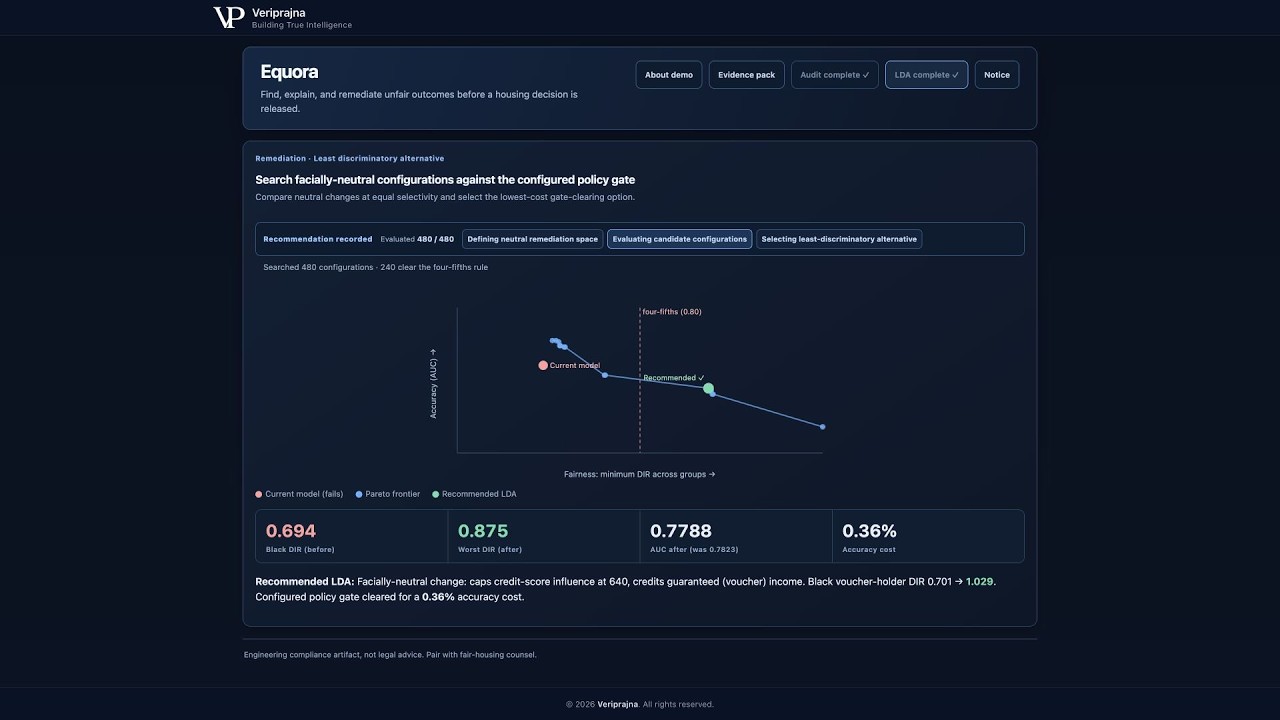
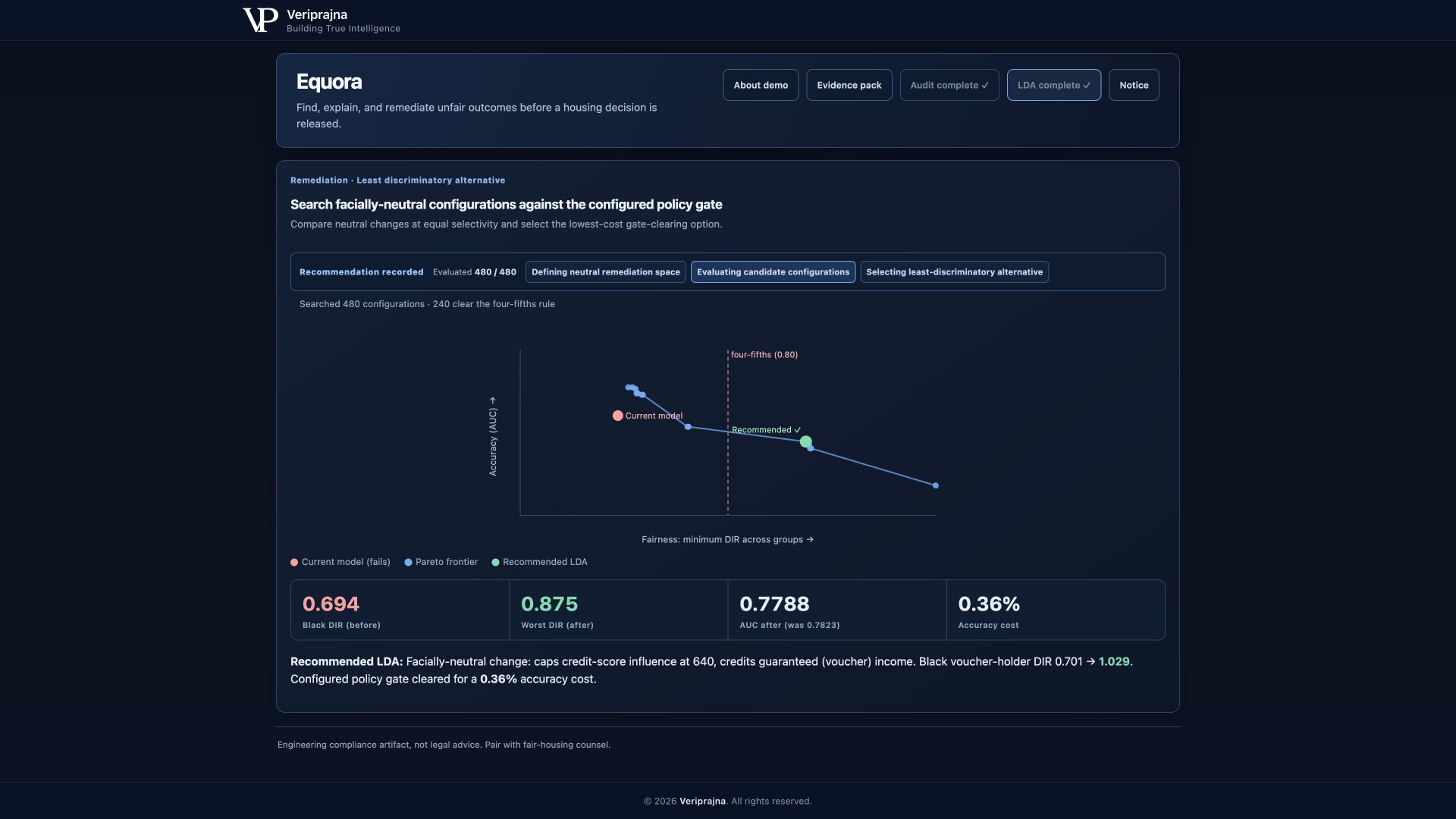
0.694 to 0.875
Worst-group DIR movement
Fixed synthetic fixture
480
Configurations evaluated
Bounded equal-selectivity search
0.36%
Measured accuracy cost
AUC 0.7823 to 0.7788
All primary results shown here come from a fixed 9,000-record synthetic applicant pool. Equora is an engineering demonstration, not legal advice or a production decisioning system.
The problem
A tenant-screening audit may tell counsel and model-risk teams that outcomes differ across protected groups. The hard work starts next: determine whether a facially neutral alternative reduces the disparity, preserves useful model performance, and can be replayed later.
The November 2024 SafeRent settlement provides important context for why screening systems receive scrutiny. The $2.275 million settlement contained no admission of wrongdoing, and this demo does not reproduce that matter.
Sources: DOJ Civil Rights Division case page and the Final Approval Order filed November 20, 2024.
How it works
The measurement, search, recommendation, and release checks remain deterministic.
Measure
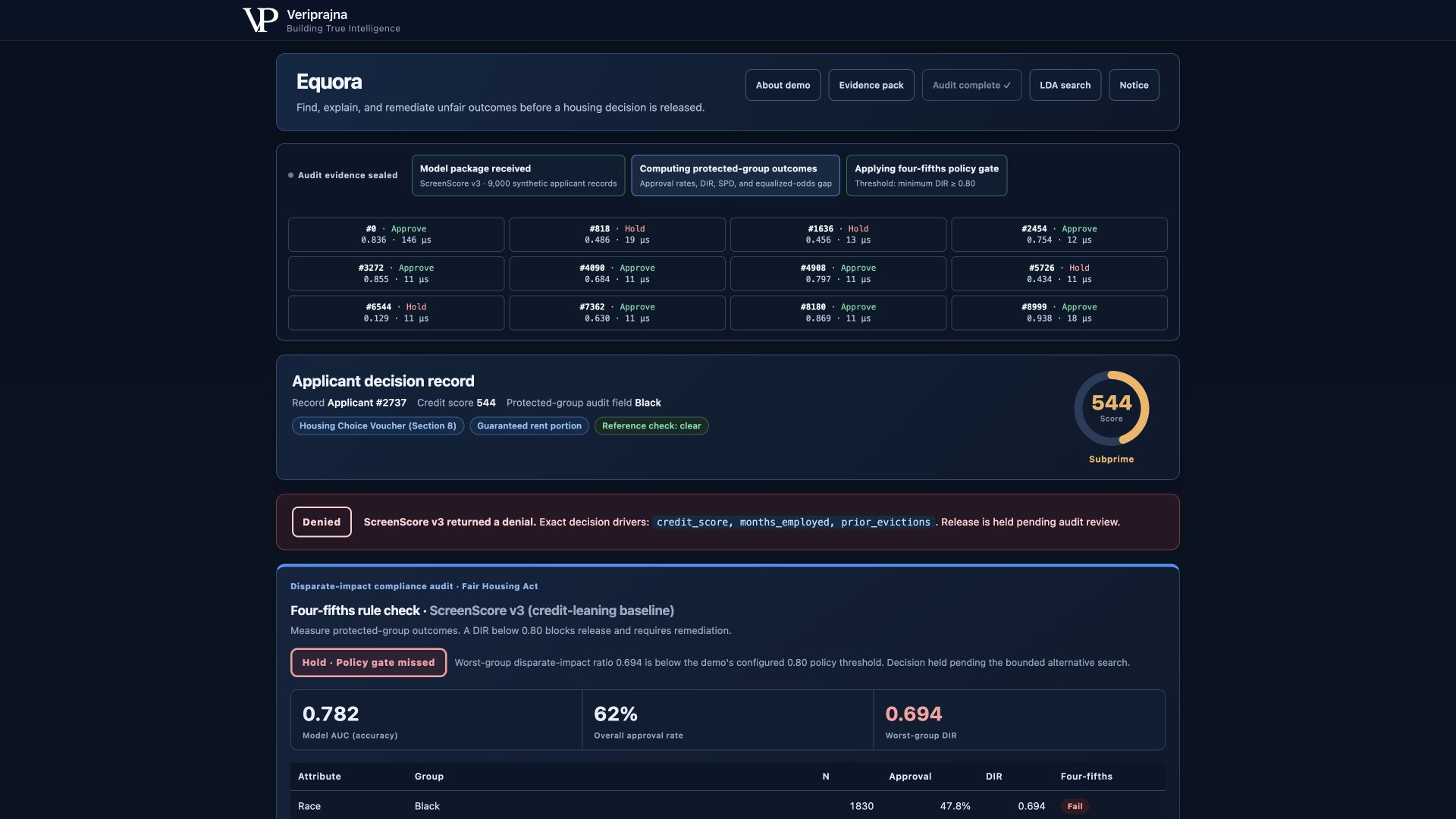
Equora fits ScreenScore v3 (credit-leaning baseline) on the bundled synthetic pool and reports approval rate, disparate-impact ratio, statistical-parity difference, and equalized-odds gap. Race and voucher status are audit fields, not model features.
Search
The Least Discriminatory Alternative (LDA) search evaluates 480 combinations of optional feature subsets, credit-score caps, guaranteed-income treatment, and regularization strength. The search space is explicit and bounded.
Select
The engine plots the accuracy and minimum-DIR Pareto frontier, then selects the qualifying candidate with the smallest measured AUC loss inside the configured 0.03 budget. If no candidate qualifies, it returns no safe alternative.
Gate
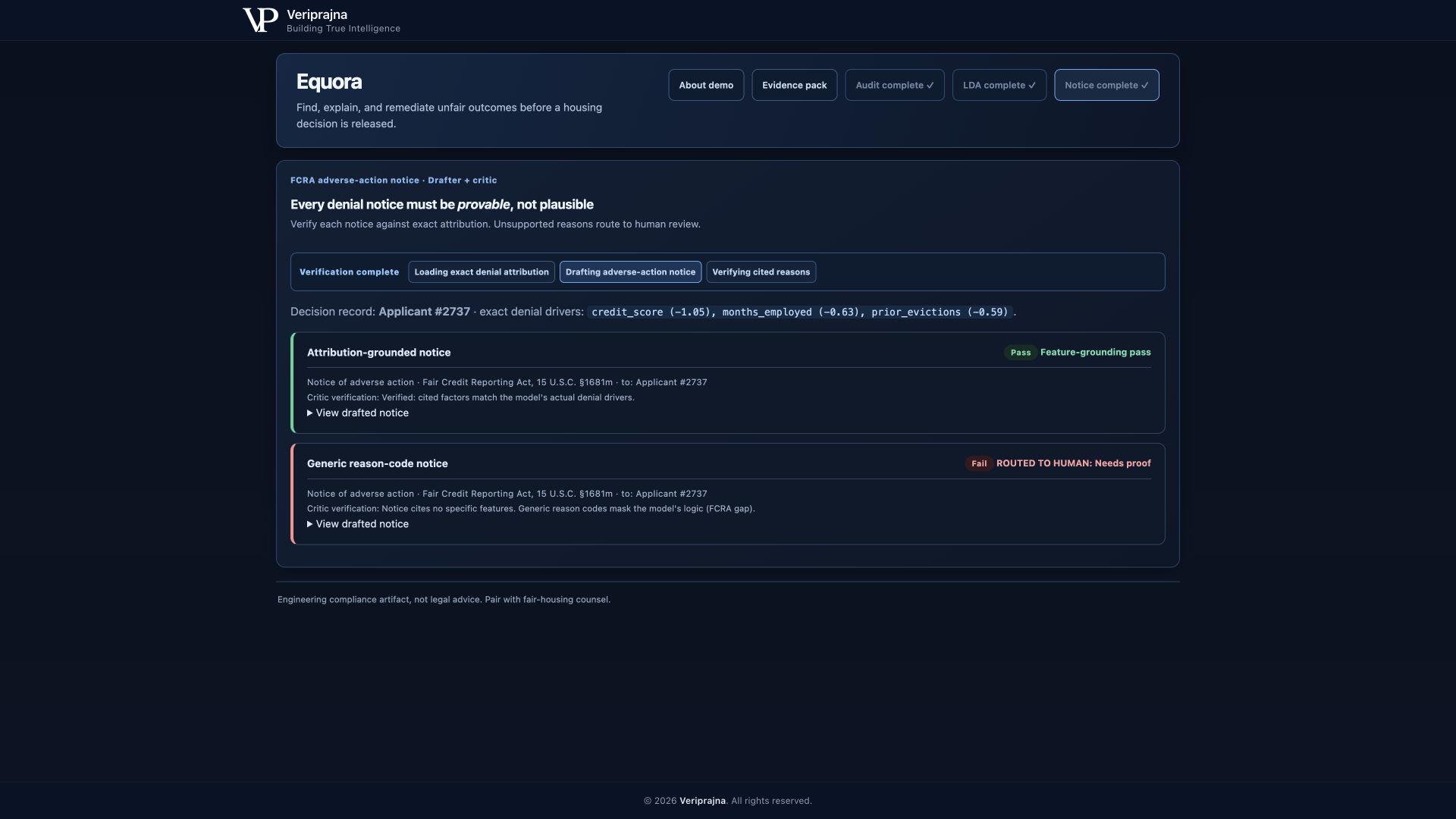
Exact linear-model attribution identifies the top three negative contributors. A feature-grounding critic compares those drivers with the reasons in the notice and routes unsupported or generic explanations to human review.
Proof from the demo
These screens show the actual local demonstration on its fixed synthetic fixture.
Honest landscape
Equora is designed to make a bounded remediation decision inspectable, not to turn one metric into a legal verdict.
| Question | A fairness score alone | Equora demonstration |
|---|---|---|
| What was measured? | A disparity at one model configuration | DIR, SPD, EO gap, approval rates, and confidence intervals on the fixed fixture |
| What could change? | Unspecified | A declared grid of facially neutral configurations compared at equal selectivity |
| Why this recommendation? | No selection record | The smallest measured AUC loss among qualifying candidates in the bounded search |
| Can notice reasons be checked? | Outside the score | Cited features are compared with the exact top three negative contributors |
Equora does not establish legal compliance, certify a model as fair, search every possible model, or validate production housing performance. Its 0.80 threshold is the demo's configured four-fifths policy gate.
The applicant pool is synthetic, the rule pack is static, and production connectors are not built. The notice critic verifies feature grounding only, while the UCI Adult run is a public census-income fairness benchmark rather than tenant data.
Equora evaluates 480 explicit, facially neutral configurations at equal selectivity. It recommends the qualifying candidate with the smallest measured AUC loss inside the demo's configured four-fifths policy gate and accuracy budget, or returns no safe alternative when none qualifies.
No. Equora uses 0.80 as the demo's configured four-fifths policy gate, not as a legal conclusion. The four-fifths heuristic originates in employment-selection guidance and does not by itself determine housing-law liability.
On the fixed synthetic fixture, AUC moves from 0.7823 to 0.7788. The measured loss is 0.0036, shown in the interface as a 0.36% accuracy cost, while worst-group DIR moves from 0.694 to 0.875.
No. Deterministic code computes metrics, applies thresholds, evaluates alternatives, and selects the recommendation. A language model, when enabled, is limited to drafting notice text, and offline mode uses a deterministic template.
No. The feature-grounding critic checks whether cited reasons match the model's top three negative feature contributions. It routes unsupported or generic reasons to human review, but it does not verify every statutory notice element or establish legal sufficiency.
No. The primary dataset is a fixed, bundled synthetic tenant-screening pool of 9,000 records. The separate UCI Adult Census Income run is a public fairness benchmark that exercises the same audit code, not a housing validation dataset.
The research behind this demo — the architecture, the verification design, and the enterprise blueprint.
Bring the model, the policy boundary, and the evidence obligations into one review.
If your team is defining audit, remediation, and release controls for housing AI, contact us to discuss the evidence the review should retain.