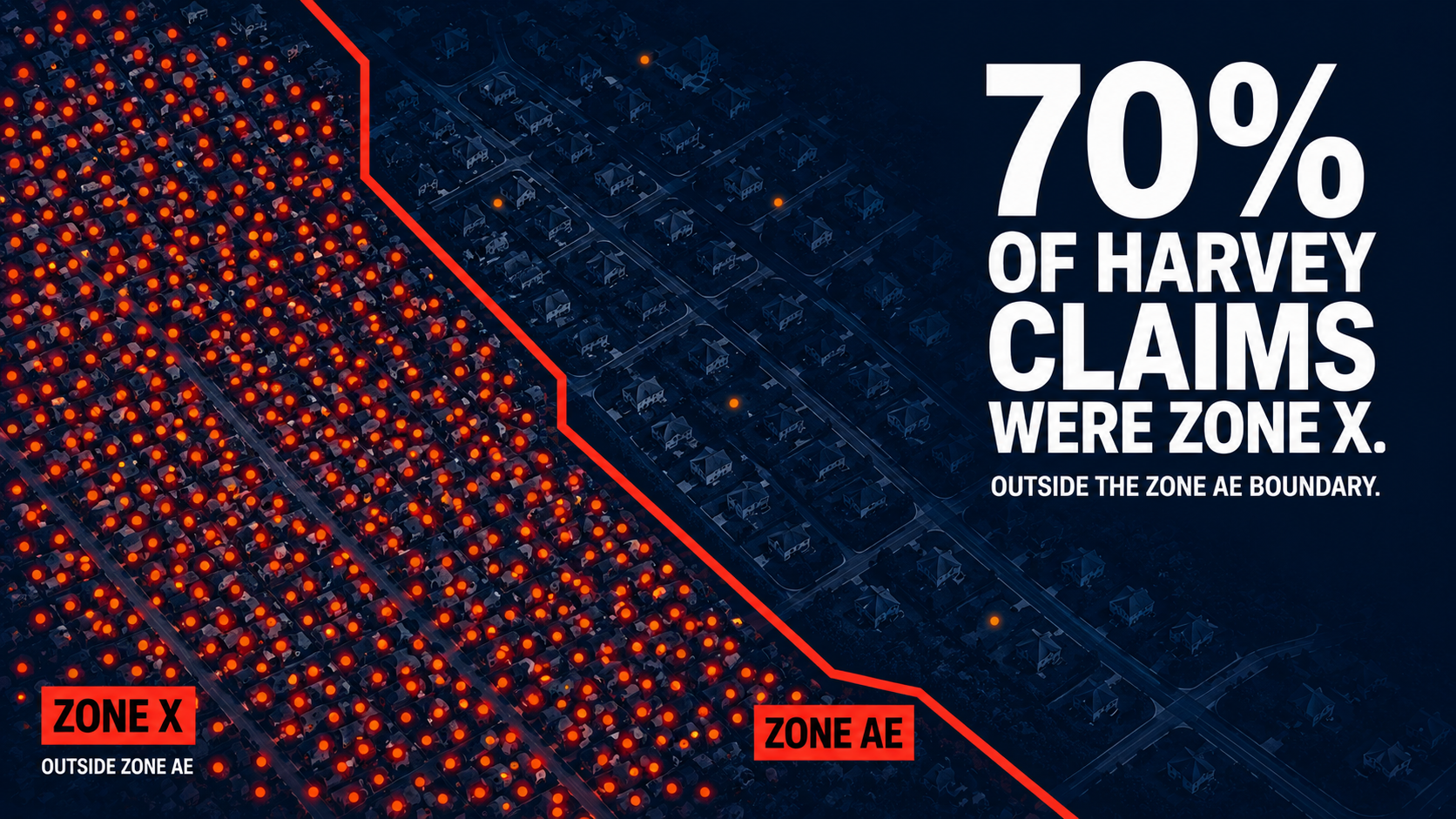
After Harvey, 70% of Harris County's flood claims came from Zone X properties. That's not a historical footnote — it's a description of how your book is priced today.
The primary failure of zone-based flood underwriting isn't missing data. It's anchoring on the wrong data. FEMA flood zone designations were built to identify the 100-year floodplain for regulatory purposes — they were never actuarial rating instruments. The result is systematic mispricing in both directions: overcharging elevated homes inside Zone AE, undercharging slab-on-grade properties in Zone X. The NC State/First Street research puts 68.3% of US flood damage outside FEMA high-risk zones. The 2025 homeowners combined ratio projection of 106.1% (III/AM Best) tells you what that mismatch costs at scale.
What's changed in 2026 is that the vendor infrastructure to fix this has reached production maturity. ZestyAI signed six carrier partnerships in Q1 2026 alone. ICEYE's SAR constellation spans 30+ satellites and has active agreements with Munich Re and AXA. First Street's Flood Factor covers every US property with fluvial, coastal, and pluvial hazard modeling. Fathom, now inside Swiss Re, is building 50,000-year probabilistic flood event sets. The property-level intelligence exists. The problem isn't the scores — it's everything between the score and an approved rate filing.
What Zone X Actually Looks Like at the Property Level
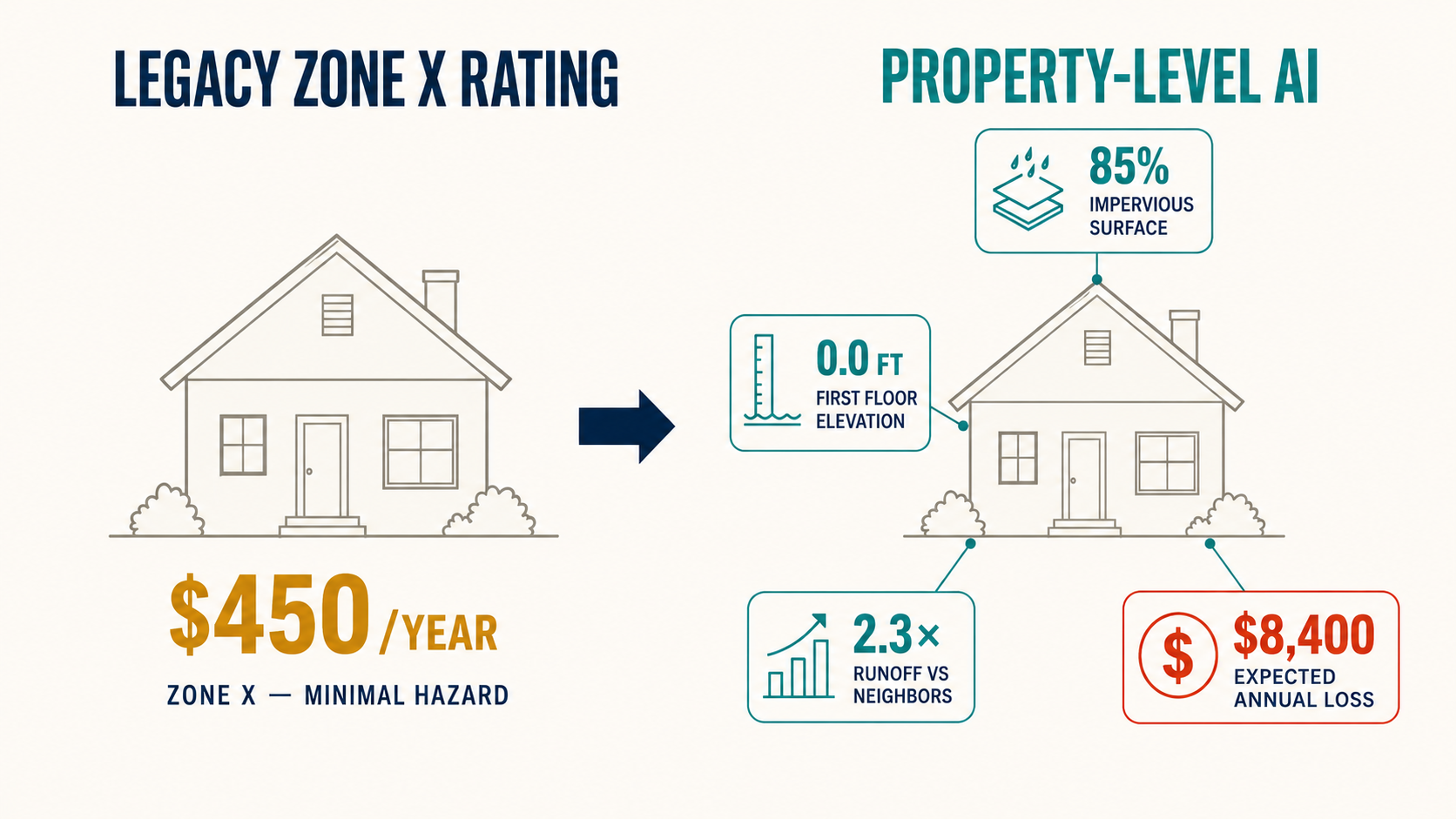
We built AI-Powered Flood Risk Underwriting around a scenario that plays out across every Southeast Texas book. A single-family home in Harris County. FEMA Zone X. Slab foundation, zero first floor elevation above adjacent grade, 85% impervious surface ratio. Nearest storm drain: 400 feet, designed for 1.5-inch/hour peak rainfall.
Your system quotes $450/year.
Computer vision-derived property analysis shows the house generates 2.3× the surface runoff of its neighbors during a 4-inch/hour rainfall event — a rainfall intensity Harris County has exceeded three times since 2016. The estimated first floor elevation is 0.0 feet above grade. The actual annual probability of 6+ inches of water intrusion: 12%. Expected annual loss: $8,400 — not the $450 collected.
On a book of 50,000 homeowners policies in Southeast Texas, this pattern of mispriced Zone X properties typically accounts for $2.8M–$4.2M in annual leakage. Harris County has 1.2 million properties in Zone X; the carriers who identified the high-risk subset before Harvey reduced their cat loss ratio by 8–12 points that year.
The property-level AI exists to flag that house at binding. The actuarial and regulatory work required to use it as a rating factor is a separate, harder problem.
The Score Isn't the Hard Part
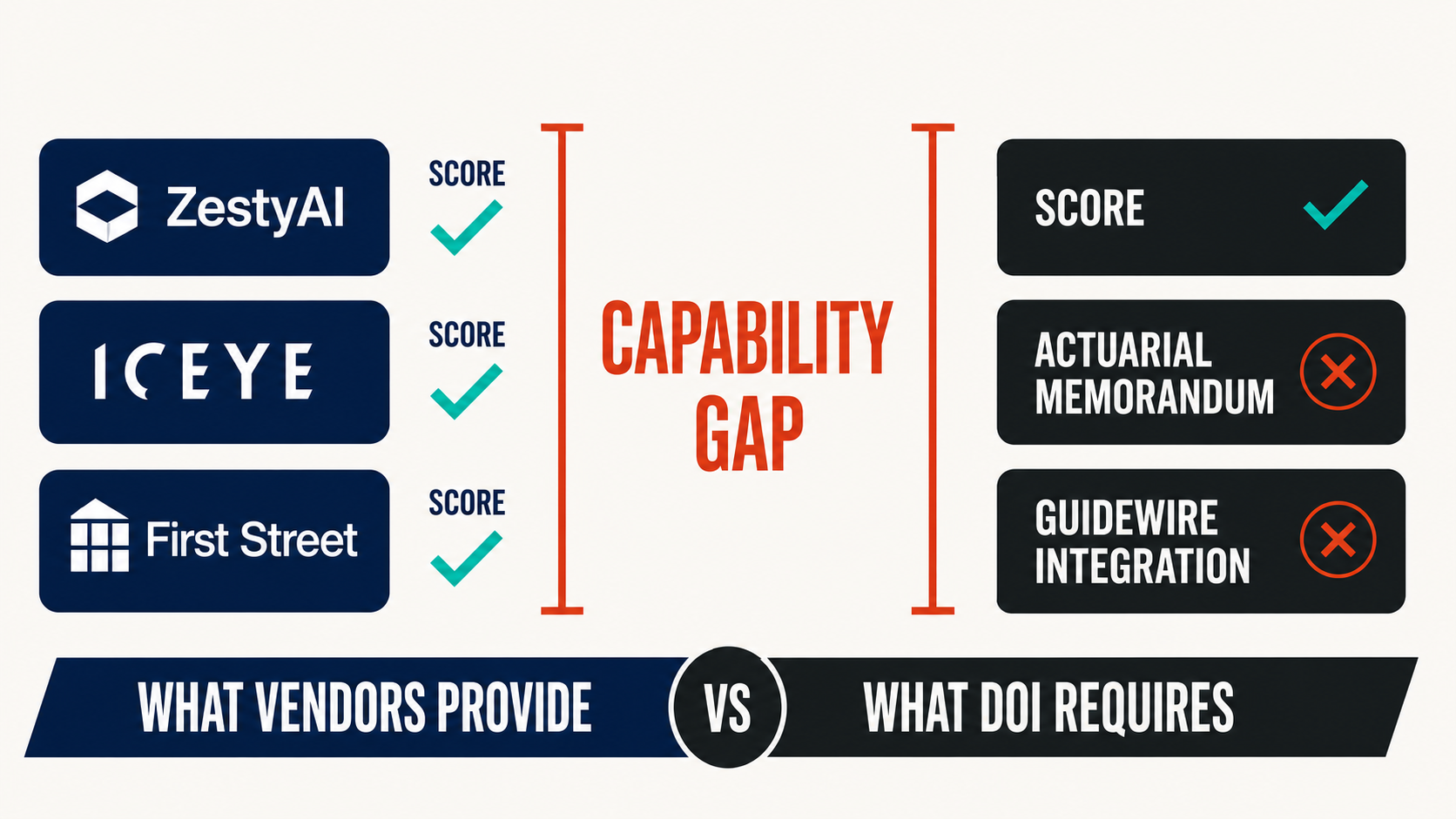
Every AI flood risk vendor solves a piece of the problem. None solves it end-to-end, and the gap between "a score" and "an approved rate filing" is where most implementations quietly stall.
ZestyAI's Z-FLOOD score is production-proven at carrier scale — six partnerships in a single quarter is a signal the market has cleared the pilot-to-production threshold — but the model's internal opacity creates friction with DOI examiners who need actuarial memoranda they can actually parse, not API documentation. First Street's Flood Factor database carries the most comprehensive US pluvial coverage, but it's structured as a consumer-facing risk score, not as a regulatory rating factor; the documentation gap between "this is the score" and "this score earns a rate differential" is the carrier's problem to solve, not First Street's. ICEYE delivers the closest thing to real-time claims triage available — SAR-derived flood extent updated every six hours during an event, building-level depth estimates from 30+ satellites — but turning a GeoTIFF overlay into an adjuster routing workflow is pipeline engineering ICEYE doesn't provide.
Fathom (inside Swiss Re post-2023 acquisition) is building the most rigorous probabilistic event sets, and the Swiss Re relationship lends reinsurer credibility — but carriers with competing reinsurance arrangements may find the ownership structure creates a conflict in cat model procurement. Verisk's Flood Score 3.0 is the DOI's familiar face — which is precisely what makes it slow. The legacy architecture that built those carrier relationships is the same one that can't integrate a new property signal without an 18-month implementation cycle.
The right integration stack for most carriers combines three of these: a property-level CV score for rating, a SAR-based event monitor for claims triage, and a climate-forward hazard layer for loss scenario modeling. Every carrier we've spoken with wants that combination. No single vendor sells it.
Between a Score and an Approved Rate Filing
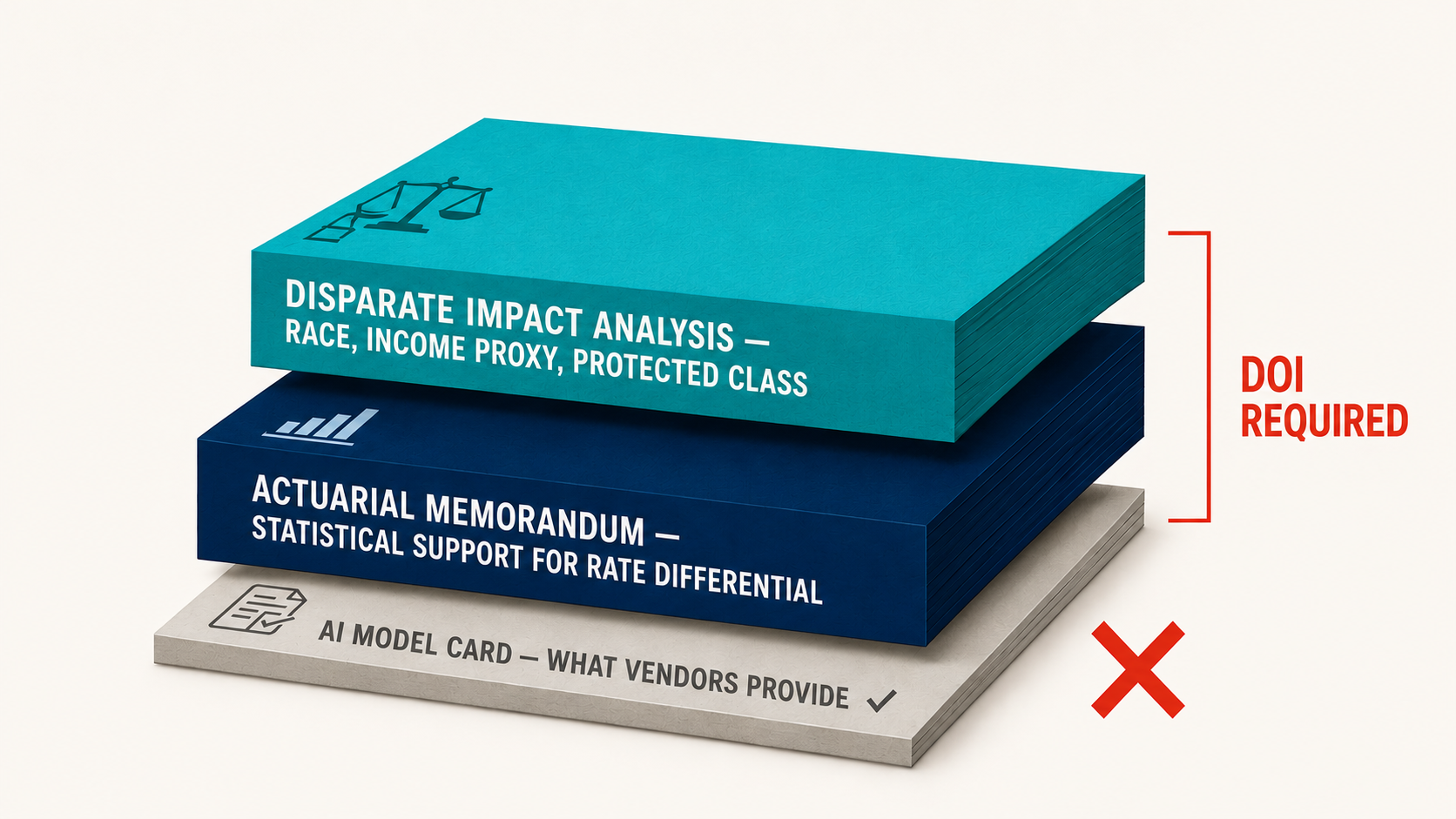
Filing a third-party AI score as a rating factor isn't attaching a vendor model card to a rate revision request. An actuarial memorandum demonstrating statistical support for the rate differential is required — not a model description, but a document demonstrating that the score earns the rate change it's being used to justify. The model description itself has to be written for a DOI examiner, which is a different reader than the carrier's own data science team. And in New York and Colorado, a separate disparate impact analysis is required showing the score doesn't produce discriminatory outcomes by race, income proxy, or protected class — a test the vendor does not conduct for you.
Vendor model cards document what the score does. They don't document that the score earns a rate differential a DOI will approve. Those are different documents, and vendors provide only the first one.
The NAIC AI Model Bulletin has now been adopted in 24+ states, and the documentation burden is expanding, not shrinking. NY DFS Circular 2024-7 adds an explicit disparate impact testing layer on top of the Model Bulletin baseline. The disparate impact test output has to cover correlations by zip for race, income proxy, and protected class — not just aggregate accuracy metrics. Carriers that assume a ZestyAI Z-FLOOD score arrives with filing-ready documentation are routinely surprised when the DOI examiner sends questions.
The Pluvial Blind Spot in the Loss Run
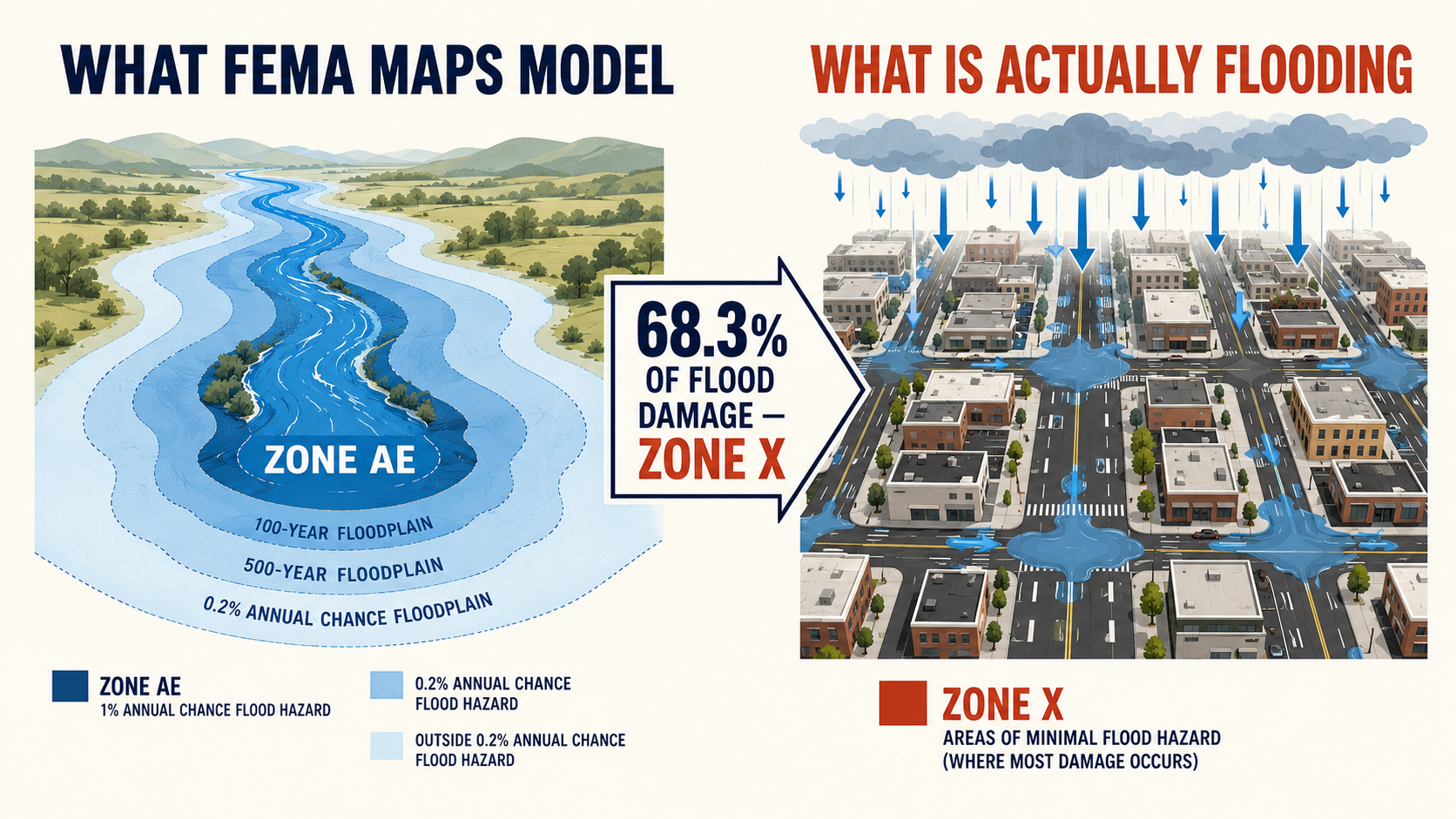
Most P&C flood loss analyses are organized around named events — Harvey, Ida, Florence. That framing makes urban rainfall flooding look episodic rather than structural, which is why it takes years to surface in traditional actuarial reserving.
Pluvial flooding — surface water from intense rainfall overwhelming local drainage capacity — is the fastest-growing component of residential flood losses and almost invisible to FEMA zone-based rating. The Zone X house in the Harris County scenario isn't at risk from a rising bayou. It's at risk because it has an 85% impervious surface ratio, zero first floor elevation, and sits on a storm sewer system designed for rainfall intensities that Harris County now routinely exceeds. The loss shows up in the loss run as a flood claim from a Zone X property — categorized as an anomaly, attributed to the named storm, repriced as a one-time cat event rather than as evidence of structural book-wide exposure.
That mismatch between what the cat model attributes causation to and what the adjuster sees on the claim is why pluvial losses accumulate in actuarial reserve development long before the pattern becomes statistically visible in a single carrier's book.
Getting the Score Into the Rating Engine
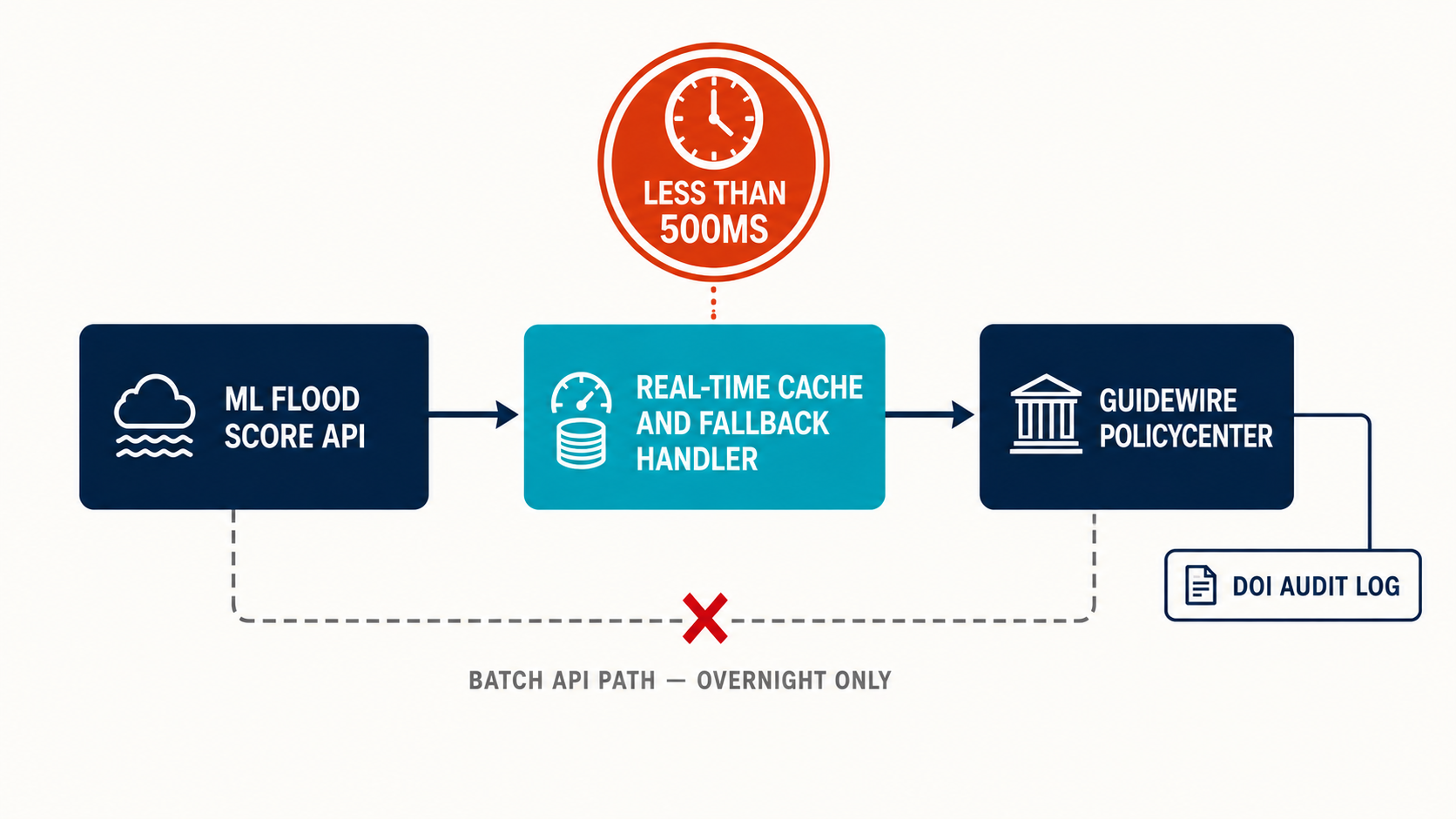
Approving the rating factor is one problem. Integrating the model output into Guidewire PolicyCenter at quote-bind latency is a separate engineering problem that vendors also don't solve.
Most ML flood score APIs are designed for batch enrichment — overnight portfolio sweeps that update property records before the underwriter opens the morning queue. Real-time quote-bind workflows require sub-500ms response time, proper caching for properties already scored, and fallback logic when the API returns a timeout or rate limit. Retrofitting a batch API for production real-time use while keeping the rating engine audit log clean for DOI review is where implementations routinely lose three to six months.
BriteCore added Torrent Flood and Taurus Flood integrations in March 2026. Guidewire's Integration Data Manager provides the framework. Neither addresses the latency and fallback engineering inside that framework.
Writing New Flood Business Without Getting Cream-Skimmed
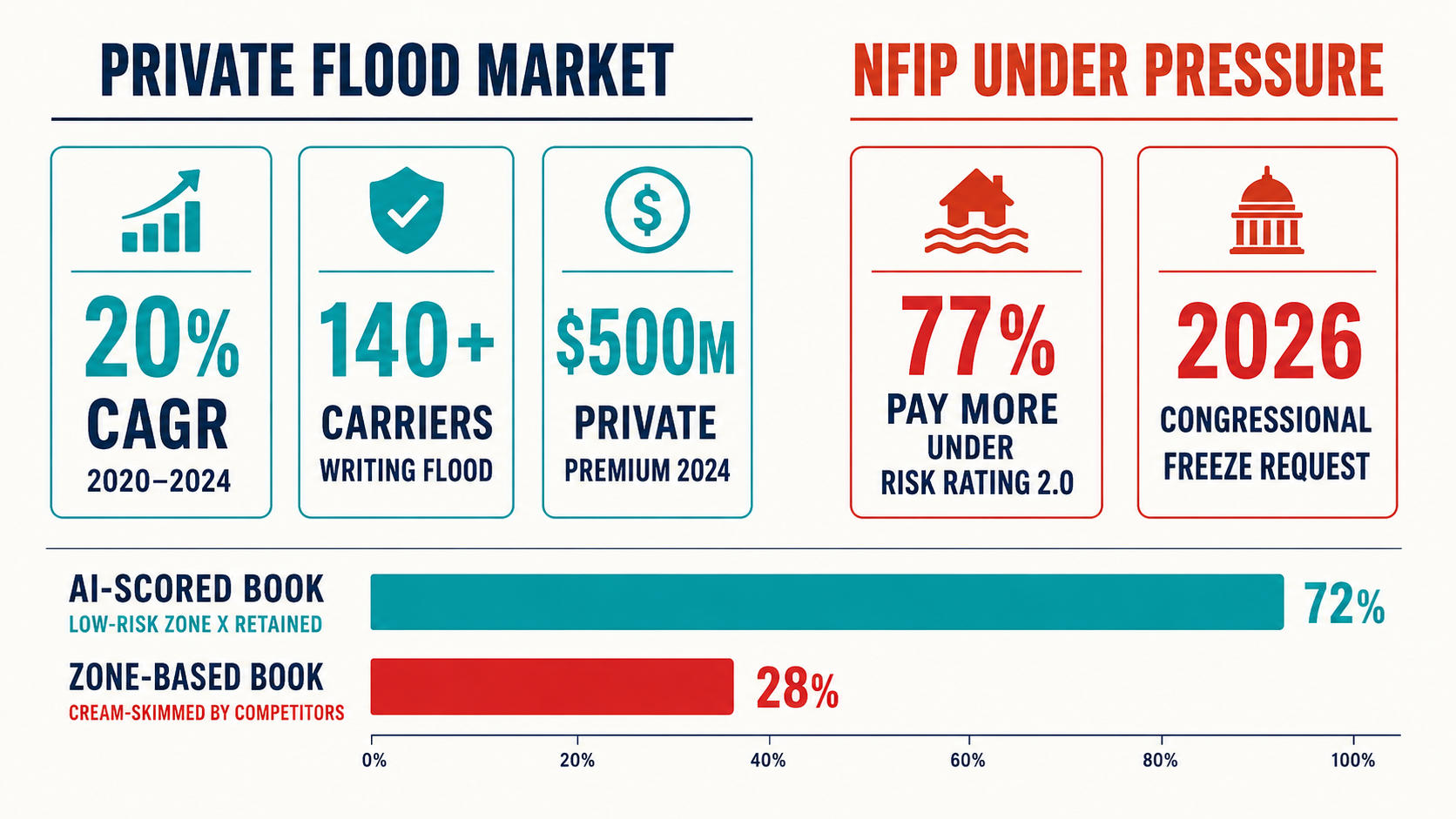
The private flood market has grown at 20% CAGR from 2020 to 2024, with approximately $500 million in private residential flood premium written in 2024 and 140+ insurers now offering policies (Resources for the Future / Beinsure). That growth reflects genuine buyer demand for alternatives to NFIP — Risk Rating 2.0 has caused 77% of NFIP policyholders to pay more, and a 2026 Congressional letter urged FEMA to halt further implementation. The instability is pushing buyers toward private alternatives.
The adverse selection risk in that migration is real. Carriers with property-level AI scoring — and the DOI filings to use it as a rating factor — are already cream-skimming the Zone X properties that are actually low-risk while correctly pricing the ones that aren't. Carriers still using FEMA zone as the primary rating variable are absorbing the remainder.
The architecture we built at AI-Powered Flood Risk Underwriting integrates vendor scores, SAR event monitoring, and the regulatory documentation into a unified rating factor. The integration work is the hard part. The combined ratio bridge chart — legacy zone-based versus AI-scored book — is the deliverable that makes a DOI filing defensible.
What It Will Actually Take to Get This Filed
The private flood market is bifurcating. On one side: carriers with property-level AI scoring and state-approved rate filings, accumulating favorable adverse selection as the NFIP destabilizes. On the other: carriers still anchoring on FEMA zones, being cream-skimmed on their best risks and retaining the worst ones at subsidized rates.
The practical question isn't whether to move to AI-based flood scoring. It's three operational questions running in parallel: which vendors produce actuarial memoranda your state's DOI examiner will actually accept; how you integrate the approved model output into your Guidewire or Duck Creek quote-bind workflow at real-time latency; and whether your current disparate impact testing approach covers what NY DFS Circular 2024-7 and the NAIC AI Model Bulletin actually require, not just what the vendor told you it covers.
We'd genuinely like to compare notes with underwriting teams working through those questions — the filing patterns vary by state, but the architecture questions converge faster than most people expect. What one DOI has accepted is often instructive about what the next one will.