
I've now been through enough flood underwriting engagements to know that the moment a carrier decides to move to property-level AI scoring, the hard part hasn't started yet.
The decision is usually driven by the same data point: 68.3% of US flood damage occurs outside FEMA high-risk zones (NC State/First Street). After Hurricane Harvey, 70% of Harris County's flood claims came from Zone X properties priced at minimal-hazard rates. That math lands. Carriers see it and want to move. And the vendor landscape has matured enough in 2026 that the scores themselves are genuinely good — ZestyAI signed six carrier partnerships in Q1 2026 alone; ICEYE's 30-satellite SAR constellation is now integrated into Munich Re and AXA's platforms. The data pipeline to identify the Zone X house that's actually a $8,400 expected-annual-loss property priced at $450/year exists.
What doesn't exist, and what I've watched carrier after carrier discover the hard way, is everything between the score and an approved DOI rate filing.
The Loss-Run Walk That Changed How I Think About This Problem
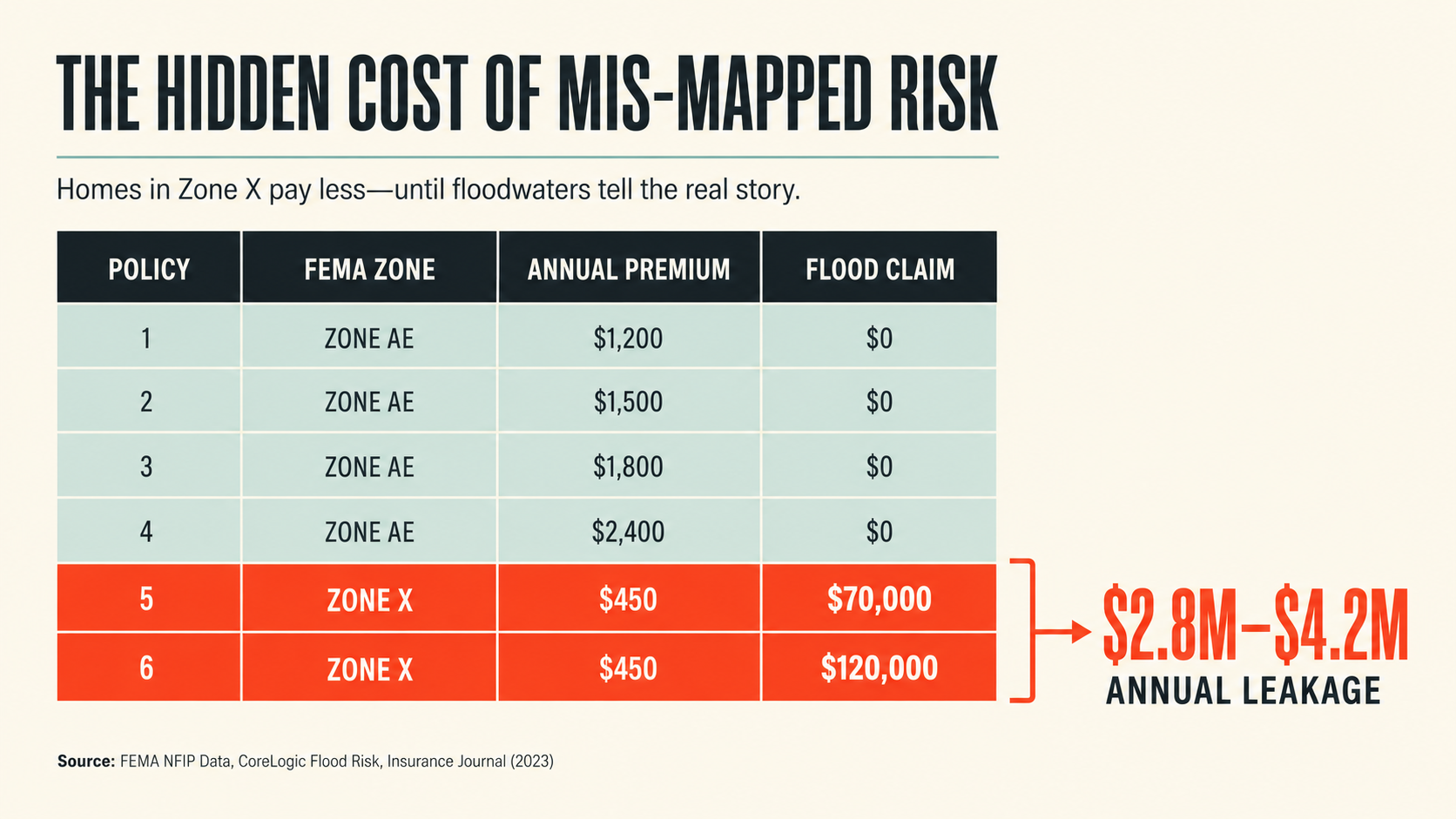
I first started understanding the real shape of this problem not from vendor pitches but from sitting with a Southeast Texas book's loss-run data. The carrier had flagged me to help them think through flood AI options after a rough cat season. What I found looking at the claim-to-zone mapping wasn't a handful of Zone X outliers — it was a structural pattern. Across 50,000 homeowners policies, roughly 30–40 properties in Zone X were generating $70K–$120K in flood claims per event against $450 annual premiums. On that book, the annual leakage from mispriced Zone X properties ran $2.8M–$4.2M.
The thing I couldn't stop thinking about: that pattern was invisible to the actuarial reserving process. The losses were categorized under named storm events (Harvey, Imelda), attributed to the storm, reserved as cat, and closed. Nothing in the process flagged "this Zone X property is structurally underpriced" — because the reserving process assumed the zone designation was correct. By the time the pattern would have surfaced statistically in a single carrier's book, it would have taken years.
That's the pluvial problem, and it's much bigger than most cat model frameworks acknowledge. Those Zone X properties weren't flooding because of a rising bayou. They were flooding because of 85% impervious surface ratios, zero first floor elevation, and storm sewer systems designed for 1.5-inch/hour peak rainfall that Harris County now routinely exceeds at 4+ inches per hour. The flood event was urban rainfall overwhelming local drainage — pluvial flooding — and it doesn't show up in FEMA zone designations because FEMA zones are built around river and coastal flood modeling, not rainfall runoff.
What Happened When the Actuary Tried to File the Score
The engagement I learned the most from wasn't one I led. It was a carrier whose actuary described to me what happened when they tried to file a ZestyAI Z-FLOOD score as a rating factor with their state DOI.
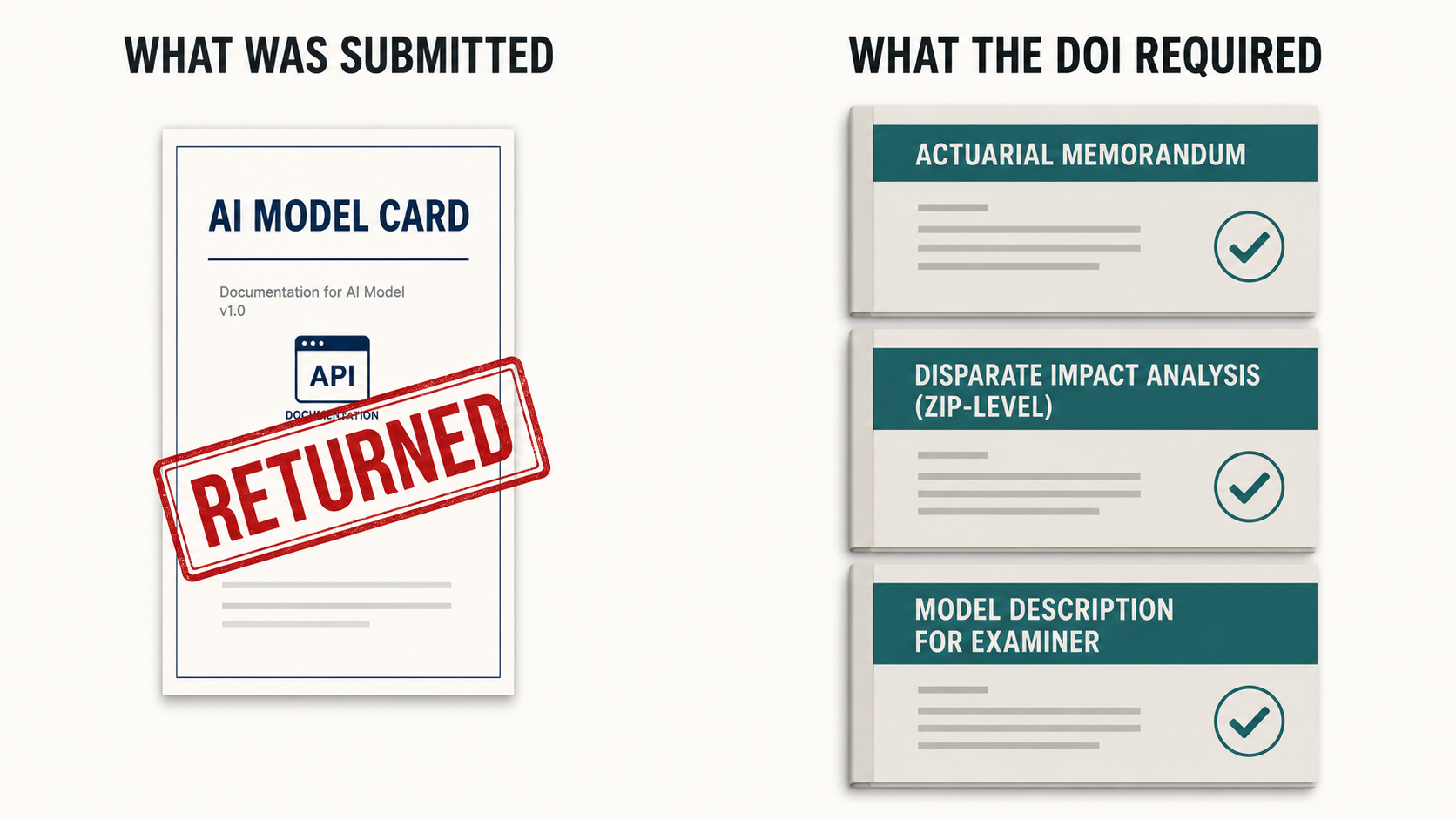
They'd bought the score. They'd validated it against their own claims history and it performed well. They put together a rate revision request, attached ZestyAI's model documentation, and submitted it. The DOI sent it back.
What was missing wasn't something ZestyAI had failed to provide. It was something ZestyAI can't provide by design: an actuarial memorandum demonstrating statistical support for the specific rate differential the carrier was applying. Not a description of what the model does — a document proving that this particular rate change is actuarially justified. In New York and Colorado, a disparate impact analysis is also required — a test showing the score doesn't produce discriminatory outcomes by race, income proxy, or protected class at the zip code level. The NAIC AI Model Bulletin is now adopted in 24+ states, and the documentation burden is expanding.
The vendor's model card describes their model. It doesn't prove your rate change. Those are different documents, and the carrier's actuarial team has to build the second one from scratch — or find someone who's already done it.
That conversation is why we built the regulatory documentation layer into what we do at AI-Powered Flood Risk Underwriting. The carriers who've gotten through the DOI filing have had to produce: combined ratio bridge charts comparing zone-based versus AI-scored books, disparate impact test outputs covering protected class correlations by zip, and model descriptions written for the examiner's reader context — not the data science team's. Vendors supply scores. The filing is the carrier's problem.
The API That Wasn't Built for What We Needed
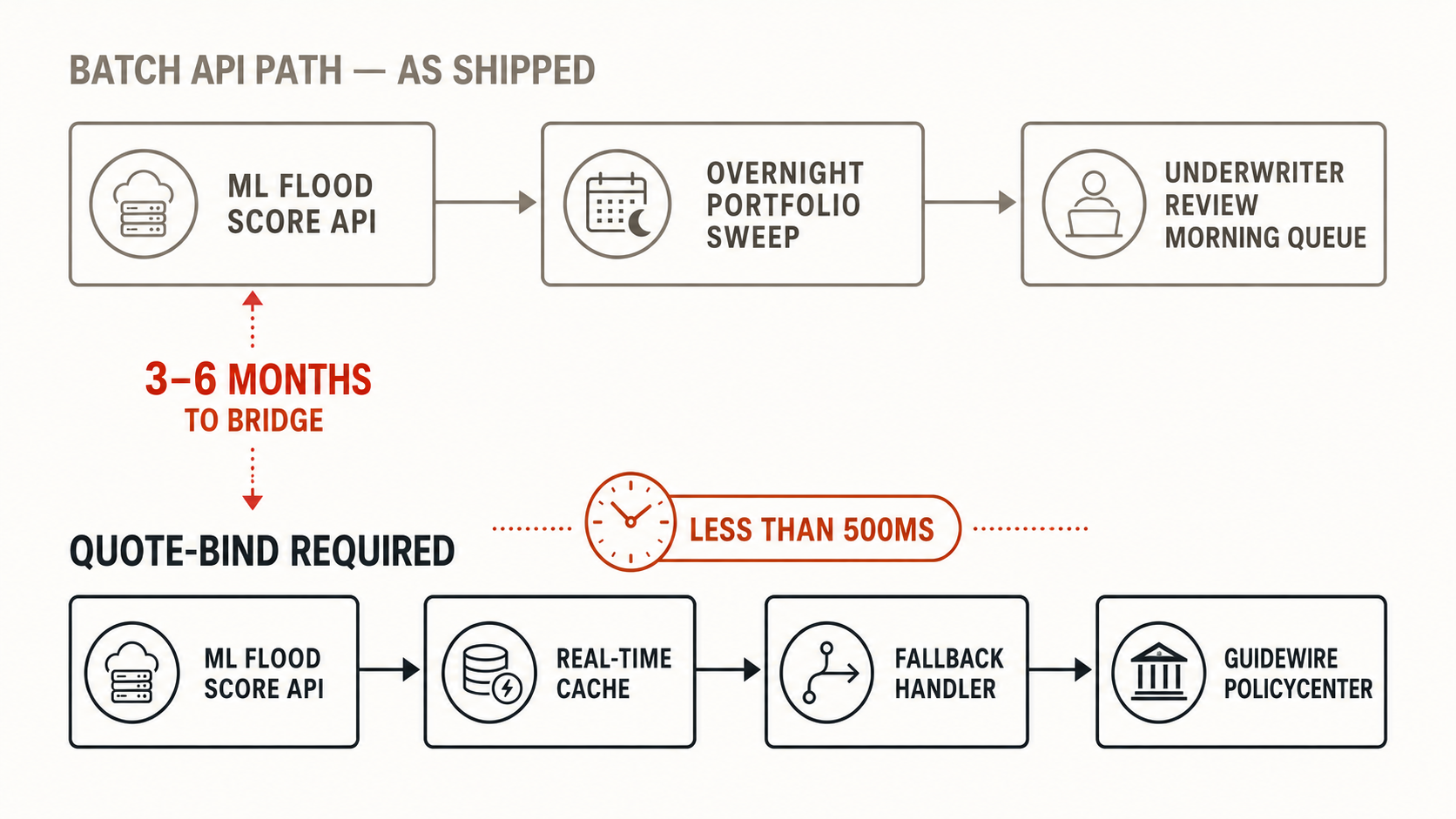
The integration problem surfaced late in an engagement that should have gone smoother. We were deep into architecture planning for a Guidewire PolicyCenter integration — flood score at quote-bind, real-time, sub-500ms — when our integration engineer pulled up the ZestyAI API documentation and flagged something I hadn't verified: the production API was built for batch enrichment. Overnight portfolio sweeps. Not real-time quote-bind.
That's not a ZestyAI failure — it's how most ML APIs are built when the primary use case is underwriting review, not real-time issuance. But for a carrier whose quote-bind workflow needed flood score integration with production-grade latency, it meant building a real-time wrapper around a batch API: response caching for properties already scored, fallback logic when the API times out or rate-limits, and audit logging clean enough that the DOI-facing documentation stayed consistent with what the rating engine was actually doing.
BriteCore added Torrent Flood and Taurus Flood integrations in March 2026. Guidewire's Integration Data Manager provides the envelope. What neither handles is the latency and fallback engineering inside that envelope — and that's where projects lose months.
The Vendor Question I Actually Get Asked
Every carrier conversation at some point gets to: "Should we go with ZestyAI, First Street, ICEYE, or build something ourselves?" And my honest answer has become: yes, probably three of those, but the vendor question is the wrong first question.
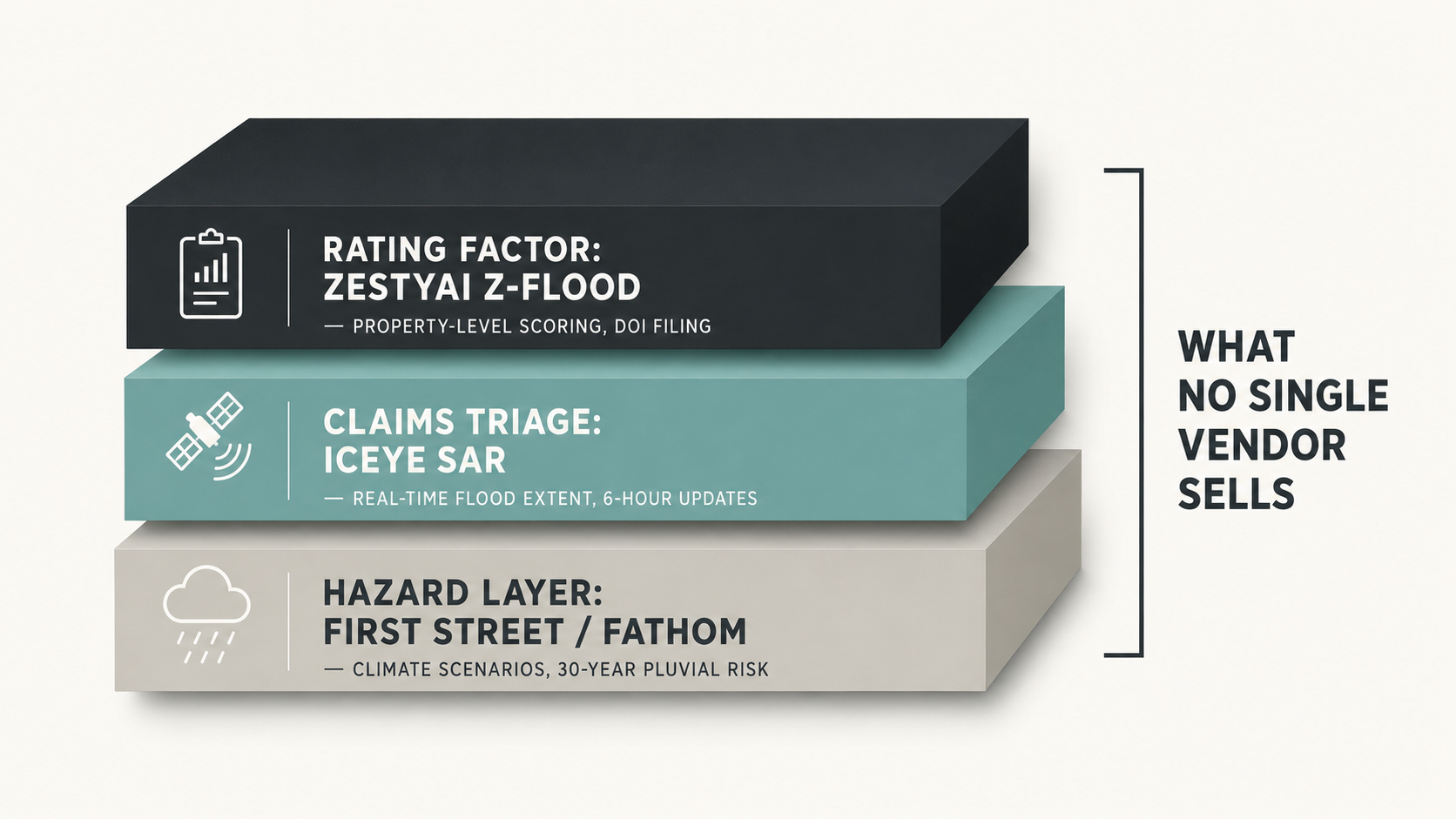
The integration stack that works for most carriers combines ZestyAI property-level CV scoring for rating (production-proven, carrier-network validated), ICEYE SAR event monitoring for claims triage (the only real-time option during a named storm — six-hour flood extent updates at building level, 30+ satellites), and First Street or Fathom for the climate-forward hazard layer (pluvial, fluvial, coastal, 30-year cumulative scenarios). Each vendor solves a different part of the stack. No single vendor sells the combination.
Fathom is now inside Swiss Re, which lends probabilistic modeling credibility but may complicate procurement for carriers with competing reinsurance relationships. The one I'd be careful about is Verisk Flood Score 3.0 — it's the examiner's familiar face, which is valuable, but I've seen carriers lose 18 months to integration timelines that the legacy architecture simply can't compress. First Street's Flood Factor database is the best pluvial coverage available for the US market, but it's not structured as a regulatory rating factor out of the box. The gap between "this is the score" and "this score earns a rate differential" is the carrier's problem to solve.
The right first question isn't which vendor. It's: what does your state's DOI expect to see in an actuarial memorandum for an AI-augmented rate factor, and do you have someone who's done one before?
Where This Is Actually Going
I've watched the private flood market grow at 20% CAGR from 2020 to 2024, with roughly $500 million in private residential premium written in 2024 and 140+ insurers now in the space (Resources for the Future / Beinsure) — and the pressure driving that growth is only increasing. NFIP Risk Rating 2.0 has caused 77% of policyholders to pay more, and a 2026 Congressional letter urged FEMA to halt further implementation. The structural pressure pushing buyers toward private alternatives isn't easing.
The carriers that come out well are the ones that complete state DOI filings for property-level AI scoring while the market is still growing — before the adverse selection pressure concentrates on the carriers still running zone-based rating. The ones who've done the filing work have a structural advantage: they can write Zone X policies with accurate pricing, cream-skim the genuinely low-risk properties, and decline or correctly price the ones that look like $450/year in NFIP terms but cost $8,400 in expected annual loss.
The filing process takes time. The integration engineering takes time. The carriers I've watched move fastest are the ones who started the regulatory work before they thought they needed to — before the combined ratio crisis, not after it.
You can see the full architecture we built at AI-Powered Flood Risk Underwriting.
The question I keep coming back to: at what combined ratio does a carrier decide the DOI filing work is worth doing? The 2025 homeowners combined ratio projection is 106.1% (III/AM Best). I'd argue the math crossed that threshold a while ago — most carriers just haven't done the integration and filing work to act on it yet.