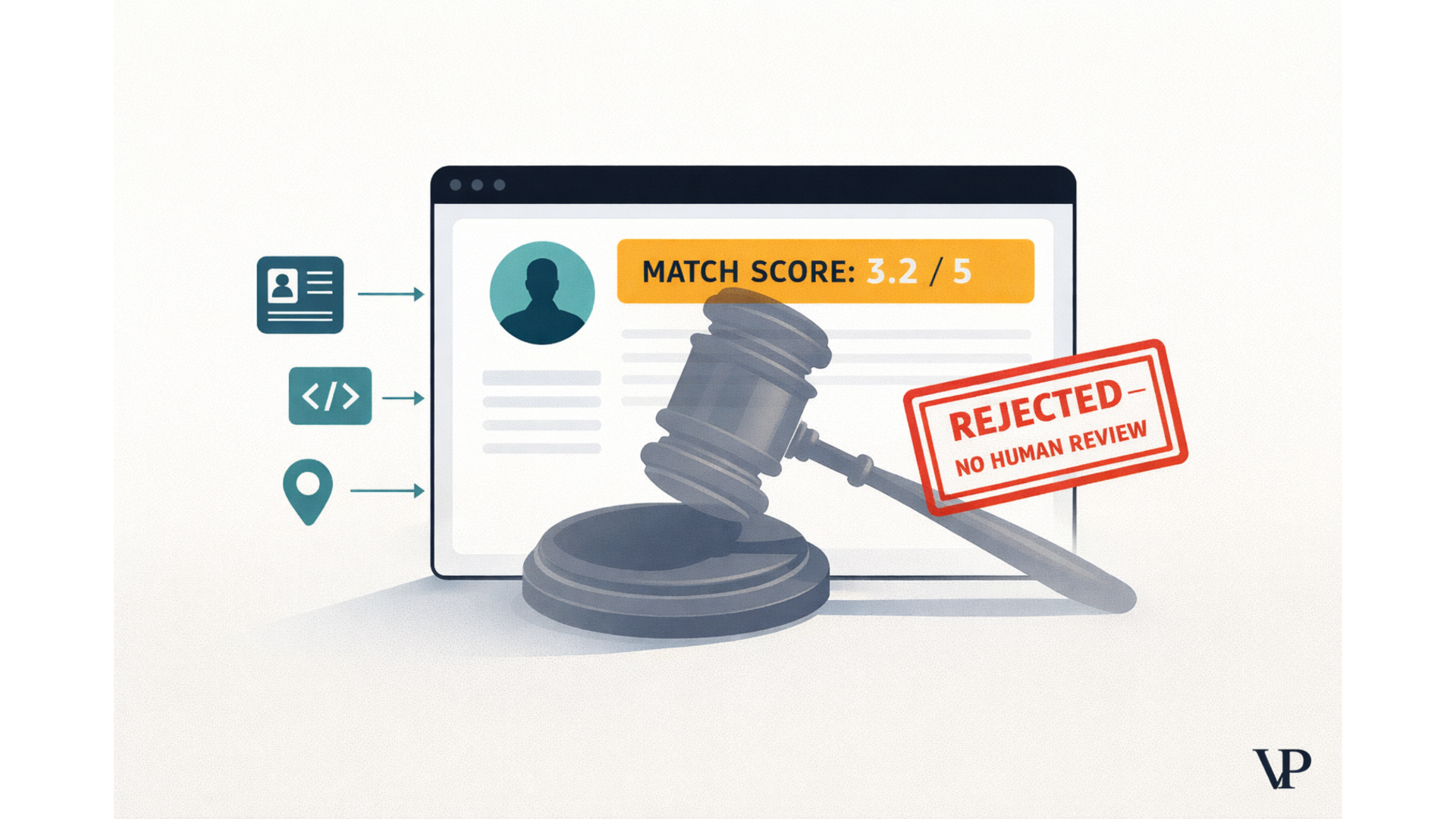
Two job applicants — one with nearly 20 years of product management experience, the other with over a decade in project management — applied to roles at PayPal and Microsoft. Both were rejected almost immediately. Neither ever spoke to a human. The reason? An AI hiring tool had already scored them using data they never consented to share, generated a secret "match score" they couldn't see, and filtered them out before a recruiter glanced at their names. In January 2026, they sued. And the ripple effects of that lawsuit — Kistler v. Eightfold AI — are about to reshape how every enterprise thinks about the AI tools in its technology stack.
This isn't a story about one vendor's legal troubles. It's about an architectural problem hiding inside thousands of companies that adopted AI hiring tools during the "Talent Intelligence" gold rush. The tools were fast, the demos were impressive, and nobody asked what was happening under the hood. Now, with Microsoft, Morgan Stanley, Starbucks, and PayPal named as Eightfold customers caught in the fallout, the question is no longer whether your AI tools are legally defensible. It's whether you even know enough about them to answer that question.
We've spent the last several months analyzing the technical and regulatory dimensions of this case. What we found goes far beyond one lawsuit — it reveals a systemic gap between how enterprise AI is built and what the law now demands. We published our full interactive analysis here, and the conclusions should concern anyone who signs off on AI procurement.
A 55-Year-Old Law Meets a Modern AI System
The legal theory at the center of the Eightfold case is deceptively simple. The plaintiffs argue that Eightfold isn't just a software vendor — it's functioning as a consumer reporting agency, the same legal category as Equifax or TransUnion.
Why does that matter? Because consumer reporting agencies are governed by the Fair Credit Reporting Act (FCRA), a law passed in 1970. Under the FCRA, any third-party report used to determine someone's eligibility for employment is a "consumer report." The person it's about has the right to know the report exists, see what's in it, and dispute anything that's wrong.
The lawsuit alleges that Eightfold's "match scores" — proprietary ratings from 0 to 5 that predict a candidate's "likelihood of success" — are exactly these kinds of reports. Candidates were scored, filtered, and rejected based on data allegedly harvested from LinkedIn profiles, GitHub repositories, and business databases, without ever being told any of it was happening.
If the courts agree that AI hiring scores are consumer reports, every vendor that ranks candidates will face the same compliance burden as a traditional background check company.
The implications cascade quickly. Enterprises can't simply point at their vendor and say "they handled it." Under the FCRA framework, the employer bears responsibility for ensuring proper disclosure, access, and adverse action procedures — regardless of which tool generated the score.
What Was Actually Harvested — And Why It Matters
The complaint describes a data collection operation that goes far beyond what most HR leaders would expect from a hiring tool. While Eightfold has denied these allegations, the lawsuit paints a picture of a system pulling from professional networks, version control platforms, internet browsing behavior, device activity, cookies, and even real-time location data.
The alleged scale is staggering: 1.5 billion data points spanning every industry globally. If accurate, this makes the platform less like a hiring tool and more like a global profiling engine.
For candidates, this creates what privacy researchers call "shadow profiles" — comprehensive dossiers assembled without explicit opt-in. For employers, it creates a different problem entirely: you may be making hiring decisions based on data your candidates never provided and never agreed to share. And in 2026, that's not just ethically questionable. In an increasing number of jurisdictions, it's illegal.
The Real Problem Is Architectural, Not Just Legal
The Eightfold case is a symptom. The disease is how most enterprise AI tools are actually built.
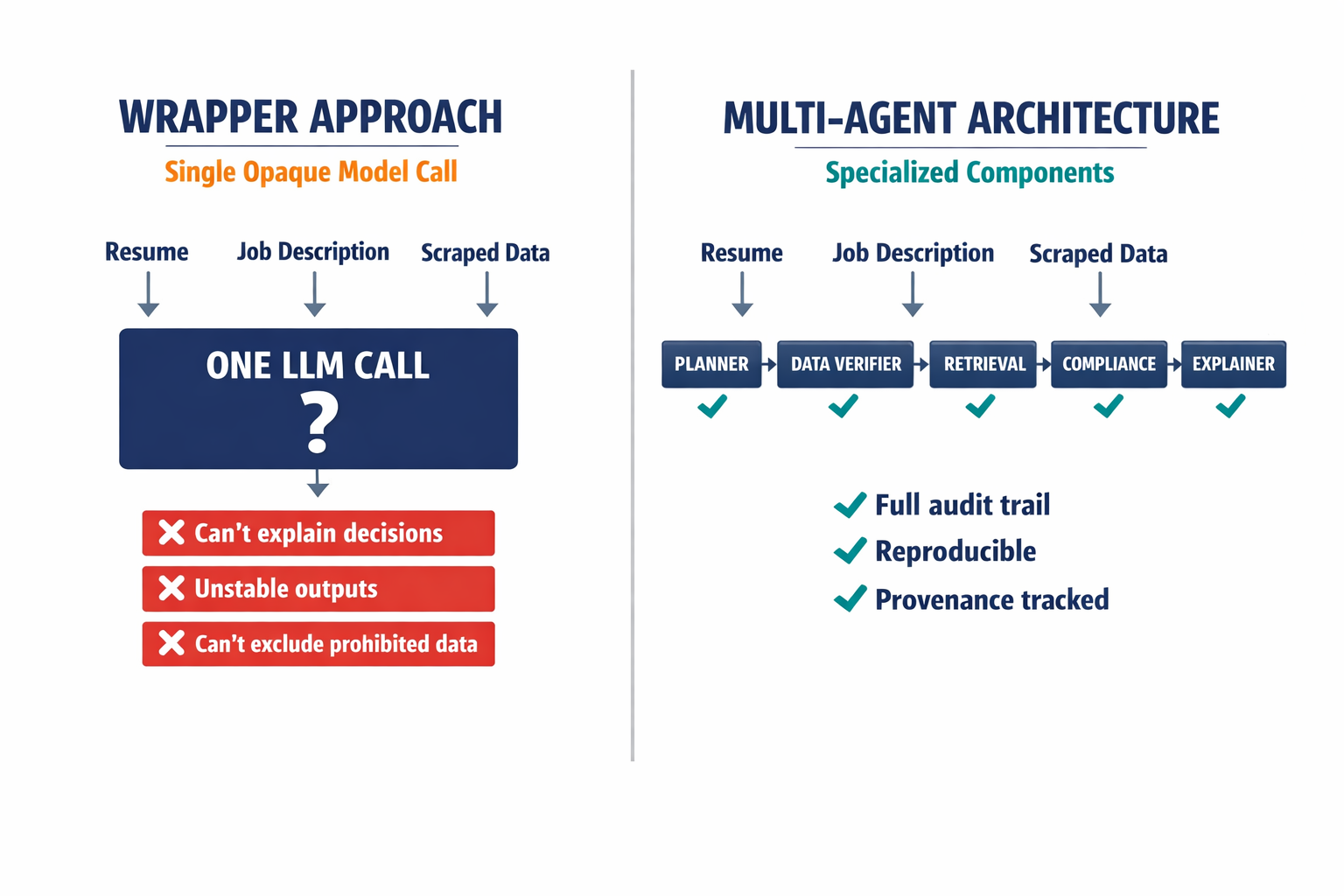
The vast majority of AI hiring tools on the market today are what the industry calls "wrappers" — applications that put a polished interface on top of a large language model like GPT-4 or Claude. The wrapper collects inputs (resumes, job descriptions, maybe some scraped data), stuffs everything into a single massive prompt, and asks the model to screen, rank, and justify its decisions all at once.
This approach has a name in engineering circles: the "mega-prompt" trap. And it has three fatal flaws for high-stakes decisions.
It can't prove why it made a decision. Because the reasoning happens inside a single opaque model call, there's no step-by-step record of which factors drove the outcome. When a regulator or a judge asks "why was this candidate rejected?", the honest answer is: we don't know exactly.
Tiny changes produce wildly different results. Rephrasing a job description or changing the order of bullet points in a resume can shift a candidate's score. That's not a system making principled decisions — it's a system making probabilistic guesses that happen to look authoritative.
It can't guarantee it ignored prohibited data. If age, location, or university prestige was embedded somewhere in the input data, the model may have used it. There's no mechanism to verify otherwise. In the context of the Eightfold lawsuit, this is the gap that transforms bias from a fixable bug into an unmanageable legal risk.
The question isn't whether your AI hiring tool has bias. It's whether your tool can prove it doesn't — and right now, most can't.
The 2026 Regulatory Wave Is Already Here
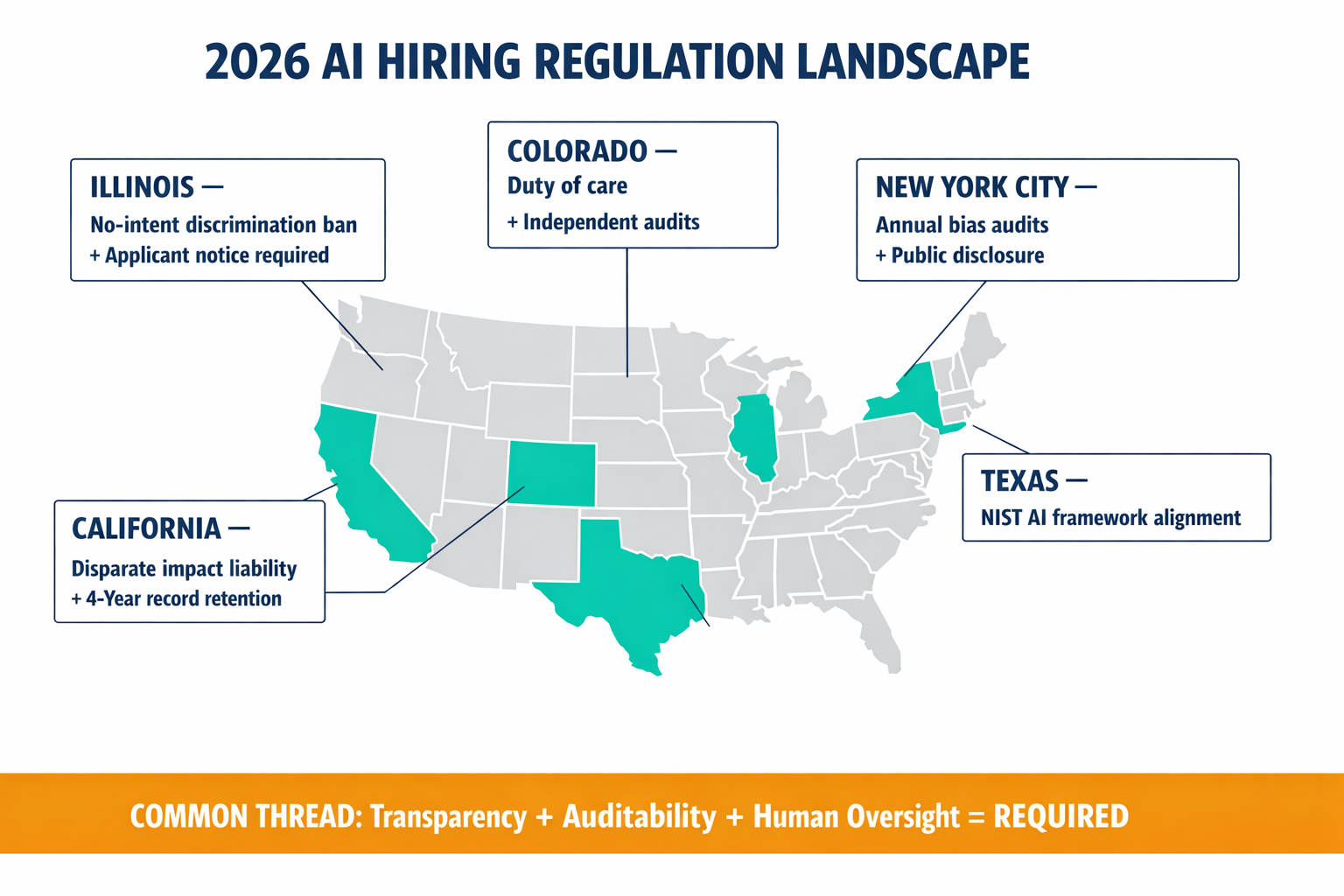
The Eightfold lawsuit arrived at the worst possible moment for companies hoping the regulatory environment would stay vague. It didn't. In 2026, AI hiring is governed by a patchwork of overlapping laws that effectively end the era of deploying these tools without rigorous oversight.
Illinois (HB 3773), effective January 2026, prohibits AI that "has the effect" of discrimination — intent doesn't matter — and requires "easily understandable" notices to every applicant.
California (SB 53) imposes liability for disparate impact regardless of intent and mandates four years of record retention for automated decision systems.
Colorado's AI Act, effective June 2026, creates a legal "duty of care" requiring routine independent audits of high-risk AI systems.
New York City's Local Law 144 already requires annual independent bias audits and public disclosure of results for any automated employment decision tool.
And Texas (TRAIGA) recommends alignment with the NIST AI Risk Management Framework, signaling that federal standards may not be far behind.
The common thread across all of these: transparency, auditability, and human oversight are no longer optional. If your AI vendor can't provide a clear audit trail showing exactly how a decision was made, you're exposed — not the vendor. The liability stays with the employer.
What Accountable AI Architecture Actually Looks Like
Moving from opaque wrappers to defensible systems requires rethinking how AI makes decisions at a structural level. Our team has been building what we call Specialized Multi-Agent Systems — architectures where the work of evaluating a candidate isn't handed to a single model in a single pass. Instead, it's distributed across purpose-built components, each with a defined role and a complete audit log.
Think of it like the difference between asking one person to simultaneously be judge, jury, investigator, and compliance officer versus having each role handled by a specialist who documents their work.
In practice, this means a planning component determines the required workflow based on the applicant's jurisdiction and current law. A separate data verification component checks the origin of every data point — flagging anything that wasn't directly submitted by the candidate. A retrieval component queries only authorized internal sources. A compliance component reviews the entire process log before any score is finalized, checking for prohibited factors. And an explainability component translates the technical decision into plain language that satisfies legal disclosure requirements.
Each of these components produces its own record. If a candidate in Illinois is evaluated, the system can demonstrate that proper notice was given before screening began, that only consented data was used, and that no prohibited attribute influenced the outcome. For the full technical architecture, see our detailed research.
Outsourcing AI doesn't outsource liability. The enterprise remains responsible for every decision its tools make.
Explainability Isn't a Feature — It's the Whole Point
The central grievance in the Eightfold lawsuit is that candidates couldn't see or challenge the scores that determined their fate. Solving this isn't just a legal necessity; it's an engineering problem with well-established solutions that most AI hiring vendors simply haven't implemented.
Techniques like SHAP (Shapley Additive Explanations) can show exactly which candidate attributes — specific skills, certifications, years of relevant experience — contributed to a score and by how much. Instead of a mysterious number between 0 and 5, you get a transparent breakdown: "+0.8 for Project Management certification, -0.5 for lack of Python experience."
Counterfactual explanations go further, answering the question candidates actually care about: "What would I need to change to get a different outcome?" This transforms a rejection from a dead end into actionable feedback — and dramatically reduces the legal friction that fuels class-action lawsuits.
The technology exists. The math is well-understood. What's been missing is the will to implement it, because explainability adds engineering complexity that wrapper-based tools were specifically designed to avoid.
What Should Your Team Do This Quarter?
If your organization uses any AI tool that screens, ranks, or scores job candidates, three actions deserve immediate attention.
Audit what you actually have. Work with legal counsel to inventory every tool involved in hiring decisions. Don't accept vendor labels at face value — a system marketed as "Talent Intelligence" may functionally be a consumer reporting agency under the FCRA. Ask your vendors directly: What data sources do you use? Do you pull information from outside the application? Do you generate scores or rankings?
Require explainability, not just accuracy. When evaluating AI vendors, "our model is 95% accurate" is no longer a sufficient answer. Ask: Can you show me exactly why this candidate was ranked third? Can you prove that location data didn't influence the score? Can you reproduce this decision six months from now if a regulator asks?
Treat AI output as input, not verdict. Train hiring teams to use AI scores as one signal among many, never as an automatic filter. Log the reasoning when a recruiter overrides a score in either direction. This creates the defensible human-in-the-loop process that every 2026 regulation requires.
The era of "move fast and break things" in AI hiring is over. What replaces it is an era where the quality of your AI architecture determines your legal exposure.
Does This Apply If We Built Our AI In-House?
Yes — and in some ways the risk is greater. Third-party vendors at least have legal teams thinking about compliance. Internal tools built by engineering teams often lack formal bias audits, explainability layers, or data provenance tracking. The same regulatory requirements apply regardless of who built the system.
Is This Just a U.S. Problem?
Not remotely. The EU AI Act classifies employment AI as "high-risk," requiring conformity assessments, human oversight, and detailed technical documentation. Organizations operating globally face compliance obligations on multiple fronts simultaneously. The Eightfold lawsuit may be filed in California, but its implications extend to any company making automated hiring decisions anywhere.
The Standard Has Changed
The Eightfold litigation marks the moment when enterprise AI accountability shifted from aspiration to legal requirement. For organizations that moved quickly to adopt AI hiring tools, the uncomfortable question is whether those tools can withstand the scrutiny that's now inevitable.
The answer, for most, is that they don't know — and that uncertainty is itself the risk. The path forward isn't abandoning AI in hiring. It's demanding that the systems making life-altering decisions about people's careers operate with the same transparency, auditability, and rigor we'd expect from any other system that determines someone's future.
We'd welcome hearing how your organization is approaching this transition — particularly if you've started auditing your existing tools or rethinking vendor requirements. The companies that get this right in 2026 won't just avoid lawsuits. They'll build hiring processes that are genuinely better for everyone involved.