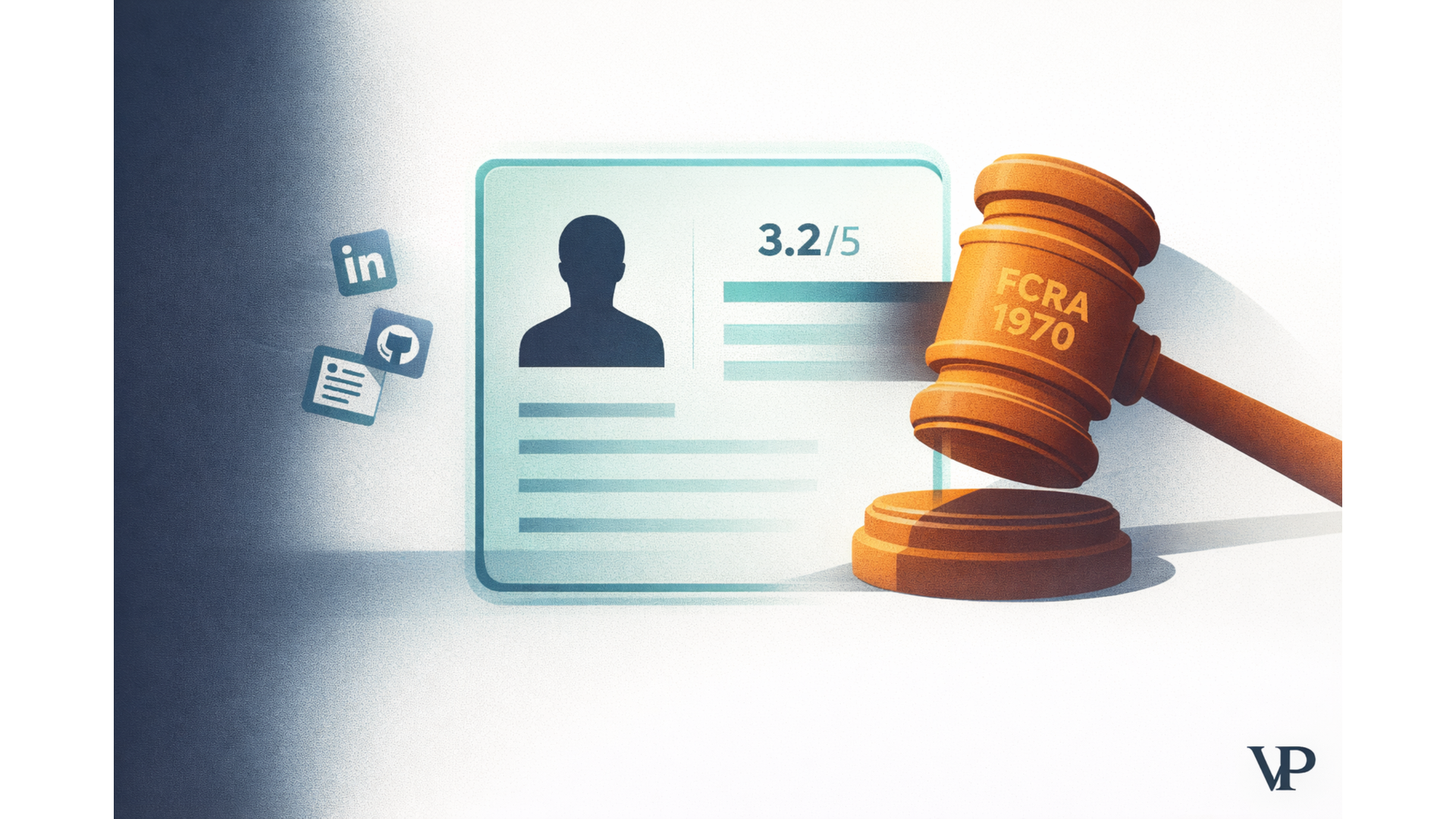
Two job applicants — one with nearly 20 years of product management experience, the other with a decade in project management — applied to roles at PayPal and Microsoft. Both were rejected almost immediately. Neither ever spoke to a human. The AI hiring tool that filtered them out had built secret dossiers on them using data they never submitted, generated match scores they never saw, and made decisions they couldn't appeal. In January 2026, they sued.
The class-action lawsuit against Eightfold AI isn't just another tech company getting dragged into court. It's the moment AI hiring tools collided with the Fair Credit Reporting Act — a consumer protection law signed in 1970, long before anyone imagined algorithms would decide who gets a job interview. And the fallout is reaching companies you'd recognize immediately: Microsoft, Morgan Stanley, Starbucks, PayPal.
I've spent the last several months studying this case and its implications, and what strikes me isn't the lawsuit itself. It's that the entire technical architecture most AI hiring tools are built on was never designed to survive this kind of scrutiny.
A 1970 Law Just Became the Biggest Threat to AI Hiring
The plaintiffs' legal argument is deceptively simple. Under the FCRA, any third-party report used to determine someone's eligibility for employment is a "consumer report." If you generate that report, you're a consumer reporting agency — subject to strict rules about disclosure, access, and the right to dispute errors.
The lawsuit alleges that Eightfold's match scores — ratings from 0 to 5 predicting a candidate's "likelihood of success" — are exactly these reports. The platform allegedly harvested data from LinkedIn profiles, GitHub repositories, and business databases to build candidate profiles without consent. It then used those profiles to score and filter applicants before a recruiter ever saw their names.
If your AI vendor scores candidates using data they didn't submit, you may already be operating an unlicensed credit bureau for employment.
Eightfold has denied these claims, stating it only uses data submitted by candidates or provided by customers. But the legal theory doesn't require proving the data was inaccurate. It requires proving that candidates were never told a report existed, never given access to it, and never offered a chance to correct it.
That's a procedural failure. And procedural failures are exactly what class-action lawsuits are built on.
Why I Started Calling This the "Second Accountability Gap"
For years, the AI ethics conversation in hiring focused on one question: Is the algorithm biased? That mattered, and it still does. But the Eightfold case reveals a second, deeper problem — one that has nothing to do with whether the algorithm's outputs are fair.
It's about whether candidates know they're being scored at all.
I remember the moment this clicked for my team. We were reviewing the complaint's description of how the system "lurks" behind job applications, collecting behavioral signals, location data, and internet activity. Someone said, "This isn't a hiring tool. This is surveillance with a match score attached."
That's the second accountability gap. The first gap was about biased outcomes. This one is about consent, transparency, and the fundamental right to know how you're being judged. The Eightfold lawsuit alleges the platform amassed 1.5 billion data points across every industry — a scale of profiling that resembles a global credit bureau more than a recruiting tool.
And the enterprises using these tools? They're not off the hook. Outsourcing the technology doesn't shift the liability.
The Architecture That Created This Mess
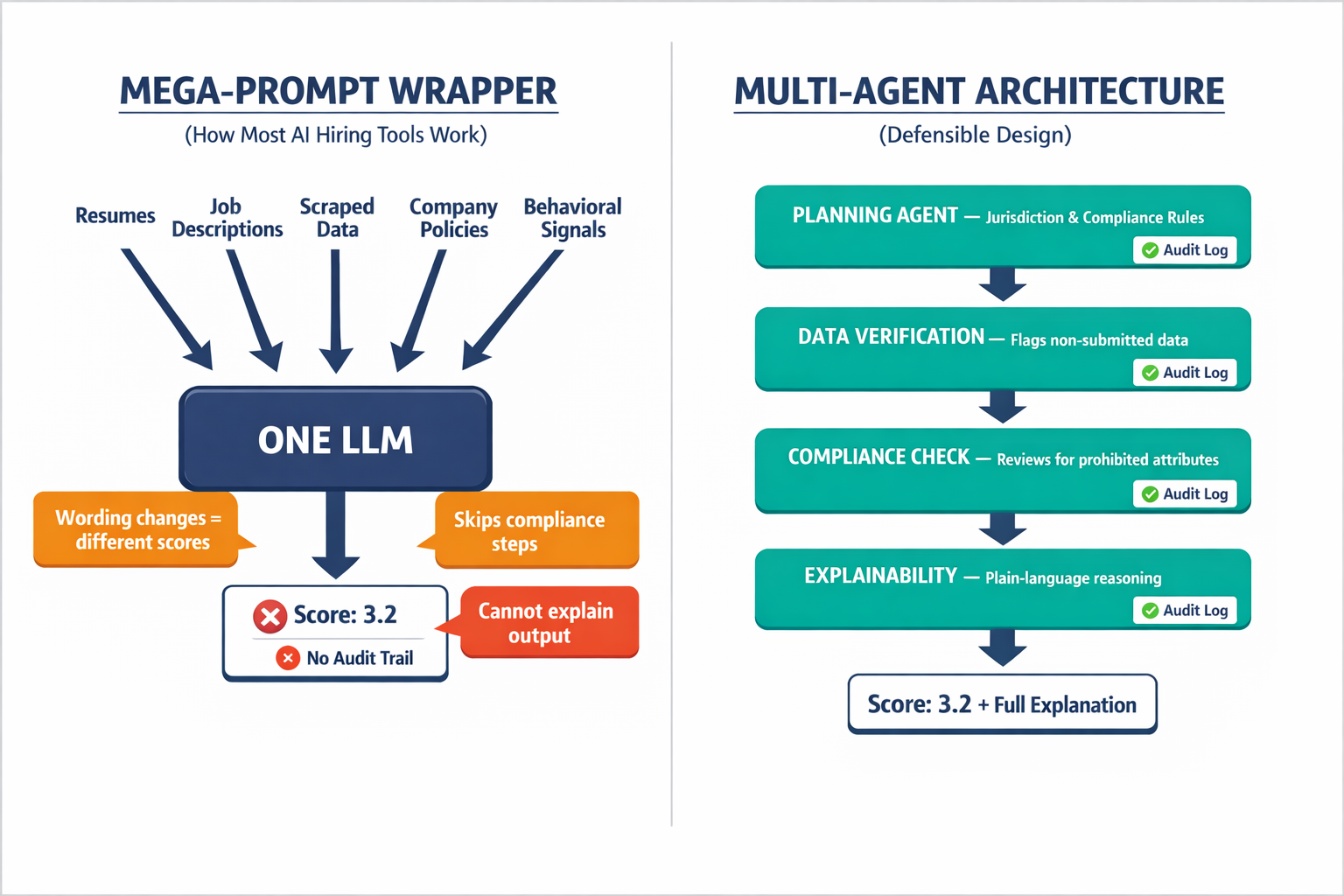
When I look at what went wrong technically — not legally, but in the engineering — I see a pattern we've been warning about for years. Most AI hiring tools are what the industry calls "LLM wrappers." They take a large language model like GPT-4 or Claude, wrap a user interface around it, and feed it everything at once: resumes, job descriptions, company policies, and whatever external data they can scrape.
This is the "mega-prompt" approach. Cram everything into one massive input, ask the model to screen, rank, and justify in a single pass, and hope for the best.
The problems with this are structural, not cosmetic:
Tiny wording changes produce different results. Rephrase the prompt slightly, and the same candidate gets a different score.
The model frequently skips required steps. If compliance checks are buried in natural language instructions, the AI may simply ignore them.
Nobody can explain the output. When a candidate asks "Why was I rejected?", there's no audit trail — just a black box that produced a number.
I explored this architectural problem in depth in our interactive analysis of the Eightfold case, and the conclusion is uncomfortable: the mega-prompt wrapper was never built to be accountable. It was built to be fast and cheap. Those priorities are now colliding with a regulatory environment that demands the opposite.
2026: The Year Compliance Became Non-Negotiable
The Eightfold lawsuit isn't happening in isolation. It's the leading edge of a regulatory wave that's already reshaping how every enterprise deploys AI in hiring.
Consider what took effect in just the first half of 2026:
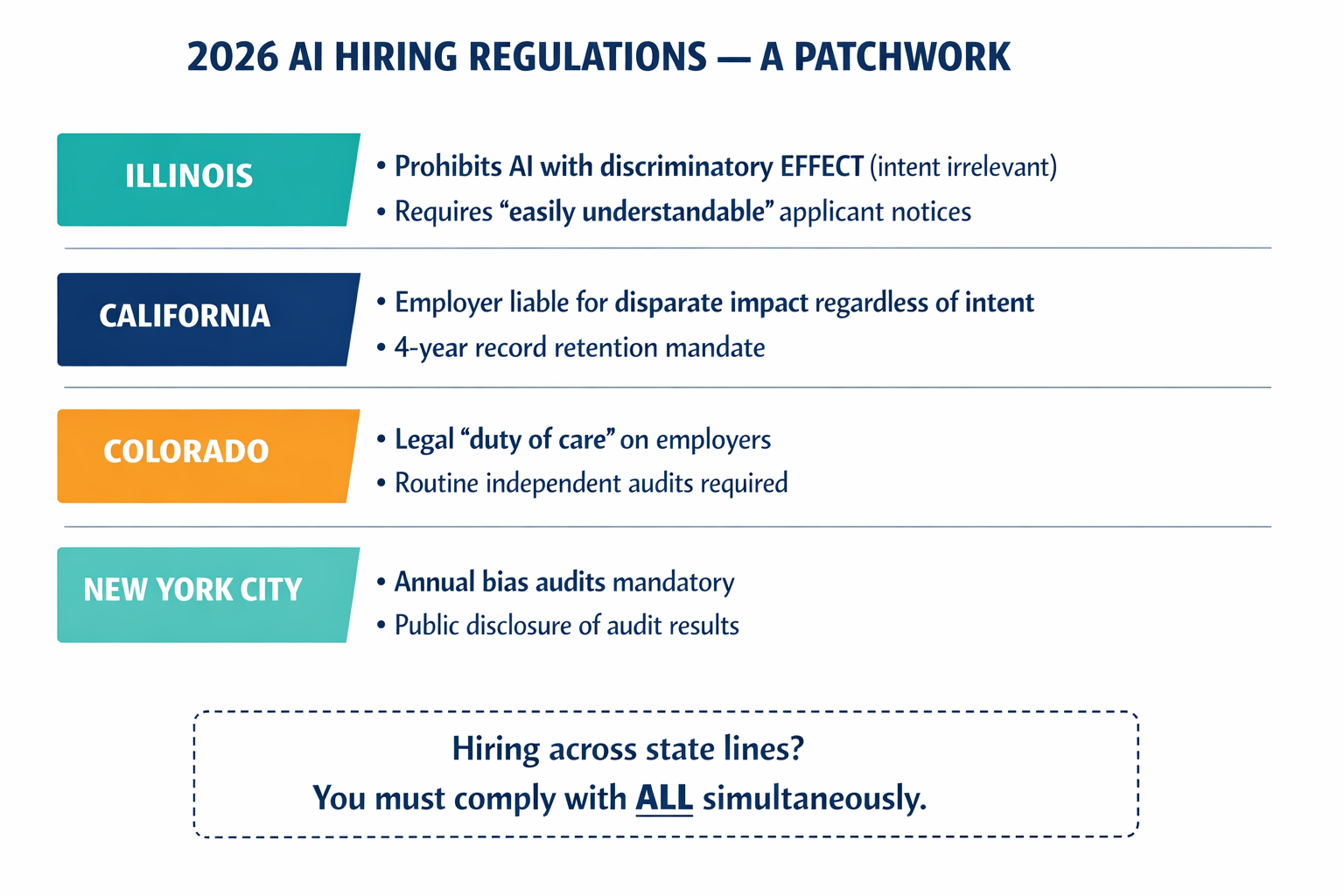
Illinois now prohibits AI hiring tools that "have the effect" of discrimination — intent doesn't matter — and requires "easily understandable" notices to every applicant.
California holds employers liable for disparate impact regardless of intent and mandates four years of record retention.
Colorado imposes a legal "duty of care" requiring routine independent audits of AI hiring systems.
New York City's Local Law 144 already requires annual bias audits and public disclosure of results.
The "move fast and break things" era of AI hiring is over. In 2026, if you can't explain a rejection, you can't legally make one.
This isn't a single federal standard you can comply with once. It's a patchwork — and if you're hiring across state lines, you're subject to all of it simultaneously. The compliance burden isn't theoretical. It's operational, ongoing, and expensive to get wrong.
What a Defensible AI Hiring System Actually Looks Like
After the Eightfold complaint became public, I had a conversation with our engineering lead that changed how I think about this problem. I asked: "Could we reproduce any past decision our system made — the exact inputs, the exact reasoning, the exact output — six months later?" The answer needs to be yes. For every candidate. Every time.
That's the standard now. And meeting it requires a fundamentally different architecture than what most vendors are selling.
Instead of feeding everything to one model in one shot, a defensible system distributes the work across specialized components — each with a defined role, limited permissions, and its own audit log. Think of it less like asking one genius to do everything and more like assembling a team where each member handles one part of the process and documents their work.
The critical pieces look something like this. A planning component determines which compliance rules apply based on the candidate's jurisdiction — if they're in Illinois, mandatory disclosure happens before any screening begins. A separate data verification component checks the origin of every data point and flags anything the candidate didn't submit themselves. A compliance component reviews the entire process before any score is finalized, checking whether prohibited attributes like location or university prestige influenced the outcome. And an explainability component translates the technical decision into plain language for both the recruiter and the candidate.
None of this is optional anymore. It's what "reasonable care" looks like under 2026 law.
Making the Black Box Transparent
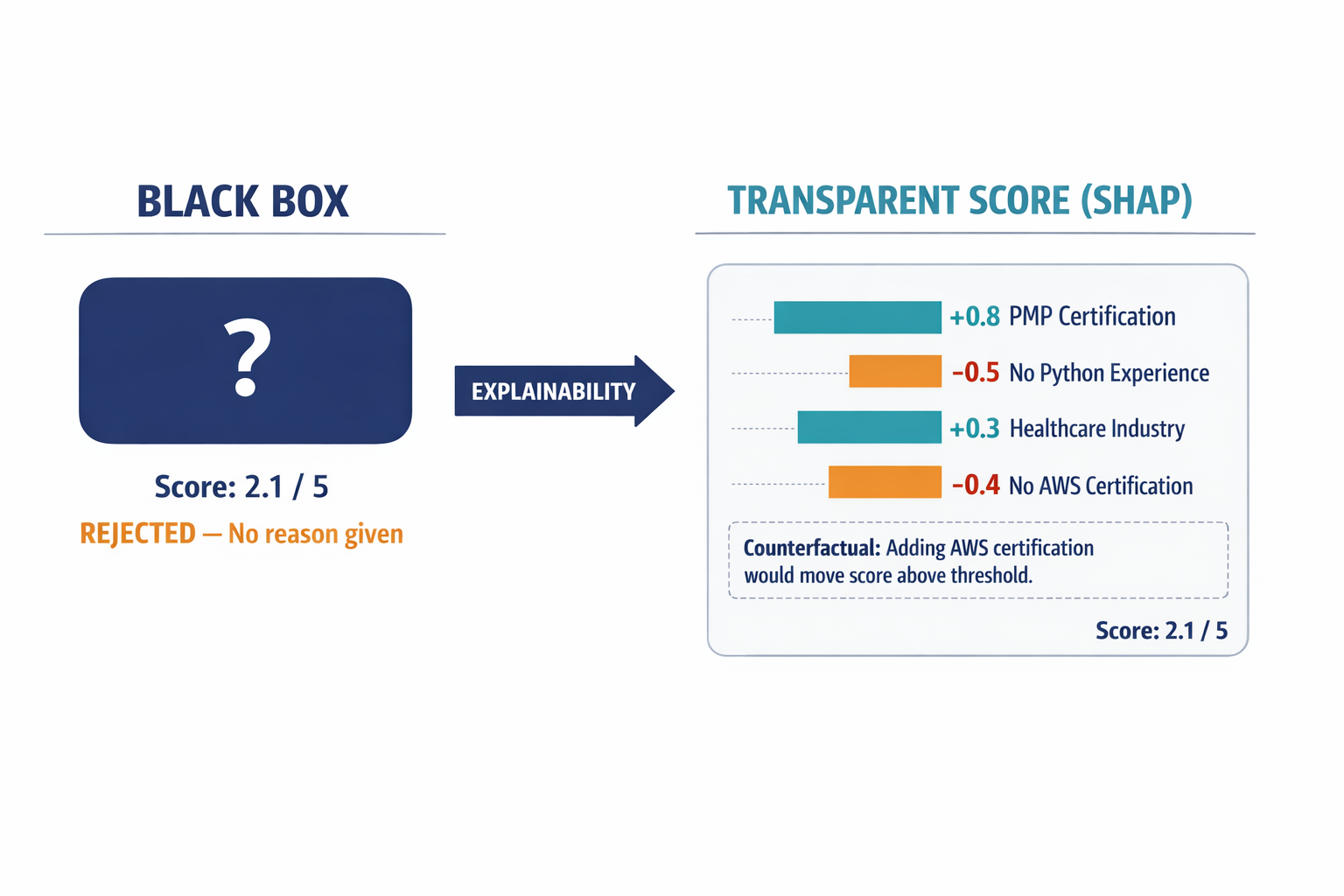
The core grievance in the Eightfold lawsuit is secrecy. Candidates couldn't see their scores, couldn't understand them, and couldn't challenge them. Solving this requires what the field calls Explainable AI — techniques that create a clear, mathematical connection between input data and automated decisions.
One approach we use is called SHAP, based on a concept from cooperative game theory. In plain terms, it calculates exactly how much each factor — a specific skill, a certification, years of experience — contributed to a candidate's final score. Instead of a mysterious number between 0 and 5, you get something like: "+0.8 for Project Management Professional certification, -0.5 for no Python experience, +0.3 for healthcare industry background."
Another technique generates what are called counterfactual explanations — essentially answering the question, "What's the smallest change that would have produced a different outcome?" For a rejected candidate, that might mean: "Adding AWS certification would have moved your score above the threshold." That's not just transparent. It's useful.
A match score without an explanation isn't intelligence. It's a verdict without a trial.
For the full technical methodology behind these explainability approaches and the multi-agent architecture, see our detailed research on the Eightfold case and enterprise AI accountability.
What About Companies Already Using These Tools?
This is the question I hear most from HR and legal leaders: "We've been using an AI screening tool for two years. What do we do now?"
Start with an honest inventory. Work with legal counsel to identify every tool in your hiring stack that screens, ranks, or scores candidates — even if the vendor doesn't call it "AI." Ask your vendors hard questions: What data sources feed the system? Does it pull information from outside the application? Does it generate scores or rankings? If the answers are vague, that's your first red flag.
Then change how your teams interact with these tools. AI scores should be treated as one input among many, not as a verdict. When a recruiter overrides a score — moving a lower-ranked candidate forward or rejecting a top-ranked one — the system should capture their reasoning. That human judgment, documented, is your strongest legal defense.
And for the longer term, push your vendors toward architectures that can actually prove their compliance. If a vendor can't show you the audit trail for a specific candidate decision — the exact data used, the exact reasoning applied, the exact score produced — they can't protect you in court.
What This Case Taught Me
I named my company Veriprajna — "Veri" for truth, "Prajna" for the Sanskrit concept of transcendent wisdom — because I believed AI should make decisions that are not just fast, but wise. The Eightfold case has reinforced something I've felt for a long time: the industry's obsession with speed and scale in AI deployment has come at the cost of something more fundamental.
When a system can reject a 20-year veteran without explanation, using data she never provided, based on a score she never saw — that's not intelligence. That's automated indifference. And the law is finally catching up.
The enterprises that thrive in this new environment won't be the ones with the most sophisticated algorithms. They'll be the ones that can look a candidate, a regulator, or a judge in the eye and explain exactly what happened and why.
If you're navigating this shift — whether you're in HR, legal, or engineering — I'd genuinely like to hear how you're approaching it. The answers aren't obvious, and I think we figure them out together.