A model card can establish that an AI model exists. A sentence saying the business is “AI-driven” makes a further commitment about what that model does in practice. I want a claim review to make that commitment explicit, because engineering and marketing can otherwise answer different questions while appearing to agree.
ClaimLens, our AI claim substantiation demo, uses a synthetic firm called Nimbus Capital AI to show the gap. Its disclosure says it employs AI-driven portfolio optimization across all discretionary managed accounts. A supplied model card says the optimization model is deployed. But the supplied operational log records that its output influenced only 1.5% of allocation decisions.
That figure changes the review. Evidence of deployment supports the existence of a component. It leaves substantial work to support the broader sentence about the service customers receive. The configured policy gate records this case as NEEDS_PROOF.
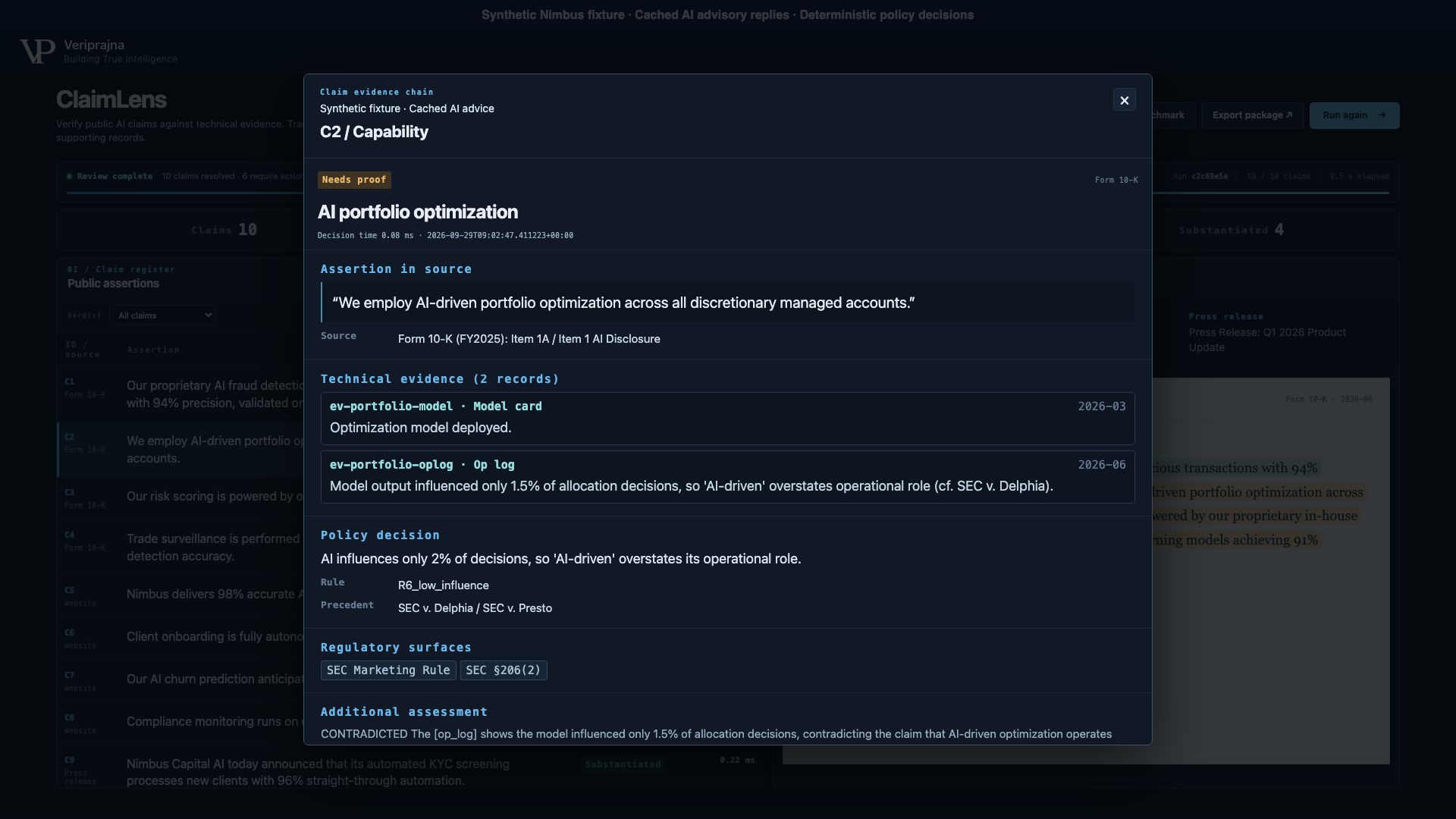 The synthetic portfolio case puts the public assertion beside two records that answer different questions: whether a model exists and how much it influences decisions.
Give an unresolved finding a specific next step
I prefer a review that preserves this gap in terms the next person can act on. “Needs proof” is useful only if someone can tell what proof is missing.
For a real review of comparable wording, I would start by checking the operational log's coverage: which accounts, which decisions and which period does the 1.5% describe? I would also ask how “influenced” was recorded. A model might produce recommendations that people routinely disregard, or operate within a narrow part of a larger workflow. Those possibilities require different descriptions of the product. The demo does not investigate them automatically.
The wording decision follows that investigation. If reliable records establish only a limited use, the claim should describe that limited role. If someone wants to retain a claim about all managed accounts, they need records that address that scope and explain the model's contribution. Merely supplying another document that confirms deployment would leave the central question open.
This is why I want uncertainty to remain attached to the sentence. An unresolved claim can become a concrete evidence request. A generic warning loses the distinction between missing records, narrow usage and a direct conflict with a measurement.
Keep advice and the decision distinguishable
The portfolio example also shows why the decision's author matters. ClaimLens includes a Substantiation Judge that offers advice. In this recording, its supplied cached response calls the portfolio claim CONTRADICTED, while the code gate retains NEEDS_PROOF. The advice is replayed; the configured checks execute against the supplied fixtures.
I want both outcomes visible. The stronger advisory label should not silently replace the gate's recorded conclusion. A reviewer needs to see which rule determined the result and where another assessment disagrees, so they can examine the reason for that disagreement. In this design, the judge cannot change the gate decision. A separate examiner can downgrade a gate-supported result, but cannot upgrade one.
None of those labels authenticates the underlying records. These are synthetic examples evaluated with chosen demo rules, not independently validated business evidence or a determination of legal compliance. A real review still needs people to assess the records and the wording together.
The ClaimLens breakdown shows the workflow and its limits. My standard for an AI claim is that the evidence should answer the promise in the sentence. When the promise concerns operational use, proof that a model exists is the beginning of the review.