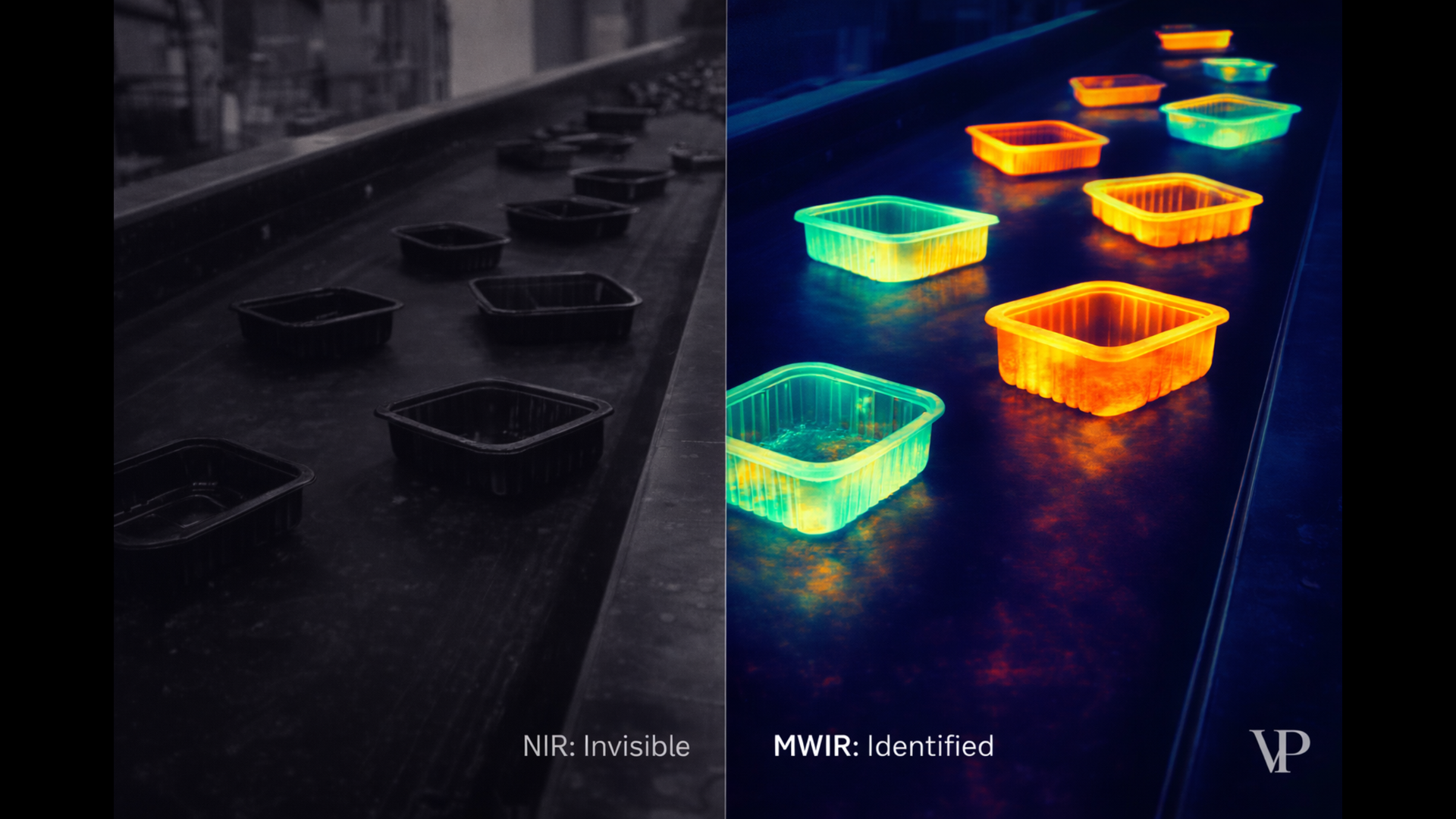
Every time you wash a black plastic food tray and toss it in the recycling bin, you're making a reasonable assumption: the system can handle it. That assumption is wrong. Millions of tons of black plastic — perfectly recyclable polypropylene, polyethylene, ABS — get ejected from recycling streams every year and sent straight to landfill or incineration. Not because the material can't be recycled, but because the sorting machines literally cannot see it. The sensors are blind to black.
This is the black plastic recycling crisis, and it's not a software problem. No amount of AI prompting or large language model wizardry can fix it. The data was never captured in the first place. What's needed is a change in the physics of how we look at waste — a shift from visible and near-infrared light into the mid-wave infrared (MWIR) spectrum, where black plastic stops hiding and starts revealing its chemical identity.
Our team at Veriprajna has spent years at this intersection of sensor physics and industrial AI. We've explored the full scope of this challenge in our interactive analysis, and what follows is the core of what we've found — and what it means for the economics of recycling.
The $2 Million Blind Spot on Every Conveyor Belt
Of the 353 million tonnes of plastic waste generated globally each year, only 9% gets successfully recycled. Black plastics make that number worse. They constitute between 3% and 15% of the total plastic waste stream depending on the region, and they disproportionately end up in the "residue" pile — the material that gets landfilled or burned.
This isn't trash. It's lost revenue.
Recycled black polypropylene pellets trade at $1,130–$1,200 per ton. Recycled ABS fetches $800–$1,100 per ton. For a mid-sized Materials Recovery Facility processing 50,000 tons per year, failing to recover just 2,000 tons of black PP means leaving over $2 million on the table — every single year.
The recycling industry doesn't have a material problem. It has a sensing problem.
And the environmental cost compounds the financial one. When black plastics can't be sorted by polymer type, even manually recovered pieces get dumped into low-value mixed streams destined for park benches at best, incineration at worst. Burning plastic releases the embodied carbon of fossil fuels right back into the atmosphere.
Why Can't Sorting Machines See Black Plastic?
The answer comes down to a single substance: carbon black pigment.
Carbon black is what makes black plastic black. It's produced from the incomplete combustion of petroleum products, and its defining property is that it absorbs light across an enormous range of wavelengths — ultraviolet, visible, and critically, near-infrared (NIR).
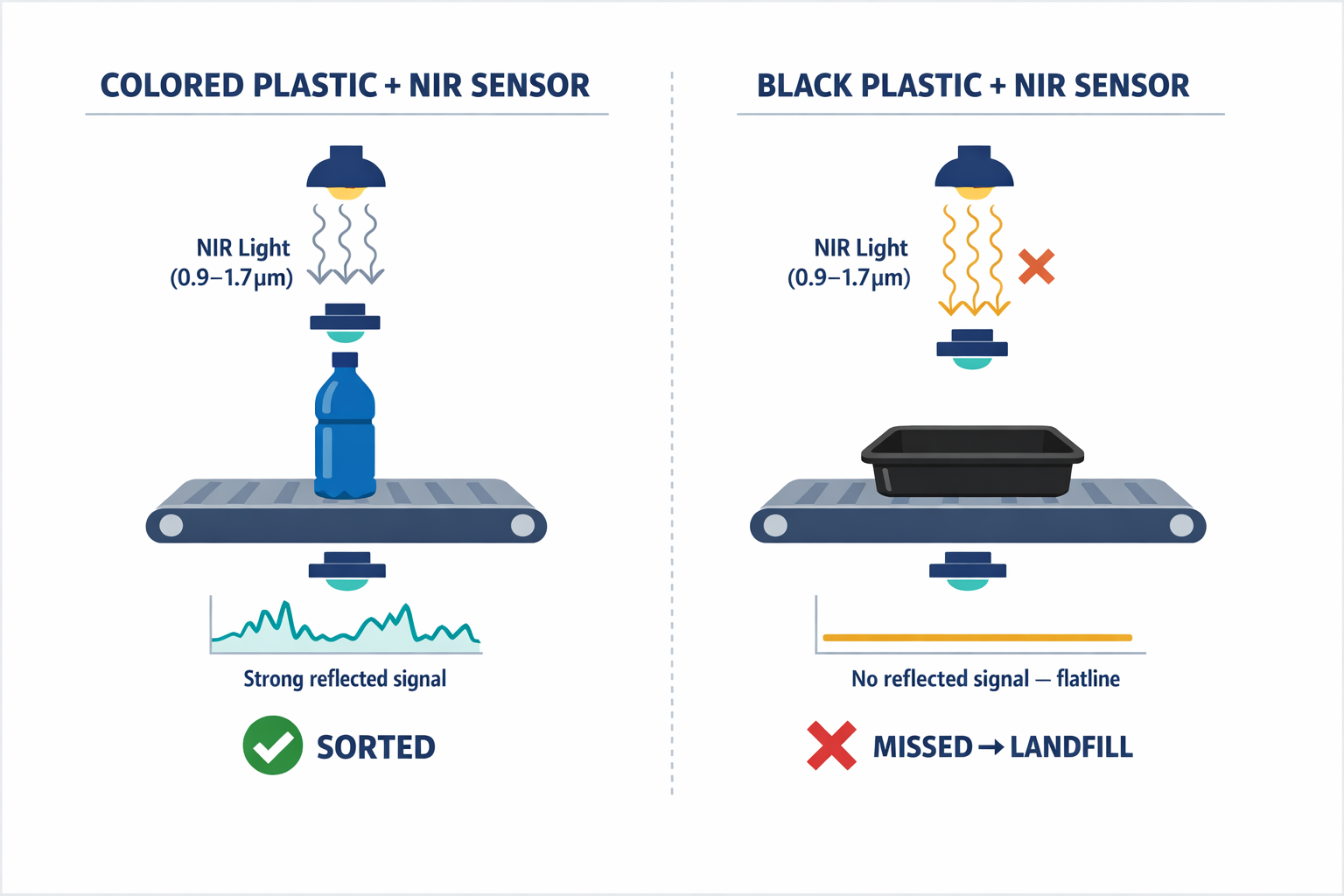
This matters because the recycling industry's standard sorting technology relies on NIR spectroscopy, operating in the 0.9–1.7 micrometer range. The process works like this: halogen lamps illuminate objects on a conveyor belt, the light bounces off the plastic, and sensors read the reflected wavelengths to identify the material's chemical fingerprint. A blue detergent bottle reflects a distinctive spectral pattern. A clear water bottle reflects a different one. The machine reads these patterns and fires air jets to sort each item into the right bin.
But when NIR light hits a carbon-black surface, the pigment swallows it. Almost nothing reflects back. The sensor gets a flatline — indistinguishable from the black rubber conveyor belt beneath it.
To the sorting machine, a black plastic tray doesn't exist. The belt looks empty.
The robot's air jets stay silent. The valuable polymer drops into the residue stream. This happens millions of times a day across thousands of facilities worldwide.
Why AI Wrappers Can't Fix a Physics Problem
There's a tempting narrative in the current AI landscape: wrap a powerful language model around any problem and let the intelligence figure it out. But this logic fails completely for black plastic sorting.
Generative AI models are prediction engines. They need input data to make predictions. When a standard NIR sensor looks at black plastic, the input data is a null set — there's no spectral curve, just noise. You cannot prompt a model to interpret data that was never captured. If you force it to classify noise, it will guess. And in an industrial process that requires 99% purity to prevent contamination of recycled bales, guessing is the same as failing.
There's also a speed problem. Industrial sorting decisions happen in under 20 milliseconds. Sending data to a cloud-based AI API introduces hundreds of milliseconds of latency — an eternity when objects are flying past on a belt moving at 3 meters per second.
The fix isn't smarter software on top of broken sensors. It's better sensors.
Seeing Chemistry, Not Color
Carbon black's absorption isn't infinite. As the wavelength of light increases beyond the near-infrared, the pigment's grip loosens. In the mid-wave infrared range (2.7–5.3 micrometers), carbon black becomes sufficiently transparent for sensors to read what's underneath.
Think of it like X-rays passing through skin to reveal bone. MWIR light passes through the black pigment to reveal the polymer's molecular structure.
This is where the physics gets elegant. The MWIR range contains what physicists call the fundamental vibrations of molecular bonds — the C-H stretches, the carbonyl groups, the aromatic rings. These vibrations produce spectral signatures that are orders of magnitude stronger than the faint "overtone" signals in the NIR range. Each polymer type produces a unique pattern:
Polyethylene (PE) shows strong C-H stretching absorptions near 3.4 micrometers
Polystyrene (PS) displays sharp aromatic C-H modes clearly separable from PE or PP
ABS with flame retardants — common in electronics waste — shows distinct chemical markers that flag it for separate handling
A black PP food tray that's invisible to a standard NIR sensor glows with a distinct, jagged spectral line under MWIR. It becomes unmistakable.
MWIR doesn't see "black shapes." It sees a stream of chemical data — the molecular identity of every object on the belt.
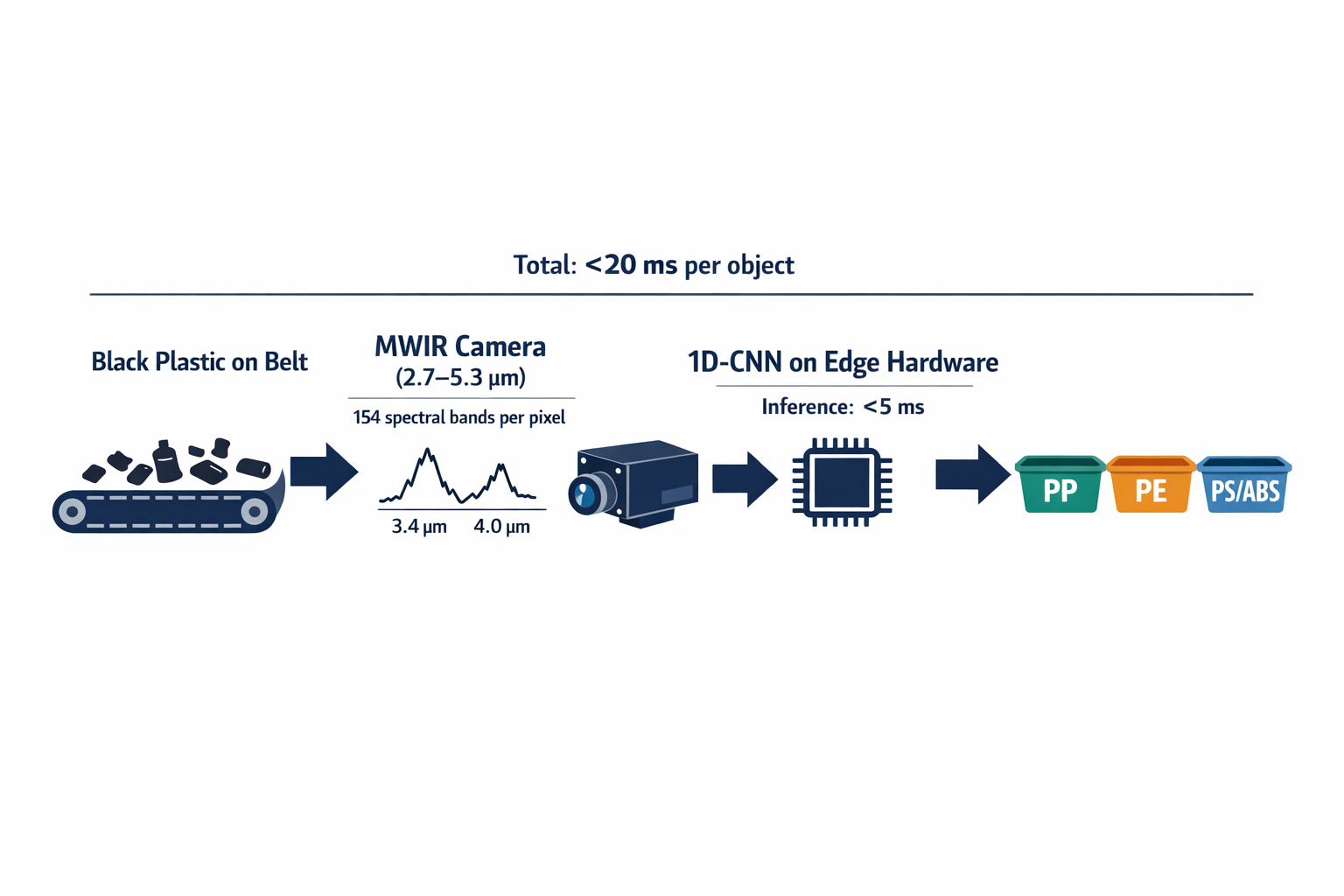
Our system uses the Specim FX50 hyperspectral camera, currently the only commercial instrument covering the full 2.7–5.3 micrometer range needed for this application. It captures 154 distinct spectral bands for every pixel, generating a rich chemical dataset in real time. The detector requires exotic semiconductor materials — indium antimonide or mercury cadmium telluride — cooled to cryogenic temperatures (around -196°C) to prevent the sensor from being blinded by its own heat. This cooling requirement alone separates serious industrial solutions from hobbyist experiments.
The AI That Reads Spectra, Not Images
Capturing the data is half the problem. The Specim FX50 generates gigabytes per second. Making that data actionable at conveyor-belt speed requires an AI architecture built specifically for spectral signals — not repurposed image recognition.
Standard computer vision models (the kind that identify cats in photos or read license plates) analyze spatial features: shapes, edges, textures. But in waste recycling, spatial features are unreliable. A crushed bottle looks nothing like an intact one. A fragment of a black car bumper is spatially identical to a fragment of a black food tray. Shape tells you almost nothing about the material.
Our approach treats the problem as signal processing, not image recognition. For every pixel on the belt, we extract a one-dimensional vector of 154 values — the spectrum — and feed it into a specialized 1D-Convolutional Neural Network (1D-CNN). Instead of square filters sliding over an image looking for edges and corners, our linear filters slide along the spectrum looking for chemical patterns: a sharp absorption dip at 3.4 micrometers, a broad shoulder at 4.0 micrometers, a characteristic doublet peak.
The network learns the grammar of molecular bonds.
This architecture is fast — critically fast. Our optimized models run with inference times under 5 milliseconds on edge hardware deployed directly on the sorting machine. No cloud. No network latency. By the time a more complex AI architecture like a Transformer would finish processing a single spectrum, our 1D-CNN has already classified the pixel and triggered the air jet.
For the full technical methodology behind our sensor fusion and neural network architecture, see our detailed research.
From Cost Center to Profit Center
The economics of this technology make the case almost self-evident.
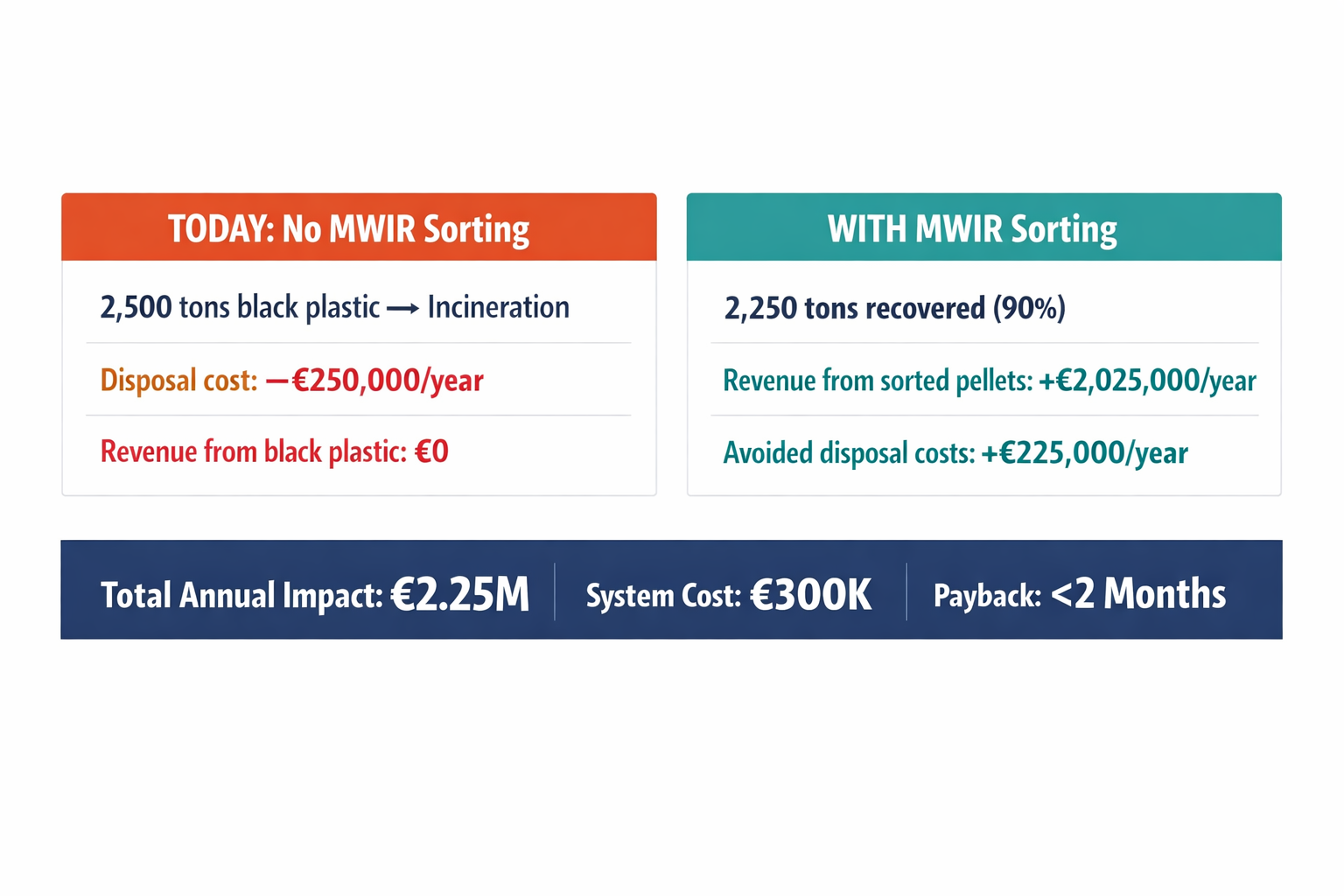
Consider a mid-sized European MRF processing 50,000 tons per year with 5% black plastic content. Today, those 2,500 tons of black plastic go to incineration at a gate fee of roughly €100 per ton — a €250,000 annual cost. With MWIR-based sorting recovering 90% of that material and selling the sorted pellets at €900 per ton, the same facility generates €2,025,000 in revenue plus €225,000 in avoided disposal costs.
Total annual impact: €2.25 million. System cost: approximately $300,000. Payback period: under two months.
This isn't a sustainability play that sacrifices margin. It's a margin play that happens to be sustainable.
The regulatory pressure amplifies the urgency. The EU's Packaging and Packaging Waste Regulation requires all packaging to be recyclable by 2030 — not theoretically recyclable in a lab, but practically recyclable in real facilities. If standard optical sorters can't see black packaging, it will be legally classified as unrecyclable. Brands will face a choice: abandon black packaging entirely, or demand technology that makes it visible. Meanwhile, landfill taxes across Europe already exceed €100 per ton in some member states, and the EU Emissions Trading System is expanding to cover waste incineration — putting a direct carbon price on every ton of plastic burned.
What About Existing Sorting Equipment?
A reasonable concern: does adopting this technology mean ripping out and replacing an entire sorting line? It doesn't. Our system is designed as a retrofit. Many MRFs have perfectly functional conveyor systems, air ejectors, and robotic arms — the mechanical infrastructure works fine. What's outdated is the sensor head and the classification software. We upgrade the "eyes and brain" of the machine without replacing the "body," which dramatically lowers the capital expenditure for operators.
We work within the existing ecosystem of sorting hardware from manufacturers like Tomra and Steinert. Where their standard firmware handles the broad middle of the waste stream, our specialized intelligence layer handles the hard edges — the specific flame-retardant mixes, the novel multilayer films, the entire dark fraction that standard sensors miss.
Beyond Sorting: What Chemical Vision Unlocks
Once you can see the molecular identity of every object moving through a facility, sorting is just the beginning. The same sensing capability enables Digital Product Passports — tracking exactly which materials flow through the recycling chain. It enables pre-shipment quality certification, verifying the purity of a bale of recycled plastic before it reaches a converter, reducing costly rejected loads. And it enables brand-level accountability: showing producers precisely how much of their specific black packaging is actually being recovered, which matters enormously as Extended Producer Responsibility laws expand globally.
The broader principle is simple. The recycling industry has been trying to sort waste by looking at its surface. That's like trying to identify a medicine by the color of its pill coating. The real information — the chemistry — is underneath. MWIR hyperspectral imaging reads that chemistry at industrial speed, and specialized neural networks translate it into sorting decisions in milliseconds.
We built this capability because the circular economy has a hole in it — a black hole, quite literally — and no amount of clever prompting will close it. Only physics will.
If your organization is grappling with material recovery rates, packaging recyclability requirements, or the economics of waste processing, we'd welcome the conversation about what chemical vision could change in your operations.