
You wash your black plastic food tray, sort it into recycling, and feel good about it. Then a machine worth half a million dollars looks right at it, sees nothing, and sends it to landfill. This happens millions of times a day, across thousands of recycling facilities worldwide, and it's not a software bug. It's a physics problem — one that no amount of AI prompting can fix. The black plastic recycling crisis is costing the industry billions and sending chemically perfect, infinitely recyclable material straight into the ground.
I've spent the last year obsessed with this problem. Not because black plastic is glamorous — it isn't — but because it represents everything wrong with how our industry thinks about AI. We keep layering smarter software on top of blind sensors, then act surprised when the system fails.
The $2 Billion Blind Spot on Every Conveyor Belt
Of the 353 million tonnes of plastic waste generated annually, only 9% gets recycled. Black plastics — the trays, coffee lids, automotive parts, and electronics casings that make up roughly 15% of the waste stream — are disproportionately responsible for that dismal number.
The reason is absurdly simple. Recycling facilities sort plastic using Near-Infrared (NIR) sensors that shine light onto objects and read the reflected spectrum to identify the material. Carbon black pigment, the stuff that makes plastic black, absorbs nearly all of that light. A black tray sitting on a black rubber conveyor belt produces zero signal. To the sorting machine, the belt looks empty.
The sensor doesn't misidentify black plastic. It doesn't see it at all.
A mid-sized facility processing 50,000 tons per year typically has about 5% black plastic content. That's 2,500 tons of perfectly recyclable polypropylene, polyethylene, and ABS being incinerated or landfilled — material that trades at $800 to $1,200 per ton as recycled pellets. Do the math across the global recycling infrastructure and you're looking at a staggering amount of lost value, every single year.
And the regulatory walls are closing in. The EU's Packaging and Packaging Waste Regulation demands that all packaging be recyclable by 2030 — not theoretically recyclable in a lab, but actually recovered at scale in real facilities. If the sensor can't see it, it's legally unrecyclable. Brands using black packaging face an existential choice: abandon the color or find a technology that makes it visible.
Why You Can't Just "AI" Your Way Out of This
When I explain this problem to people in tech, the first response is almost always the same: "Can't you train a better model?" Or: "What about using GPT-4 to classify the images?"
I understand the instinct. We live in a moment where large language models feel like they can solve anything. But this is a category error — like asking a better microphone to help you see in the dark.
If the sensor captures no data, there is no data for any model to learn from. A generative AI model predicting "this is probably polypropylene" based on statistical priors isn't sensing. It's guessing. In an industrial process that requires 99% purity to avoid contaminating an entire batch of recycled material, guessing is worse than useless.
There's a practical problem too. Industrial sorting decisions happen in under 10 milliseconds. The plastic flies past the sensor on a belt moving at 3 meters per second. Sending data to a cloud-based API and waiting for a response introduces hundreds of milliseconds of latency — an eternity when you need to fire a precisely timed blast of compressed air to eject a specific tray.
I wrote about this distinction between "AI wrappers" and deep technology in detail in our interactive analysis of the black plastic recovery challenge. The core argument is straightforward: you cannot prompt your way past a missing sensor. You have to change the physics.
Changing the Light Changes Everything
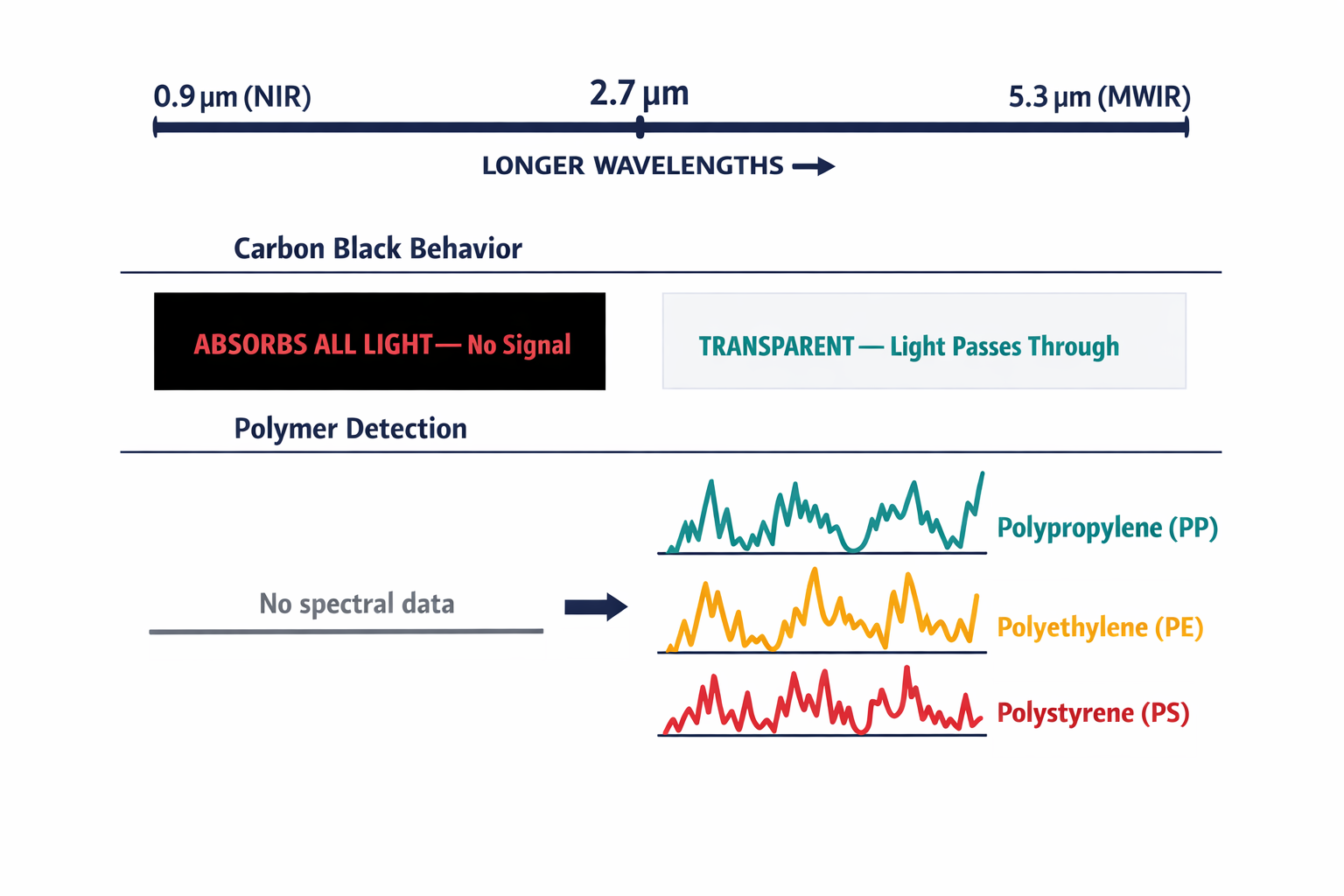
Carbon black's absorption isn't infinite. It has a weakness.
As you move from the near-infrared wavelengths (where current sorters operate) into the Mid-Wave Infrared (MWIR) range — specifically 2.7 to 5.3 micrometers — carbon black becomes increasingly transparent. At these longer wavelengths, the pigment stops acting as a wall and starts acting as a window.
What you see through that window is extraordinary. In the MWIR range, the fundamental molecular vibrations of polymers produce spectral signatures that are orders of magnitude stronger than in the NIR. Every type of plastic has a unique chemical fingerprint: polypropylene looks different from polyethylene, which looks different from polystyrene, which looks different from ABS. A black PP food tray that was invisible a moment ago now glows with a distinct, jagged spectral line — unmistakable, classifiable, sortable.
We stopped trying to make the AI smarter at guessing. We made the sensor capable of seeing.
Think of it like this: standard recycling sensors are trying to identify objects by shining a flashlight on them. Carbon black swallows that flashlight. MWIR is like switching to thermal vision — suddenly the objects reveal themselves through their own chemistry, regardless of color.
The hardware that makes this possible is a hyperspectral camera called the Specim FX50, currently the only commercial sensor covering the full MWIR range we need. It's not a simple upgrade. The detector requires exotic semiconductor materials — indium antimonide or mercury cadmium telluride — and must be cooled to cryogenic temperatures (around -196°C) using a built-in Stirling cooler, because MWIR sensors are essentially detecting heat and would be blinded by their own thermal noise otherwise.
This is what separates deep technology from software features. You can't replicate a cryogenic hyperspectral imaging system with a few API calls.
Reading Chemistry, Not Shapes
Capturing the MWIR data is only half the problem. The camera generates 154 distinct spectral bands for every pixel, producing gigabytes of data per second. That data needs to be interpreted in real time — under 5 milliseconds per classification — to keep pace with the conveyor belt.
My team's first instinct was wrong, and I think that's worth admitting. We initially explored standard image-recognition neural networks — the kind that power everything from facial recognition to self-driving cars. These 2D convolutional networks are brilliant at recognizing spatial features: the shape of a bottle, the curve of a handle.
But spatial features are nearly useless in waste recycling. A crushed black car bumper fragment looks spatially identical to a crushed black food tray fragment. Shape tells you nothing. Chemistry tells you everything.
So we flipped the approach entirely. Instead of treating the sensor data as an image, we treat it as a signal. For every pixel on the conveyor belt, we extract a one-dimensional vector of 154 values — the spectrum — and feed it into a 1D-Convolutional Neural Network (1D-CNN) that's been trained to recognize the grammar of molecular bonds. The network learns that a sharp absorption dip at 3.4 micrometers means one thing; a broad shoulder at 4.0 micrometers means another.
The results are fast and definitive. Our 1D-CNN runs inference in under 5 milliseconds on edge hardware — no cloud, no network latency, no waiting. In the time it takes a more complex architecture like a Transformer to process a single spectrum, our model has already classified the pixel and triggered the air jet.
For the full technical methodology behind our spectral classification approach, see our detailed research paper.
The System in Practice
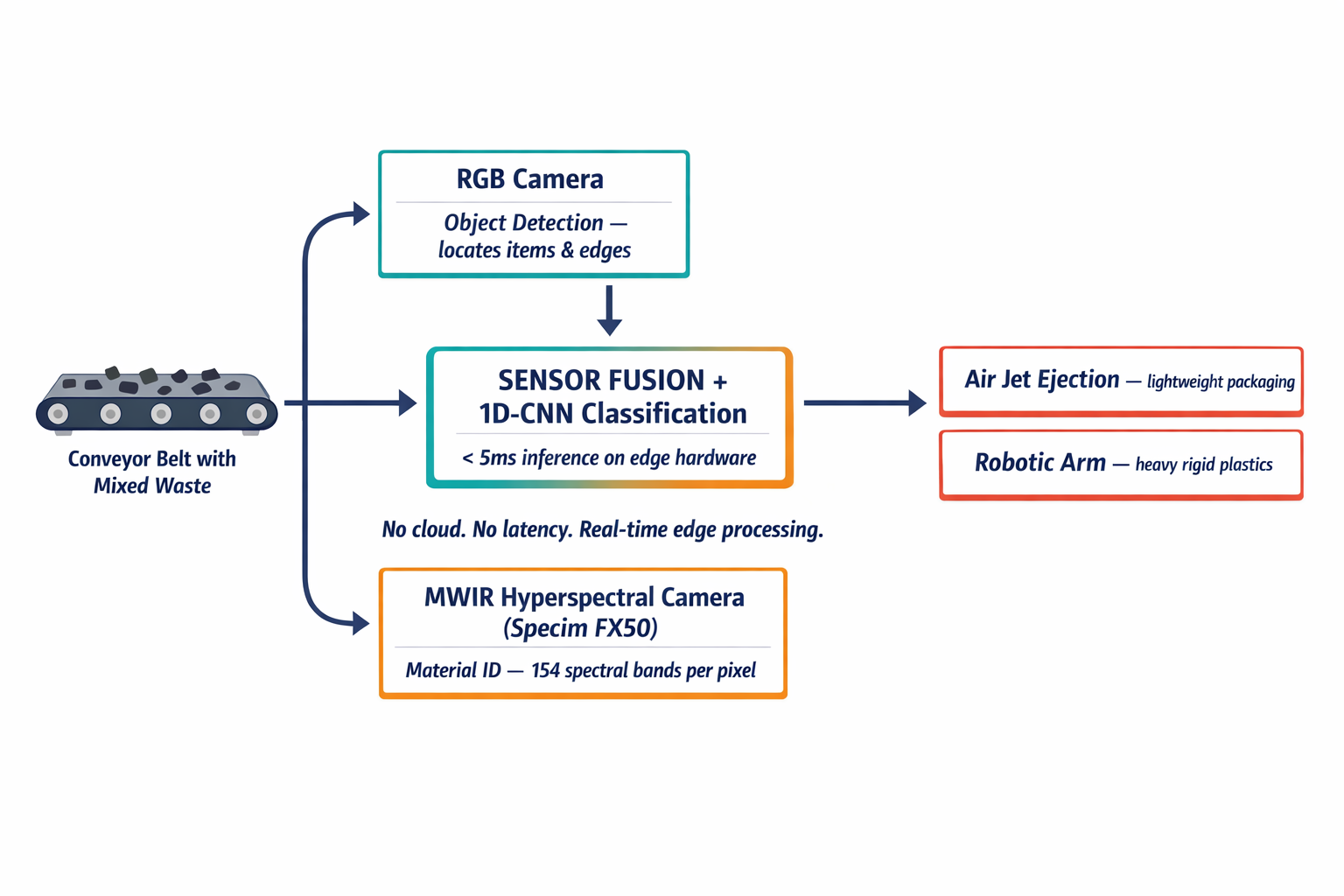
In a working installation, the MWIR camera doesn't operate alone. We pair it with a standard high-resolution RGB camera in what's called sensor fusion — using each sensor for what it does best.
The RGB camera handles object detection: "there's an item at these coordinates, and here are its edges." It's cheap, fast, and spatially precise. The MWIR camera handles identification: "the material inside those edges is black polypropylene." The system fuses both data streams and sends a composite instruction to the sorting hardware — either a precisely timed blast of compressed air for lightweight packaging, or a command to a robotic arm for heavier rigid plastics.
We don't replace the sorting machine. We replace its eyes and brain.
This matters commercially because most recycling facilities have perfectly functional conveyor systems and ejection hardware. They don't need a new body — they need an upgrade to their sensing and intelligence layer. Retrofitting existing equipment dramatically lowers the capital expenditure for operators, which brings me to the part that made me stop and recalculate three times.
The Economics That Made Me Recalculate
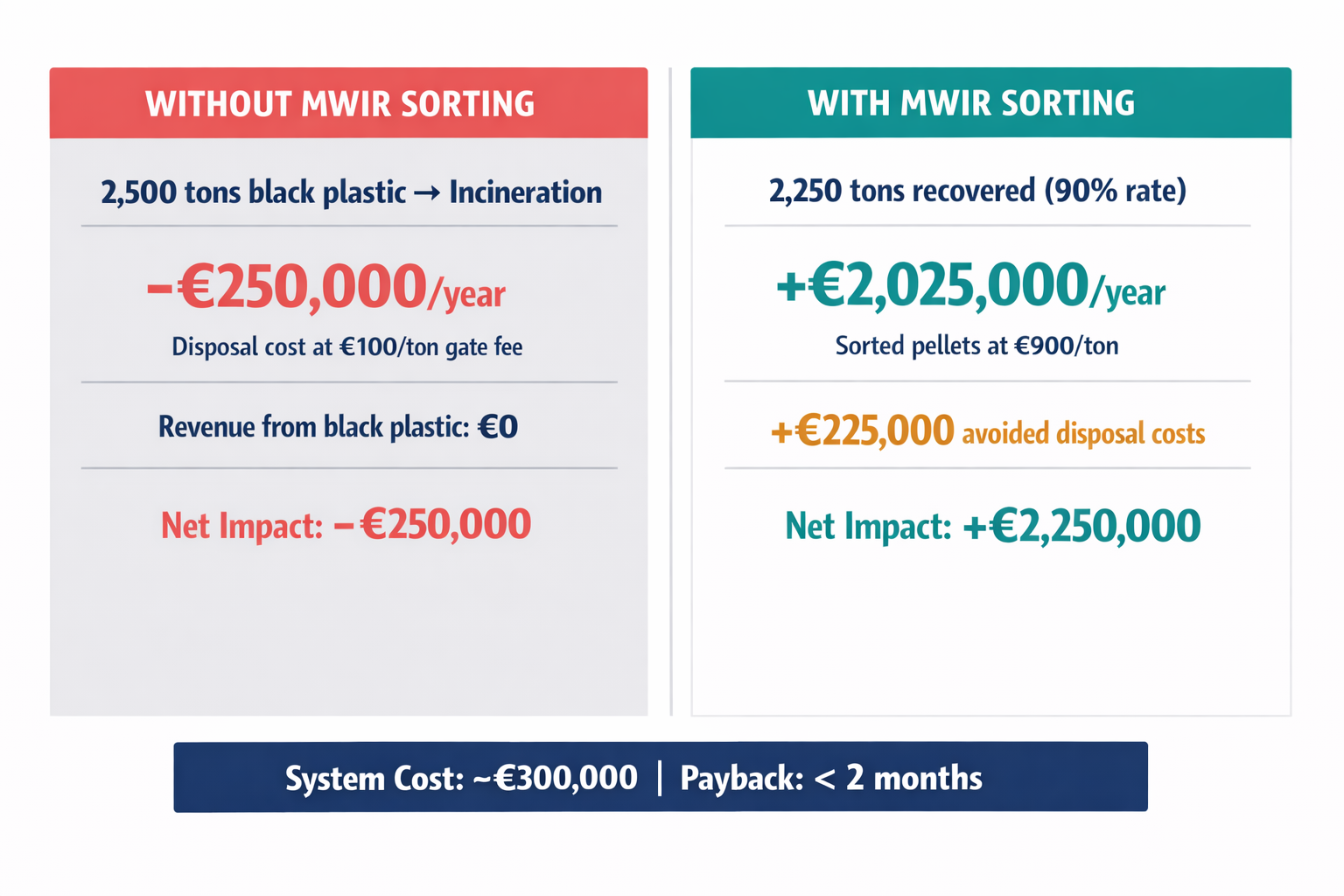
I expected the business case to be positive. I did not expect a payback period under two months.
Consider a mid-sized European facility processing 50,000 tons per year with 5% black plastic content. Today, that 2,500 tons gets incinerated at a gate fee of roughly €100 per ton — a cost of €250,000 annually just to destroy valuable material.
With MWIR sorting recovering 90% of that stream, the facility sells 2,250 tons of sorted black plastic pellets at approximately €900 per ton. That's €2,025,000 in new revenue plus €225,000 in avoided disposal costs. Total annual impact: €2.25 million. Against a system capital cost of roughly $300,000, the math is almost embarrassing.
And the economics are only getting more favorable. Landfill taxes across Europe now exceed €100 per ton in some countries. The EU Emissions Trading System is expanding to cover waste incineration, meaning facilities will soon pay carbon taxes on every ton of plastic they burn. Meanwhile, recycled pellet prices have reached parity with virgin resin in Europe, and in some sectors they command a premium because demand for post-consumer recycled content outstrips supply.
The most expensive thing a recycling facility can do with black plastic is throw it away.
What About Scaling This Beyond Europe?
The question I get most often: does this only work in Europe, where regulations are strictest and landfill costs are highest?
The short answer is that the physics works everywhere — carbon black is carbon black whether you're in Stuttgart or São Paulo. The economics shift by region, but they're moving in one direction globally. US tipping fees are climbing past $100 per ton on both coasts. California's SB 54 is shifting waste management costs onto producers. Extended Producer Responsibility laws are proliferating across Asia.
The harder question is whether MWIR sensor costs will come down fast enough for emerging markets. Right now, the Specim FX50 and its cryogenic cooling system represent a significant capital investment. But we've seen this curve before with every sensor technology — from LIDAR to NIR itself. As demand grows and competing sensors enter the market, costs will compress. Our 1D-CNN architecture is designed to be sensor-agnostic precisely because we expect this hardware landscape to evolve.
Another objection I hear: "Won't brands just stop using carbon black pigment?" Some will, and some already have. But black plastic serves a real manufacturing purpose — it lets producers use mixed-color recycled feedstock and homogenize it into a uniform product. Eliminating black plastic means eliminating one of the most practical pathways for using recycled content. The better answer is to make black plastic sortable, not to ban it.
What This Means If You Run a Facility
If you operate a Materials Recovery Facility, the immediate action is to quantify your black plastic leakage. Most operators I've spoken with don't know the number — it's buried in the residue stream, invisible in both the literal and accounting senses. Get a composition audit of your residue. The revenue sitting in your reject pile might surprise you.
If you're a packaging brand using black plastic, the regulatory clock is ticking toward 2030. The question isn't whether you'll need to prove your packaging is recyclable at scale — it's whether the infrastructure will exist to prove it. Technologies like MWIR hyperspectral sorting are what make that proof possible.
And if you're building in the AI space, I'd ask you to consider whether the problem you're solving is actually a data problem or a sensor problem. The most sophisticated model in the world is useless if the input is a null set. Sometimes the breakthrough isn't a better algorithm. It's a better photon.
I'd genuinely like to hear from anyone working on the waste stream side of this — whether you're seeing black plastic losses in your operations, experimenting with alternative pigments, or exploring different sensing approaches. The circular economy doesn't close itself.